USCIS Updates Guidance on L-1 Extension Fees for Covered Employers
USCIS L-1 fee guidance now reaches covered-employer extension petitions. See which filings and workforce counts matter, then request a free evaluation.
Published on October 27, 2026· Updated October 27, 2026
Talk to an immigration attorney
Free call. A clear plan for your case.
Free & confidential · Se habla espanol · Mon-Fri 8am-7pm, Sat 9am-2pm (ET)

Have questions? Talk to an attorney - free evaluation.
Call 1-844-967-3536Free Tool
Check Your USCIS Case Status Now
Enter your receipt number - get the official USCIS status in English or Spanish. No registration.
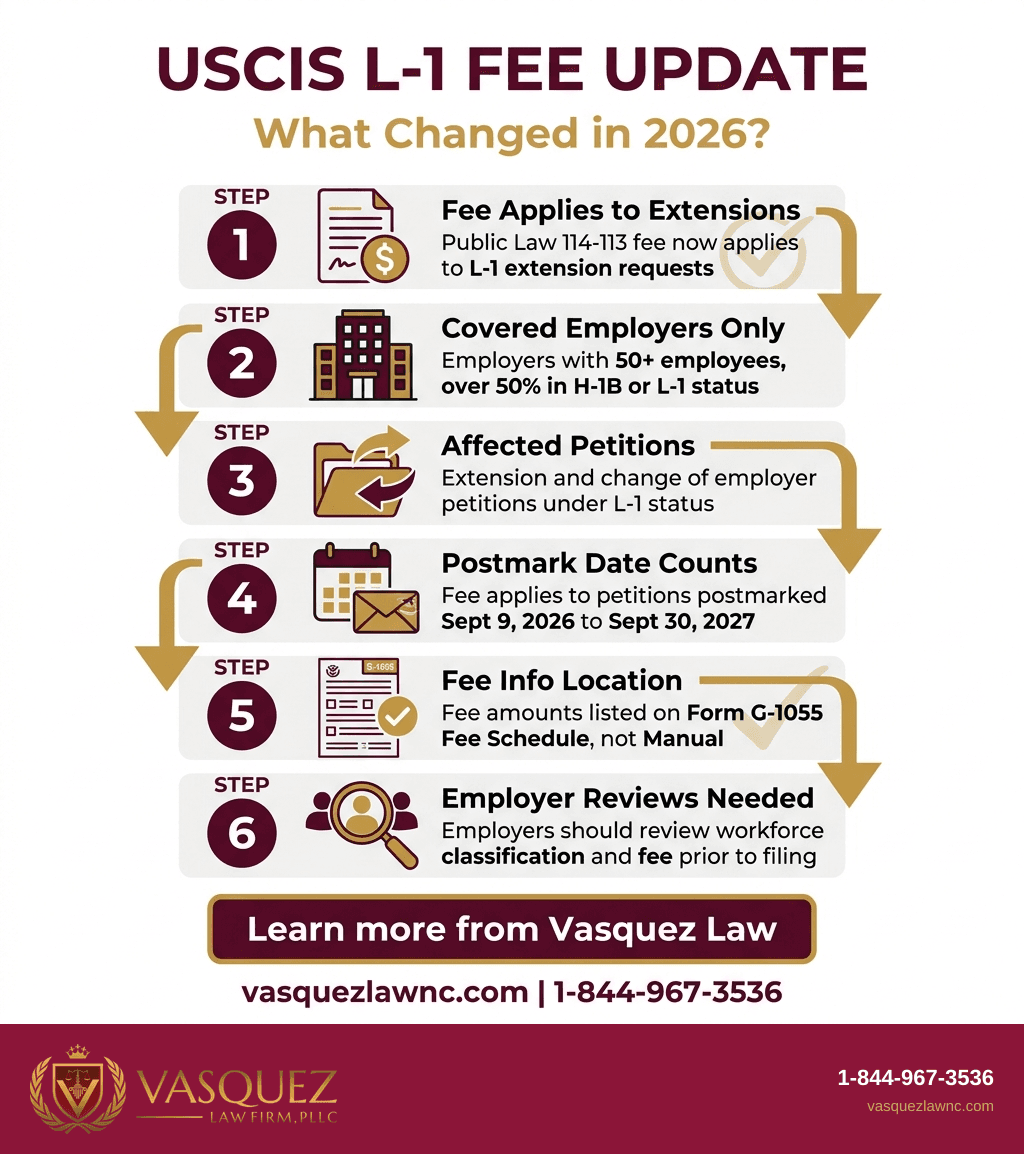
USCIS now charges the Public Law 114-113 fee for L-1 extension petitions filed by covered employers. The fee also applies to other L-1 petitions filed by covered employers. The agency made this change effective September 9, 2026. The change appears in USCIS Policy Alert PA-2026-16.
An intracompany transferee is a worker who moves within the same company. When a business decides whether to extend that worker's authorization, the filing packet may now include a fee. That fee did not previously apply to an extension request. Our immigration attorneys help employers and workers review the petition type. They also review the requested benefit and current USCIS fee requirements before filing.
This article gives general legal information. It is not legal advice for any person or company. Employers seeking L-1 guidance can work with our business immigration team. We offer consultations nationwide through Zoom or phone.
What changed in USCIS L-1 fee guidance?
USCIS issued Policy Alert PA-2026-16 on October 27, 2026. The alert updates Volume 2, Part L, Chapter 7, Section B of the USCIS Policy Manual. It follows a DHS final rule published August 10, 2026. That rule became effective September 9, 2026.
The main change involves L-1 extension petitions. An extension petition asks USCIS to continue a worker's L-1 status. For covered employers, the final rule now applies the Public Law 114-113 fee to L-1 extension petitions as well as petitions seeking a change of employers.
Accordingly, as of September 9, 2026, under the 9-11 Biometric Fee final rule, the Public Law 114- 113 fee applies to all L-1 petitions filed by covered employers postmarked on or before September 30, 2027, unless the petitioner is filing an amended petition that does not seek an extension of the alien’s currently authorized L-1 status.
The alert also changes how USCIS shows fee amounts. The Policy Manual no longer lists those amounts in this section. Instead, USCIS sends petitioners to the Fee Schedule, Form G-1055. Petitioners should use that schedule for fees connected to Form I-129 filings for an L-1 beneficiary. The schedule includes the Fraud Prevention and Detection fee. It also includes the Public Law 114-113 fee.
A filing-date rule with practical force
USCIS connects this guidance to the petition's postmark date. The postmark date is the date shown by the mailing service. A petitioner should identify the exact form before preparing payment. The petitioner should also decide whether the form asks USCIS to extend the beneficiary's currently authorized L-1 stay. These steps can help prevent a payment mistake.
Which employers and petitions does the L-1 fee reach?
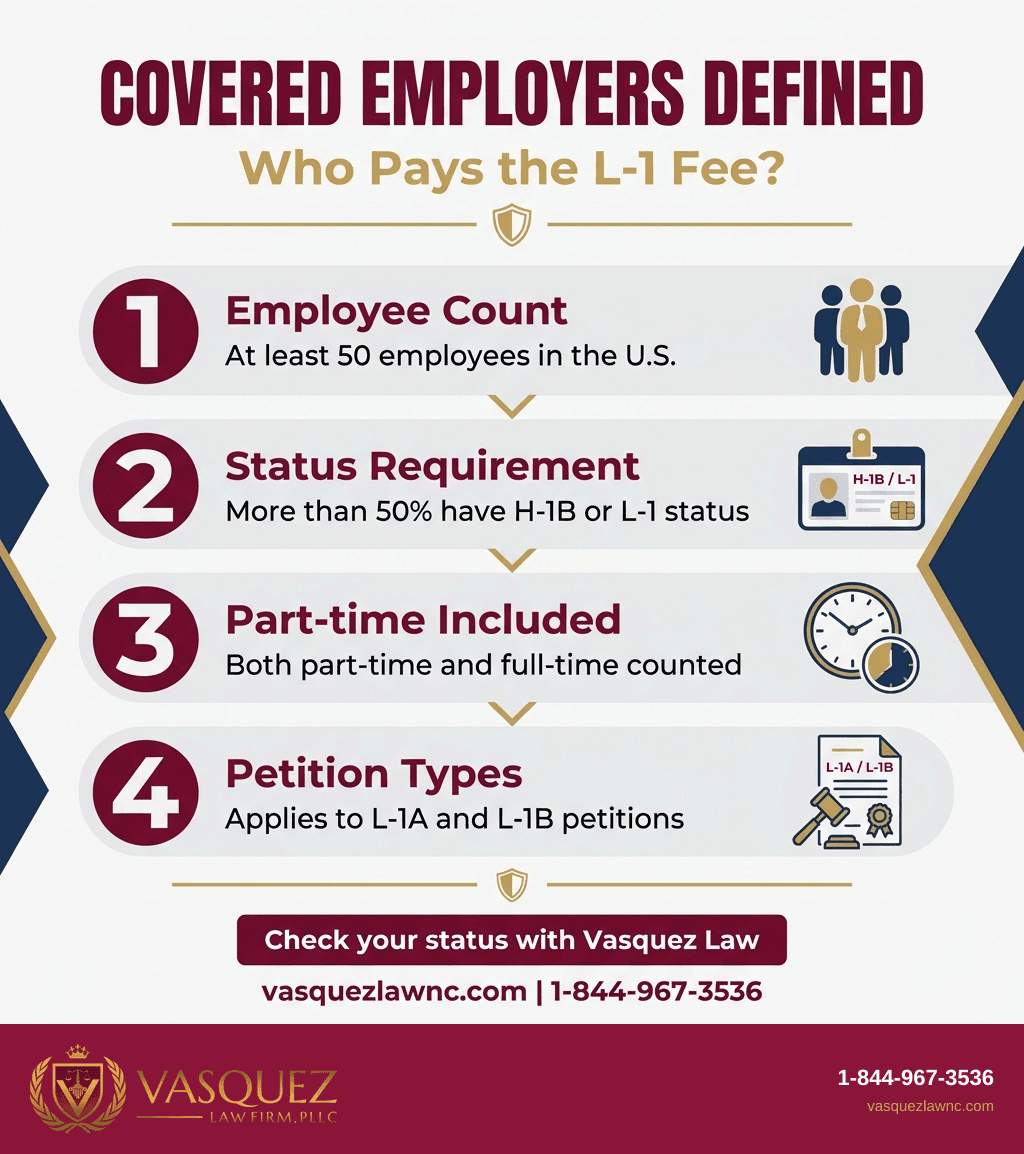
The updated USCIS L-1 fee guidance applies to covered employers. A covered employer is an H-1B or L-1 petitioner with at least 50 employees in the United States. More than 50 percent of its employees, in the aggregate, must hold H-1B, L-1A, or L-1B nonimmigrant status. Nonimmigrant status is temporary permission to stay in the United States for a specific purpose.
The calculation includes part-time employees. It also includes full-time employees. This point matters when a company reviews its workforce. A review that leaves out part-time staff can give the wrong answer. It can wrongly suggest that the employer does not meet the covered-employer definition.
Clarifies that part-time and full-time employees are included when calculating whether more than 50 percent of the petitioner’s employees, in the aggregate, are in H-1B or L-1 status.
For covered employers, the fee applies to all L-1 petitions filed within the stated postmark period, unless the petitioner is filing an amended petition that does not seek an extension of the alien’s currently authorized L-1 status.
An L-1A petition concerns an intracompany transferee in a managerial or executive capacity. A managerial capacity generally involves managing people or important company functions. An executive capacity generally involves making important company decisions. An L-1B petition concerns an intracompany transferee with specialized knowledge. Specialized knowledge means knowledge of the company's products, services, research, systems, or procedures. The alert uses its covered-employer rules for L-1A and L-1B status in the workforce calculation.
Why classification and workforce records matter
Companies should not treat every Form I-129 amendment in the same way. An amendment is a petition that changes an existing filing or request. The benefit requested in the petition controls the exception described by USCIS. Employers often first ask whether an amendment changes the worker's authorized stay. They should answer that question before mailing the petition.
USCIS processing times may help a petitioner track a case after filing. They do not replace a fee review. Employers can review the agency's USCIS Processing Times page after a properly filed petition is pending. A processing time is an estimate for agency action. It does not decide whether a fee is due.
What law sits behind the L-1 fee?
The background starts with the Consolidated Appropriations Act of 2016, Public Law 114-113. USCIS identifies that statute as imposing the fee for certain L-1A and L-1B petitions. The policy update explains how DHS applies the fee after the regulatory change.
DHS published the 9-11 Response and Biometric Entry-Exit Fee for H-1B and L-1 Visas final rule at 91 FR 51360. That rule extended the fee framework to L-1 extension petitions. Policy Alert PA-2026-16 then revised the Policy Manual. The revision reflects the rule.
L-1 petitions use Form I-129, Petition for a Nonimmigrant Worker. In this setting, the petitioner is generally the employer seeking classification for the beneficiary. The beneficiary is the worker proposed for L-1 status. These labels help explain the fee analysis. Covered-employer status depends on the petitioner's U.S. workforce.
Where to find current fee information
The agency no longer places particular fee amounts in this Policy Manual section. Petitioners should consult Form G-1055 when preparing a filing. They should then confirm the correct payment method for the requested L-1 benefit. The USCIS Policy Manual remains the agency's public reference point for this guidance.
This difference matters. The alert reports a Policy Manual update. It also reports a final-rule change. It does not make every employer's fee review the same. The correct result depends on the employer, petition, requested benefit, and filing date.
What should an L-1 petitioner do before filing?
First, identify what the Form I-129 requests. It may request an initial grant. It may request a change of employers. It may request an extension of status. It may request an amendment. That label helps determine whether the amended-petition exception in Policy Alert PA-2026-16 could apply.
Next, prepare a current U.S. workforce roster. The roster should include part-time and full-time employees. Separate employees in H-1B, L-1A, and L-1B status from everyone else. Then apply the aggregate calculation described by USCIS. Aggregate means considered together as one group.
Then review the current Form G-1055 Fee Schedule. Review every payment connected to the L-1 filing. USCIS specifically directs petitioners to that schedule for Form I-129 fees. The schedule includes the Fraud Prevention and Detection fee. It also includes the Public Law 114-113 fee.
Keep records that support the workforce calculation. Keep them with the company's petition records. Also keep records that support the petition category. If the filing is an amendment, preserve materials showing whether the request seeks an extension of the beneficiary's authorized L-1 stay. These records can help explain the filing if USCIS asks questions.
Employers planning other worker classifications can also compare the separate FY 2027 H-1B registration developments before making broader staffing decisions. The H-1B registration process is separate from this L-1 fee change. The comparison may still help a company plan its staffing needs.
Need to assess an L-1 filing before it is sent? Vasquez Law Firm offers a free immigration evaluation by Zoom or phone for business immigration matters nationwide. Se Habla Español.
What should employers watch next?
The updated guidance takes effect September 9, 2026, and applies to petitions postmarked on or after that date. The Public Law 114-113 fee itself applies to covered-employer L-1 petitions postmarked on or before September 30, 2027. The amended-petition exception still applies. Employers should review the Form G-1055 Fee Schedule for future Form I-129 filings. USCIS directs filers there for current fee amounts.
Employers should also monitor Volume 2, Part L, Chapter 7 of the USCIS Policy Manual. Policy Alert PA-2026-16 says USCIS may make minor technical, stylistic, and conforming changes. These changes must remain consistent with the update.
Companies with long-term international staffing plans should include filing review in the transfer timeline. Filing review should not wait until the final mailing-room task. A clear classification decision can help the petitioner choose the right filing. A supported workforce calculation can also help. Together, they support an informed filing choice under the rule now in place.
Frequently Asked Questions
Does the USCIS L-1 fee guidance apply to extensions?
Yes, for covered employers. Policy Alert PA-2026-16 reflects the final rule extending the Public Law 114-113 fee to petitions requesting extensions of L-1 status. The rule applies within the stated postmark period. An amended petition is excepted only when it does not seek an extension of the beneficiary's currently authorized L-1 status.
Who is a covered employer for this fee?
A covered employer is an H-1B or L-1 petitioner with at least 50 U.S. employees when more than 50 percent of those employees, in the aggregate, are in H-1B, L-1A, or L-1B nonimmigrant status. USCIS says the calculation includes both part-time and full-time employees.
Do part-time employees count in the workforce calculation?
Yes. USCIS expressly clarifies that part-time and full-time employees are included when calculating whether more than 50 percent of the petitioner's workforce is in H-1B or L-1 status. A workforce analysis that omits either group can affect the covered-employer determination.
When does an amended L-1 petition avoid the fee?
No. The exception described in the alert applies to an amended petition that does not request an extension of the worker's currently authorized L-1 status. A petitioner should examine the actual benefit request in Form I-129 rather than rely only on the word amendment.
Where can I find the current L-1 filing fees?
USCIS directs petitioners to the Fee Schedule, Form G-1055. The policy update removes particular fee amounts from the L-1 Policy Manual section and points filers to that schedule for fees associated with Form I-129, including the Fraud Prevention and Detection fee and the Public Law 114-113 fee.
What USCIS policy section changed?
Policy Alert PA-2026-16 updates Volume 2, Nonimmigrants, Part L, Intracompany Transferees, Chapter 7, Filing, cited as 2 USCIS-PM L.7. The update revises the fees discussion to reflect the final rule's extension of the fee framework to covered-employer L-1 extension petitions.
Before submitting an L-1 petition, seek guidance tailored to the filing and workforce facts. Vasquez Law Firm offers a free evaluation for nationwide business immigration matters by Zoom or phone. This article is general information, not individualized legal advice.
Sources
Reviewed by Attorney Vasquez, Managing Attorney
Need legal help?
Immigration in NC and FL. Personal injury and workers compensation across NC. Criminal defense in Johnston, Harnett and Pitt counties, and traffic tickets in 10 NC counties. Tell us your county and we will tell you exactly what we can do.
Keep Reading


William Vasquez
Founder & CEO, Vasquez Law Firm, PLLC
William Vasquez is the founder and CEO of Vasquez Law Firm, PLLC, a results-driven firm specializing in immigration, criminal defense, personal injury, and workers' compensation. A U.S. Air Force veteran and recipient of the Joint Service Achievement Medal, William is dedicated to fiercely fighting for his clients' rights.
Related Legal Services
Need legal help? Learn more about learn about our immigration practice, or contact us for a free evaluation.
You can also visit statewide immigration attorneys for more information.