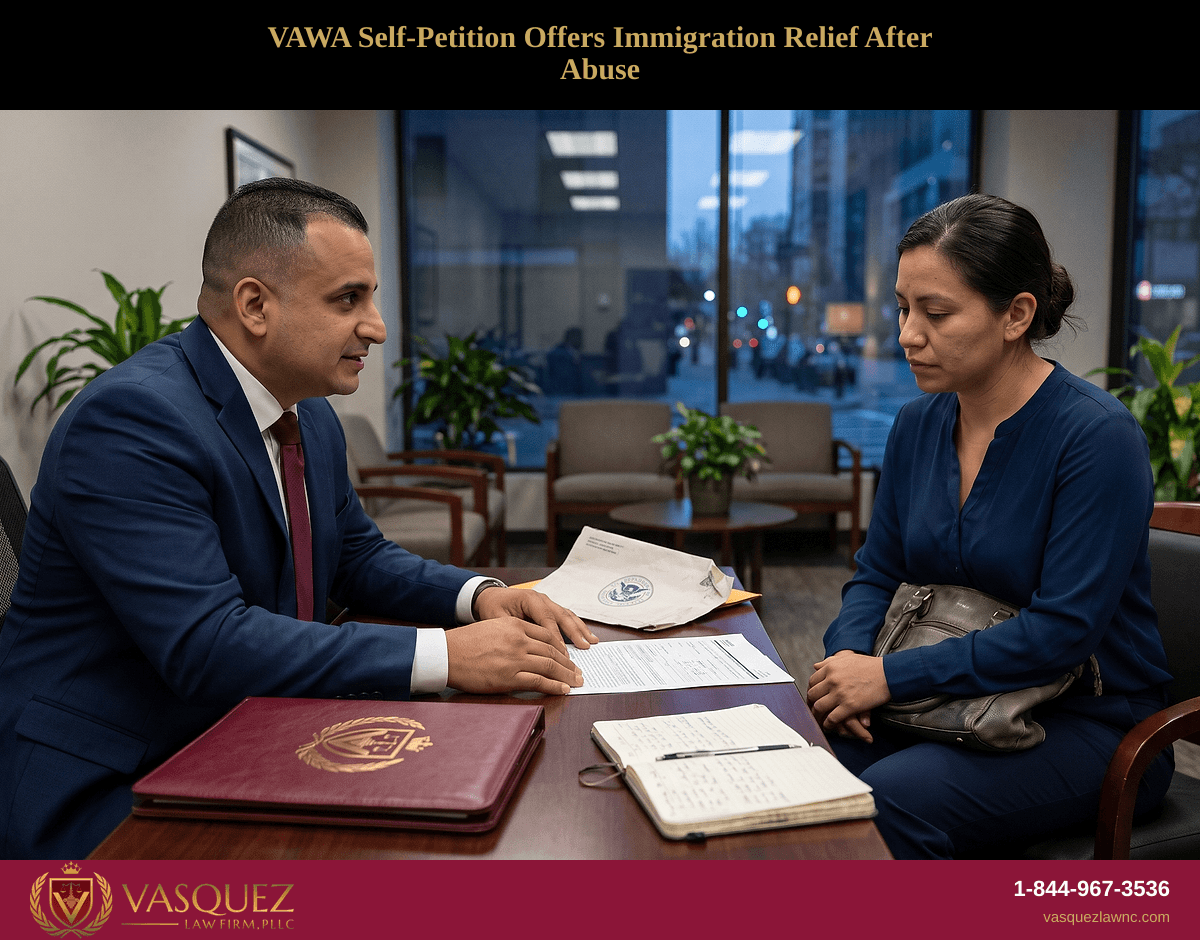
VAWA Self-Petition Offers Immigration Relief After Abuse
Need a VAWA self-petition after abuse? See eligibility, Form I-360 evidence, work options, and green card steps. Request a free evaluation today.
Published on October 23, 2026· Updated October 24, 2026
Talk to an immigration attorney
Free call. A clear plan for your case.
Free & confidential · Se habla espanol · Mon-Fri 8am-7pm, Sat 9am-2pm (ET)
Have questions? Talk to an attorney - free evaluation.
Call 1-844-967-3536Worried how the latest immigration news affects you?
Schedule a confidential case review with an immigration attorney - know exactly where you stand.
USCIS Case Status
Check your USCIS case status
Enter your receipt number and get the official status. Free, no registration.
VAWA Self-Petition Offers Immigration Relief After Abuse
A VAWA self-petition may help an abused spouse, child, or parent seek immigration classification without the abusive relative’s knowledge, consent, or participation. This VAWA self-petition guide explains who may qualify. It also explains what Form I-360 requires. It describes how an approved petition may support a later green card application. Vasquez Law Firm provides immigration services nationwide. The firm offers in-person consultations in Raleigh, NC and Orlando, FL.
Need confidential help with a VAWA self-petition? William J. Vasquez is ready to review your immigration options. Se Habla Español.
Call: 1-844-967-3536
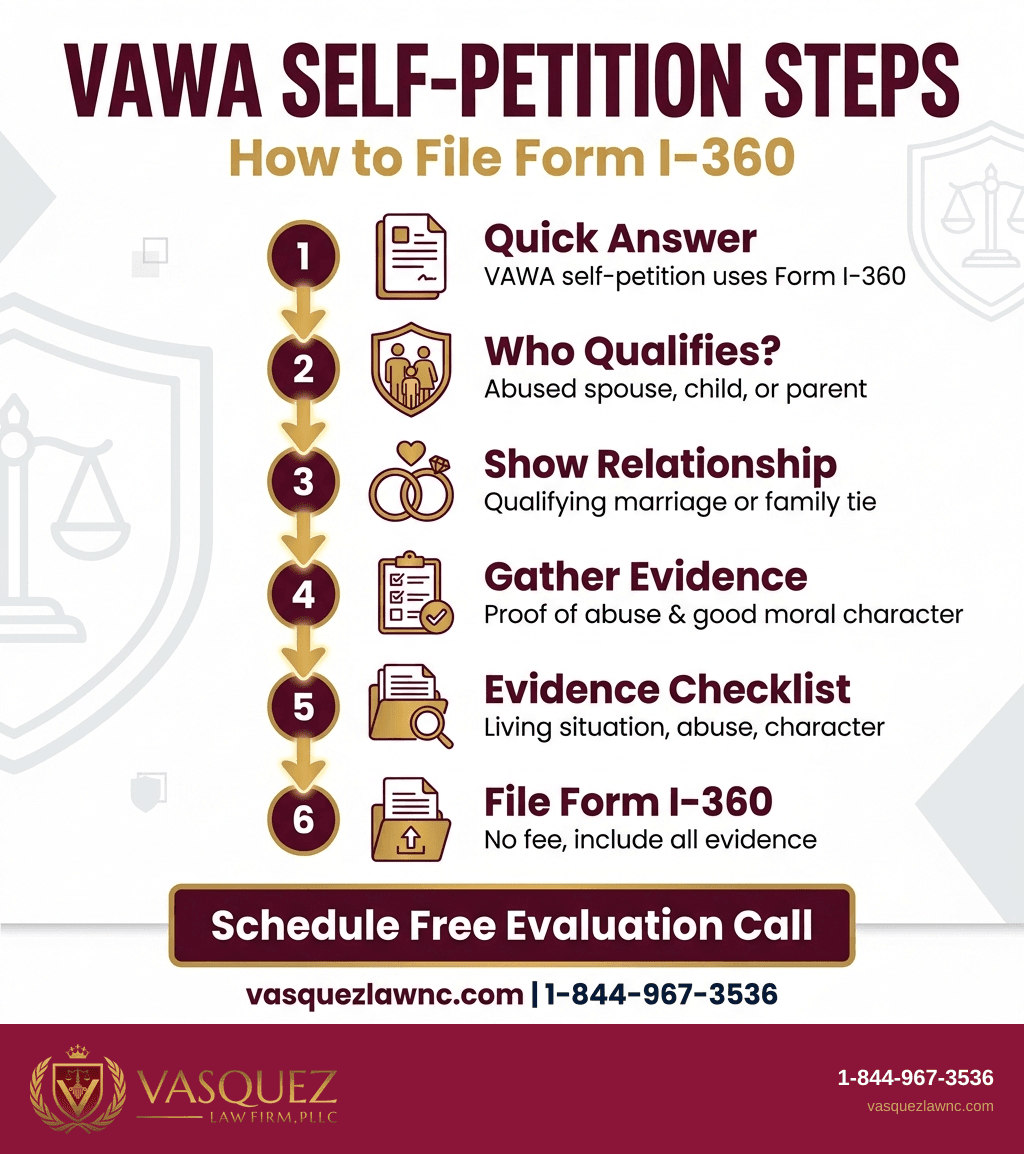
Quick Answer
A VAWA self-petition allows certain abused family members of U.S. citizens or lawful permanent residents to independently petition for immigrant classification without the abuser’s knowledge, consent, or participation in the immigration process.
- It uses Form I-360.
- There is no fee to file Form I-360 as a VAWA self-petitioner.
- Approval alone does not grant immigration status.
- An approved petitioner may later seek a green card if eligible.
Who can qualify for a VAWA self-petition?
An abused spouse of a U.S. citizen or lawful permanent resident may be able to self-petition. A spouse may also qualify if their U.S. citizen or lawful permanent resident spouse subjected their child to battery or extreme cruelty. An abused unmarried child may self-petition. A parent abused by a U.S. citizen son or daughter may also qualify.
USCIS describes this protection as a way for survivors to seek safety and independence. Our immigration legal services for family-based cases can help a person assess whether the family relationship fits the federal categories before filing.
Congress provided aliens who have been abused by their U.S. citizen or lawful permanent resident relative the ability to independently petition for themselves (self-petition) for immigrant classification without the abuser’s knowledge, consent, or participation in the immigration process.
What relationship must the petitioner show?
A spouse must show a qualifying marriage relationship. This can include some former-spouse and intended-spouse situations described by USCIS. A spouse must show that the marriage was entered in good faith. This means the marriage was not entered to evade immigration laws.
A child self-petitioner must be unmarried. USCIS also allows a child to file after reaching twenty-one but before reaching twenty-five. This applies when the abuse was the main reason for filing later. A parent petitioner must have a U.S. citizen son or daughter who is twenty-one or older.
What evidence supports a VAWA self-petition?
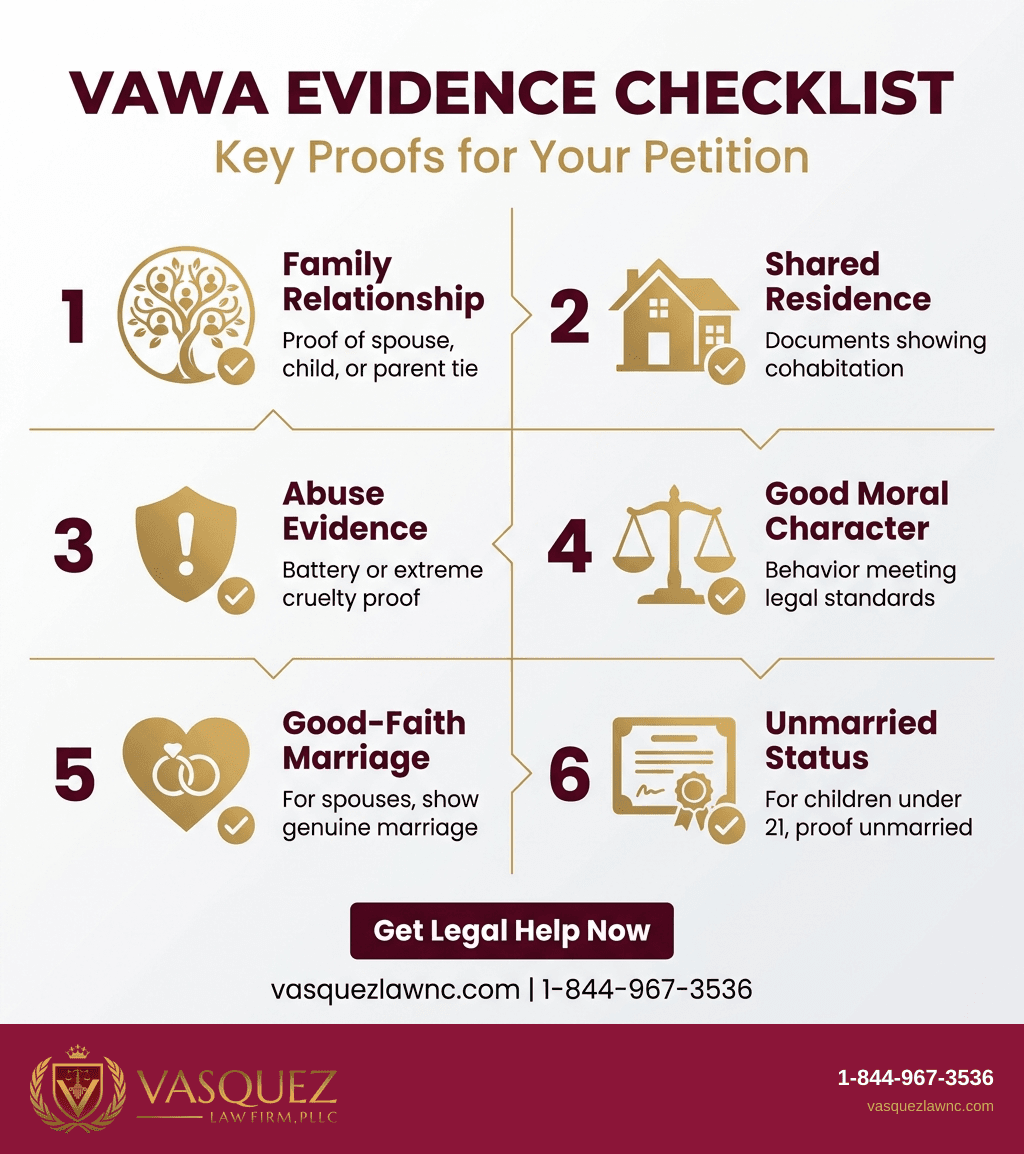
Form I-360 requires evidence of every eligibility element. An eligibility element is a fact the petitioner must prove. USCIS identifies the central elements as a qualifying relationship, battery or extreme cruelty during that relationship, shared residence, and good moral character. A spouse also needs evidence of a good-faith marriage.
Evidence should connect to the legal requirement it supports. The needed materials differ by family situation. Documents should therefore be organized carefully. Do not send an unexplained stack of records.
What should the evidence checklist include?
- Evidence of the qualifying family relationship.
- Evidence of living with the abusive relative.
- Evidence of battery or extreme cruelty.
- Evidence addressing good moral character.
- For a spouse, evidence that the marriage was entered in good faith.
- For a derivative child, evidence of the child’s relationship and unmarried status.
Cases we handle often involve a missing connection between a document and the eligibility element it should prove. A clear filing identifies what each record shows. It also explains why the record matters to the VAWA self-petition.
How do you file Form I-360 for VAWA relief?
The filing begins with Form I-360, Petition for Amerasian, Widow(er), or Special Immigrant. USCIS states that there is no fee to file Form I-360 as a VAWA self-petitioner. The petition should include evidence for the applicable requirements. It should also include any derivative-child evidence.
- Identify the correct self-petitioner category, spouse, child, or parent.
- Gather records tied to each eligibility requirement.
- Submit Form I-360, Petition for Amerasian, Widow(er), or Special Immigrant. If you are applying as a spouse or child of an abusive U.S. citizen or lawful permanent resident, you may include your child(ren) as derivative beneficiaries on the self-petition if they are under 21 years old and unmarried at the time of filing.
- Use a safe address and keep address information current through the applicable USCIS procedure.
- Keep copies of everything submitted and every USCIS notice received.
For a spouse or child petitioner, unmarried children under twenty-one may be included as derivative beneficiaries when filing. A derivative beneficiary is a qualifying family member who may receive benefits through the main petitioner. A parent self-petitioner cannot include derivative beneficiaries. The USCIS page on abused spouses, children and parents explains these categories and filing steps.
Can an approved VAWA self-petition lead to a green card?
An approval provides immigrant classification. Immigrant classification is a category that may support a later immigration application. Approval does not itself provide immigration status to the self-petitioner or derivative beneficiaries. The next question is whether the person meets the separate requirements to apply for lawful permanent residence.
Lawful permanent residence is the legal status commonly called a green card. A person in the United States may file Form I-485 for adjustment of status when an immigrant visa is immediately available. Adjustment of status is the process of applying for permanent residence from inside the United States. USCIS states that Form I-485 may be filed with Form I-360, while it is pending, or after approval. This is allowed if a visa is immediately available. Outside the United States, the process may proceed through consular processing when a visa becomes available. Consular processing is the visa process at a U.S. embassy or consulate.
Can the petitioner seek employment authorization?
An approved Form I-360 petitioner may apply to work in the United States. Employment authorization is official permission to work. USCIS will automatically consider initial employment authorization when the petitioner requests it on Form I-360. The petitioner must check the appropriate box. The petition must also be approved.
If that initial request was not made, the approved petitioner may file Form I-765 for employment authorization. Derivative children may also file Form I-765 after Form I-360 approval. For related immigration protection information, read our guide to U visas for crime victims.
What happens if USCIS schedules a VAWA interview?
USCIS may request an interview under 8 C.F.R. § 103.2(b)(9). A person who receives an interview notice must follow its instructions. USCIS says the interview notice is sent to the self-petitioner’s safe address. It is also sent to the legal representative on file.
Being selected for an interview does not necessarily mean that a deficiency has been identified in your case, nor does it alter eligibility requirements or applicable evidentiary standards.
USCIS says officers with specialized training conduct these interviews. The officers use trauma-informed interview techniques. USCIS also uses confidentiality protections under 8 U.S.C. § 1367. Missing a required interview may result in denial of the self-petition and adjustment application.
Which VAWA filing mistakes can create problems?
- Filing without evidence for each eligibility element. Fix this by organizing records by requirement.
- Using an unsafe mailing address. Fix this by using the safe address process.
- Assuming approval immediately creates status. Approval provides immigrant classification, not status.
- Leaving out eligible derivative-child evidence. Include age, marital-status, and relationship evidence.
- Ignoring an interview notice. Follow the notice instructions promptly.
- Confusing VAWA with another humanitarian option. Confirm the correct form and eligibility category.
If you remember one point, remember this: a VAWA self-petition depends on facts and evidence that match the federal eligibility rules.
Confidential preparation matters. Speak with Vasquez Law Firm about your VAWA self-petition options. Se Habla Español.
Call: 1-844-967-3536
How does the federal VAWA process protect confidentiality?
USCIS describes confidentiality protections under 8 U.S.C. § 1367 for interviews. Its process directs interview notices to a selected petitioner’s safe address.
A petitioner may receive a Notice of Prima Facie Case after establishing initial eligibility. A prima facie case is one that appears eligible based on the first review. USCIS explains that spouse and child self-petitioners, as well as derivatives, may be considered qualified aliens for certain federal and state public benefits after prima facie eligibility or approval. Parent self-petitioners are treated differently for that purpose.
Vasquez Law Firm’s immigration representation includes reviewing whether Form I-360, adjustment of status, employment authorization, and safe-address issues should be considered together. The USCIS Policy Manual includes Volume Three, Part D on VAWA protections.
Frequently Asked Questions
Who is eligible for a VAWA self-petition?
USCIS lists abused spouses and children of U.S. citizens or lawful permanent residents, plus parents abused by U.S. citizen sons or daughters who are twenty-one or older. Each category has separate relationship requirements. The person must also show battery or extreme cruelty, shared residence, and good moral character. A spouse must show a good-faith marriage.
Can a former spouse file a VAWA self-petition?
If you are married to a U.S. citizen or permanent resident abuser, your marriage to the abuser was legally terminated by death (U.S. citizen spouses only) or a divorce (for reasons related to the abuse) within the 2 years prior to filing your petition, or your spouse lost or renounced citizenship or permanent resident status within the 2 years prior to filing your petition due to an incident of domestic violence, you may have a qualifying relationship for a VAWA self-petition. The facts and timing need careful review because the qualifying relationship is a required element of Form I-360. A person should preserve records concerning the marriage and its termination.
Is there a fee for Form I-360 as a VAWA self-petitioner?
No. USCIS states that there is no fee to file Form I-360 as a VAWA self-petitioner. That does not mean every later immigration filing has the same fee rule. The VAWA petition, employment authorization request, and green card application are distinct steps. Review the current form instructions before filing any related application.
Can I include my children on a VAWA self-petition?
A spouse or child self-petitioner may include qualifying unmarried children who are under twenty-one when filing. USCIS requires evidence of the child’s age, unmarried status, and relationship to the self-petitioner. A parent self-petitioner cannot include derivative beneficiaries. An eligible child may also be added when the self-petitioner applies for lawful permanent residence.
Does an approved I-360 give me immigration status?
No. USCIS explains that an approved Form I-360 provides immigrant classification, not immigration status. Depending on the person’s circumstances, an approved petitioner may seek lawful permanent residence through adjustment of status or consular processing when a visa is available. Eligibility for the green card application remains a separate analysis.
Can an approved VAWA petitioner work?
An approved Form I-360 petitioner may seek employment authorization. USCIS automatically considers an initial employment authorization document request when the correct box is checked on Form I-360 and the petition is approved. If the request was not made there, the approved petitioner may file Form I-765. Derivative children may also request work authorization after approval.
What if USCIS calls me for a VAWA interview?
Follow the interview notice carefully. USCIS may require an interview under 8 C.F.R. § 103.2(b)(9), and failure to appear may lead to denial. USCIS states that selection for an interview does not itself show a problem in the case. The agency uses trained officers and confidentiality protections for these interviews.
Can a VAWA self-petitioner apply for a green card?
An approved VAWA self-petitioner may apply for lawful permanent residence if the other requirements are met. A person in the United States may use Form I-485 if an immigrant visa is immediately available. USCIS permits filing Form I-485 with Form I-360, while it is pending, or after approval when eligibility and visa availability permit that route.
About Vasquez Law Firm
Vasquez Law Firm handles immigration, personal injury, workers’ compensation, criminal defense, and traffic matters. In immigration cases, the firm offers nationwide representation. It also offers in-person consultations in Raleigh, NC and Orlando, FL. Our bilingual support staff helps clients communicate clearly throughout the process.
William J. Vasquez leads the firm with a direct, compassionate approach. That approach appears in the firm’s motto, Yo Peleo® (I Fight). A free evaluation can help identify the immigration documents and procedural questions that need prompt attention.
Sources and References
A VAWA self-petition can be an important path toward independence. The evidence and filings must fit your facts. Contact Vasquez Law Firm for a free, confidential evaluation. Se Habla Español.
Start Your Free Evaluation Now
Call: 1-844-967-3536
Filing a VAWA self-petition?
VAWA lets abused spouses, children, and parents self-petition confidentially, without the abuser involved. 15-min call to see if you qualify, no fee.
Keep Reading
For how Vasquez Law Firm can help, see our VAWA page.
Reviewed by Attorney Vasquez, Managing Attorney
William Vasquez
Founder & CEO, Vasquez Law Firm, PLLC
William Vasquez is the founder and CEO of Vasquez Law Firm, PLLC, a results-driven firm specializing in immigration, criminal defense, personal injury, and workers' compensation. A U.S. Air Force veteran and recipient of the Joint Service Achievement Medal, William is dedicated to fiercely fighting for his clients' rights.
Related Legal Services
Need legal help? Learn more about NC immigration legal team, or contact us for a free evaluation.
You can also visit NC immigration legal help for more information.