BIA Holds South Carolina Second-Degree Assault Is a Crime Involving Moral Turpitude
The BIA held that a South Carolina assault conviction is a crime involving moral turpitude. Review the legal test and request a free evaluation.
Published on October 27, 2026· Updated October 27, 2026
Talk to an immigration attorney
Free call. A clear plan for your case.
Free & confidential · Se habla espanol · Mon-Fri 8am-7pm, Sat 9am-2pm (ET)
Have questions? Talk to an attorney - free evaluation.
Call 1-844-967-3536Worried how the latest immigration news affects you?
Schedule a confidential case review with an immigration attorney - know exactly where you stand.
USCIS Case Status
Check your USCIS case status
Enter your receipt number and get the official status. Free, no registration.
BIA Holds South Carolina Second-Degree Assault Is a Crime Involving Moral Turpitude
A Philippine national was admitted to the United States on March 1, 2020. The person now faces reinstated removal proceedings. The Board of Immigration Appeals decided that a South Carolina second-degree assault conviction is a crime involving moral turpitude. In the respondent’s case, 30 I&N Dec. 185 (BIA 2026), the Board vacated the Immigration Judge’s decision granting the respondent’s motion to terminate and remanded the case for further proceedings.
This result matters because a South Carolina assault moral turpitude finding can put a noncitizen's immigration status at risk. This can happen when the legal requirements for removal are met. People reviewing a conviction's immigration effects can speak with our immigration attorneys. They can discuss federal immigration options and the records that matter.
Legal disclaimer: This article provides general legal information, not legal advice for any individual case. Immigration consequences depend on the conviction statute, record, immigration history, and procedural posture.
What did the South Carolina assault moral turpitude decision hold?
On October 27, 2026, the Board of Immigration Appeals held that assault and battery in the second degree under South Carolina Code § 16-3-600(D)(1) is categorically a crime involving moral turpitude. “Categorically” means that the legal analysis looks at the offense as defined by the statute. The Board found that both subparagraphs (a) and (b) of section 16-3-600(D)(1) involve moral turpitude.
A conviction for assault and battery in the second degree under section 16-3-600(D)(1) of the Code of Laws of South Carolina, which requires a reckless mental state and the actual or attempted infliction of “moderate bodily injury,” is categorically for a crime involving moral turpitude.
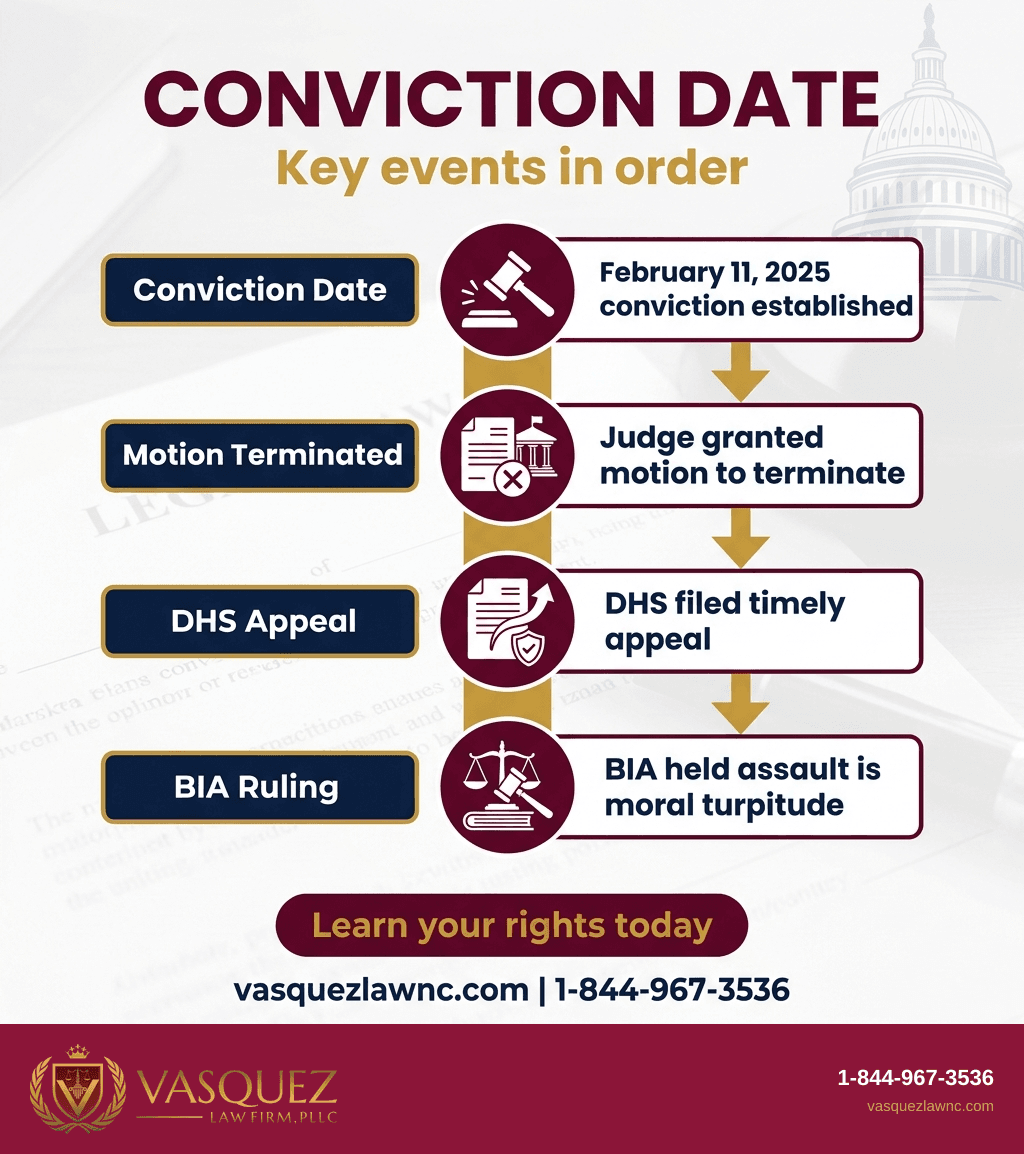
The case began with a February 11, 2025 conviction. The Department of Homeland Security charged the respondent under INA § 237(a)(2)(A)(i). That section is codified at 8 U.S.C. § 1227(a)(2)(A)(i). The charge was based on a crime involving moral turpitude committed within five years after admission. It also required that the offense carry a possible sentence of one year or longer.
An Immigration Judge granted a motion to terminate proceedings on June 6, 2025. A motion to terminate asks the court to end the case. The judge decided that DHS had not shown that the conviction was for a crime involving moral turpitude. DHS filed its appeal on July 7, 2025. The Board found the appeal timely because the written order issued on June 6.
Why the appeal changed the case
The Board vacated the termination decision. “Vacated” means that the Board set the decision aside. The Board found that recklessness was the minimum culpable mental state for the statute. A culpable mental state is the level of blame or awareness required by the law. The Board also found that the required harm made the conduct serious enough for the immigration classification.
DHS’ appeal is sustained, the Immigration Judge’s decision granting the respondent’s motion to terminate is vacated, and the removal proceedings are reinstated.
The decision does not itself order removal. It returns the record to the Immigration Judge for more proceedings and a new decision. This difference matters to anyone following a South Carolina assault moral turpitude issue in immigration court.
Who can this South Carolina assault moral turpitude ruling affect?
The ruling concerns people convicted under South Carolina Code § 16-3-600(D)(1). This is the state's second-degree assault and battery statute. In the respondent’s case, the Board considered removability under INA § 237(a)(2)(A)(i), which addresses a crime involving moral turpitude committed within five years after admission and for which a sentence of one year or longer may be imposed.
South Carolina law defines moderate bodily injury. This means an injury involving prolonged loss of consciousness, temporary or moderate disfigurement, or temporary loss of a bodily organ's function. It also includes treatment requiring regional or general anesthesia, or a fracture or dislocation. The definition excludes one-time treatment and observation for minor injuries. Examples include scratches, cuts, abrasions, bruises, burns, and splinters. These injuries ordinarily do not require extensive medical care.
The statute also covers unlawfully injuring another person, or offering or attempting to injure another person with the present ability to do so, when the act involves nonconsensual touching of private parts. South Carolina defines private parts to include genital areas, buttocks, and female breasts. The Board found that both statutory alternatives involve moral turpitude. Therefore, it did not need to identify which alternative appeared in the respondent's conviction record.
Why the criminal label is not the full immigration analysis
The Board explained that the sentence's seriousness does not decide whether an offense is a crime involving moral turpitude. A conviction record marked non-violent also does not decide that issue. Instead, immigration adjudicators assess the offense's legal elements under the categorical approach. This approach is a method that focuses on the minimum conduct covered by the statute. It requires a realistic probability of prosecution. It does not examine the facts underlying the respondent’s particular conduct.
In our experience, cases often turn first on getting the exact judgment, charging record, plea materials, and immigration admission history. These records are needed before anyone can assess the real exposure. They can show whether this specific South Carolina assault moral turpitude framework is relevant. They can also show what procedural steps remain available.
For people in removal proceedings, a conviction analysis should happen along with a review of notices, hearing records, and possible relief. Relief means a legal form of protection that may let a person remain in the United States. Our federal immigration legal team works with clients nationwide on the immigration consequences of criminal convictions.
What law governs crimes involving moral turpitude?
INA § 237(a)(2)(A)(i), 8 U.S.C. § 1227(a)(2)(A)(i), permits removal charges when the listed timing and possible-sentence conditions accompany a conviction for a crime involving moral turpitude. Under 8 C.F.R. § 1240.8(a), DHS must prove removability in proceedings involving an admitted respondent. This responsibility is called the burden of proof.
In the respondent’s case, the Board applied the categorical approach. It described a crime involving moral turpitude as one whose elements require reprehensible conduct and a culpable mental state. Reprehensible conduct means conduct that is seriously wrong or blameworthy. The opinion treated intent, knowledge, willfulness, and recklessness as culpable mental states for that inquiry.
How the categorical approach works
The approach examines the statutory elements. It does not examine a prosecutor's narrative or the respondent's individual conduct. When a statute has separate alternative elements, it can be divisible. A divisible statute is one that lists separate offenses or elements that the court can examine separately. The Board noted that § 16-3-600(D)(1) is divisible. Its two subparagraphs describe separate offenses.
Here, the Immigration Judge found that the record did not reveal which subparagraph supported the conviction. The Board concluded that this did not alter the result. Both alternatives met its moral-turpitude analysis. The Board found that reckless conduct combined with actual or potential moderate bodily injury was sufficiently grave. It also found that the nonconsensual touching described in the other alternative was morally reprehensible.
This legal framework is different from deciding whether an individual has a defense, qualifies for relief, or can challenge a charge in immigration court. Readers facing court proceedings can review our discussion of the immigration hearing process. They should also seek advice tailored to their record.
What should you do after a South Carolina assault conviction?
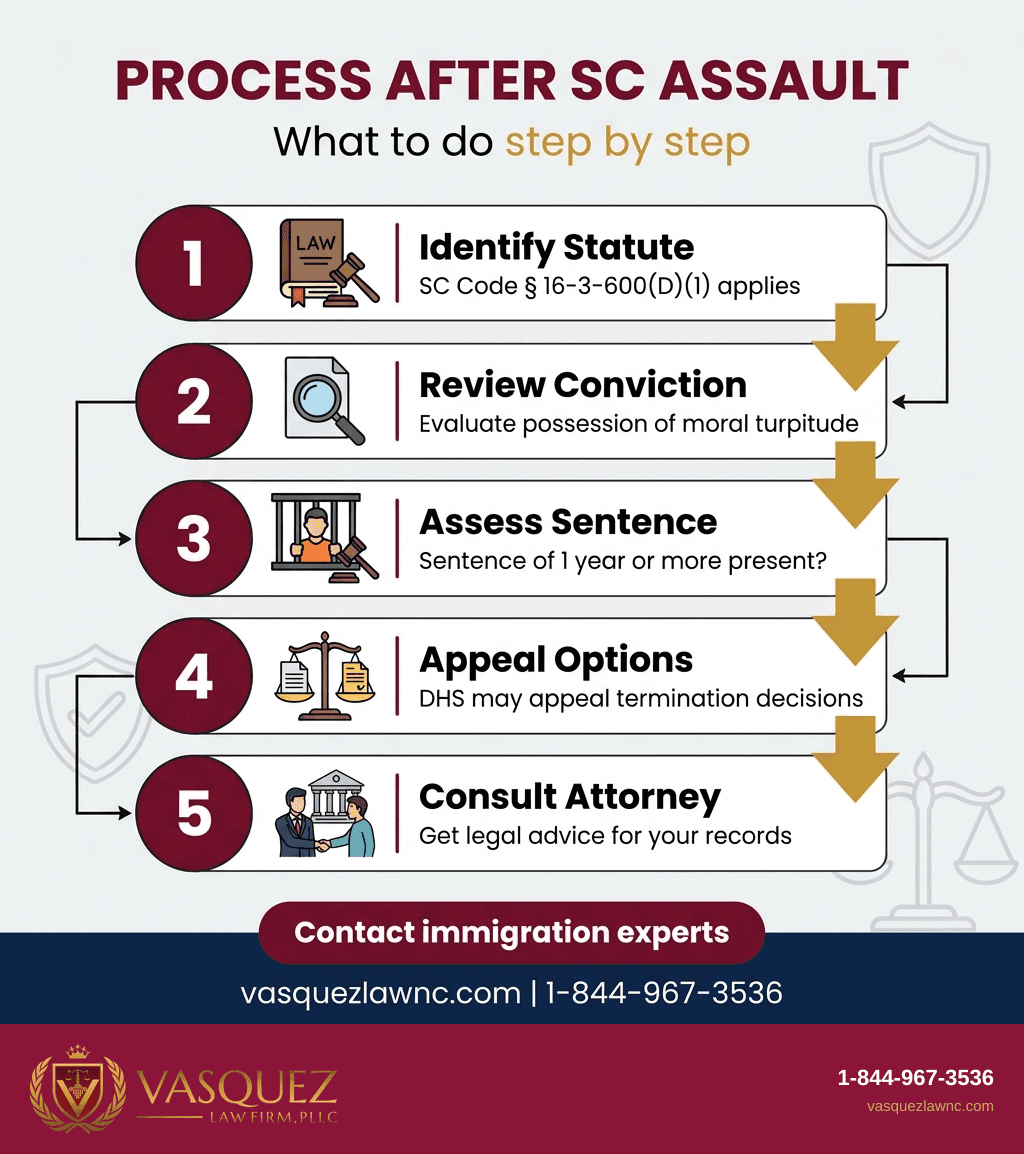
Start by collecting the complete criminal record. Do not rely only on a docket entry or background-check summary. Gather the final judgment, charging document, plea agreement or trial record, sentencing materials, and any appellate papers. The categorical approach makes the statute's wording and the conviction documents central to the immigration analysis.
Next, assemble immigration records that establish the date and manner of admission. Also collect records showing current status, notices from DHS or immigration court, and all scheduled hearing information. In this decision, the admission date and the offense timing were part of the charged removal ground.
Do not assume that a short sentence, a non-violent notation, or an offense title alone resolves the question. The Board specifically rejected those features as decisive of the statutory moral-turpitude classification. A careful review can identify whether the charged ground applies. It can also show whether the government has met its burden.
Prepare for the immigration case, not only the criminal case
Keep copies of every filing and order. If proceedings have already begun, track the Immigration Judge's instructions. Preserve proof of service as well. If a prior immigration decision needs more review, the standards discussed in our BIA motion to reopen overview may help explain why procedural posture matters. Procedural posture means the stage and status of the case.
Need an immigration-case review? Vasquez Law Firm offers a free evaluation for people concerned about how a conviction may affect immigration status. Request a free evaluation to discuss your records and options. Se Habla Español.
What should you watch after the BIA ruling?
The Board remanded the respondent’s case to the Immigration Judge for further proceedings. A remand sends the case back for more proceedings and a new decision. The Board's order reinstated removal proceedings. The case remains before the Immigration Judge for that next stage.
People with a South Carolina second-degree assault conviction should monitor their own immigration-court notices. They should preserve current contact information with the court and DHS. The key question in an individual case is whether the person meets every requirement of the removal ground. The person may also have relief or defenses available in the proceedings.
For official federal immigration guidance outside a pending court case, USCIS maintains its USCIS Policy Manual. Immigration court filings and orders require close attention to the directions issued in the particular proceeding.
The practical lesson is not to treat a South Carolina assault moral turpitude classification as the final word on every immigration outcome. It is a major legal finding about the offense. The remaining immigration process still requires evidence, legal analysis, and a decision in the individual case.
Frequently Asked Questions
Is South Carolina second-degree assault now considered a crime involving moral turpitude?
Yes. In the respondent’s case, 30 I&N Dec. 185 (BIA 2026), the Board held that a conviction under South Carolina Code § 16-3-600(D)(1) is categorically a crime involving moral turpitude. The decision addressed both moderate bodily injury and nonconsensual private-part touching alternatives in the statute.
Does the decision automatically remove someone from the United States?
No. The Board reinstated removal proceedings and remanded the case to the Immigration Judge for further proceedings and a new decision. A moral-turpitude classification can support a removal charge, but the government must establish the statutory removal ground and the immigration court process continues.
Why did recklessness matter in the Board's analysis?
The Board concluded that recklessness was the minimum culpable mental state for the South Carolina statute. It held that recklessness, coupled with the statute's required injury or conduct, could satisfy the culpable-mental-state and reprehensible-conduct components of a crime involving moral turpitude.
Does a non-violent notation on the record prevent immigration consequences?
No. The Board stated that the seriousness of the conduct or severity of the sentence is not determinative of whether a statutory offense is a crime involving moral turpitude. It also rejected reliance on the conviction record's non-violent notation as a basis to change the legal classification.
What is the maximum sentence for this South Carolina offense?
South Carolina Code § 16-3-600(D)(2) sets a maximum sentence of three years' imprisonment for second-degree assault and battery. In the respondent’s case, there was no dispute that a sentence of one year or longer could be imposed, one of the elements relevant to the charged removal ground.
What records should I bring for an immigration review?
Bring the final judgment, charging document, plea or trial materials, sentencing records, immigration documents, notices to appear, and hearing notices. Those materials help identify the conviction statute, the procedural posture, the admission history, and the removal charge that an immigration adjudicator may evaluate.
Legal disclaimer: This information is general and cannot replace advice on a specific case. For a free consultation, contact Vasquez Law Firm. We meet immigration clients in Raleigh, NC and Orlando, FL, and assist clients nationwide. Contact our immigration team to discuss your situation.
Sources
Reviewed by Attorney Vasquez, Managing Attorney
Need legal help?
Immigration in NC and FL. Personal injury and workers compensation across NC. Criminal defense in Johnston, Harnett and Pitt counties, and traffic tickets in 10 NC counties. Tell us your county and we will tell you exactly what we can do.
Keep Reading


William Vasquez
Founder & CEO, Vasquez Law Firm, PLLC
William Vasquez is the founder and CEO of Vasquez Law Firm, PLLC, a results-driven firm specializing in immigration, criminal defense, personal injury, and workers' compensation. A U.S. Air Force veteran and recipient of the Joint Service Achievement Medal, William is dedicated to fiercely fighting for his clients' rights.
Related Legal Services
Need legal help? Learn more about our immigration legal services, or contact us for a free evaluation.
You can also visit immigration lawyers serving all of North Carolina for more information.