USCIS Deference Policy Proposal Could Shift Reviews in 2026
USCIS proposes ending deference for I-129 extensions, raising RFE risk and uncertainty. Protect your record, request a free evaluation today.
Published on October 14, 2026
Talk to an immigration attorney
Free call. A clear plan for your case.
Free & confidential · Se habla espanol · 24/7
Have questions? Talk to an attorney - free evaluation.
Call 1-844-967-3536Free Tool
Check Your USCIS Case Status Now
Enter your receipt number - get the official USCIS status in English or Spanish. No registration.
USCIS Deference Policy Proposal Could Shift Reviews in 2026
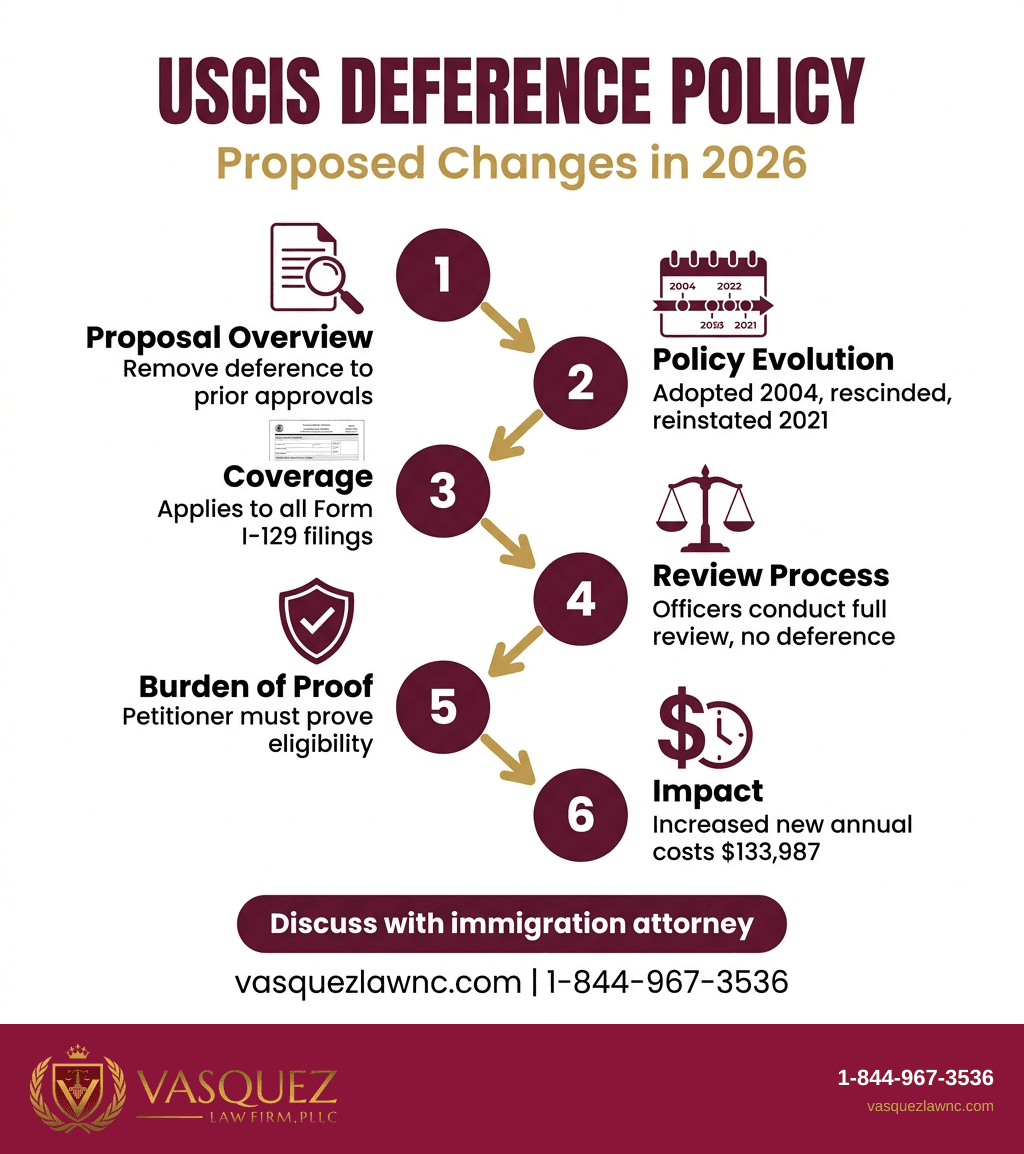
On October 14, 2026, USCIS proposed removing a rule about deference. Deference means giving weight to an earlier approval. The rule generally tells officers to defer to an earlier approval when an employer files a qualifying Form I-129 extension. For workers who need an extension to keep working, the USCIS deference policy proposal could lead to a closer review. Officers could review facts that USCIS already accepted once before.
Worried About Immigration Policy Changes?
New policies can affect your case. Get current legal advice from an experienced immigration attorney.
The proposal covers the entire country. However, it is not in effect. DHS must publish a final rule before 8 CFR 214.1(c)(5) can be removed. Employers and workers considering an extension can discuss record preparation with Vasquez Law Firm's immigration attorneys. These attorneys handle federal immigration matters nationwide.
Legal disclaimer: This article provides general legal information. It does not provide legal advice for any person or petition. An I-129 filing depends on its evidence, classification, and facts. A prior approval remains relevant evidence. However, it does not remove the need to prove eligibility in a later filing.
What did USCIS propose for its deference policy?
Federal Register Document 2026-20941 is titled Removing Deference to Prior USCIS Determinations of Eligibility. It proposes removing 8 CFR 214.1(c)(5). The regulation now directs USCIS to give deference to an earlier eligibility decision in certain Form I-129 filings. Those filings must involve the same parties and underlying facts.
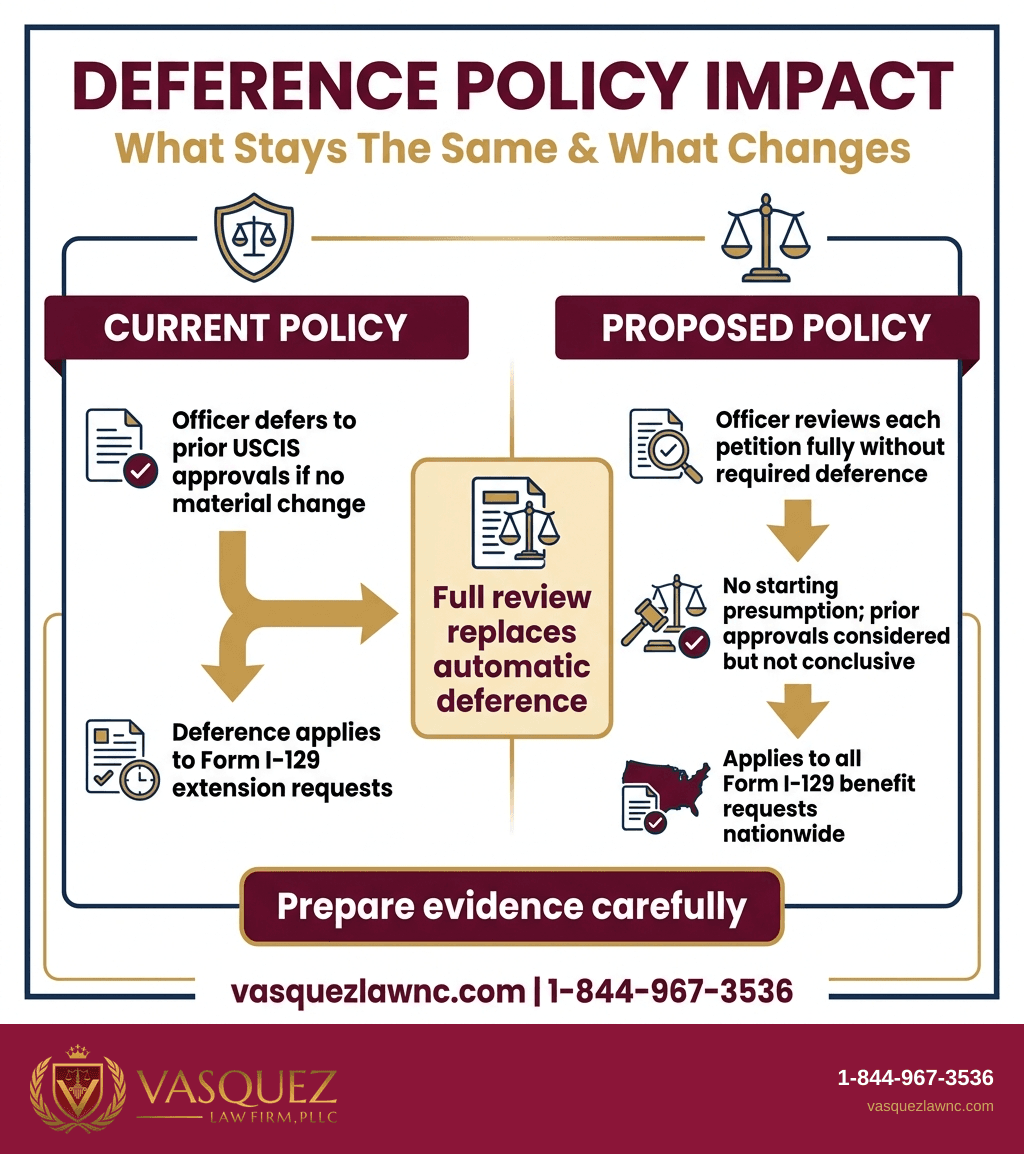
Under the current rule, an officer generally defers to the earlier decision. The officer may not do so if there was a material error, a material change, or new material information that harms eligibility. A material change is a fact that could affect whether the worker or employer still meets the requirements of the requested classification.
“This proposed change would apply to all benefit requests filed using Form I-129, Petition for a Nonimmigrant Worker.”
DHS says the proposed removal would let officers conduct a full review of each petition. Officers would not have to begin from a position of deference. The agency says officers could still consider an earlier approval when it matters. The proposal would remove the required starting point of deference. It would not stop an officer from reviewing an earlier decision.
The notice identifies INA section 291, 8 U.S.C. 1361, as the statutory basis for keeping the burden of proof on the petitioner, applicant, or beneficiary. The burden of proof means the responsibility to provide enough evidence. For an employer-sponsored I-129 extension, the petitioner usually must submit evidence. That evidence must show that the job, employer, and worker remain eligible under the requested classification.
How did the policy develop?
USCIS first adopted a deference approach through an April 2004 memorandum. The agency rescinded that approach in October 2017. It reinstated the approach in April 2021 through the USCIS Policy Manual. USCIS codified it in December 2024. The October 14 proposal would reverse that codified provision.
The comment period closes November 13, 2026. Comments must be submitted through Regulations.gov under DHS Docket No. USCIS-2026-0529. DHS warns that email, mailed, hand-delivered, and couriered comments will not count as comments on the proposal.
Who could the USCIS deference policy proposal reach?
The proposal reaches benefit requests filed on Form I-129, Petition for a Nonimmigrant Worker. The notice focuses on extension requests. In these requests, the same petitioner seeks to continue a worker's employment or authorized stay. The worker must remain in the same nonimmigrant classification.
People use Form I-129 for several temporary worker classifications. The notice discusses H-1B and L-1A extensions in its analysis. Its stated scope, however, covers all benefit requests filed using Form I-129. The proposal does not change the basic eligibility standards for a classification. Instead, it changes the framework USCIS would use to review a later filing.
A worker may feel the practical effects even though the employer is often the petitioner. The petitioner is the person or entity that files the request. If USCIS requests more evidence, the employer may need to document the offered role, business operations, compensation, contracts, work location, and the worker's qualifications again. The worker may also need records showing continued maintenance of nonimmigrant status. Maintaining status means following the rules of the worker's temporary immigration category.
“The deference regulation does not itself guarantee approval of an extension.”
DHS estimates that removing deference would create approximately $133,987 in new annual costs for petitioners. The estimate is based on an expected increase in requests for evidence, known as RFEs. An RFE asks a petitioner for additional documentation before USCIS decides the filing. DHS also expects longer adjudication times. Adjudication means the agency's decision-making process. DHS also expects more uncertainty about continued employment.
The agency cites its site-visit data as part of its program-integrity reason. Program integrity means checking whether filings and related programs follow the rules. For H-1B extension cases visited from fiscal years 2022 through 2025, the combined non-compliance or fraud percentage was 22.39 percent. For the earlier fiscal years 2018 through 2020, when USCIS had no deference policy, it was 16.77 percent. DHS acknowledges that other factors may have contributed.
What stays the same for workers?
Eligibility still depends on the requirements of the particular visa classification. The proposal does not remove an employer's ability to petition for a worker's continued employment. It also does not remove a worker's ability to remain and work. The petitioner must establish continued eligibility, and USCIS must approve the necessary request.
In our experience, extension cases become harder when a filing treats the earlier approval as a replacement for current evidence. The filing should address the present job, employer, and worker.
What does immigration law already require for I-129 extensions?
INA section 291, codified at 8 U.S.C. 1361, places the burden of proof on the person seeking an immigration benefit. DHS relies on that statute when arguing that a petitioner must show eligibility for each benefit request. This includes an extension of petition validity.
Separate rules govern an extension of stay. An extension of stay is permission to remain in the United States for more time. Under 8 CFR 214.1(c)(1), a petitioner may request an extension of stay through Form I-129 for eligible classifications. Under 8 CFR 214.1(c)(6), an extension ordinarily requires two things. The worker must be in nonimmigrant status when the request is filed. The worker must also have maintained that status.
The current 8 CFR 214.1(c)(5) is narrower than a general rule saying every earlier decision controls later immigration matters. It applies when a Form I-129 request involves the same parties and the same underlying facts. Its listed exceptions are material error, material change, or new adverse material information.
Why does the burden of proof matter?
Evidence must show that the requested benefit is available now. For an extension, a petitioner should not assume that a prior approval proves continued eligibility. Circumstances may have changed. Changes may involve duties, operations, contracts, worksite arrangements, compensation, or the worker's status history.
DHS says the proposal would match the regulation to the statutory burden. It would also allow fuller fact-finding. Critics may focus on the notice's prediction that more RFEs could follow. They may also focus on longer processing and employment uncertainty. These competing concerns explain why the public-comment record matters before a final rule is considered.
What should an employer or worker do before an I-129 extension?
First, compare the planned extension filing with the earlier approval. Look for changes in the offered position, work duties, compensation, worksite, company structure, contracts, or the worker's qualifications. Explain any differences clearly. A clear explanation can help more than leaving USCIS to guess why the records differ.
Second, organize current supporting evidence. The Federal Register notice says petitioners seeking an extension of stay must submit proof that the worker maintained status. They must also submit the initial evidence required by regulations and Form I-129 instructions. Keep copies of prior approvals, I-94 records, pay records, role descriptions, and business evidence. The evidence should support the present petition.
Third, respond carefully if USCIS issues an RFE or a notice of intent to deny. An RFE requests more evidence. A notice of intent to deny, often called a NOID, tells the petitioner that USCIS intends to deny the filing. The petitioner can respond by addressing the stated concerns. The notice explains that officers must give petitioners an opportunity to respond to new information under 8 CFR 103.2(b)(16)(i).
Fourth, check official case-processing information. Do not rely only on a prior extension timeline. USCIS publishes its Processing Times page for case-processing estimates. Estimates are not a promise of a decision date.
If your filing involves H-1B, L-1, H-2B, E-2, TN, student-visa, or related business immigration issues, our immigration legal team offers virtual consultations by Zoom or phone. Request a free evaluation to discuss how current evidence supports your extension. Se Habla Español.
What should readers watch for after this USCIS proposal?
The immediate date to watch is November 13, 2026. That is when the public comment period ends. DHS invites comments about legal, economic, environmental, and federalism effects. Comments should identify USCIS and DHS Docket No. USCIS-2026-0529. They should address a specific part of the proposal. They should support suggested changes with data, information, or authority.
The next decisive development would be publication of a final rule in the Federal Register. Until then, 8 CFR 214.1(c)(5) remains the current regulation. Readers can monitor the Federal Register notice and the online docket. These sources may show comments, alerts, and any final rule.
It is not yet settled whether a final rule would keep the proposal exactly as published. DHS will review public comments before deciding. What is settled today is that a previous I-129 approval does not guarantee a later approval. The petitioner remains responsible for establishing eligibility for the benefit sought.
What's Your Immigration Situation?
Answer 3 questions - we'll tell you your options
Question 1 / 3
What best describes your situation?
Keep Reading
For current agency guidance, review the USCIS Policy Manual. Also review the regulations governing the classification at issue. Employers should preserve current evidence now. They should not wait for an RFE before rebuilding the record.

Frequently Asked Questions
Is the USCIS deference policy proposal already effective?
No. The October 14, 2026 publication is a notice of proposed rulemaking. It proposes removing 8 CFR 214.1(c)(5), but the regulation remains in place unless DHS publishes a final rule. A proposal begins public rulemaking. It does not itself change the standard that USCIS officers must apply to current cases.
Does this proposal apply only to H-1B petitions?
No. DHS states that the proposal would apply to all benefit requests filed using Form I-129. The notice uses H-1B and L-1A site-visit data in its discussion of program integrity, but its stated scope is not limited to those classifications. The exact evidence required still depends on the nonimmigrant classification requested.
Would USCIS ignore a prior approval if the rule changes?
No. DHS says the proposal would not prohibit officers from considering a prior approval where relevant. The proposed change would remove the instruction to begin with deference. USCIS would instead assess the current request on its own record and determine whether the petitioner established continued eligibility.
What is a material change in an I-129 extension case?
The current regulation lists a material change in circumstances or eligibility requirements as an exception to deference. In plain terms, it is a change significant enough to affect eligibility. The notice gives examples of potentially relevant business or position changes, including reduced operations, lost contracts, altered job duties, and compliance issues.
Can an RFE be issued even if USCIS approved the first petition?
Yes. The notice explains that an officer may request additional documentation based on the merits of the case. DHS expects more RFEs if deference is removed because officers may conduct a more thorough review of evidence previously considered. A prior approval does not eliminate the petitioner's burden to prove the current request.
What records should be preserved for an extension?
The notice calls for evidence of maintained status and the initial evidence required by regulations and Form I-129 instructions. Records may include prior approval notices, I-94 documentation, evidence of current employment, materials supporting the offered role, and records that explain any meaningful changes since the earlier petition. The needed evidence varies by classification.
Legal disclaimer: The facts of an I-129 petition can affect employment authorization and immigration status. Contact Vasquez Law Firm for a free consultation tailored to your situation. Immigration consultations are available in person in Raleigh, NC and Orlando, FL, while business immigration consultations are available by Zoom or phone.
Schedule your free immigration consultation and prepare an extension record that addresses the evidence USCIS will review.
Sources
- Removing Deference to Prior USCIS Determinations of Eligibility, Federal Register Document 2026-20941
- USCIS Policy Manual
Reviewed by Attorney Vasquez, Managing Attorney

William Vasquez
Founder & CEO, Vasquez Law Firm, PLLC
William Vasquez is the founder and CEO of Vasquez Law Firm, PLLC, a results-driven firm specializing in immigration, criminal defense, personal injury, and workers' compensation. A U.S. Air Force veteran and recipient of the Joint Service Achievement Medal, William is dedicated to fiercely fighting for his clients' rights.
Related Legal Services
Need legal help? Learn more about learn about our immigration practice, or contact us for a free evaluation.
You can also visit statewide immigration legal services for more information.