USCIS Charlotte Asylum Office Will Open on Oct. 13, 2026
USCIS Charlotte asylum office opens Oct. 13 for Carolinas applicants. Check your interview notice before travel and request a free evaluation today.
Published on October 9, 2026· Updated October 10, 2026
Talk to an immigration attorney
Free call. A clear plan for your case.
Free & confidential · Se habla espanol · 24/7
Have questions? Talk to an attorney - free evaluation.
Call 1-844-967-3536Free Tool
Check Your USCIS Case Status Now
Enter your receipt number - get the official USCIS status in English or Spanish. No registration.
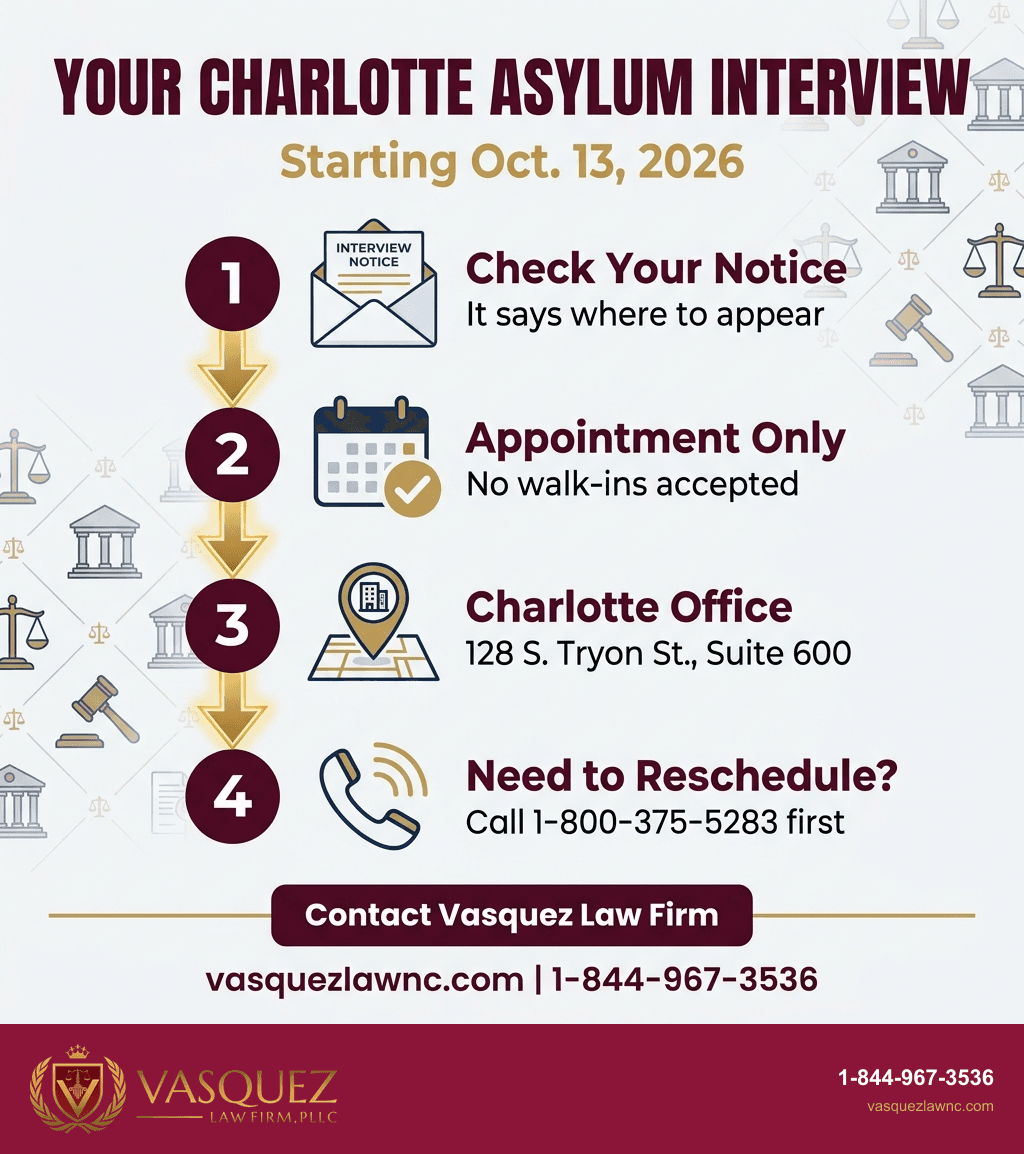
Beginning October 13, 2026, an asylum applicant living in North Carolina or South Carolina may receive an interview notice. The notice may direct that person to the new USCIS Charlotte Asylum Office at 128 South Tryon Street, Suite 600. This location change matters. The notice, not a guess about the nearest USCIS office, controls where the applicant must appear.
The federal change applies to eligible applicants who live in either Carolina. This includes people who seek advice from Orlando, Florida. Our immigration attorneys provide federal immigration guidance from Raleigh, NC and Orlando, FL. This article gives general information. It is not legal advice for any individual case.
Seeking Asylum in the US?
You must file within 1 year of arrival. Our attorneys can help build your case.
USCIS announced the opening in its October 9, 2026 newsroom alert, USCIS Opens Asylum Office in Charlotte. The immediate task for applicants is simple but important. Read every line of an interview notice. Attend only at the location USCIS identifies.
What happened with the USCIS Charlotte Asylum Office?
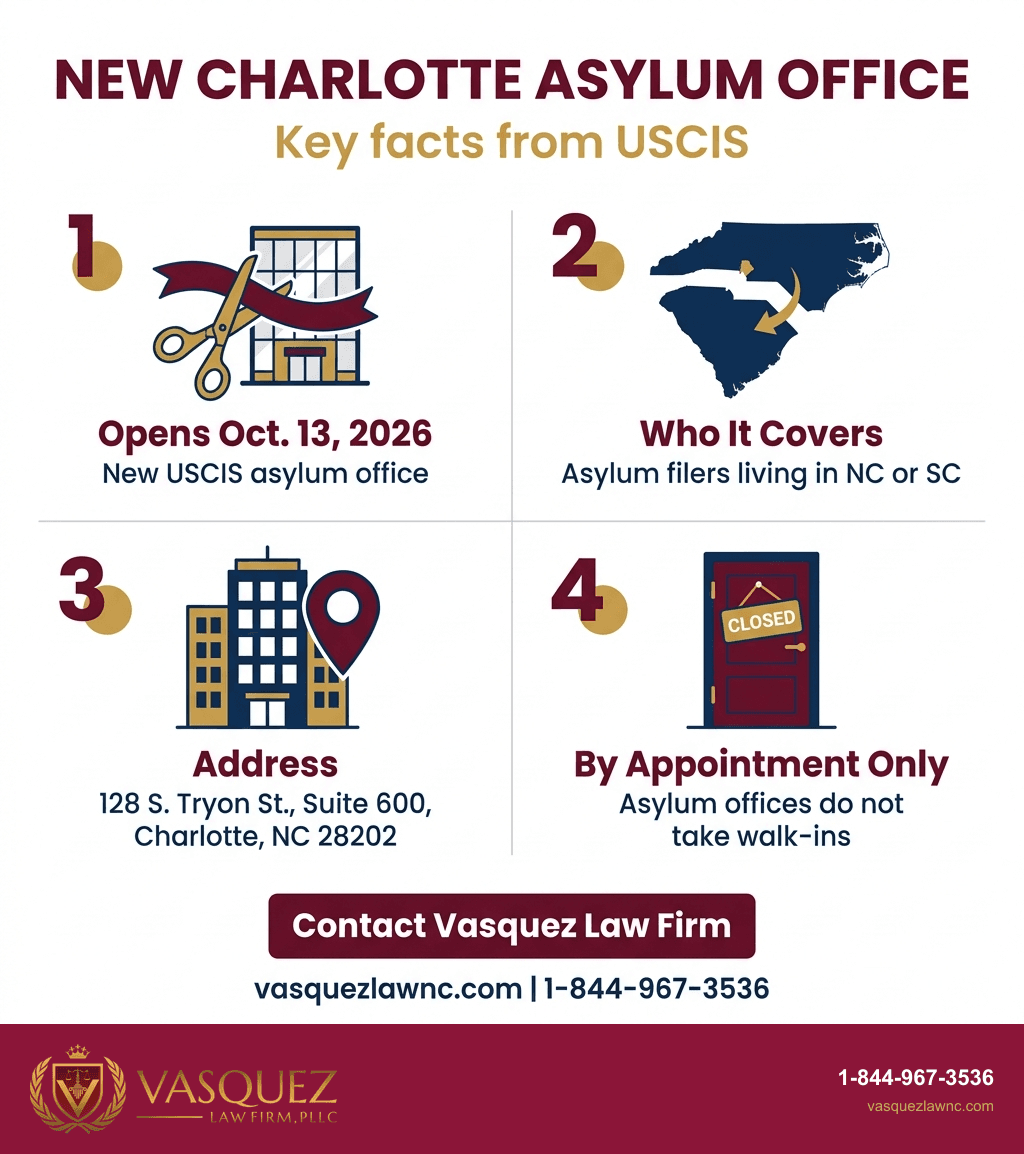
USCIS said on October 9 that it is opening an asylum office in Charlotte, North Carolina. The agency set October 13, 2026 as the start date for the new office's jurisdiction. This applies to people residing in North Carolina or South Carolina who have filed, or are filing, for asylum.
Beginning Oct. 13, 2026, aliens residing in North Carolina or South Carolina who have filed or are filing for asylum will fall under the jurisdiction of the new Charlotte Asylum Office and may be scheduled to appear for interview at this location.
The alert gives one street address: 128 South Tryon Street, Suite 600, Charlotte, North Carolina 28202. The USCIS Charlotte asylum office is appointment-only. It is not a walk-in location. The announcement does not say that people may visit to ask about a pending case.
What controls the interview location?
USCIS expressly tells applicants to review the interview notice. A notice can list the appearance details for a particular case. Those details include where the applicant must report. The agency also directs applicants to the USCIS Asylum Office Locator for office-location information.
The new office may make interviews more geographically convenient for some residents, particularly applicants living in Charlotte, Greensboro, Asheville, Raleigh, Wilmington, Columbia, or other communities in the Carolinas. Convenience, however, does not replace the official instruction. An applicant who receives a notice listing Charlotte should plan around that notice even if another USCIS facility is closer to home.
For example, a person living in Columbia, South Carolina, might search online and find a USCIS field office in that city. That field office may handle certain benefit applications, biometrics, or other services, but it may not conduct the person's affirmative asylum interview. Going to the wrong facility could result in a missed appointment and unnecessary delay.
What does the opening mean for pending cases?
The announcement indicates that the new office will have jurisdiction over covered applicants, but it does not state that every pending case will immediately receive a new interview date. Some cases may remain pending while USCIS reviews scheduling capacity, background checks, filing records, or other administrative requirements. Applicants should avoid assuming that the opening guarantees an immediate interview.
Applicants should also keep copies of prior notices. If USCIS later issues a new notice, the newer document may contain different scheduling information. Keep both documents together and compare the case number, applicant name, interview date, time, and location. If anything appears inconsistent, seek clarification before traveling.
Who will the Charlotte Asylum Office serve?
The stated scope has two parts. The person must reside in North Carolina or South Carolina. That person must also have an asylum filing, whether the filing is already complete or is being made. USCIS does not provide a case count or an interview backlog figure in this announcement. It also does not give a separate list of categories excluded from the new jurisdiction.
This is an affirmative asylum development. Affirmative asylum generally means that a person asks USCIS for asylum instead of first asking in immigration court. The agency's alert refers applicants to its guidance on preparing for an affirmative asylum interview.
Interviews and other services are by appointment only. Asylum offices do not accept walk-ins.
An applicant should not confuse the new USCIS Charlotte asylum office with a USCIS Charlotte field office or an application support center. These offices have different functions. The interview notice identifies the appointment USCIS has scheduled. In our experience, clients often ask the same first question after receiving an interview notice. They want to know whether they can change the appointment location without affecting the case.
Why does the notice matter?
It tells the applicant where to appear for the specific interview. It also helps prevent a mistake. For example, an applicant might travel to an office based only on a web search for “USCIS office near me.”
Residence can also become important when an applicant moves after filing. A person who filed while living in Virginia but later moved to North Carolina may need to update USCIS and confirm that the agency has the current address. Similarly, an applicant who moves from North Carolina to another state should not assume that the Charlotte office will continue to handle the case without any jurisdictional review.
Address changes should be reported through the appropriate USCIS process, and applicants should keep proof that the update was submitted. A forwarding address with the postal service may not be enough. USCIS correspondence can contain appointment deadlines, and failing to receive a notice does not always eliminate the consequences of missing an interview.
Examples of applicants who may be affected
Consider an applicant who lives in Durham and filed Form I-589 affirmatively with USCIS. If that applicant receives an interview notice directing an appearance in Charlotte, the applicant should follow the notice rather than report to a Durham-area application support center. An applicant in Rock Hill, South Carolina, may receive similar instructions even if the person's closest immigration-related facility is across the state line.
Another example involves a family in North Carolina whose principal applicant filed an asylum application and included a spouse and child. The family should read the notice carefully to determine who is expected to attend. The interview requirements may differ depending on the case and the information USCIS requests. A family should not assume that one person can appear for everyone without confirming the instructions.
What asylum law applies to an affirmative interview?
The Charlotte opening is an administrative jurisdiction announcement. In this context, jurisdiction means the agency's authority over a case or area. The announcement is not a new asylum eligibility statute. A statute is a written law passed by Congress. As background, Immigration and Nationality Act Section 208, codified at 8 U.S.C. § 1158, authorizes asylum applications. It also sets core limits on eligibility. The refugee definition appears at 8 U.S.C. § 1101(a)(42).
Federal regulations at 8 C.F.R. § 208.9 govern interviews on asylum applications. Regulations are agency rules that explain how a law works. They provide the legal framework for USCIS interviews. The October 9 alert identifies the Charlotte office's jurisdiction beginning October 13.
What has not changed?
The USCIS notice does not announce a new filing deadline. It does not announce a revised asylum standard or a new eligibility test. Applicants should review the USCIS Policy Manual for agency policy materials. They should also obtain advice tailored to their record.
An affirmative asylum interview generally gives the applicant an opportunity to explain the application and answer questions about identity, family history, travel, immigration history, and the reasons protection is requested. The officer may ask about past events, feared harm, political or religious activity, membership in a particular group, or other facts relevant to the application.
The applicant's burden is not satisfied merely by attending the interview. The written application, supporting evidence, testimony, and applicable law must be considered together. A change in office location does not eliminate the need to address inconsistencies, missing documents, translation issues, filing deadlines, or possible bars to asylum.
Why does preparation require a case-specific review?
Two applicants from the same city may have very different legal issues. One person may have strong documentary evidence but a difficult filing deadline question. Another may have timely filed but need to explain differences between a declaration, prior visa application, border records, and testimony. A general office announcement cannot resolve those individual questions.
Applicants should review the complete record before the interview, including every version of Form I-589, amendments, declarations, affidavits, medical records, identity documents, police reports, social media evidence, and prior immigration filings. If an error appears, the applicant should discuss the appropriate way to address it rather than quietly relying on an inaccurate document.
What should I do if USCIS schedules my interview?
First, save the original interview notice. Read it promptly. Confirm the date, time, and appearance location printed by USCIS. Do not rely on an old notice, a friend's appointment, or a general office listing.
Second, organize a copy of the asylum application, supporting evidence, identity documents, and any USCIS correspondence. Keep these materials in one file. This can help an applicant and counsel check that the interview record is complete. Our asylum immigration legal team can review the meaning of an interview notice and the applicant's case history.
Third, contact USCIS if a reschedule is necessary before the appointment. USCIS directs applicants to call the USCIS Contact Center at 1-800-375-5283. The alert does not give a separate Charlotte Asylum Office phone number for case questions. For disability access needs, USCIS directs the public to its Disability Accommodations for the Public webpage.
Prepare the logistics
Plan the route to 128 South Tryon Street, Suite 600, well in advance. Consider traffic, parking, public transportation, weather, childcare, work obligations, and the possibility of security screening. Downtown travel can take longer than expected, particularly during weekday morning appointments. Arriving late may create avoidable stress and may affect whether the office can complete the appointment.
Applicants should also confirm whether an interpreter is needed and whether the interview notice contains instructions about interpretation. A person should not assume that a friend or family member may interpret without approval. Children should not automatically be used as interpreters for sensitive testimony. If the applicant has hearing, mobility, visual, medical, or other access needs, request an accommodation as early as possible.
Review the substance of the case
Before the appointment, compare the application with the applicant's current memory and circumstances. Review dates, locations, names, relationships, arrests, employment, school history, travel, and prior statements made to government officials. Minor mistakes can happen, but the applicant should be prepared to explain an important discrepancy honestly and clearly.
Bring original documents when appropriate, along with organized copies. Useful materials may include passports, national identity documents, birth and marriage certificates, proof of relationship, medical or psychological records, letters from witnesses, news reports, organizational records, and evidence concerning country conditions. The relevance of each item depends on the case, and unsupported documents may require explanation regarding authenticity and translation.
Keep records after the interview
After the interview, write down the date, location, names if known, documents submitted, and any instructions given by the officer. Keep proof of delivery for later submissions. USCIS may request additional evidence, and a deadline in a written request should be treated seriously.
An interview does not necessarily produce an immediate decision. The case may remain pending for additional review, background checks, supervisory review, or other reasons. Applicants should continue monitoring mail and official online case information while keeping USCIS informed of address changes.
What's Your Immigration Situation?
Answer 3 questions - we'll tell you your options
Question 1 / 3
What best describes your situation?
Keep Reading
Received an asylum interview notice or need to prepare for one? Request a free evaluation with Vasquez Law Firm. Se Habla Espanol.
What should applicants watch next?
Starting October 13, the settled rule is clear. North Carolina and South Carolina residents who have filed or are filing for asylum fall under the Charlotte office's jurisdiction. Applicants should watch their mail and official USCIS account notices. They should then compare those instructions with the agency's USCIS processing-times page for general case-status context.
One important question remains case-specific. Only the applicant's notice can answer whether USCIS will schedule that applicant at Charlotte. The October 9 announcement says applicants “may be scheduled” there. It does not promise an interview date or outcome.
Applicants should monitor more than one source of information. Check the physical mailbox, update contact information when necessary, and review any official USCIS account associated with the case. Keep envelopes and notices because postmarks and delivery dates may help establish when a document was received.
Processing-time information is useful for general planning, but it is not a guarantee. A posted estimate may reflect broad categories and may not account for the facts of a particular case. A case can take longer because of a pending background check, a request for evidence, an address change, a transfer, a need for supervisory review, or other administrative circumstances.
What if the applicant does not receive a notice?
If an applicant believes an interview should have been scheduled but has received nothing, the applicant should confirm that USCIS has the correct address and that the case number is being used correctly. Contacting USCIS or consulting counsel may help identify whether the case is pending, transferred, returned, rejected, or affected by another issue. Applicants should not appear at the office without an appointment to investigate.
People should also be cautious about unofficial messages. USCIS does not ask applicants to pay a stranger by gift card, cryptocurrency, or wire transfer to secure an interview. A message that demands immediate payment, promises approval, or uses an unfamiliar email address may be fraudulent. Preserve suspicious communications and verify information through official channels.
Frequently Asked Questions
When does the Charlotte Asylum Office begin serving applicants?
USCIS says the new jurisdiction begins October 13, 2026. The announcement was released October 9, 2026. Applicants residing in North Carolina or South Carolina who have filed or are filing for asylum fall under the office's jurisdiction beginning on that date. This does not mean every applicant will receive an interview immediately. Scheduling depends on USCIS procedures, available appointments, case status, and the instructions in the applicant's individual notice.
What is the USCIS Charlotte Asylum Office address?
USCIS lists the physical and mailing address as 128 South Tryon Street, Suite 600, Charlotte, North Carolina 28202. Applicants should still follow the address and appearance instructions on their own interview notice. Before traveling, confirm the date, time, applicant name, and any security or document instructions. Do not assume that the address is a walk-in service location or that it handles every type of immigration appointment.
Can I walk in to ask about my asylum case?
No. USCIS states that interviews and other services are by appointment only and that asylum offices do not accept walk-ins. A pending-case question should be handled through the proper USCIS channel or with legal counsel, not an unscheduled office visit. Arriving without an appointment may not provide access to an officer and could result in wasted travel. Bring the interview notice if USCIS has scheduled an appointment.
How can I reschedule an asylum interview?
USCIS instructs applicants who need to reschedule before their appointment to call the USCIS Contact Center at 1-800-375-5283. Keep records of the notice and any request. A reschedule can affect a case, so obtain case-specific advice before acting when possible. Explain the reason clearly, follow any instructions USCIS provides, and keep confirmation numbers or other proof. Do not simply miss the appointment without contacting USCIS.
Does this announcement change who qualifies for asylum?
No eligibility change appears in the October 9 alert. Asylum eligibility remains governed by federal law, including 8 U.S.C. § 1158, and the applicable regulations. The announcement addresses office jurisdiction and interview scheduling, not the legal standard for protection. Applicants still must present facts and evidence addressing the requirements for asylum, possible statutory bars, filing deadlines, and any issues arising from prior immigration or criminal history.
Where should I send a new asylum application?
The USCIS Charlotte announcement does not provide a filing address. It says residents of North Carolina and South Carolina who have filed or are filing fall under the office's jurisdiction. Applicants should use current official USCIS filing instructions for their form and avoid assuming that the Charlotte address is a filing location. Filing requirements can change, so verify the correct form edition, fee rules, delivery address, and supporting-document instructions before submission.
Legal disclaimer: This article provides general federal immigration information and does not create an attorney-client relationship. For guidance on your facts, contact Vasquez Law Firm for a free consultation with an immigration team serving clients nationwide from Raleigh, NC and Orlando, FL.
Reviewed by Attorney Vasquez, Managing Attorney

William Vasquez
Founder & CEO, Vasquez Law Firm, PLLC
William Vasquez is the founder and CEO of Vasquez Law Firm, PLLC, a results-driven firm specializing in immigration, criminal defense, personal injury, and workers' compensation. A U.S. Air Force veteran and recipient of the Joint Service Achievement Medal, William is dedicated to fiercely fighting for his clients' rights.
Related Legal Services
Need legal help? Learn more about immigration lawyers in North Carolina, or contact us for a free evaluation.
You can also visit immigration legal services throughout NC for more information.


