Affirmative Asylum Referral Without Interview Changes, 2026
Facing an affirmative asylum referral without interview? DHS allows some cases to reach immigration court before USCIS interviews. Know your rights today.
Published on October 14, 2026
Talk to an immigration attorney
Free call. A clear plan for your case.
Free & confidential · Se habla espanol · 24/7
Have questions? Talk to an attorney - free evaluation.
Call 1-844-967-3536Worried how the latest immigration news affects you?
Schedule a confidential case review with an immigration attorney - know exactly where you stand.
USCIS Case Status
Check your USCIS case status
Enter your receipt number and get the official status. Free, no registration.
Affirmative Asylum Referral Without Interview Changes, 2026
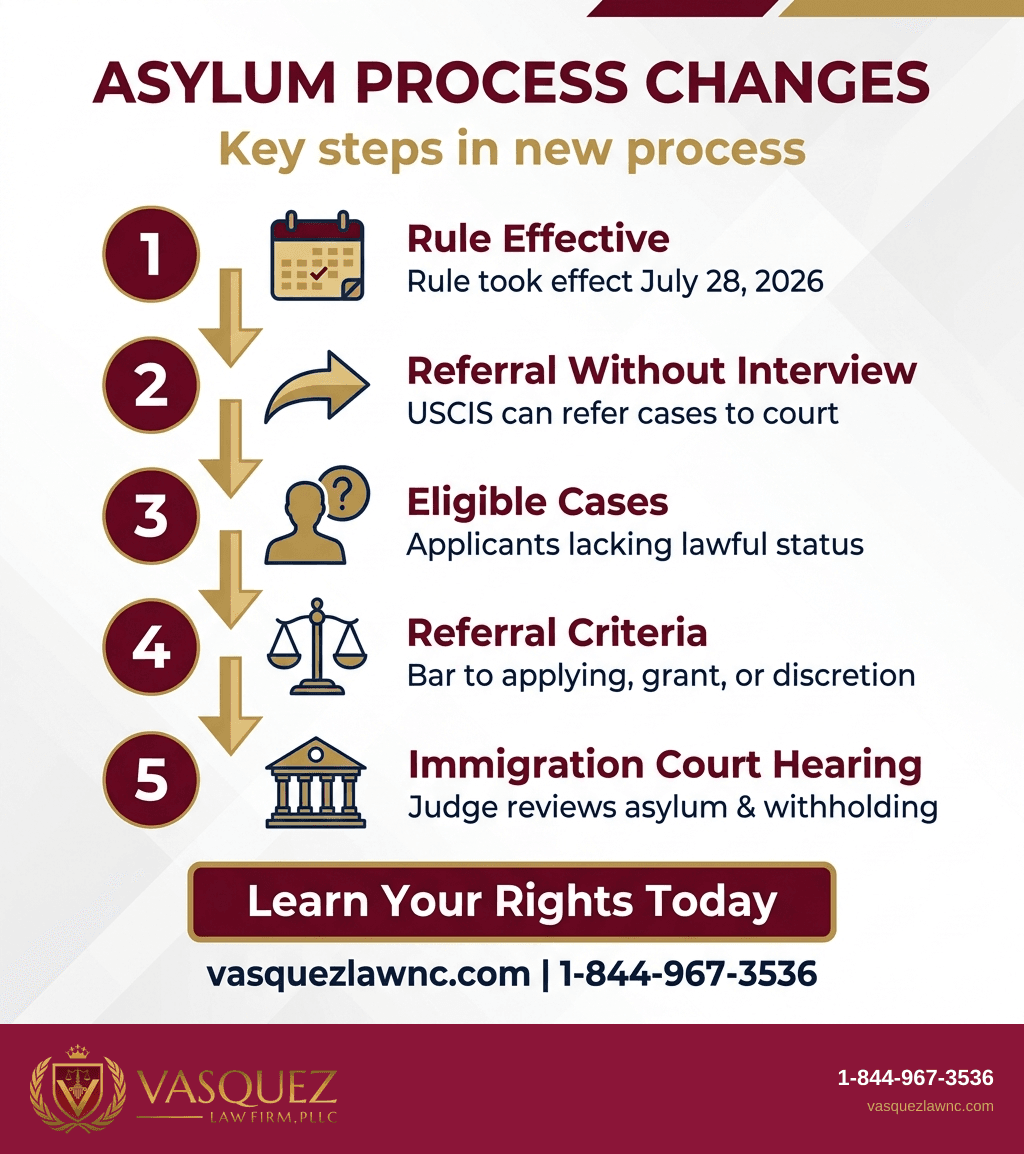
On July 28, 2026, USCIS gained authority to send certain affirmative asylum cases to immigration court without first holding a USCIS interview. If you are waiting in the affirmative asylum process, this change may decide who handles your next hearing. It may be an asylum officer or an immigration judge.
The interim final rule, Affirmative Asylum Referrals Without Interview, Federal Register Document 2026-15190, applies nationwide. People with a pending Form I-589 should understand how an affirmative asylum referral without interview may change their case. They still may seek asylum or withholding of removal before an immigration judge.
This is general legal information. It is not legal advice for any individual case. An applicant facing a referral should review the notice, filing history, and evidence with immigration attorneys. These lawyers can assess the facts of that case.
What changed in the affirmative asylum process?
Federal Register Document 2026-15190 took effect on July 28, 2026. It is an interim final rule. This means DHS made the regulatory change effective while asking the public for comments. The comment period closed on September 28, 2026.
The rule changes 8 CFR part 208. It allows an asylum officer to refer certain affirmative asylum applications to the Department of Justice Executive Office for Immigration Review. This office is called EOIR. The officer may rely on the record and other relevant evidence. The officer may do so without conducting an interview.
“USCIS still conducts an interview prior to a grant or denial of asylum, or where an asylum interview with USCIS complies with other legislation or settlement agreements.”
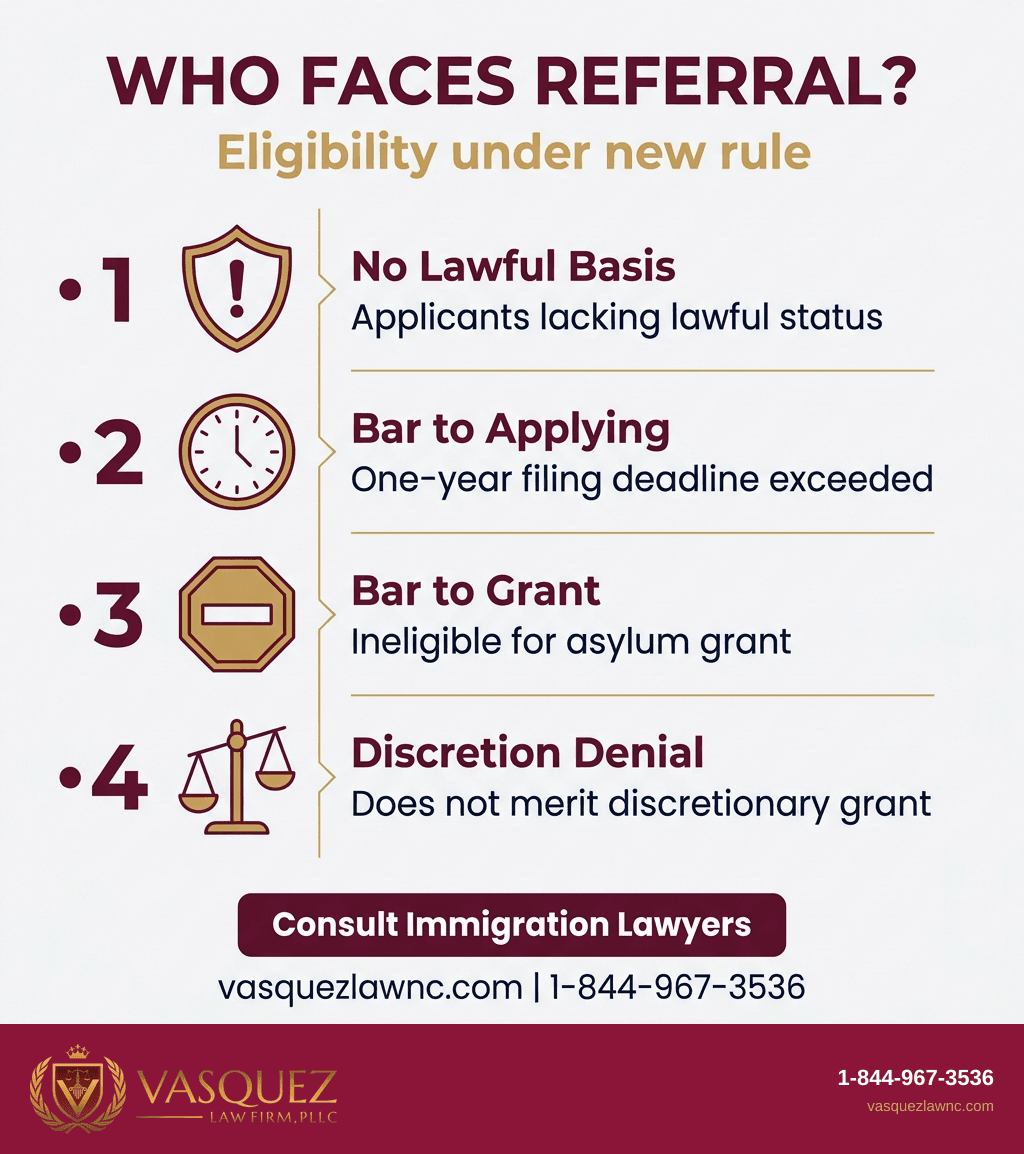
That difference matters. USCIS still interviews an applicant before approving asylum or denying asylum when the applicant has a lawful basis to remain in the United States. The new affirmative asylum referral without interview process concerns applicants who do not maintain a lawful basis to remain. It also concerns applicants whom USCIS decides are not eligible for a grant or do not merit a grant as a matter of discretion.
USCIS also removed regulatory language that described a right to an interview. The agency changed 8 CFR 208.4(a), 208.10, 208.14(c), and 208.19. A referral letter must still explain the reason for referral in writing. It no longer must include a credibility assessment, which is an evaluation of whether the applicant appears truthful.
Why DHS made the change
DHS said the rule aims to reduce the affirmative asylum backlog. It also aims to direct USCIS resources toward cases that require testimony. At the end of fiscal year 2025, the affirmative asylum backlog exceeded 1.4 million cases, according to the rule.
The agency estimates that about 132,167 future affirmative asylum applicants each year may be referred without an interview. The possible reasons include a bar to applying, a bar to a grant, or a discretionary finding. The rule estimates that up to 444,724 pending cases may be affected. That number equals 31 percent of the 1,434,145-case backlog.
Who can face an affirmative asylum referral without interview?
The rule covers affirmative asylum applicants who do not maintain a lawful basis to remain in the United States. Their records must also show a ground for referral. USCIS may refer a case without an interview when the applicant is barred from applying for asylum. It may also refer the case when the applicant is barred from a grant of asylum, does not merit asylum as a matter of discretion, or is not eligible on the merits of the claim.
A common issue is the one-year filing deadline. INA § 208(a)(2)(B), 8 U.S.C. § 1158(a)(2)(B), generally requires an asylum application within one year of the applicant’s last arrival. Under the rule’s listed parameters, 444,724 pending affirmative applications were filed more than one year after last entry or had a blank entry date. This figure was reported as of December 11, 2025.
Filing after one year does not end every asylum analysis. Under INA § 208(a)(2)(D) and 8 CFR 208.4(a)(4)-(5), changed circumstances or extraordinary circumstances can excuse a late filing. The applicant must prove the requirements. Evidence may include records that support changed country conditions, a serious illness, a legal disability, prior lawful status, or other circumstances recognized in the regulation.
“An alien who is not eligible to apply for asylum for failure to meet the one-year filing requirement is still eligible to apply for withholding of removal before an IJ.”
In other words, a USCIS affirmative asylum referral without interview can move the asylum claim into removal proceedings. Removal proceedings are the immigration court process used to decide whether a person may remain in the United States. The immigration judge may consider asylum and withholding of removal. Withholding of removal is a separate protection. It uses a different legal standard and does not provide all benefits associated with asylum.
What remains protected
The applicant’s burden of proof does not change. This means the applicant must provide enough proof to meet the legal standard. Under 8 CFR 208.13, the applicant must establish refugee status. Refugee status means the person meets the legal definition of a refugee.
The core claim still depends on past persecution or a well-founded fear of future persecution. The persecution must be tied to race, religion, nationality, membership in a particular social group, or political opinion.
In our experience, clients often ask whether the immigration court process ends their protection claim. It does not. Instead, the claim moves into a different forum.
What asylum law still applies after this rule?
The Refugee Act of 1980 added the asylum procedure to INA § 208. Congress codified that section at 8 U.S.C. § 1158. The Illegal Immigration Reform and Immigrant Responsibility Act of 1996 later created the one-year filing deadline. It also authorized procedures for considering asylum claims.
USCIS has initial jurisdiction over many Form I-589 applications under 8 CFR 208.2. Initial jurisdiction means the agency generally reviews the application first. The affirmative asylum process refers to an application first filed with USCIS. The defensive asylum process occurs in immigration court. There, an immigration judge considers protection claims during removal proceedings.
Eligibility and statutory bars
INA § 208(b), 8 U.S.C. § 1158(b), governs asylum grants. INA § 101(a)(42), 8 U.S.C. § 1101(a)(42), defines a refugee. The applicant bears the burden of proving eligibility. Asylum remains discretionary even when an applicant meets the refugee definition. Discretionary means the decision-maker may grant or deny asylum after reviewing the facts and legal requirements.
INA § 208(b)(2), 8 U.S.C. § 1158(b)(2), contains bars to asylum. These bars include persecution of others, conviction of a particularly serious crime, certain serious crimes outside the United States, national-security grounds, terrorism-related grounds, and firm resettlement in another country. Firm resettlement means the person received a secure and lasting right to live in another country.
When evidence indicates that a bar may apply, the applicant must prove by a preponderance of the evidence that the bar does not apply. This standard means the evidence must show that something is more likely true than not true.
The rule does not replace the immigration judge’s role. After referral, the judge can hear claims for asylum or withholding of removal under 8 CFR 1208.14 and 8 CFR 1240.1(a). A referral is not an asylum approval. It is also not a final judicial decision on the applicant’s protection claim.
What should you do if USCIS refers your asylum case?
First, keep the written referral notice. Keep every Form I-589 receipt, biometrics notice, and address update as well. The referral letter identifies the basis for USCIS action. The immigration court process will also require organized records.
Second, build a dated filing timeline. Include the date of last arrival and the Form I-589 filing date. Also include past immigration applications, lawful-status records, and evidence connected to any one-year deadline exception. A late-filing issue often turns on proof. It does not depend only on a personal explanation.
Third, preserve evidence that supports the fear claim. This may include identity records, declarations, medical records, police reports, communications, photographs, country-condition evidence, and witness information. Translate non-English materials accurately. Keep the original documents.
Fourth, do not miss immigration court mail. A Notice to Appear begins removal proceedings. The immigration court will set hearings. Update any address as required. Appear at every scheduled hearing unless the court authorizes another arrangement.
Fifth, evaluate all relief that may be available in court. Relief means a legal way to avoid removal or receive protection. The rule explains that immigration judges can consider forms of relief that USCIS cannot grant in affirmative asylum processing. An individualized review is essential. Eligibility depends on the facts, immigration history, and evidence.
Need to understand an affirmative asylum referral without interview? Vasquez Law Firm offers a free evaluation for immigration matters. Se Habla Español. Request a free immigration evaluation with a team serving clients nationwide and meeting clients in Raleigh, NC and Orlando, FL.
What should asylum applicants watch next?
The settled rule today is that USCIS may refer qualifying affirmative asylum cases without an interview. This authority took effect July 28, 2026. USCIS retains discretion to interview an applicant. It must conduct an interview before a grant or denial of asylum.
It is not yet settled whether USCIS will issue future policy guidance. Such guidance may identify which referral categories it will prioritize. DHS stated that the rule gives USCIS flexibility to issue future guidance. The agency may base that guidance on changing trends and agency priorities.
Applicants can monitor the USCIS Policy Manual and the rule’s docket for agency updates. People with an already scheduled interview should continue to follow the appointment notice. Under 8 CFR 208.10, failure to appear for a scheduled asylum interview without authorization or exceptional circumstances can carry serious consequences.
USCIS processing delays remain relevant for applicants who continue in the affirmative asylum queue. The agency’s USCIS Processing Times tool is the official place to check posted processing information. It does not replace a case-specific notice.
Frequently Asked Questions
Can USCIS approve asylum without an interview?
No. The July 2026 rule says USCIS still conducts an interview before granting asylum. The rule permits referral without an interview in certain cases, but it does not create a process for USCIS to approve an affirmative asylum application without one.
Can USCIS deny asylum without an interview?
The rule says USCIS still conducts an interview before a denial of asylum. The new authority concerns referral to EOIR without an interview for applicants who do not maintain a lawful basis to remain and whom USCIS determines are ineligible for a grant or do not merit one.
Does a referral without interview mean my asylum claim is over?
No. A referral places the matter in removal proceedings before an immigration judge. The rule states that the applicant can apply for asylum or withholding of removal before the judge. The applicant must still prove eligibility and respond to any filing bar or statutory bar raised in the case.
What is the difference between affirmative and defensive asylum?
Affirmative asylum begins with USCIS, which generally has initial jurisdiction over a Form I-589 under 8 CFR 208.2. Defensive asylum is considered by an immigration judge in removal proceedings. The new rule can move certain affirmative filings into the immigration court process earlier.
Can the one-year deadline lead to a referral without interview?
Yes. DHS identifies the one-year filing deadline as a basis that may support referral without an interview. Applicants may still seek to prove changed circumstances or extraordinary circumstances under INA § 208(a)(2)(D) and 8 CFR 208.4(a)(4)-(5).
Can I still seek withholding of removal after a late asylum filing?
Yes. The rule states that a person ineligible to apply for asylum because of the one-year filing requirement remains eligible to apply for withholding of removal before an immigration judge. Withholding has its own requirements and should be assessed on the specific record.
Sources
- Affirmative Asylum Referrals Without Interview, Federal Register Document 2026-15190
- USCIS Policy Manual
Have a pending asylum case or a referral notice? Contact Vasquez Law Firm for a free consultation tailored to your immigration history and evidence. Speak with our immigration legal team. This article provides general information and is not individualized legal advice.
Reviewed by Attorney Vasquez, Managing Attorney
Seeking Asylum in the US?
You must file within 1 year of arrival. Our attorneys can help build your case.
Keep Reading


William Vasquez
Founder & CEO, Vasquez Law Firm, PLLC
William Vasquez is the founder and CEO of Vasquez Law Firm, PLLC, a results-driven firm specializing in immigration, criminal defense, personal injury, and workers' compensation. A U.S. Air Force veteran and recipient of the Joint Service Achievement Medal, William is dedicated to fiercely fighting for his clients' rights.
Related Legal Services
Need legal help? Learn more about our immigration legal services, or contact us for a free evaluation.
You can also visit North Carolina immigration law firm for more information.