USCIS Immigration Fee Corrections Restore EAD Timing in 2026
USCIS immigration fee corrections restore the 30-day asylum EAD decision timeframe for covered initial filings. Review your case and request a free evaluation.
Published on October 16, 2026· Updated October 19, 2026
Talk to an immigration attorney
Free call. A clear plan for your case.
Free & confidential · Se habla espanol · Mon-Fri 8am-7pm, Sat 9am-2pm (ET)
Have questions? Talk to an attorney - free evaluation.
Call 1-844-967-3536Free Tool
Check Your USCIS Case Status Now
Enter your receipt number - get the official USCIS status in English or Spanish. No registration.
USCIS restored a processing protection. It can affect how an asylum applicant plans for work authorization. The correction restores the 30-day processing timeframe for certain initial asylum-based employment authorization applications. The correction is applicable as of May 29, 2026.
The issue looks technical on paper. It has personal effects in real life. An applicant may have a pending Form I-589, Application for Asylum and for Withholding of Removal. That applicant may be waiting to work lawfully. USCIS must decide an initial employment authorization document, or EAD, request. Our immigration attorneys can explain how the USCIS immigration fee corrections relate to the documents and status in an individual case.
The July correction also connects the EAD rule to the Annual Asylum Fee framework. Congress enacted that framework through H.R. 1. This article gives general legal information. It does not give legal advice for any person. A case-specific review with Vasquez Law Firm's immigration legal team may help before someone files with USCIS or responds to the agency.
What did USCIS correct in the immigration fee rule?
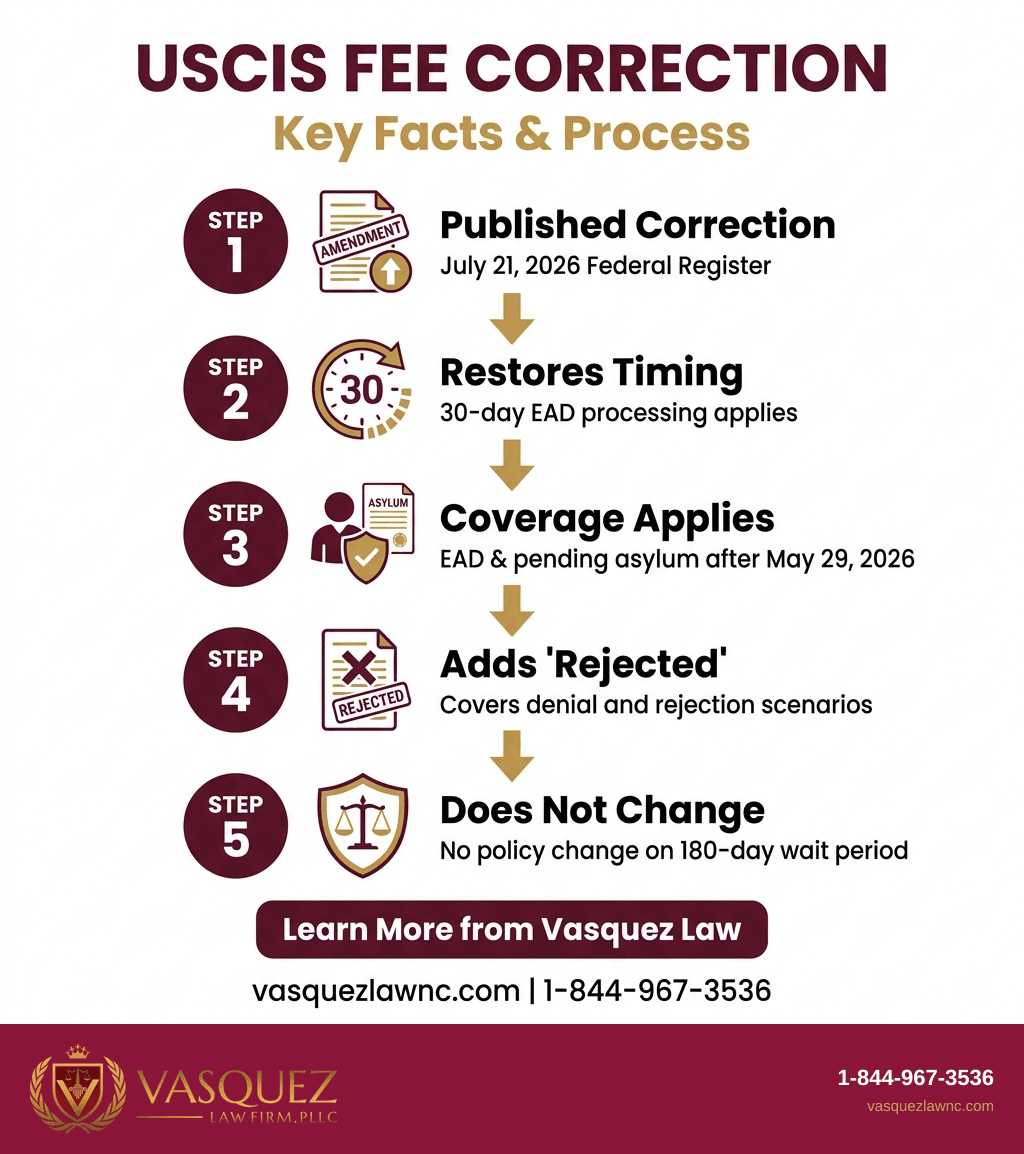
On July 21, 2026, the Department of Homeland Security published a correcting amendment in the Federal Register. The document number is FR Doc. 2026-14698. It corrected regulatory text in an interim final rule published April 29, 2026. The rule is titled USCIS Immigration Fees and Related Procedures Required by H.R. 1 Reconciliation Bill.
The April rule put several H.R. 1 provisions into regulations. DHS listed the Form I-94 fee requirement. It listed the Annual Asylum Fee. It listed the filing fee for every asylum application. It also listed limits on some Temporary Protected Status employment authorization validity periods. During that revision, DHS accidentally left out language in 8 CFR 208.7(a)(1). That language addressed the timeframe for initial asylum-based EAD applications.
If the asylum application is not so rejected or denied, USCIS shall have 30 days from the date of filing of the application for employment authorization to grant or deny that application, except that no employment authorization shall be issued to an asylum applicant prior to the expiration of the 180-day period following the filing of the asylum application filed on or after April 1, 1997.
DHS said the correction restores language that it removed by mistake. DHS did not describe it as a new policy. The agency said it continued to give priority to initial applications under 8 CFR 274a.12(c)(8). An adjudication is an agency decision on an application.
The correction took effect on July 21, 2026. It applies as of May 29, 2026, at 12 a.m. Eastern Time. DHS stated that it covers applications pending on that date. It also covers applications filed on or after that date. This timing matters. A correction can remove uncertainty caused by the way the April text was reformatted.
Why did the wording matter?
The missing sentence gave USCIS a specific timeframe. It applied to a covered initial EAD application. Restoring the sentence keeps that processing rule in place. DHS is also considering a separate proposal. That proposal would address longer EAD processing timelines.
Who does the USCIS immigration fee correction reach?
The corrected provision covers an applicant seeking an initial EAD under 8 CFR 274a.12(c)(8). The basis must be a pending asylum application. USCIS immigration fee corrections matter most when the asylum application and the initial work permit request remain connected and pending.
USCIS cannot issue employment authorization before the expiration of the 180-day period following the filing of an asylum application filed on or after April 1, 1997. The 30-day timeframe addresses USCIS action on the EAD application. It does not remove the separate rule about when USCIS may issue employment authorization.
The correction also adds the word “rejected” to the regulatory language. DHS explained how that word works. An EAD application filed after an asylum application has been denied or rejected is itself rejected. If USCIS denies or rejects the asylum application while the EAD application remains pending, USCIS denies the EAD application.
Because the IFR provides that failure to pay the Annual Asylum Fee (AAF) results in rejection of the pending Form I-589, DHS is adding “rejected” to the 8 CFR 208.7(a)(1)(v) language so that the regulation expressly covers both denials and rejections of asylum applications.
Both denial and rejection of an asylum application can affect eligibility for a pending-asylum EAD application as described in this rule. The document connects the rejection result to the Annual Asylum Fee mechanism under 8 U.S.C. 1810(b).
What this does not change
The correction does not make substantive changes to the policies in the IFR. DHS described a proposal in a February 23, 2026 notice of proposed rulemaking that could extend the processing timeframe to 180 days for EAD applications received on or after the effective date of a future final rule. A notice of proposed rulemaking is a public notice of a possible future regulation.
In our experience, clients often ask one first question. Does a pending asylum filing still support an initial work permit request after a fee-related notice arrives? The answer can depend on the filing record, the notice, and the date.
What law governs asylum EAD timing and fees?
Section 208.7 of Title 8 of the Code of Federal Regulations governs employment authorization tied to a pending asylum application. The Code of Federal Regulations is the collection of federal agency regulations. The related EAD eligibility category is 8 CFR 274a.12(c)(8). That category identifies applicants with pending asylum applications.
Congressional provisions cited by DHS provide the statutory background for the April interim final rule. The notice identifies 8 U.S.C. 1807 for the Form I-94 fee requirement as applied by USCIS. It identifies 8 U.S.C. 1808 for the Annual Asylum Fee. It identifies 8 U.S.C. 1802 for the fee required with every asylum application at filing.
DHS also cited 8 U.S.C. 1810(b). That statute addresses employment authorization limits connected to the Annual Asylum Fee. Under the corrected regulation, rejection or denial of an asylum application affects a related pending-asylum EAD request. Readers should separate this fee framework from another question. The fee rules do not decide whether an asylum claim will ultimately be granted.
Why did DHS publish a correction without advance comment?
DHS relied on the Administrative Procedure Act's good-cause provisions. The provisions are 5 U.S.C. 553(b)(B) and 5 U.S.C. 553(d)(3). The Administrative Procedure Act is a federal law that sets rules for agency action. DHS concluded that notice, comment, and a delayed effective date were unnecessary. The department viewed the change as a correction of a technical error. It did not view the amendment as a substantive policy change.
The separate February proposal remains important background. Its public comment period closed April 24, 2026. USCIS said it is reviewing the comments. The agency will consider whether to finalize EAD processing changes in a future rule.
What should an asylum applicant do after the USCIS immigration fee corrections?
First, separate the asylum application from the EAD application. Then review the status of each one. Keep a copy of the Form I-589 receipt notice. Keep the initial EAD filing receipt. Keep every USCIS notice. Also keep proof of any payment connected to the asylum filing. These records help show the filing sequence addressed by 8 CFR 208.7.
Next, read every USCIS notice carefully. An Annual Asylum Fee notice can affect the pending Form I-589. The regulatory framework appears in FR Doc. 2026-14698. Rejection or denial of the asylum application can also decide the result of a related initial EAD application.
Then confirm whether the EAD request is an initial application under 8 CFR 274a.12(c)(8). The 30-day language applies to that category. USCIS maintains a public Processing Times page. Applicants can check agency-posted processing information there. A general online estimate does not replace the rule's requirements.
Finally, keep proof of delivery. Keep copies of every filing as well. A qualified representative can compare the notices, filing history, and corrected regulation. That review can happen before the representative advises on an individual response. See our discussion of the asylum filing deadline. That deadline presents separate timing issues in asylum cases.
Questions about an asylum filing or initial EAD request? Vasquez Law Firm offers a free evaluation for immigration matters nationwide. Se Habla Español.
What should applicants watch for next?
8 CFR 208.7(a)(1)(v) contains the 30-day timeframe. It covers initial pending-asylum EAD applications that meet the rule. The timeframe remains subject to the 180-day restriction on issuance. USCIS is reviewing comments on the proposed changes to the processing timeline and will consider whether to finalize them in a future rule.
DHS said the February proposal would extend the current timeframe to 180 days. It would apply to EAD applications received on or after the effective date of a future final rule. That proposal is not the July correction. The July action preserves the current regulatory text. DHS is considering long-term policy separately.
For agency guidance about USCIS procedures, monitor the USCIS Policy Manual. Also monitor Federal Register publications. The key question for applicants concerns any future final rule. Such a rule could change the processing timeline for EAD applications filed later.
Readers may also find context in our analysis of the automatic EAD extension rule. That rule concerns a different employment authorization issue. Do not assume that an automatic-extension rule answers questions about an initial pending-asylum EAD application.
Frequently Asked Questions
Did USCIS create a new asylum EAD processing rule?
No. DHS characterized the July action as a correcting amendment. It restored text that was omitted during the April interim final rule's revision and reformatting of 8 CFR 208.7(a)(1). The corrected provision preserves the 30-day decision timeframe for the covered initial EAD applications discussed in the rule.
When does the correction apply?
The correcting amendment became effective July 21, 2026. DHS made it applicable as of May 29, 2026, at 12 a.m. Eastern Time. The department stated that it applies to applications pending on, or filed on or after, that date.
What is the 30-day timeframe in the corrected regulation?
Under 8 CFR 208.7(a)(1)(v), USCIS has 30 days from the date an eligible initial EAD application is filed to grant or deny it, if the underlying asylum application has not been rejected or denied. The regulation separately bars issuance before the stated 180-day period.
Can USCIS issue an asylum EAD before the 180-day period ends?
No. The restored language expressly says that employment authorization cannot be issued before the expiration of the 180-day period following the filing of an asylum application filed on or after April 1, 1997. The 30-day adjudication language does not remove that issuance restriction.
How can an Annual Asylum Fee affect an EAD request?
DHS explained that failure to pay the Annual Asylum Fee results in rejection of the pending Form I-589 under the interim final rule. The correction aligns EAD consequences with that mechanism. An EAD application filed after the asylum case is rejected or denied is rejected, while a pending EAD application is denied.
Is DHS considering a longer processing period for asylum EAD applications?
Yes, DHS described a February 23, 2026 proposed rule that would extend the current timeframe to 180 days for applications received on or after a future final rule's effective date. USCIS stated that it is reviewing comments received by April 24, 2026 and will consider future action.
Where can I verify the correction?
The official publication is the Federal Register correcting amendment, FR Doc. 2026-14698, titled USCIS Immigration Fees and Related Procedures Required by H.R. 1 Reconciliation Bill, Correction. Review that publication alongside your USCIS receipts and notices, because individual filing records determine how the rule may apply.
Sources
- USCIS Immigration Fees and Related Procedures Required by H.R. 1 Reconciliation Bill, Correction, FR Doc. 2026-14698
- USCIS Policy Manual
Immigration rules can turn on the date, filing type, and notice in your record. Contact Vasquez Law Firm for a free consultation and guidance tailored to your circumstances. We meet immigration clients in Raleigh, NC and Orlando, FL, and serve clients nationwide.
Schedule Your Free Consultation
Disclaimer: This article provides general legal information, not individualized legal advice. Reading it does not create an attorney-client relationship.
Reviewed by Attorney Vasquez, Managing Attorney
Seeking Asylum in the US?
You must file within 1 year of arrival. Our attorneys can help build your case.
Keep Reading



William Vasquez
Founder & CEO, Vasquez Law Firm, PLLC
William Vasquez is the founder and CEO of Vasquez Law Firm, PLLC, a results-driven firm specializing in immigration, criminal defense, personal injury, and workers' compensation. A U.S. Air Force veteran and recipient of the Joint Service Achievement Medal, William is dedicated to fiercely fighting for his clients' rights.
Related Legal Services
Need legal help? Learn more about experienced immigration attorneys in Charlotte, or contact us for a free evaluation.
You can also visit immigration legal services throughout NC for more information.