USCIS Tightens Review of SIJ Petitions
By William J. Vásquez · Updated November 23, 2026
The USCIS SIJ policy update changes I-360 review for pending cases. Learn who is affected, prepare evidence, and contact us for a free evaluation today.
Published on November 23, 2026· Updated November 23, 2026
Talk to an immigration attorney
Free call. A clear plan for your case.
Free & confidential · Se habla espanol · Mon-Fri 8am-7pm, Sat 9am-2pm (ET)
Have questions? Talk to an attorney - free evaluation.
Call 1-844-967-3536Free Tool
Check Your USCIS Case Status Now
Enter your receipt number - get the official USCIS status in English or Spanish. No registration.
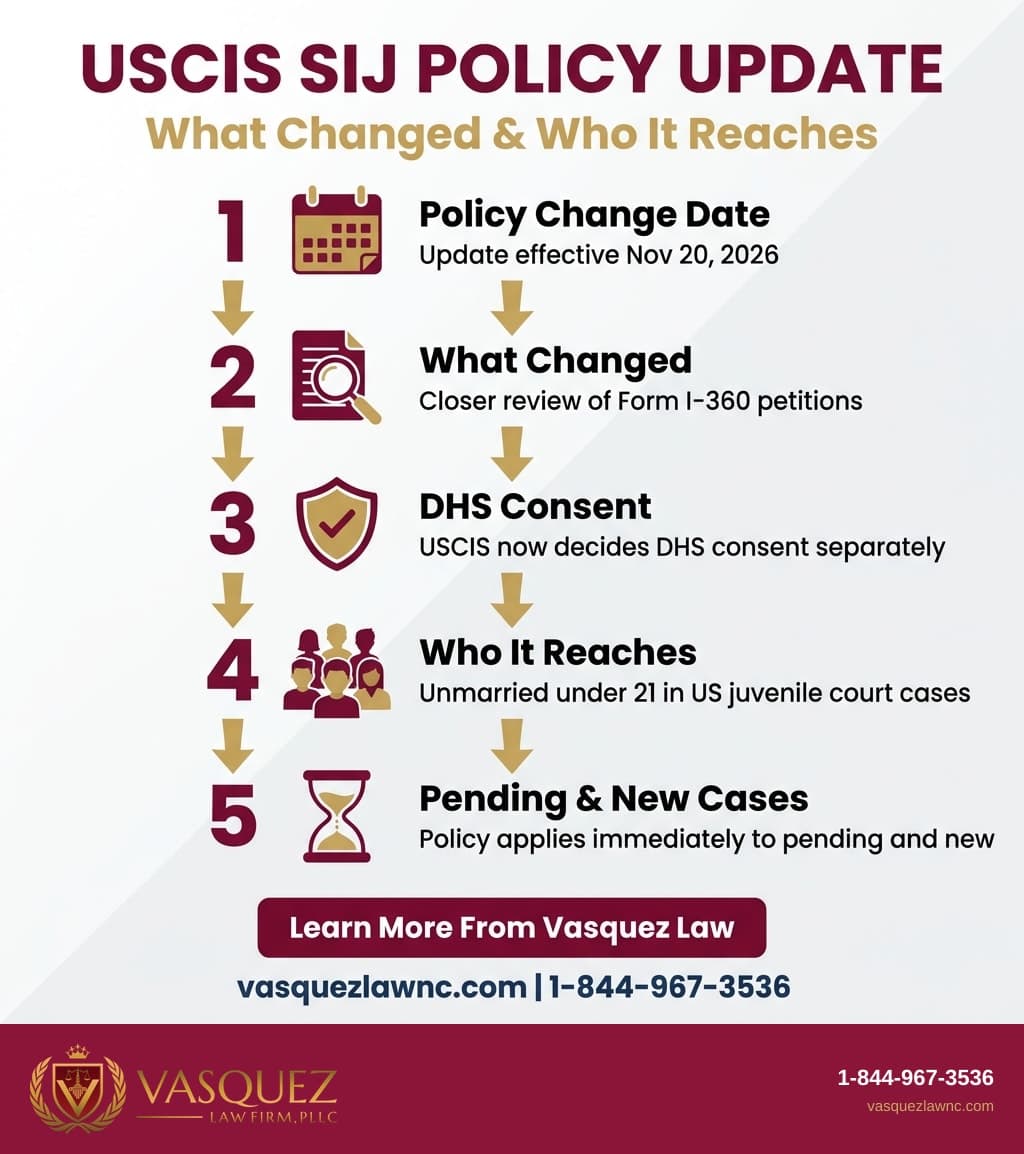
USCIS changed its review of Special Immigrant Juvenile petitions on November 20, 2026. The USCIS SIJ policy update tells officers to review Form I-360 petitions more closely and independently. This includes the facts behind a state juvenile court order. The update is effective immediately upon publication.
For a young person seeking protection after abuse, neglect, abandonment, or a similar basis under state law, this change makes a complete and consistent record more important. A juvenile court order remains essential. However, USCIS will make its own decision about whether the request meets federal Special Immigrant Juvenile (SIJ) requirements. USCIS will also decide whether the request deserves consent from the Department of Homeland Security (DHS).
Legal disclaimer: This article provides general legal information, not legal advice for any individual case. Immigration outcomes depend on the facts, documents, and law governing each petition.
What did the USCIS SIJ policy update change?
USCIS issued Policy Alert PA-2026-17, Addressing Program Integrity Concerns in Special Immigrant Juvenile Petitions, on November 20, 2026. The alert changes Volume 6, Part J, Chapters 1 through 4 of the USCIS Policy Manual.
The USCIS SIJ policy update took effect immediately. It covers pending Form I-360 petitions. It also covers petitions filed on or after the publication date. USCIS states that approval of an I-360 does not by itself create lawful status, lawful presence, or eligibility to apply for employment authorization.
This guidance, contained in Volume 6 of the Policy Manual, is effective immediately and applies to requests pending or filed on or after the publication date.
The main change concerns DHS consent. DHS consent is USCIS’s separate federal decision about whether an SIJ request meets the consent requirement. USCIS says it will examine whether the petitioner truly sought help from a juvenile court because of parental maltreatment. It will also consider whether the person mainly sought an immigration benefit instead.
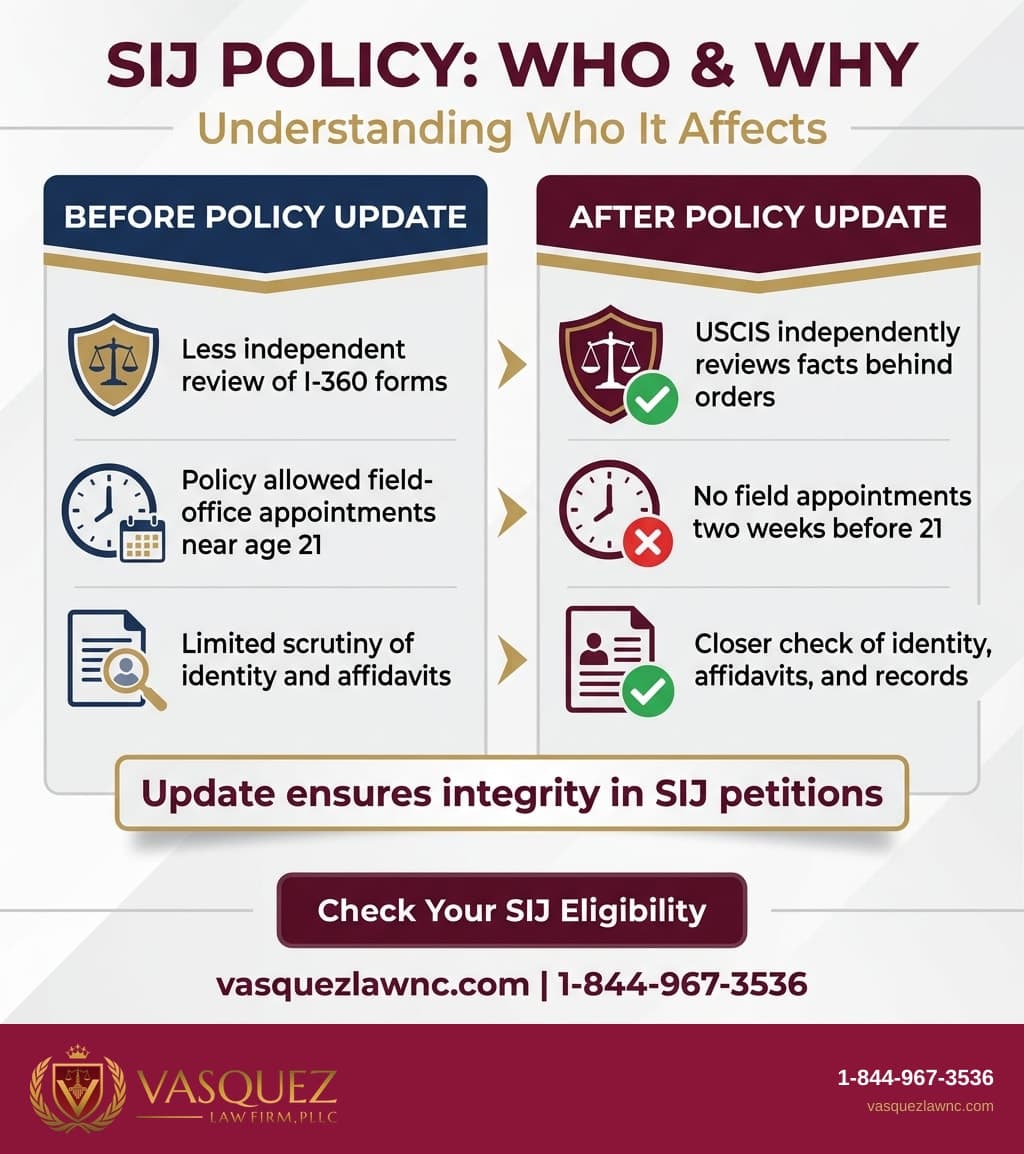
The agency may review court records, supporting documents, and information from government agencies or databases. This means USCIS may compare information from several sources. A court order will not prevent USCIS from asking whether the facts support the request.
PA-2026-17 also confirms USCIS authority to interview SIJ petitioners. It removes earlier Policy Manual language that allowed a petitioner to file Form I-360 with a field-office appointment during the two weeks before turning 21. It also removes detailed language about secondary age evidence when primary birth records are unavailable.
Why USCIS changed its review
USCIS connected the update to a July 2025 agency report. That report reviewed more than 300,000 SIJ petitions filed from the start of fiscal year 2013 through February 2025. The agency reported that filings rose 317 percent. Filings increased from 18,711 in fiscal year 2020 to 78,156 in fiscal year 2025.
USCIS said this growth contributed to an approximate five-year wait after SIJ petition approval. During that wait, a petitioner may be waiting for an EB-4 visa to become available. EB-4 is the employment-based fourth preference visa category. The agency also cited concerns about identity verification, derogatory information, and petitions supported by affidavits and court orders that it believed needed closer review.
Who does the USCIS SIJ policy update reach?
The USCIS SIJ policy update applies to unmarried people under 21 who are present in the United States. It applies to people subject to state juvenile court proceedings related to abuse, neglect, abandonment, or a similar basis under state law. It applies when they seek SIJ classification through Form I-360.
The policy guidance is effective immediately and applies to requests pending or filed on or after the publication date. Petitioners who prepared documents under earlier guidance may still have their cases reviewed under the revised policy.
In this article, a petitioner means the person who files or seeks approval of the SIJ petition. Approved SIJ petitions issued before the update took effect remain subject to the prior policy, according to PA-2026-17. The alert treats those approvals differently from new and pending cases.
What remains necessary for an SIJ petition
A state juvenile court must make the required findings. Those findings involve dependency, custody, or placement. The court process and the federal immigration process have different jobs. A state court decides matters within its authority. USCIS decides federal SIJ eligibility and whether to grant DHS consent.
The update clarifies that USCIS independently determines whether an alien is eligible for SIJ classification, including whether the information submitted in support of an SIJ Form I-360 petition is true and correct, and meets eligibility requirements. The agency specifically says officers should give more scrutiny to fact patterns identified in its July 2025 report. These include claims that one parent abandoned the child.
This review can be difficult for families. The legal record often includes court orders, affidavits, identity documents, school or medical records, and immigration filings. An affidavit is a written statement that a person signs as truthful. In our experience, the cases we handle often turn on whether records from different stages tell the same factual story.
People pursuing Special Immigrant Juvenile immigration representation should understand that a real need for protection remains central to the classification. The new review framework places more weight on proving that need. Reliable and consistent evidence can help explain why the juvenile court order was needed.
What law governs Special Immigrant Juvenile Status?
The Immigration and Nationality Act (INA) authorizes a grant of SIJ classification on a case-by-case basis to an alien who has been declared dependent on a juvenile court or has been legally committed to, or placed in the custody of, a state agency or department, an individual, or another entity by a juvenile court, provided that USCIS determines that a primary purpose of seeking the juvenile court order was to obtain relief from parental maltreatment, and not to obtain an immigration benefit.
The DHS consent requirement has existed since 1998. Under the USCIS SIJ policy update, the agency describes consent as a separate federal decision. USCIS says it does not defer to state court findings on consent. This remains true even though state juvenile courts make custody and dependency decisions within their jurisdiction.
Consent is not automatic; it is a safeguard to ensure SIJ petitions are bona fide and the required juvenile court determinations are sought primarily to obtain relief from parental abuse, neglect, abandonment, or a similar basis under state law.
Bona fide means genuine or made in good faith. Federal regulation 8 C.F.R. § 204.11(b)(5) addresses the bona fide requirement. It gives an example of circumstances where USCIS may withhold consent. PA-2026-17 says the agency will follow the evidence. It will use that evidence to evaluate why the petitioner sought the court order.
SIJ approval and a future green card are separate steps
SIJ classification is not the same as lawful permanent residence. Lawful permanent residence is the status commonly called a green card. An approved I-360 petition may support a later application for a Special Immigrant Juvenile Status green card when an EB-4 visa is available.
Visa availability depends on the priority date. The priority date is generally the date the petition was filed. Approval alone does not mean that a visa number is immediately available. A petitioner may need to wait even after USCIS approves the petition.
The USCIS alert identifies the EB-4 backlog as a practical result of increased SIJ filings. Petitioners can check the USCIS Processing Times page for agency processing information. Petition processing and visa availability are separate issues. The processing page cannot by itself show when an EB-4 visa will become available.
What should an SIJ petitioner do now?
Start by reviewing every document that supports the facts behind the juvenile court order. The USCIS SIJ policy update makes consistency critical. Officers may compare the court record, affidavits, identity documents, and information already held by government agencies.
First, keep a complete copy of the signed juvenile court order and related pleadings. Pleadings are the written papers filed in the court case. Second, organize documents that support the factual basis for abuse, neglect, abandonment, or the comparable state-law ground used in the court proceeding.
Third, review Form I-360 and every attached declaration. A declaration is a written statement about facts. Check the dates, names, family relationships, and addresses. Make sure the information is accurate and matches the other records when possible.
Fourth, preserve primary identity and age records when they are available. Primary records are original or main records, such as a birth certificate. If a document is unavailable, do not assume that an earlier approach to secondary evidence will control under the revised manual language. Secondary evidence is another record used when the primary record cannot be obtained. Obtain legal guidance before submitting explanations or substitute records.
Fifth, prepare for a possible USCIS request for evidence or interview. A request for evidence is a notice asking for more documents or information. The agency says it may request more information to establish the factual basis for a court determination. It also confirms its authority to interview SIJ petitioners.
Need to assess a pending I-360 petition? Vasquez Law Firm offers a free evaluation for immigration matters. Our immigration attorneys meet clients in Raleigh, NC and Orlando, FL. Se Habla Español. Request your free evaluation. Request Free Evaluation
What should SIJ petitioners watch next?
The revised policy guidance took effect on November 20, 2026, and applies to petitions pending or filed on or after that date. USCIS will use the revised Policy Manual guidance. It will also assess DHS consent independently. Petitioners should watch USCIS correspondence closely. Look for interview notices or requests for additional evidence.
The key question for a pending case is whether the evidence will show a genuine reason for seeking juvenile court relief. The evidence should show that the petitioner sought relief to address parental maltreatment. That is the inquiry PA-2026-17 tells adjudicators to conduct.
USCIS identifies the revised material as Volume 6, Part J of its Policy Manual. The USCIS Policy Manual is the official page to monitor for future SIJ manual updates. Families should also keep copies of every filing and notice. The SIJ record may be reviewed across several stages.
For related immigration procedure updates, readers may also review our coverage of BIA appellate procedures in 2026. A careful record can give a petitioner a clearer basis for responding if USCIS asks questions later. BIA means the Board of Immigration Appeals.
Sources
- USCIS Policy Alert PA-2026-17, Addressing Program Integrity Concerns in Special Immigrant Juvenile Petitions
- USCIS Policy Manual
Frequently Asked Questions
Does the USCIS SIJ policy update apply to pending I-360 petitions?
Yes. The guidance is effective immediately and applies to requests pending or filed on or after the publication date. USCIS states that the guidance took effect immediately. A pending petitioner should review the full record for consistency, including court documents, affidavits, identity evidence, and the information entered on Form I-360.
Does an approved SIJ petition give lawful status?
No. PA-2026-17 affirms that approval of an SIJ Form I-360 does not make a person lawfully present and does not confer lawful status. The alert also says I-360 approval does not itself create eligibility to apply for employment authorization. SIJ classification and a later permanent-residence application are separate immigration steps.
Can USCIS interview an SIJ petitioner?
Yes. The policy alert affirms that USCIS has authority to interview SIJ petitioners as part of adjudicating Form I-360. The agency may also request additional information to establish the factual basis for a juvenile court determination. Petitioners should treat any interview notice or evidence request as a serious part of the federal review.
Will USCIS accept a state juvenile court order by itself?
A qualifying juvenile court order remains necessary, but USCIS independently evaluates SIJ eligibility and DHS consent. PA-2026-17 directs officers to review the factual basis of the court order, consistency across evidence, and discrepancies in the record. USCIS separately determines whether the request was bona fide and genuinely sought protection from parental maltreatment.
What is DHS consent in an SIJ case?
DHS consent is USCIS’s federal determination that an SIJ request merits approval after the petitioner establishes eligibility. Under INA § 101(a)(27)(J), USCIS assesses whether juvenile court relief was sought primarily for protection from abuse, neglect, abandonment, or a similar state-law basis, rather than primarily to obtain an immigration benefit.
What happened to SIJ approvals issued before November 20, 2026?
PA-2026-17 states that petitions approved before the effective date remain subject to the prior policy. The revised USCIS SIJ policy update instead applies to newly filed and pending petitions. Anyone with a pending matter should avoid assuming that prior approval standards will govern the current adjudication of their I-360 petition.
Legal disclaimer: This information is general and is not a substitute for advice about your facts. Do not navigate an SIJ petition alone. Contact Vasquez Law Firm for a free evaluation with an immigration attorney. Our team meets clients in Raleigh, NC and Orlando, FL. Schedule a Free Evaluation.
Reviewed by Attorney Vasquez, Managing Attorney
Worried About Immigration Policy Changes?
New policies can affect your case. Get current legal advice from an experienced immigration attorney.
Keep Reading


William Vasquez
Founder & CEO, Vasquez Law Firm, PLLC
William Vasquez is the founder and CEO of Vasquez Law Firm, PLLC, a results-driven firm specializing in immigration, criminal defense, personal injury, and workers' compensation. A U.S. Air Force veteran and recipient of the Joint Service Achievement Medal, William is dedicated to fiercely fighting for his clients' rights.
Related Legal Services
Need legal help? Learn more about experienced immigration attorneys in Charlotte, or contact us for a free evaluation.
You can also visit NC immigration legal help for more information.