USCIS Issues Naturalization Moral Character Guidance
By William J. Vásquez · Updated November 13, 2026
USCIS good moral character naturalization guidance explains benefit and support reviews. Contact Vasquez Law Firm for a free case evaluation.
Published on November 12, 2026· Updated November 13, 2026
Talk to an immigration attorney
Free call. A clear plan for your case.
Free & confidential · Se habla espanol · Mon-Fri 8am-7pm, Sat 9am-2pm (ET)
Have questions? Talk to an attorney - free evaluation.
Call 1-844-967-3536Free Tool
Check Your USCIS Case Status Now
Enter your receipt number - get the official USCIS status in English or Spanish. No registration.
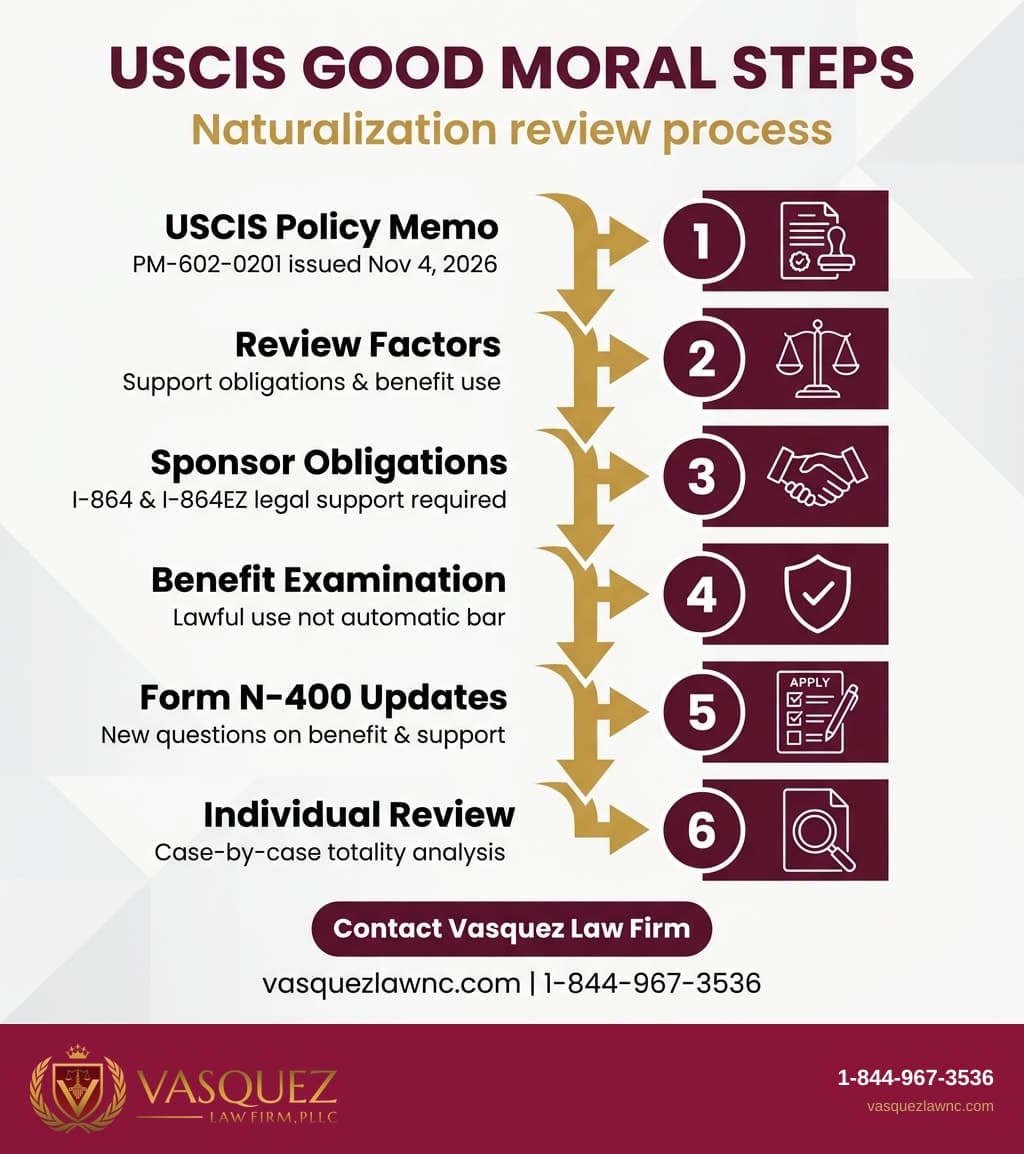
On November 4, 2026, USCIS issued policy memorandum PM-602-0201. The memorandum tells officers to review financial support, public-benefit conduct, and support for dependents. Officers must consider these matters when deciding whether a naturalization applicant has good moral character. A person preparing Form N-400, the Application for Naturalization, should understand that records about child support, benefit applications, and sponsorship promises may now receive more attention.
The immigration attorneys at Vasquez Law Firm help people assess citizenship eligibility under federal law. This article gives general legal information. It does not give legal advice for any individual case.
USCIS good moral character naturalization reviews remain individualized. This means officers must look at the facts of each case. Lawful receipt of public benefits is not itself a bar to citizenship. However, the memorandum tells officers to examine the reason for benefit use and the conduct connected with it.
Questions about USCIS good moral character naturalization standards? Contact Vasquez Law Firm for a free evaluation of your record. Se Habla Español.
What did USCIS announce about good moral character on November 4, 2026?
USCIS issued PM-602-0201. Its title is Good Moral Character Determination: Failure to Support Dependents, Public Benefits, and Sponsorship through Affidavit or Declaration of Support. The policy memorandum concerns Form N-400 decisions. It identifies conduct that may lead to an adverse good moral character finding. An adverse finding is a decision that the applicant does not meet this requirement.
The memorandum tells officers to review several issues. They may ask whether an applicant willfully failed to support dependents. They may ask whether the applicant failed to honor support commitments. They may ask whether the applicant unlawfully obtained benefits. They may also ask whether the applicant helped dependents unlawfully obtain benefits. Finally, they may ask whether the applicant received means-tested public benefits because of intentional avoidance of self-sufficiency. Means-tested benefits are benefits tied to income or resources.
USCIS will conduct a review of whether an alien has willfully failed to support his or her dependents, failed to comply with obligations on Form I-864, Form I-864EZ, Form I-864A, Form I-134, or Form I-134A while those obligations were in effect, unlawfully obtained or helped his or her dependents unlawfully obtain public benefits, or received means-tested public benefit due to a reason that is identified by average citizens of the community as intentional avoidance of self-sufficiency. (Source: U.S. Department of Homeland Security Policy Memorandum PM-602-0201, November 4, 2026)
This language applies to naturalization applicants, including those who signed financial support forms for another immigrant. Form I-864 is an affidavit of support. It is a contract in which a sponsor agrees to provide support for a sponsored immigrant. Form I-864A is the related contract for a qualifying household member.
The memorandum also discusses Form I-134 and Form I-134A. These are declarations used for certain temporary stays and parole programs. It states that on January 28, 2025, USCIS announced that it had paused acceptance of Form I-134A.
Why does the Form N-400 review matter?
Good moral character is a required part of naturalization. Naturalization is the legal process of becoming a U.S. citizen. PM-602-0201 says USCIS will draft Policy Manual content and adjudicative guidance. Adjudicative guidance is direction for officers who decide applications. USCIS also plans to revise Form N-400. The revised form will collect additional information about benefit use and support of dependents.
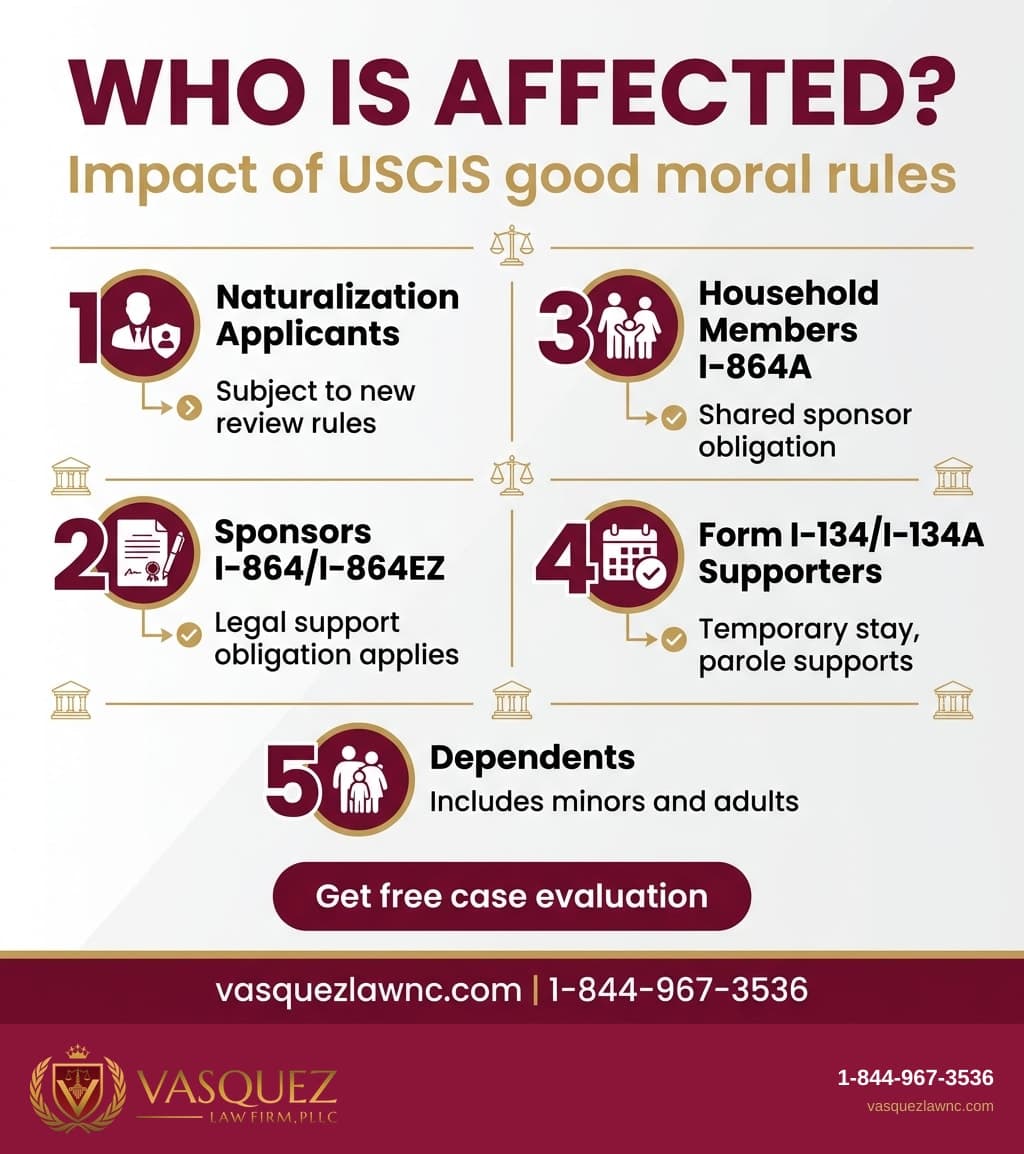
Who can USCIS good moral character naturalization reviews affect?
The memorandum discusses conduct that may affect a finding of good moral character for naturalization applicants. These include willful failure or refusal to support dependents, fraud or deception involving public benefits, and failure to comply with sponsorship obligations.
A dependent may be an adult. A dependent may also be someone who is not the applicant's son or daughter. The memorandum explains that officers may examine whether a person deserted a minor child. They may examine whether the person paid no support. They may also examine whether the person paid a clearly insufficient amount under a court order or, if there is no court order, under community standards. Officers may consider support obligations in the United States or abroad.
The difference between the forms matters for sponsors. A Form I-864 or Form I-864EZ sponsor has a legal support obligation. A household member who signs Form I-864A also has such an obligation. The obligation begins after the sponsored person becomes a lawful permanent resident. A lawful permanent resident is commonly called a green-card holder. The memorandum says the obligation generally requires support at an annual income of at least 125 percent of the federal poverty line during the enforceable period.
A Form I-134 or I-134A supporter agrees to provide financial support to the named person. The commitment applies during the temporary stay or parole period. The memorandum says a willful failure to meet that commitment may weigh against community standards. It may therefore affect the good moral character analysis.
Does lawful benefit use automatically block citizenship?
No. The memorandum repeatedly separates lawful receipt from fraud. It also separates lawful receipt from deliberate conduct meant to avoid self-sufficiency. The memorandum requires an individualized, case-by-case, totality-of-the-circumstances analysis. This analysis considers all relevant facts together. Officers must consider the reason for benefit use. They must also consider efforts toward self-sufficiency, rehabilitation evidence, and positive contributions.
However, lawful receipt of public benefits is neither a bar to naturalization nor always considered as a negative factor in the totality of the circumstances.
This limit is important. An officer must connect an adverse determination to specific conduct. That conduct must fall below the moral standards of average citizens in the community. The decision cannot rest only on poverty, disability, or lawful benefit receipt. The naturalization and citizenship pathways process still depends on the evidence in each application.
What law already governs good moral character for citizenship?
An alien applying for naturalization must establish good moral character during the relevant statutory period. Under 8 CFR 316.10, the applicant has the burden of proof. The burden means the applicant must prove eligibility by a preponderance of the evidence. This means the evidence must show that eligibility is more likely than not.
Sections 101(f)(1) through (9) of the INA identify specific types of conduct that automatically prevent a person from demonstrating good moral character. The statute also includes a “catch-all clause” which allows USCIS to determine the alien may lack good moral character even if he or she does not fit within the listed categories. The regulation at 8 CFR 316.10(b)(3)(i) treats willful failure to support dependents as a conditional bar. A conditional bar is a rule that may prevent eligibility unless the applicant shows an exception. Here, the exception is extenuating circumstances.
The Illegal Immigration Reform and Immigrant Responsibility Act of 1996 created the requirement for a legally enforceable Affidavit of Support Under Section 213A of the INA (Form I-864 or Form I-864EZ) to reduce the potential for an intending immigrant to become a public charge. The memorandum describes Form I-864 sponsorship as a commitment. Its purpose is to reduce the chance that an intending immigrant becomes a public charge. A public charge is a person whom the government considers primarily dependent on certain public support.
How does public-benefit fraud differ from legal benefit use?
Fraud or deception in applying for, receiving, or using public benefits may constitute a crime involving moral turpitude. The memorandum describes examples of misconduct related to public benefits, such as submitting false information about income or household size, failing to report disqualifying changes, unauthorized receipt, and use of multiple identities.
The memorandum also says conduct outside the statutory period can remain relevant. This is true when the conduct relates to present character or whether the applicant has reformed. Reformed means the person has changed the conduct and now follows the law. This distinction makes complete and accurate disclosure important. For broader immigration representation, review the firm's federal immigration law services.
How should I prepare for USCIS good moral character questions?
Start by building a clear factual record before filing Form N-400. A factual record is a complete collection of documents and information about the relevant events. Collect court orders, payment histories, receipts, bank records, and written communications. These records should show support provided to dependents. If you could not pay, preserve records that explain why. Also preserve records showing any effort to comply.
Next, gather copies of every Form I-864, I-864EZ, I-864A, I-134, or I-134A that you signed. Keep proof of payments, housing support, insurance, or other assistance. These records should cover the time when the relevant obligation remained in effect. A sponsor should also keep records showing the sponsored person's status. Keep records showing when the support commitment began and ended.
Review benefit applications and renewal records for accuracy. Preserve notices that report income, household changes, travel, and eligibility updates. Do not change records. Do not give an agency incomplete information. If an earlier filing contains an error, an attorney can review the facts. An attorney can also evaluate lawful options for correcting or addressing the error.
In our experience, applicants often first ask whether a lawful benefit can by itself cause citizenship denied due to good moral character. The more useful question is what the full record shows. It should show the person's honesty, support, and intent.
Gather evidence of positive contributions and rehabilitation when relevant. The memorandum tells officers to weigh the totality of circumstances. Organized records can help place a difficult period in its proper context. People replacing proof of citizenship may also find guidance in this resource on a naturalization certificate replacement.
Questions about USCIS good moral character naturalization standards? Request a free evaluation with Vasquez Law Firm. Se Habla Español.
What should I watch for after policy memo PM-602-0201?
USCIS states that it will draft and implement Policy Manual content and adjudicative guidance for officers. It also states that Form N-400 will be revised. The revised form will collect additional information about public-benefit use and support of dependents. The official USCIS Policy Manual is the agency page to watch for published guidance.
The memorandum describes itself as guidance for USCIS personnel. It says the guidance does not remove officers' authority to make adjudicatory decisions. Applicants can rely today on two core rules. Lawful benefit receipt is not automatically disqualifying. USCIS must also conduct an individualized analysis.
One material question remains for applicants. It concerns how the revised Form N-400 questions will ask about benefit use and support obligations. Until then, preparation should focus on accuracy and documentation. Applicants should also carefully review any past benefit or support issue before an interview.
Applicants with a pending naturalization case can check agency time estimates through USCIS Processing Times. They should remember that processing estimates do not decide eligibility.
Frequently Asked Questions
What is good moral character for U.S. citizenship?
Good moral character is a statutory naturalization requirement under INA § 316. USCIS assesses conduct during the relevant period under INA § 101(f) and 8 CFR 316.10.
Can lawful public benefits prevent naturalization?
Lawful public-benefit receipt alone does not prevent naturalization. An adverse finding must be based on specific conduct that does not measure up to the moral standards of average citizens in the community, rather than poverty, disability, or lawful benefit receipt. Fraud, deception, false eligibility information, or deliberate avoidance of self-sufficiency can create different concerns.
Can unpaid child support affect a citizenship application?
It can. Willful failure to support dependents is a conditional bar to good moral character under 8 CFR 316.10(b)(3)(i), unless the applicant establishes extenuating circumstances. USCIS may examine court orders, actual payments, the adequacy of support, and relevant obligations in the United States or abroad.
Can an I-864 sponsor's conduct affect that sponsor's naturalization?
Yes. PM-602-0201 says a sponsor who fails to meet Form I-864 or I-864EZ obligations during the enforceable period may face a negative factor in the good moral character analysis. The same review can reach a household member who signed Form I-864A, which carries joint and several liability for support.
What records help prove good moral character immigration eligibility?
Useful records may include support orders, payment histories, benefit applications, notices reporting changed circumstances, copies of signed support forms, and proof of financial assistance provided. The best records are complete, consistent, and accurate. Evidence showing efforts toward self-sufficiency, rehabilitation, and positive contributions may also matter under the totality-of-the-circumstances review.
Will USCIS change Form N-400 because of this memorandum?
Yes. The memorandum states that USCIS will revise Form N-400 to collect additional information to ensure that it can determine whether aliens have demonstrated good moral character, including information about public benefit use and support of dependents. It also says officers will question and scrutinize naturalization applicants after policy guidance is published to determine whether applicants meet their burden of proving all eligibility requirements.
Where can I get help reviewing a naturalization record?
Before submitting Form N-400, seek advice tailored to your facts if you have support arrears, benefit-history questions, a sponsorship commitment, or a prior fraud concern. This article is general information and does not create an attorney-client relationship or promise an outcome.
Vasquez Law Firm offers a free case review for immigration clients nationwide and meets clients in Raleigh, NC and Orlando, FL. Contact us to discuss your naturalization record and available options.
Which official materials explain this policy?
Reviewed by Attorney Vasquez, Managing Attorney
Worried your citizenship will be questioned?
Recent enforcement makes documentation more important than ever. 15-min call to see what proof you need.
Keep Reading
William Vasquez
Founder & CEO, Vasquez Law Firm, PLLC
William Vasquez is the founder and CEO of Vasquez Law Firm, PLLC, a results-driven firm specializing in immigration, criminal defense, personal injury, and workers' compensation. A U.S. Air Force veteran and recipient of the Joint Service Achievement Medal, William is dedicated to fiercely fighting for his clients' rights.
Related Legal Services
Need legal help? Learn more about our immigration legal services, or contact us for a free evaluation.
You can also visit our North Carolina immigration practice for more information.