Asylum Status Can Protect You From Persecution
By William J. Vásquez · Updated November 20, 2026
Need asylum status in the United States? See who may qualify, how Form I-589 works, and what proof matters. Request a free evaluation today.
Published on November 20, 2026· Updated November 20, 2026
Talk to an immigration attorney
Free call. A clear plan for your case.
Free & confidential · Se habla espanol · Mon-Fri 8am-7pm, Sat 9am-2pm (ET)
Have questions? Talk to an attorney - free evaluation.
Call 1-844-967-3536Worried how the latest immigration news affects you?
Schedule a confidential case review with an immigration attorney - know exactly where you stand.
USCIS Case Status
Check your USCIS case status
Enter your receipt number and get the official status. Free, no registration.
Asylum Status Can Protect You From Persecution
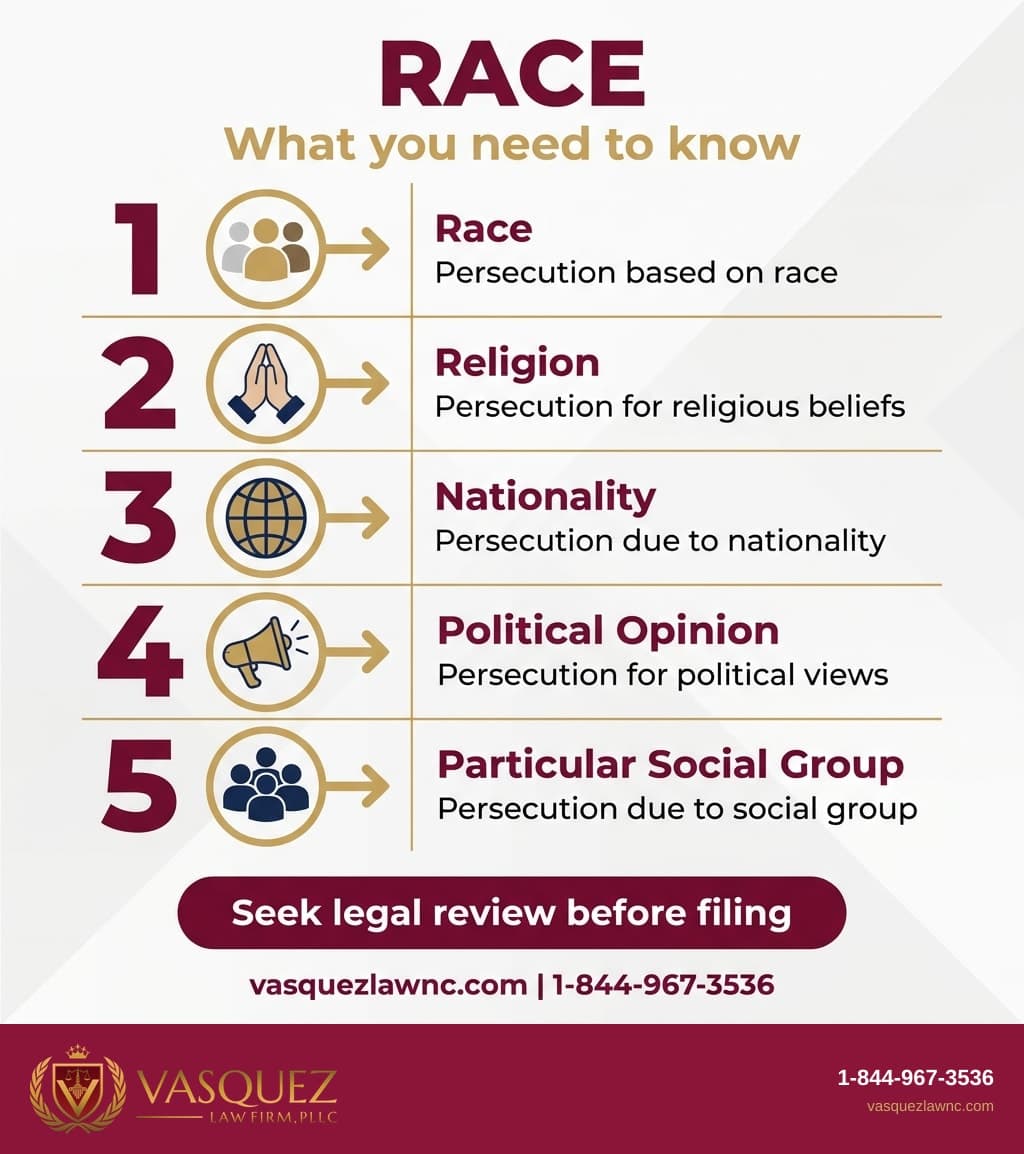
Asylum status may protect a person who has suffered persecution. It may also protect someone who fears persecution in the future. The persecution must be because of race, religion, nationality, political opinion, or membership in a particular social group. This federal protection has strict legal requirements. However, a person’s current immigration status and nationality do not automatically prevent an application. This guide explains the asylum status framework. It also explains Form I-589, immigration court claims, and records that may matter.
Do you need help reviewing an asylum status concern? William J. Vasquez offers free immigration consultations. Se Habla Español.
Call 1-844-967-3536.
Quick Answer
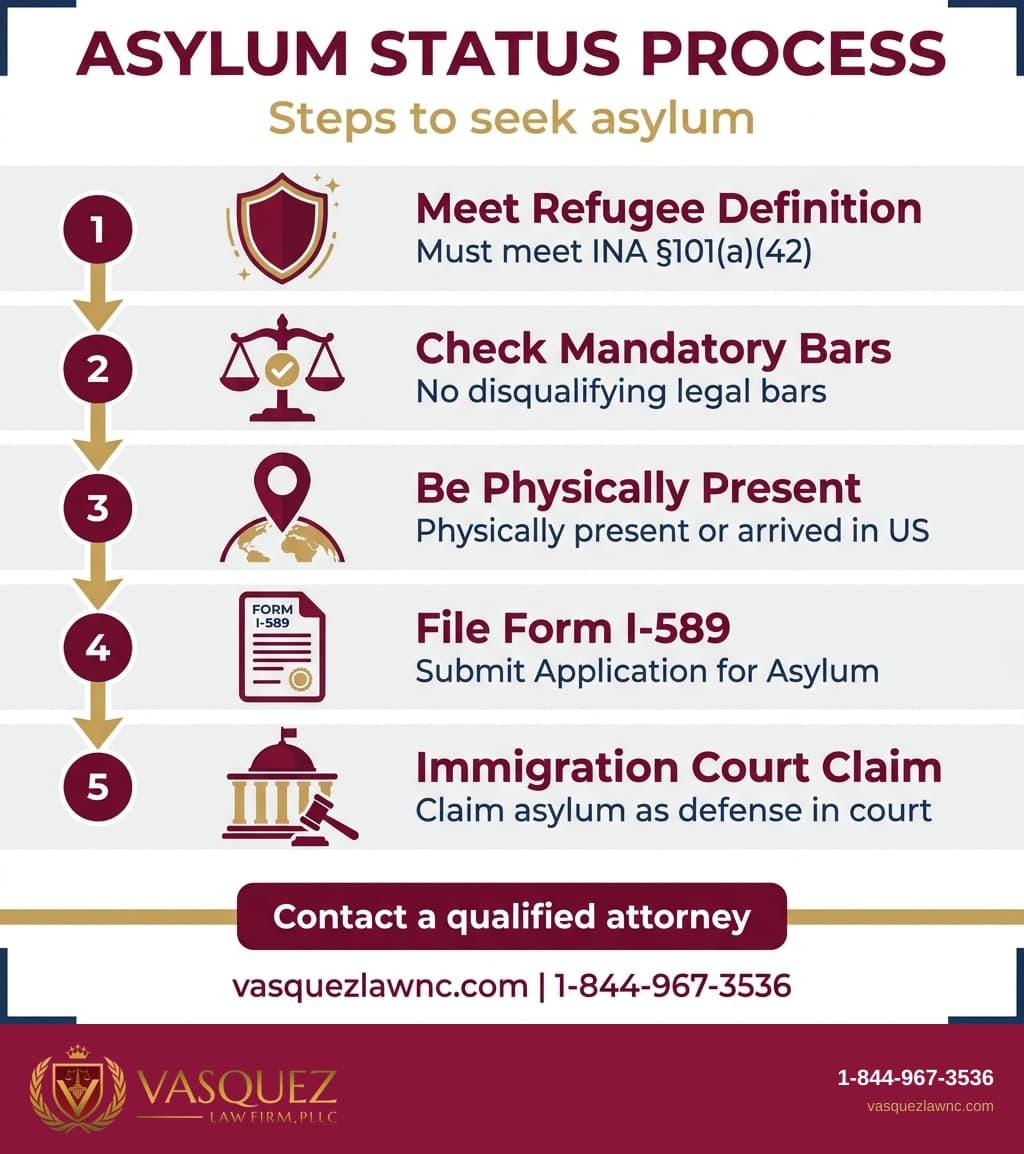
Asylum status is protection that may be granted to a person who is physically present in the United States. It may also be granted to someone who has arrived here. The person must meet the refugee definition. The refugee definition is the legal test for showing that a person qualifies as a refugee. The person also must not face a mandatory bar. A mandatory bar is a legal rule that can prevent an asylum grant. An applicant may file Form I-589 with USCIS. The applicant may also seek asylum in immigration court as a defense against removal.
- Asylum is based on persecution or a well-founded fear of future persecution.
- The protected grounds are race, religion, nationality, political opinion, and particular social group.
- Nationality and current immigration status do not prevent an asylum application.
- A mandatory bar can affect eligibility.
What does asylum status mean in the United States?
A person may have entered on a visitor visa. That person may now fear persecution after returning home. The person may ask whether asylum status is possible. USCIS explains that refugee or asylum status may be granted to aliens who suffered persecution. It may also be granted to aliens with a well-founded fear of future persecution. The reason must be race, religion, nationality, membership in a particular social group, or political opinion.
Refugee or asylum status may be granted to aliens who have been persecuted or have a well-founded fear of future persecution on account of their race, religion, nationality, membership in a particular social group, and/or political opinion.
The key issue is the connection between the persecution and at least one protected ground. The same connection must exist between a protected ground and any feared persecution. Fear by itself is not the complete legal test. The individual must meet the refugee definition in INA § 101(a)(42). That definition is codified at 8 U.S.C. § 1101(a)(42).
Asylum is different from refugee admission. Refugee admission is the process for people outside the United States. Asylum status concerns a person who is physically present in the United States. It also concerns a person who has arrived here. For broader help with federal immigration representation for asylum matters, the firm can review the available process.
Which protected grounds matter?
Refugee or asylum status may be granted to aliens who have been persecuted or have a well-founded fear of future persecution on account of their race, religion, nationality, membership in a particular social group, and/or political opinion. A clear account should name the ground connected to the harm. It should also name the ground connected to the fear of harm. The legal analysis depends on the facts. It also depends on documents and the person’s own account.
Who may qualify for pending asylum status?
An applicant may be in the country without a particular visa category. That person may still consider asylum. USCIS states that aliens may apply for asylum in the United States. This is true regardless of nationality or current immigration status. This point matters to people who worry about an expired status. It also matters to people with temporary status.
Aliens may apply for asylum in the United States regardless of nationality or current immigration status.
USCIS lists several asylum eligibility points. The applicant must meet the INA § 101(a)(42) refugee definition. The applicant must not face a mandatory bar. The applicant must be physically present in the United States. The applicant may instead have arrived in the United States. The person must also either file Form I-589 with USCIS or request asylum during immigration court proceedings as a defense against removal.
Why do mandatory bars matter?
A mandatory bar is a legal rule that can prevent asylum status. This may happen even when a person reports a fear of persecution. USCIS includes the absence of a mandatory bar among the asylum conditions. Whether a particular history triggers a bar requires a careful review. The review must consider the facts and the applicable law.
At our Orlando office, we often see one question first. Does the person’s present immigration status prevent an asylum filing? USCIS confirms that nationality does not automatically block an application. Current immigration status also does not automatically block it. The refugee definition remains central. The mandatory-bar analysis also remains central.
How does Form I-589 start an asylum status claim?
Form I-589 is titled Application for Asylum and for Withholding of Removal. USCIS identifies this form as the application used for asylum filings with USCIS. A person in immigration court may use a different path. That person may request asylum as a defense against removal from the United States.
- First, identify the forum. The claim may be filed with USCIS. It may instead be raised in immigration court proceedings.
- Organize a complete account of past persecution. Include the well-founded fear of future persecution.
- Identify the protected ground connected to the account.
- Review possible mandatory bars before filing or presenting the claim.
- Keep copies of every filing, notice, and supporting record.
People checking my case status should separate two issues. One issue is the status of a case. The other issue is the legal strength of an asylum claim. The correct forum matters. A complete filing record also matters. For discussion of related removal-defense concerns, see this explanation of a BIA asylum decision involving Guatemala.
What changes in immigration court?
USCIS explains that a person may request asylum in immigration court proceedings. The request acts as a defense against removal. This differs from filing Form I-589 directly with USCIS. The asylum request is raised inside removal proceedings. The same refugee definition remains important. Mandatory-bar issues also remain important.
What evidence can support an asylum application?
A written account should name a protected ground. The claim is stronger when records are organized and consistent. USCIS describes the legal basis for asylum status. Therefore, an applicant should focus the evidence on persecution. The evidence should also address fear of future persecution. It should show the protected reason connected to that harm or fear.
Evidence checklist for an asylum claim
- A detailed personal statement describing persecution or feared future persecution.
- Identity and travel records that help establish the applicant’s history.
- Records connected to threats, harm, beliefs, identity, or political activity, where available.
- Witness statements from people with direct knowledge.
- Documents that support the claimed protected ground.
- Copies of immigration notices and the completed Form I-589 filing.
Evidence should be truthful. It should also be consistent and connected to the legal elements. Do not change documents. Do not submit a statement prepared by someone else without checking every fact. A review through immigration services for protection-based claims can help a person understand the documents. It can also help explain how those documents relate to the legal standard.
What asylum status mistakes should applicants avoid?
A person may have a genuine fear. The person may still weaken the claim with an unclear record. Inconsistent information can also cause problems. The best preparation is not dramatic language. The best preparation is an accurate account. The account should connect the facts to a protected ground.
- Mistake: Treating any danger as asylum eligibility. Fix: Explain the connection to race, religion, nationality, political opinion, or particular social group.
- Mistake: Ignoring a possible mandatory bar. Fix: Discuss the full history before filing.
- Mistake: Confusing refugee admission with asylum status. Fix: Confirm whether the person is outside the United States or physically present here.
- Mistake: Filing records without keeping copies. Fix: Maintain an organized personal file.
- Mistake: Giving a general fear without a factual explanation. Fix: Describe the persecution or feared future persecution accurately.
- Mistake: Forgetting that immigration court is a possible forum. Fix: Identify whether removal proceedings are pending.
If you remember one point: asylum status depends on the refugee definition. The person must have physical presence or arrival. The person must not face a mandatory bar.
For a broader procedural perspective, readers may also review immigration appellate procedures. That discussion does not replace advice on an individual asylum filing.
Why is asylum status a federal immigration issue?
An asylum claim can affect a person living anywhere in the United States. Immigration law is federal law. USCIS identifies the INA refugee definition in section 101(a)(42). INA § 208 is the federal asylum provision. It is codified at 8 U.S.C. § 1158.
The USCIS page titled Refugees and Asylum explains the physical-presence rule. An asylum applicant must be physically present in the United States. The applicant may instead have arrived here. The page also identifies Form I-589. It identifies immigration court asylum requests as the two pathways described on that page.
Processing questions may require careful attention. The form and forum both matter. USCIS publishes a processing-times tool. The tool should be checked by selecting the relevant form and service center. Do not assume that another applicant’s timeline predicts your pending asylum status.
When should you call about an asylum status concern?
A removal notice may require prompt legal review. A fear of return may also require prompt review. Uncertainty about where to raise a claim can create another concern. The following situations deserve a careful consultation:
- You are physically present in the United States and fear persecution upon return.
- You need to identify whether the feared harm relates to a protected ground.
- You are considering Form I-589.
- You have immigration court proceedings and want to understand asylum as a defense against removal.
- You are concerned a mandatory bar could affect the claim.
- You need to organize records before making factual statements to an immigration agency or court.
Speak with Vasquez Law Firm about an asylum-related immigration concern. Free evaluations are available. Se Habla Español.
Call 1-844-967-3536.
About Vasquez Law Firm
Vasquez Law Firm handles immigration matters with compassionate and direct advocacy. William J. Vasquez leads a veteran-founded firm. The firm focuses on practical communication and careful preparation. The firm’s Yo Peleo® approach shows a commitment to standing up for clients. It also reflects a commitment to giving clear information about legal risks.
For immigration matters, Vasquez Law Firm meets clients in Raleigh, NC and Orlando, FL. The firm serves immigration clients nationwide. Our bilingual support staff can communicate in English and Spanish. William J. Vasquez is admitted to the North Carolina State Bar and the Florida Bar.
Attorney trust and preparation
William J. Vasquez has practiced since 2011. Immigration claims require precise facts. They also require organized records and an understanding of the federal process. The firm can evaluate whether the presented facts may call for further asylum analysis.
Frequently Asked Questions
What does asylum status mean?
Asylum status is a form of protection that may be granted to an individual persecuted, or with a well-founded fear of future persecution, on account of race, religion, nationality, political opinion, or membership in a particular social group. The person must meet the refugee definition, avoid a mandatory bar, and be physically present in the United States or have arrived here.
Who qualifies for asylum in the United States?
USCIS identifies several conditions. The individual must meet the refugee definition in INA § 101(a)(42), must not be subject to a mandatory bar, and must be physically present in the United States or have arrived. The claim must involve persecution or a well-founded fear of future persecution connected to a protected ground.
Can a person apply despite current immigration status?
Yes. USCIS states that aliens may apply for asylum in the United States regardless of nationality or current immigration status. That point does not decide every case. The applicant must still satisfy the refugee definition and other conditions USCIS lists, including the requirement that the person is not subject to a mandatory bar.
What form is used for an asylum application?
USCIS identifies Form I-589, Application for Asylum and for Withholding of Removal, as the form used to apply for asylum with USCIS. A person in immigration court proceedings may request asylum as a defense against removal. The appropriate process depends on whether the claim is being presented to USCIS or in immigration court.
Can asylum be requested in immigration court?
Yes. USCIS explains that an individual may request asylum in immigration court proceedings as a defense against removal from the United States. This route remains tied to the refugee definition, protected grounds, and mandatory-bar analysis. A person should preserve copies of court notices and carefully review the facts before presenting a claim.
Is asylum the same as refugee status?
No. USCIS describes refugee status for people outside the United States who meet the refugee definition and other listed requirements, including being of special humanitarian concern to the United States. Asylum applies to a person physically present in the United States or who has arrived here. The two protections share the refugee definition but use different processes.
What is a mandatory bar to asylum?
USCIS lists the absence of a mandatory bar as a condition for asylum status. A mandatory bar is a legal issue that can prevent an asylum grant. Because its application depends on the facts and law involved, a person who believes a bar may be relevant should seek a careful legal review before filing Form I-589 or presenting a court claim.
How can I check my case status?
My case status questions concern a specific filing or proceeding, while asylum eligibility concerns the legal basis for protection. USCIS offers tools and information through its official website. A pending asylum status inquiry should be reviewed with the correct form, filing record, and forum in mind, because USCIS processing and immigration court proceedings are different processes.
Sources and References
Ready to discuss an asylum status concern? Contact Vasquez Law Firm for a free, confidential immigration consultation. Se Habla Español.
Start Your Free Evaluation Now
Call 1-844-967-3536.
Seeking Asylum in the US?
You must file within 1 year of arrival. Our attorneys can help build your case.
Keep Reading

For how Vasquez Law Firm can help, see our asylum page.
Reviewed by Attorney Vasquez, Managing Attorney

William Vasquez
Founder & CEO, Vasquez Law Firm, PLLC
William Vasquez is the founder and CEO of Vasquez Law Firm, PLLC, a results-driven firm specializing in immigration, criminal defense, personal injury, and workers' compensation. A U.S. Air Force veteran and recipient of the Joint Service Achievement Medal, William is dedicated to fiercely fighting for his clients' rights.
Related Legal Services
Need legal help? Learn more about our immigration law practice, or contact us for a free evaluation.
You can also visit our North Carolina immigration practice for more information.