USCIS Continues to Accept and Process DACA Renewals
By William J. Vásquez · Updated November 9, 2026
USCIS DACA renewal requests should be filed 120 to 150 days before expiration. Protect work authorization and request a free evaluation today.
Published on November 9, 2026· Updated November 9, 2026
Talk to an immigration attorney
Free call. A clear plan for your case.
Free & confidential · Se habla espanol · Mon-Fri 8am-7pm, Sat 9am-2pm (ET)
Have questions? Talk to an attorney - free evaluation.
Call 1-844-967-3536Free Tool
Check Your USCIS Case Status Now
Enter your receipt number - get the official USCIS status in English or Spanish. No registration.
USCIS Continues to Accept and Process DACA Renewals
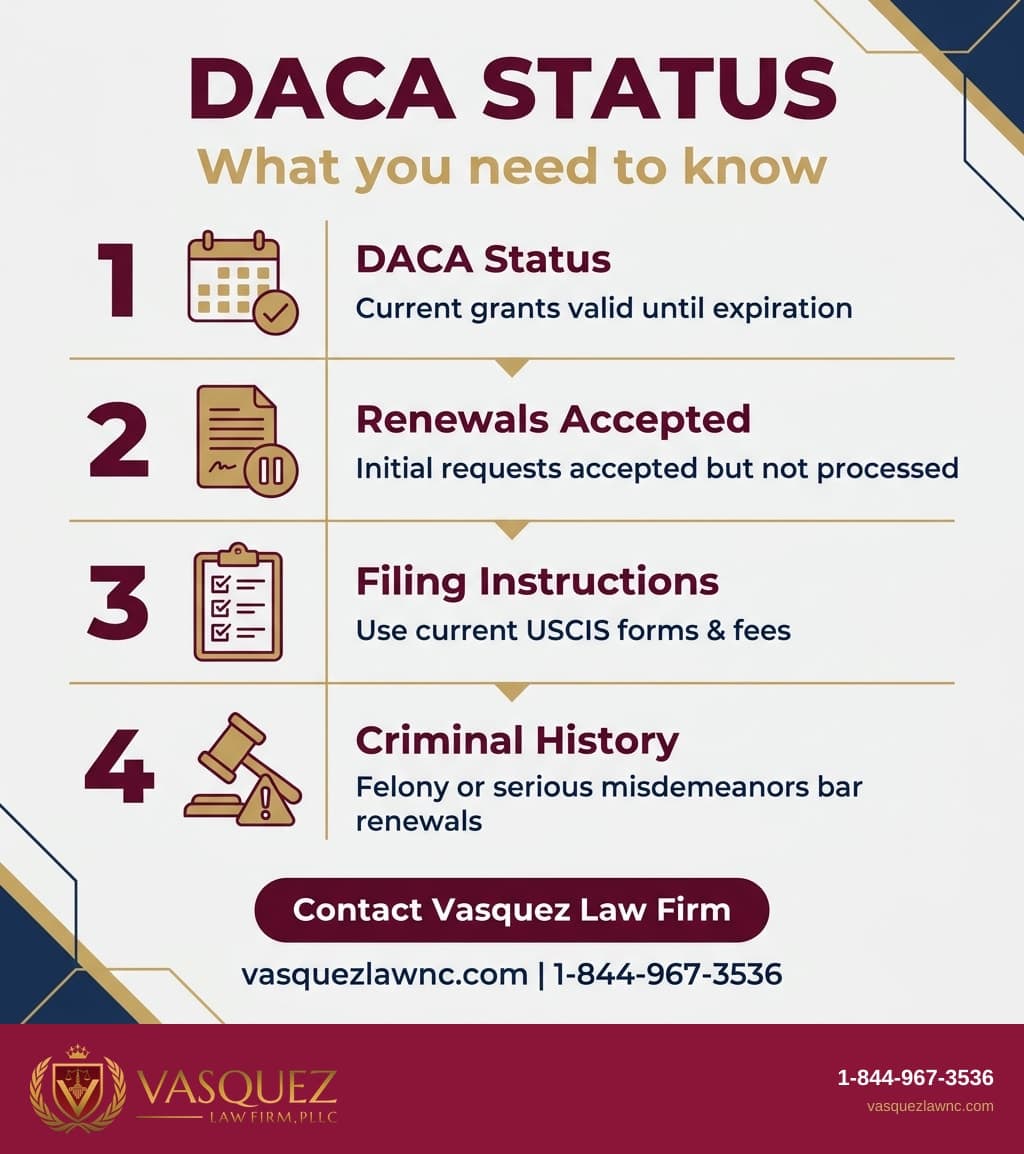
USCIS DACA renewal rules matter. A current DACA grant and related Employment Authorization Document remain valid until their expiration dates unless individually terminated. USCIS continues to accept and process renewal requests. It accepts initial DACA requests but does not process them. Filing a USCIS DACA renewal during the recommended window can reduce the risk of a gap in work authorization.
Need help reviewing a DACA renewal? William J. Vasquez and the firm provide immigration representation. Se Habla Español.
Call 1-844-967-3536.
Quick Answer
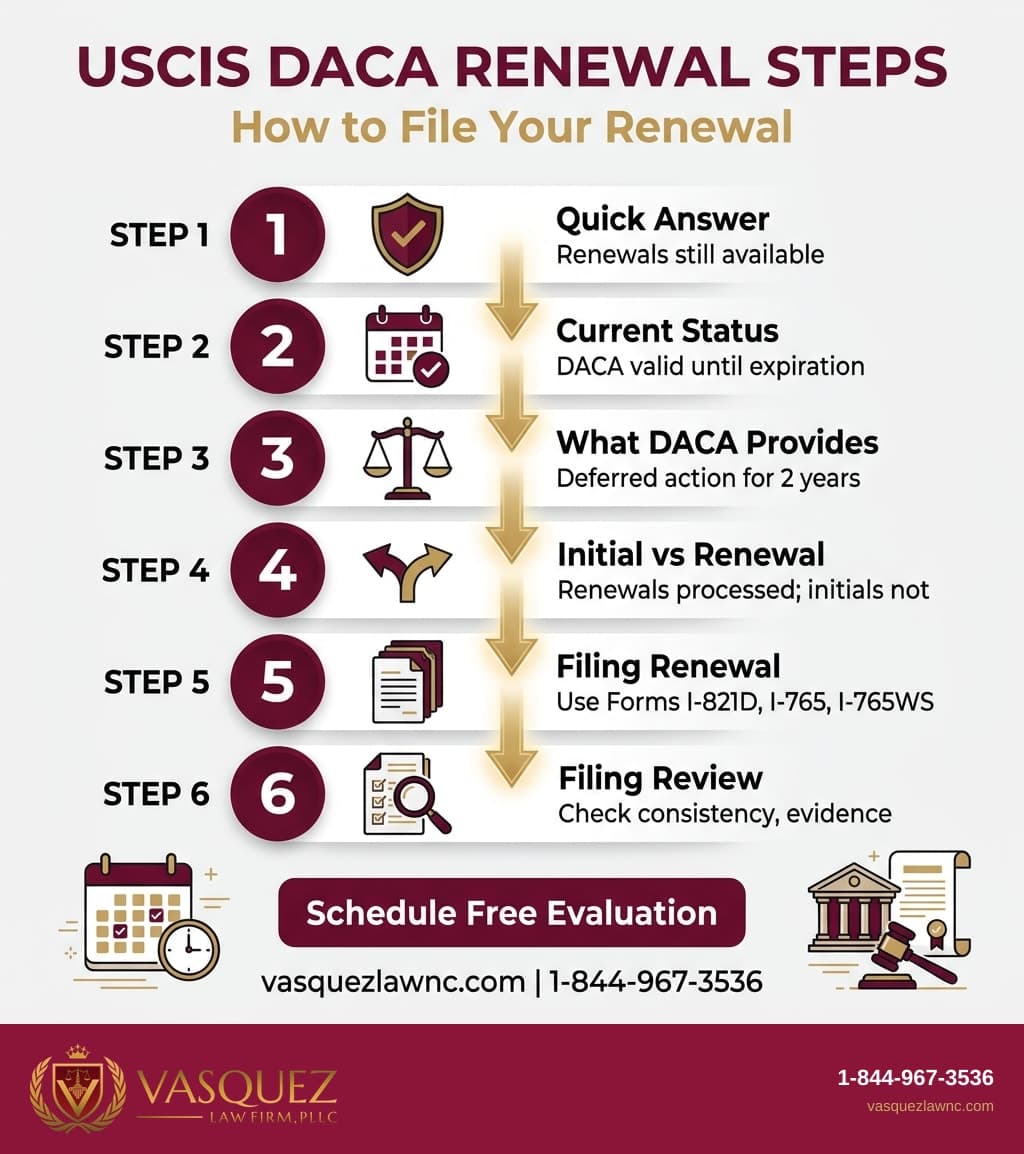
USCIS continues to accept and process DACA renewal requests and accompanying employment authorization applications from eligible requestors. Having received DACA previously does not by itself establish eligibility for renewal processing. Deferred action means that the government delays removal action for a limited time. USCIS recommends filing between 120 and 150 days before the expiration shown on the Form I-797 approval notice.
- Renewals remain under 8 C.F.R. §§ 236.22 and 236.23.
- Initial requests are accepted but not processed.
- DACA is deferred action, not lawful immigration status.
- Do not travel without advance parole.
What is the current USCIS DACA status?
A person whose DACA expires soon faces a practical problem. A late filing can create a period without work authorization. The USCIS page titled Consideration of Deferred Action for Childhood Arrivals (DACA) was last reviewed January 24, 2025. It explains that current grants and related Employment Authorization Documents remain valid until expiration unless USCIS ends them individually.
USCIS will continue to accept and process DACA renewal requests and accompanying applications for employment authorization under the DACA regulations at 8 CFR 236.22 and 236.23.
The USCIS alert describes the Fifth Circuit decision dated January 17, 2025. A higher court may still review that decision. The alert also discusses the continuing injunction affecting initial DACA requests. An injunction is a court order that requires or prevents certain actions. A person considering a renewal can review immigration representation for DACA and related filings before submitting forms.
What DACA provides
DACA is an exercise of prosecutorial discretion. Prosecutorial discretion means that immigration officials choose whether to take removal action in a particular case. DACA defers removal action for a period of two years, subject to renewal. A recipient may request employment authorization. DACA does not itself provide lawful status.
Initial requests versus renewals
USCIS continues accepting initial requests. However, it does not process them under the court order described on its DACA page. This differs from USCIS DACA renewal processing. Renewal processing continues for eligible requestors.
How do you file a USCIS DACA renewal?
USCIS instructs applicants to use the current form editions for Form I-821D, Form I-765, and Form I-765WS. They must include the correct fees. They should organize supporting evidence by the guideline it supports.
- Check the expiration date on the current Form I-797 approval notice.
- Prepare Form I-821D, Form I-765, and Form I-765WS consistently.
- Gather legible copies of identity and other supporting records.
- Use USCIS filing instructions and submit the proper fees.
- Track notices through a USCIS online account or by mail.
- Attend the Application Support Center biometric appointment if scheduled.
USCIS says most DACA renewals are adjudicated within 120 days. Adjudicated means decided by the agency. USCIS reports a median of one month in fiscal year 2023. The agency advises filing 120 to 150 days before expiration. Filing more than 150 days early does not produce a faster decision. Check the USCIS processing times page for current form-specific information.
Practical filing review
In our experience, the document most often missing from a renewal packet is not a passport. It is a clear explanation and records for an arrest, citation, or changed immigration history. A careful review should compare every answer with prior filings. It should address changes, travel, and criminal records accurately.
Which DACA renewal documents should you gather?
A renewal request should be internally consistent. This means that the information should match throughout the filing. USCIS lists identity records such as a passport or national identity document from the requestor’s country of origin, a birth certificate with photo identification, a school or military ID with a photo, or a U.S. government immigration or other document bearing the requestor’s name and photo. The needed evidence depends on the issue in the request.
- Current and prior DACA approval notices.
- Identity records and copies of current employment authorization documents.
- Records concerning travel after receiving DACA.
- Certified court records and disposition documents where applicable.
- Evidence supporting any explanation required by the forms.
- Copies of the complete filing package and delivery confirmation.
USCIS directs requestors to provide all required supporting documents and evidence. It also warns that knowingly and willfully providing materially false information on Form I-821D can violate 18 U.S.C. § 1001. This law addresses certain false statements to the government. For help assessing how DACA fits into a broader family immigration plan, see our discussion of a Green Card based on a qualifying relationship.
Criminal history requires care
Under 8 C.F.R. § 236.22(b)(6), a conviction for a felony or significant misdemeanor, or three or more convictions for other misdemeanors not occurring on the same date and not arising out of the same act, omission, or scheme of misconduct, disqualifies a person from DACA consideration. A felony is a serious crime. A misdemeanor is generally a less serious criminal offense. USCIS identifies driving under the influence as a disqualifying significant misdemeanor regardless of sentence. A minor traffic offense is not per se disqualifying. Per se means automatically or by that fact alone. USCIS considers the totality of circumstances, meaning all relevant facts together.
Can a DACA recipient travel outside the United States?
Travel can cause severe immigration consequences. USCIS explains that, after DACA is approved, a recipient may file Form I-131 to request advance parole. Advance parole is written permission to seek return to the United States after travel. Unauthorized travel may interrupt continuous residence. Departure without advance parole creates a significant risk of being unable to return.
DACA recipients who depart the United States without first obtaining an advance parole document run a significant risk of being unable to reenter the United States; obtaining an advance parole document prior to departure is strongly encouraged to reduce the risk of being unable to return and resume DACA. (Source: USCIS DACA Page)
A person with a prior deportation or removal order should not assume travel is safe. A removal order is a government order requiring a person to leave the United States. USCIS states that departure without additional steps to address removal proceedings will likely result in being considered deported or removed. This is a reason to request an individualized review before making travel plans.
Travel checklist
- Confirm that DACA has been approved before seeking advance parole.
- Do not leave while a DACA request is under review.
- Wait for advance parole approval before departing.
- Review prior removal proceedings before travel.
- Keep copies of the advance parole document and travel records.
What USCIS DACA renewal mistakes can delay a case?
A mismatched name, date of birth, or address across forms can complicate a filing. USCIS asks requestors to write those details exactly the same way on each form. It also cautions mail filers to use the current versions. Mail filers should avoid highlighters, red ink, and white-out corrections. These items can affect scanning.
- Filing too late: use the 120 to 150 day recommendation.
- Using an outdated form: download the current edition from USCIS.
- Leaving a form unsigned: verify signatures before filing.
- Omitting I-765WS: include all required forms.
- Missing biometrics: attend the scheduled appointment.
- Ignoring a Request for Evidence: respond within the stated period.
- Traveling without advance parole: wait for approval before departure.
- Hiding a criminal matter: provide accurate information and records.
If you remember one point, remember this: an expiring DACA grant calls for organized action, not assumptions. The firm’s federal immigration legal services can help review the filing record and available options.
Why does federal DACA law matter nationwide?
The controlling regulations cited by USCIS are 8 C.F.R. §§ 236.21 through 236.25. The relevant renewal provisions are 8 C.F.R. § 236.22 and 8 C.F.R. § 236.23.
USCIS says that a discretionary DACA denial cannot be appealed through an administrative appeal or a motion to reopen or reconsider. An administrative appeal asks another agency decision-maker to review the decision. A motion to reopen or reconsider asks the agency to review the case again. Under 8 C.F.R. § 236.23(c)(2), USCIS generally will not issue a Notice to Appear or refer a case to ICE based on a DACA denial unless the matter involves fraud, national security, or public safety concerns. For an alleged administrative error, USCIS describes a Service Request Management Tool review process.
Have an expiring approval, travel concern, or criminal-history question? Request a free immigration evaluation with Vasquez Law Firm. Se Habla Español.
Call 1-844-967-3536.
Frequently Asked Questions
Can I renew DACA?
USCIS continues to accept and process DACA renewal requests and related employment authorization applications. A current DACA recipient should check the expiration date on the Form I-797 approval notice and use the agency’s recommended 120 to 150 day filing window. Eligibility and discretionary concerns can require individual analysis.
Can USCIS process my first DACA request?
USCIS accepts initial DACA requests but does not process them under the injunction described on its DACA page. That position differs from renewal processing. Current grants and related Employment Authorization Documents remain valid until they expire unless individually terminated.
Does DACA give lawful immigration status?
No. USCIS explains that deferred action does not provide lawful status. DACA is a discretionary decision to defer removal action for a period of two years, subject to renewal. It may support a request for employment authorization.
When should I submit a DACA renewal?
USCIS strongly encourages DACA recipients to submit renewal requests between 120 and 150 days before the expiration date on the current approval notice. Filing in that window reduces the risk that DACA and employment authorization will expire before USCIS reaches a decision. Filing earlier than 150 days does not speed a decision.
Can I travel while my DACA renewal is pending?
USCIS distinguishes two situations. Travel on or after August 15, 2012, while a DACA request is under review affects continuous residence. For someone who has already received DACA, travel after receiving advance parole does not interrupt continuous residence, while unauthorized travel may interrupt it. A recipient cannot travel until receiving advance parole. After DACA approval, Form I-131 may be used to request advance parole, but departure should not occur before that document is approved.
Can a DUI affect DACA?
Yes. USCIS lists driving under the influence as a significant misdemeanor under 8 C.F.R. § 236.22(b)(6), regardless of the sentence imposed. A single conviction for a significant misdemeanor is disqualifying for DACA purposes. Obtain complete records and seek individualized immigration advice before filing.
What happens if USCIS denies DACA?
USCIS states that there is no administrative appeal and no motion to reopen or reconsider for its discretionary denial determination. If the person believes USCIS made an administrative error, the agency describes a service-request process. The facts and the reason for the decision should be reviewed carefully.
Can I get a fee waiver for DACA?
USCIS describes very limited fee exemptions for defined circumstances, including certain serious disabilities, qualifying unreimbursed medical debt, and some minors without support. A request must be filed and favorably adjudicated before filing without a fee. USCIS also states that ordinary fee waivers are unavailable for DACA requests and related employment authorization applications.
About Vasquez Law Firm
Vasquez Law Firm handles immigration matters with bilingual support and a practical focus on timely filings. William J. Vasquez leads the firm’s work for clients seeking help with federal immigration processes. The firm meets immigration clients in Raleigh, NC and Orlando, FL, and assists immigration clients nationwide. Its Yo Peleo® commitment reflects determined and compassionate advocacy.
For a free evaluation, contact the firm about your USCIS DACA renewal, documents, travel plans, or immigration history. Se Habla Español.
Sources and References
Ready to review a USCIS DACA renewal before expiration? Contact Vasquez Law Firm for a free, confidential evaluation. Se Habla Español.
Start Your Free Evaluation Now
Call 1-844-967-3536.
Are you a DACA recipient?
Recent rulings change what renewal looks like. We can review your status in a 15-minute call before your next renewal window.
Keep Reading
For how Vasquez Law Firm can help, see our DACA page.
Reviewed by Attorney Vasquez, Managing Attorney

William Vasquez
Founder & CEO, Vasquez Law Firm, PLLC
William Vasquez is the founder and CEO of Vasquez Law Firm, PLLC, a results-driven firm specializing in immigration, criminal defense, personal injury, and workers' compensation. A U.S. Air Force veteran and recipient of the Joint Service Achievement Medal, William is dedicated to fiercely fighting for his clients' rights.
Related Legal Services
Need legal help? Learn more about our immigration legal services, or contact us for a free evaluation.
You can also visit our NC immigration team for more information.