DOJ Finalizes BIA Appeal Procedures
By William J. Vásquez · Updated November 17, 2026
BIA appellate procedures 2026 change deadlines and require complete notices. Contact our immigration team for help understanding your appeal options.
Published on November 17, 2026· Updated November 17, 2026
Talk to an immigration attorney
Free call. A clear plan for your case.
Free & confidential · Se habla espanol · Mon-Fri 8am-7pm, Sat 9am-2pm (ET)
Have questions? Talk to an attorney - free evaluation.
Call 1-844-967-3536Worried how the latest immigration news affects you?
Schedule a confidential case review with an immigration attorney - know exactly where you stand.
USCIS Case Status
Check your USCIS case status
Enter your receipt number and get the official status. Free, no registration.
DOJ Finalizes BIA Appeal Procedures
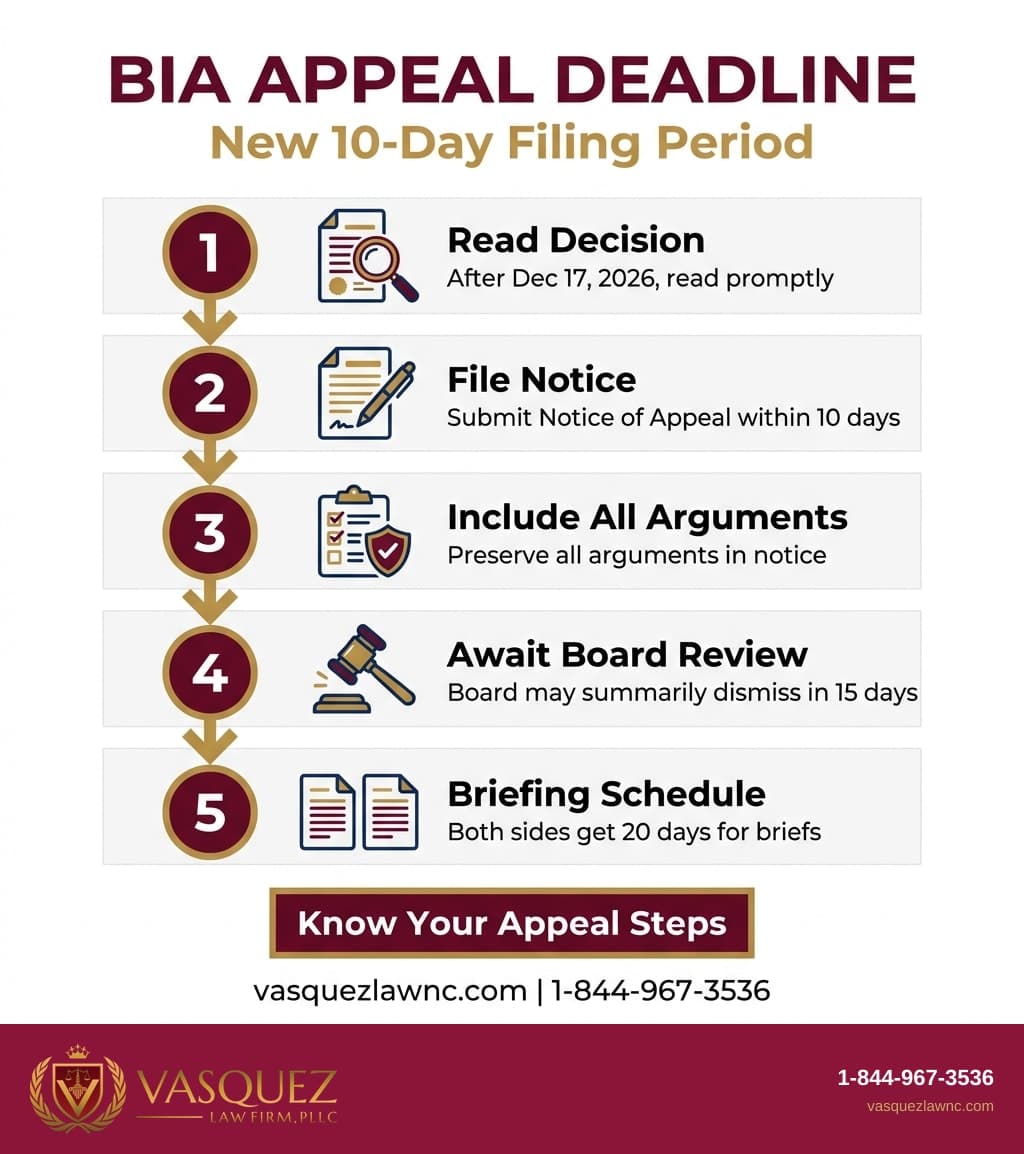
On December 17, 2026, most people seeking Board of Immigration Appeals review will face a 10-day filing period. The new default will be summary dismissal. Summary dismissal means the Board ends an appeal without a written opinion. The Department of Justice finalized the BIA appellate procedures 2026 after the Board's pending caseload rose from 35,837 cases in fiscal year 2017 to 325,774 cases in fiscal year 2026. People should understand the BIA appeal deadline before acting.
The rule's changes apply to decisions issued on or after the rule's effective date. People considering an appeal should understand the new BIA appellate procedures 2026 before filing. The Notice of Appeal, sometimes called the BIA appeal form, must now preserve every argument. Our immigration attorneys can explain the federal process and review available options.
Need help with an immigration appeal? Contact our team for a free evaluation of your options.
Legal disclaimer: This article provides general legal information, not legal advice for any individual case. Immigration outcomes depend on the record, the decision, and the law that applies to the person involved.
What changed in the BIA appellate procedures?
EOIR published its final rule, Appellate Procedures for the Board of Immigration Appeals, Federal Register Document 2026-23320, on November 17, 2026. The rule becomes effective December 17, 2026. It finalizes an interim final rule published February 6 and effective March 9.
The public comment period for the interim rule closed April 8. The period had been extended. EOIR received 1,615 comments. A federal district court partially vacated three interim provisions on March 8. The court found that the agency had not met Administrative Procedure Act notice and comment requirements. These requirements tell an agency how to inform the public and consider public comments. EOIR states that this final rule follows notice and comment procedures. It says the provisions become operative on the effective date.
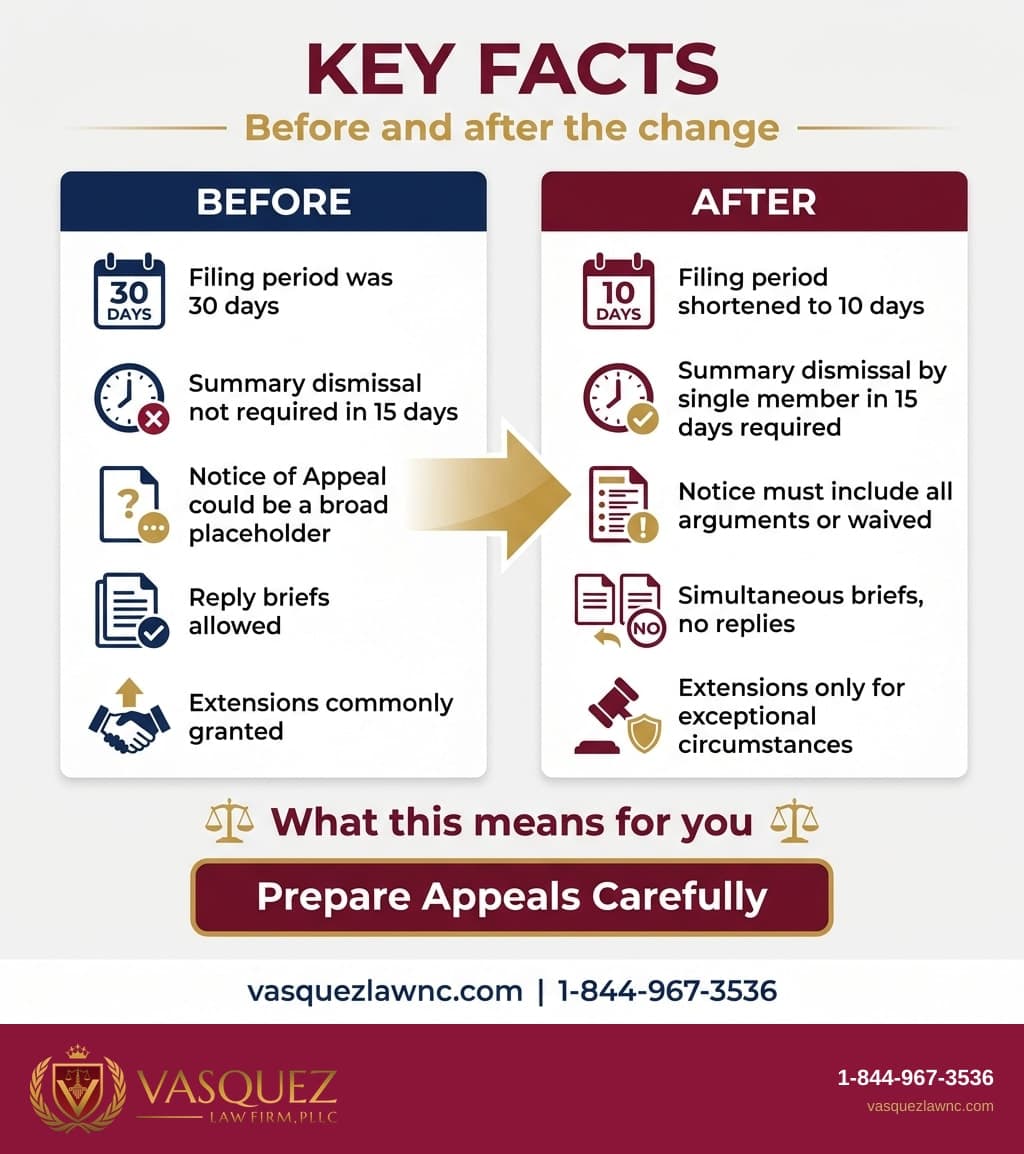
For most appeals, the filing period changes from 30 days to 10 days. Appeals of asylum decisions on the merits remain within the rule's stated exception. The final rule generally requires a single Board member to summarily dismiss an appeal within 15 days of filing unless the appeal is referred for en banc consideration and a majority of permanent Board members votes to accept it for further consideration within 10 days of filing. En banc consideration involves the Board as a whole, with voting limited to permanent members.
The Board dismisses, without opinion, the appeal from the Immigration Judge's decision. The decision below is, therefore, the final agency determination.
That is the language the Board will use in a summary dismissal order under 8 CFR 1003.1(d)(2)(ii). The rule says the Board issues the order after considering the appeal's substance. It also says the order shows that the result below was correct. It does not necessarily approve every part of the immigration judge's reasoning.
The BIA appellate procedures 2026 set simultaneous briefs for appeals that are not summarily dismissed. Simultaneous briefs means both sides submit their briefs on the same schedule. Each side receives 20 days from the Board's briefing schedule. Reply briefs are not permitted. Extensions are limited to exceptional circumstances. The rule also provides that arguments omitted from the Notice of Appeal are waived. Waived means the party usually loses the right to raise those arguments later.
Who do the BIA appellate procedures reach?
The final rule applies to appeals of any decision issued on or after December 17, 2026, as specified in the amended regulations.
People appealing most immigration judge decisions must account for the 10-day BIA appeal deadline. The exception identified in the rule covers appeals of asylum decisions on the merits. A person who receives a decision after the effective date should read it promptly. The person should then assess whether an appeal is available.
The rule also expressly applies the 10-calendar-day period to appeals in practitioner discipline cases. A practitioner is a lawyer or other authorized representative. Either party may appeal an adjudicating official's decision in those matters. The final rule says this clarification applies prospectively. It covers decisions issued on or after the effective date.
EOIR reported that 76 percent of people with completed Board appeals in fiscal year 2025 had representation before the Board. The agency also points to limited appearance procedures under 8 CFR 1003.38(g)(2). These procedures can allow a practitioner to help with defined legal documents. The practitioner may do so without entering a full appearance for the entire appeal.
For a person facing removal whose appeal is subject to the final rule, the argument-preservation requirement will take effect on December 17, 2026. The BIA appellate procedures 2026 require the notice to contain all arguments. Arguments not raised in the Notice of Appeal are deemed waived. This may affect both administrative review and later federal court review. Administrative review means review within the immigration agency.
In our experience, the cases we handle often turn first on timing. We must review the immigration judge's decision quickly. We must also identify the issues for appeal quickly. This helps preserve the client's strongest legal arguments.
What law governs a BIA appeal?
Congress gives the Attorney General authority over immigration laws through INA section 103(g). This provision is codified at 8 USC 1103(g). Codified means placed into the United States Code. EOIR relied on that authority for the final rule. The Board's procedures appear mainly in 8 CFR part 1003.
The final rule revises provisions including 8 CFR 1003.1 through 1003.3, 1003.5 through 1003.6, 1003.38, and 1003.42. Under revised 8 CFR 1003.1(d)(2)(ii), a summary dismissal without opinion makes the immigration judge's decision the final agency determination. This is the agency's final decision for that administrative appeal.
That administrative result does not erase statutory federal court review. Statutory means created by a law passed by Congress. INA section 242, codified at 8 USC 1252, governs petitions for review of final removal orders in federal courts. A petition for review is a request asking a federal court to review an agency decision. The Department wrote that the rule does not alter the statutory right to seek federal court review.
Importantly, although the changes made in this rule are a significant departure from past Board processes—in particular, the switch to summary dismissal as the default outcome—this rule does not alter an alien's statutory right to obtain Federal court review. (Source: Department of Justice, Executive Office for Immigration Review, Final Rule, printed page 73876)
Background checks remain relevant when the underlying decision grants immigration status, relief, protection from removal, or another immigration benefit. The final rule retains the restriction in 8 CFR 1003.1(d)(6)(i). It explains that the Board must wait if required identity, law enforcement, or security checks have expired and need updating.
The rule also changes transcript practice. In a case not summarily dismissed, the Board will arrange a transcript only when one is otherwise warranted. A transcript is a written record of what was said at a hearing. EOIR lists appeals of motions to reopen or reconsider, custody redeterminations, interlocutory appeals, and matters remanded from federal court as examples. In those matters, a new transcript may not be needed.
What should I do if I may appeal an immigration judge's decision?
Start with the written immigration judge decision. Note the date it was issued. Under the new BIA appellate procedures 2026, that date may determine whether the final rule applies. Preserve a complete copy of the decision, hearing materials, prior filings, and evidence central to the disputed ruling.
Next, identify every legal and factual issue that may support an appeal. The final rule codifies that arguments must be raised in the Notice of Appeal. Other arguments are deemed waived. A careful issue list can identify the ruling being challenged. It can also identify the record support and the legal basis for the challenge.
Then assess the filing window immediately. Most affected appeals have 10 days. An appeal of an asylum decision on the merits falls within the exception stated in the rule. Do not assume that a future brief can repair an incomplete Notice of Appeal. Under these new BIA rules, the BIA appeal process treats omitted arguments differently.
If a case moves beyond summary dismissal, prepare for simultaneous briefing. The parties have 20 days after the Board sets the schedule. Reply briefs are unavailable. Extensions require exceptional circumstances. Keep copies of every filing and Board notice. This includes any order that identifies the immigration judge's decision as the final agency determination.
People who need focused document help may have another option. The rule notes EOIR's limited appearance process. A qualified practitioner may be able to help with a defined filing. The practitioner may do so without assuming full representation. Removal appeals are handled through EOIR and the Board under their own regulations.
Need to assess an immigration appeal? Vasquez Law Firm offers a free evaluation for immigration matters. We meet immigration clients in Raleigh, NC and Orlando, FL. Request your free evaluation. Se Habla Español.
What should I watch after the BIA rule becomes final?
December 17 is the key effective date for the final rule. The Department says the new summary-dismissal procedures apply to appeals of decisions issued on or after that date. Appeals already pending before the Board are not placed under that stated effective-date rule.
Watch the Board's orders closely. An order dismissing without opinion makes the immigration judge's decision the final agency determination under 8 CFR 1003.1(d)(2)(ii). That designation matters when evaluating any available motion practice and statutory judicial review.
The rule includes a severability provision. This means EOIR intends other provisions to continue operating if a court stays, enjoins, or invalidates a portion. A stay temporarily pauses a rule. An injunction orders a party to stop or take an action.
For official updates, monitor EOIR's regulations and the Federal Register entry titled Appellate Procedures for the Board of Immigration Appeals. The BIA appellate procedures 2026 will also be applied through individual Board orders. Prompt review of every notice is essential.
Frequently Asked Questions
When do the new BIA appellate procedures become effective?
The final rule becomes effective December 17, 2026. EOIR states that its summary-dismissal procedures apply to appeals of any decision issued on or after that date. The rule finalized an interim rule that had been published in February, after the agency received 1,615 public comments and completed notice and comment procedures.
What is the BIA appeal deadline under the final rule?
For most affected appeals, the deadline is 10 days instead of 30 days. The rule identifies an exception for appeals of asylum decisions on the merits. The deadline is especially significant because the Notice of Appeal must raise every argument the appealing party intends to preserve.
Can the Board dismiss my appeal without a written opinion?
Yes. The BIA appellate procedures make summary dismissal the default outcome. A single Board member must dismiss an appeal within 15 days of the appeal being filed unless the appeal receives en banc referral and a majority of permanent Board members votes to accept it for further consideration within 10 days of the appeal being filed.
What happens if the Board summarily dismisses an appeal?
The Board's order will state that the immigration judge's decision is the final agency determination. The rule says the dismissal reflects that the result below was correct, although it does not necessarily approve all reasoning in that decision. The Department says statutory federal court review remains available under INA section 242.
Will I be able to file a reply brief with the BIA?
No. In appeals that are not summarily dismissed, the rule establishes simultaneous briefing. Each side has 20 days after the Board sets a briefing schedule, and reply briefs are not permitted. Extensions are limited to exceptional circumstances, so parties should organize the record and arguments before the briefing schedule arrives.
Can limited assistance be used for a BIA appeal?
EOIR states that people may seek limited assistance from practitioners for legal documents, including the Notice of Appeal and briefs, through the Board's limited appearance procedures. That option may be important where full representation is not arranged. It does not change the filing deadline or the requirement to preserve arguments in the notice.
Sources
- Federal Register: Appellate Procedures for the Board of Immigration Appeals, Document 2026-23320
- USCIS Policy Manual
Legal disclaimer: This information is general and cannot predict the result of an appeal. For guidance tied to your record and immigration judge decision, contact Vasquez Law Firm's immigration legal team for a free case review about BIA appellate procedures 2026. Talk with our team.
Reviewed by Attorney Vasquez, Managing Attorney
Worried About Immigration Policy Changes?
New policies can affect your case. Get current legal advice from an experienced immigration attorney.
Keep Reading


William Vasquez
Founder & CEO, Vasquez Law Firm, PLLC
William Vasquez is the founder and CEO of Vasquez Law Firm, PLLC, a results-driven firm specializing in immigration, criminal defense, personal injury, and workers' compensation. A U.S. Air Force veteran and recipient of the Joint Service Achievement Medal, William is dedicated to fiercely fighting for his clients' rights.
Related Legal Services
Need legal help? Learn more about immigration lawyers in North Carolina, or contact us for a free evaluation.
You can also visit immigration attorneys across North Carolina for more information.