BIA Upholds Frivolous Asylum Finding, Dismisses Appeal
By William J. Vásquez · Updated November 18, 2026
A BIA ruling affirms a frivolous asylum application finding and permanent INA ineligibility after deliberate fabrication. Contact our attorneys for a free case evaluation.
Published on November 18, 2026· Updated November 18, 2026
Talk to an immigration attorney
Free call. A clear plan for your case.
Free & confidential · Se habla espanol · Mon-Fri 8am-7pm, Sat 9am-2pm (ET)
Have questions? Talk to an attorney - free evaluation.
Call 1-844-967-3536Worried how the latest immigration news affects you?
Schedule a confidential case review with an immigration attorney - know exactly where you stand.
USCIS Case Status
Check your USCIS case status
Enter your receipt number and get the official status. Free, no registration.
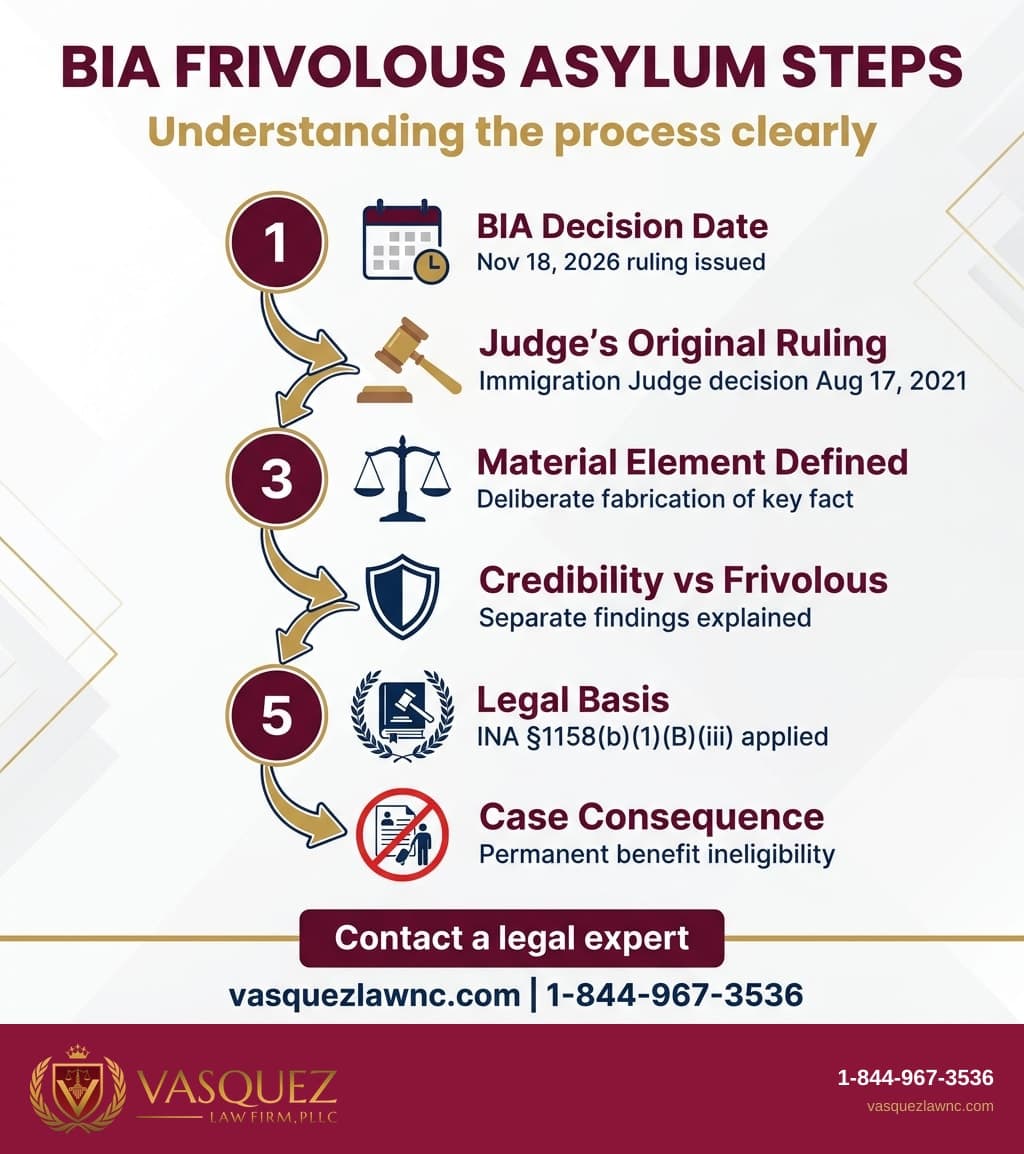
November 18, 2026: A person may become permanently ineligible for benefits under the Immigration and Nationality Act if they knowingly file a frivolous asylum application that includes a material, deliberate fabrication. A material fact is an important fact. A deliberate fabrication is information someone knowingly makes up. This is addressed in the Board of Immigration Appeals decision in Matter of K-L-S-, 30 I&N Dec. 241 (BIA 2026).
The BIA frivolous asylum application ruling shows why applicants should review every statement and document carefully before filing. The Board dismissed an appeal. It affirmed an Immigration Judge's adverse credibility and frivolousness findings. An adverse credibility finding means that the judge does not believe important parts of a person's testimony. A frivolousness finding means the judge found that the person knowingly submitted a deliberately fabricated, important fact. The decision is a strong reminder that an asylum application must match the person's testimony, records, and supporting evidence.
Seeking Asylum in the US?
You must file within 1 year of arrival. Our attorneys can help build your case.
Schedule a Free Evaluation to discuss an asylum filing, credibility concern, or removal matter with an immigration attorney.
For people seeking protection, a frivolous asylum application finding can have consequences far beyond the denial of one case. The Board explained that the respondent in this decision became permanently ineligible for immigration benefits under the INA.
Legal disclaimer: This article provides general legal information, not advice for any individual case. Asylum, credibility, removal, and appeal issues depend on the record in each proceeding.
What happened in the BIA frivolous asylum application ruling?
On November 18, 2026, the Board of Immigration Appeals issued Matter of K-L-S-, 30 I&N Dec. 241. It affirmed an Immigration Judge's denial of asylum, withholding of removal, and Convention Against Torture protection. Withholding of removal is protection that prevents removal to a country where a person faces a required level of persecution. The Immigration Judge's underlying decision was dated August 17, 2021.
The respondent was a native and citizen of India. He claimed political persecution because he belonged to the Shiromani Akali Dal Amritsar, also called the Mann party. He alleged confrontations with Bharatiya Janata Party members. He also alleged police threats after a report and a later assault.
The Immigration Judge found inconsistencies about the claimed assaults, injuries, treatment, party activities, and later hiding. The decision also identified a party letter. That letter described the respondent as a rally speaker and influential orator. His testimony described support work instead. He said he set up chairs, distributed food and water, unloaded trucks, and hung posters.
“Simply presenting hypothetical arguments and suggested alternative views of the evidence is not sufficient to establish clear error in the factual findings of the Immigration Judge.”
The Board found that the record supported the credibility finding. A record is the evidence and filings in the case. The Board noted nearly identical affidavits attributed to neighbors and the respondent's mother. An affidavit is a written statement made under oath. The Board also considered redacted declarations from 20 other asylum cases. Those declarations described closely similar sequences of events.
The BIA separately upheld the finding that the respondent knowingly filed a frivolous asylum application. This distinction matters. An adverse credibility finding does not automatically create a frivolousness finding. The Board dismissed the appeal. It described the respondent's arguments as lacking a meaningful factual or legal basis.
Why the separate finding matters
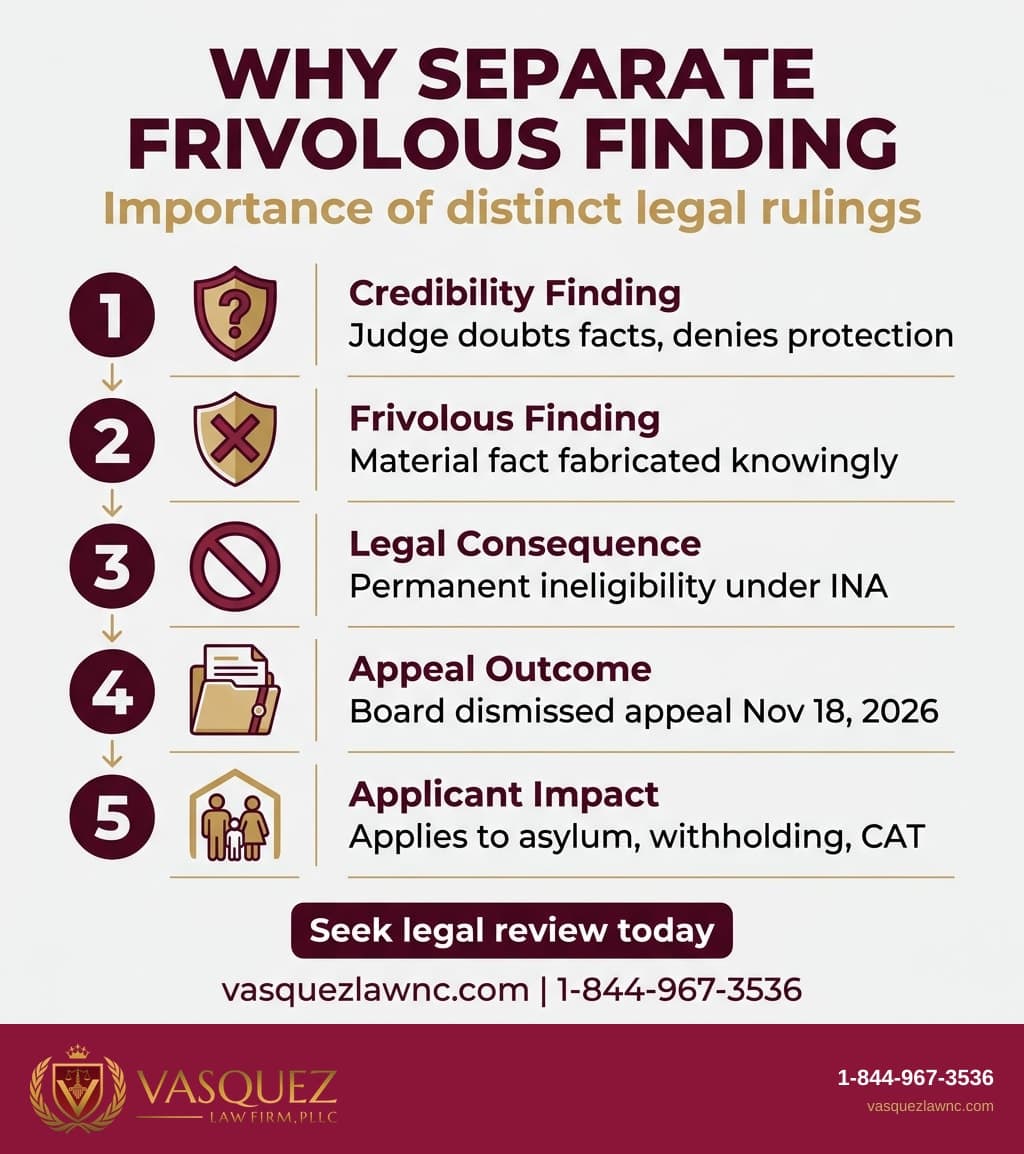
An asylum denial and a frivolous asylum application finding are different outcomes. A credibility ruling can defeat a protection claim. A properly supported frivolousness finding can create permanent ineligibility for benefits under the INA.
Who can this BIA frivolous asylum application decision affect?
The decision directly resolves the respondent's appeal.
The Board focused on applications where an Immigration Judge finds deliberate fabrication of a material element. A material element is a fact important to whether the person qualifies for protection. In this case, the Immigration Judge found problems involving the claimed political role, attacks, injuries, medical treatment, supporting affidavits, and account of persecution.
The Board emphasized that credibility review considers the totality of circumstances. This means the judge considers all important facts together. Under INA section 208(b)(1)(B)(iii), codified at 8 U.S.C. § 1158(b)(1)(B)(iii), an Immigration Judge may consider internal consistency. The judge may also compare statements with one another and with other evidence in the record.
People with genuine claims should not assume that one inconsistency automatically ends their cases. The legal question depends on the record in that case. The respondent here received notice of the possible consequence. He also knew that the Department of Homeland Security believed the claim was fabricated. He had an opportunity to address discrepancies. He also affirmed the application contents.
In our experience, the cases we handle often turn first on whether a client's written application, oral testimony, translations, and supporting records tell the same accurate story.
That is why families should preserve original records. They should identify translation issues early. They should explain mistakes with evidence rather than speculation. A careful filing can protect a valid claim from avoidable credibility disputes.
If you are concerned about an asylum credibility finding or possible immigration fraud findings, Contact Our Immigration Attorneys for a case review.
Similar language can create serious questions
The BIA highlighted affidavits that were nearly identical in wording. They included typographical and grammatical errors. The Board also discussed similarities between the respondent's account and declarations filed in other cases. Similarity alone is not the legal label for frivolousness. It must find material and deliberate fabrication.
What law governs a frivolous asylum application finding?
INA section 208(d)(6), codified at 8 U.S.C. § 1158(d)(6), provides the central consequence. A person who knowingly files a frivolous asylum application after receiving notice is permanently ineligible for benefits under the INA. That is why the required procedural safeguards matter.
The regulation at 8 C.F.R. § 1208.20 defines a frivolous application as one in which any material element is deliberately fabricated. In Matter of Y-L-, 24 I&N Dec. 151 (BIA 2007), the Board described four elements. First, the person must receive notice of the consequences. Second, there must be a specific finding that the person knowingly filed a frivolous application. Third, sufficient evidence must show deliberate fabrication of a material element. Fourth, the person must have a sufficient opportunity to explain discrepancies or implausible facts.
Matter of K-L-S- applied that framework. The BIA wrote that frivolousness does not automatically follow an adverse credibility ruling. The adjudicator must decide whether the identified fabrication was material and deliberate.
"Knowingly filing a frivolous asylum application has a grave consequence—permanent ineligibility for any benefits under the INA." (Source: 30 I&N Dec. 241 (BIA 2026))
Background law also distinguishes the available forms of protection. Asylum is governed by INA section 208. Withholding of removal is governed by INA section 241(b)(3)(A), codified at 8 U.S.C. § 1231(b)(3)(A). Convention Against Torture protection is addressed in 8 C.F.R. §§ 1208.16(c), 1208.17, and 1208.18(a).
When each request relies on the same discredited factual account, a credibility finding can undermine all of them.
Appeals have a limited purpose
The BIA reviews factual findings for clear error under 8 C.F.R. § 1003.1(d)(3)(i). In this decision, the Board said that alternative theories without record evidence did not show clear error. It also cited 8 C.F.R. § 1003.1(d)(2)(i)(D). That rule addresses appeals filed without an arguable basis in fact or law.
What should asylum applicants do to protect their cases?
Start by reading every page of the asylum application before signing it. Confirm dates and locations. Confirm political activity, injuries, travel history, family facts, and prior statements. Do not sign an application that contains a story you know is wrong.
Next, organize supporting evidence by event. Keep original medical records, police materials, party letters, photographs, messages, and affidavits. A statement from a relative or witness should describe what that person actually knows. It should not copy another person's wording. This remains true simply because a preparer offers a template.
Then compare the application with prior immigration filings, border interviews, visa records, declarations, and expected testimony. If there is an error, discuss it promptly with qualified counsel. Counsel means a lawyer who represents or advises you. The safest correction is accurate and supported. It must also be made through the proper procedure.
Prepare to explain how each document was created, obtained, translated, and delivered. In Matter of K-L-S-, the Board considered the respondent's lack of knowledge about when a party document was created. It also considered his concession that the document's description of his activities was inaccurate.
Use a qualified interpreter when needed. Ask for clarification during preparation and testimony rather than guessing. Identify a misunderstanding clearly. It should never become an excuse for inventing facts.
If you have received a Notice to Appear, an Immigration Judge decision, or a BIA briefing schedule, seek individual legal guidance quickly. Our immigration attorneys can review asylum filings and removal-case records during a free evaluation. Se Habla Español. Schedule Free Evaluation
For readers already considering an appeal, our overview of BIA appellate procedures in 2026 explains the appellate process in broader terms. A sound appeal identifies legal or factual error. It supports that claim with the existing record.
What's Your Immigration Situation?
Answer 3 questions - we'll tell you your options
Question 1 / 3
What best describes your situation?
Keep Reading
What should readers watch after Matter of K-L-S-?
The practical rule today is clear. Asylum applicants should treat every material statement and supporting document as evidence. The court may test that evidence against testimony and other records. The BIA's decision reinforces the difference between an unsupported appeal argument and an appeal that identifies clear error in the record.
The Board's decision offers a practical lesson. Truthful preparation is not only ethical. It protects the legal options a person may need later.

Frequently Asked Questions
What is a frivolous asylum application?
Under 8 C.F.R. § 1208.20, an asylum application is frivolous if a material element is deliberately fabricated. The finding requires more than an adverse credibility decision. The adjudicator must apply separate safeguards, including notice, a specific knowing-filing finding, evidence of deliberate fabrication, and a meaningful chance to explain discrepancies.
Does an adverse credibility finding automatically make an asylum application frivolous?
No. Matter of K-L-S- states that frivolousness does not automatically follow an adverse credibility determination. The Immigration Judge or BIA must separately determine that a material element was deliberately fabricated and that the applicant knowingly filed the frivolous application after receiving the required warning.
What happens after a frivolous asylum application finding?
INA section 208(d)(6) makes a person who knowingly files a frivolous asylum application permanently ineligible for benefits under the INA, after proper notice. In Matter of K-L-S-, the Board affirmed that consequence after finding that the record supported a knowing, material, deliberate fabrication determination.
Can copied affidavits hurt an asylum case?
They can. The Board considered affidavits that were nearly identical, including the same uncommon phrasing and errors. Supporting statements should reflect each witness's own knowledge and language. A person should preserve the basis for every affidavit and be prepared to explain who drafted, translated, and reviewed it.
Can the BIA consider similarities to other asylum claims?
Yes. In this case, the BIA considered similarities between the respondent's account and redacted declarations from other asylum cases. The respondent was confronted with those materials and given an opportunity to respond. The Board treated the similarities as relevant to credibility and to the deliberate-fabrication analysis.
What should I do if my asylum application contains an error?
Do not invent an explanation or repeat an inaccurate fact at an interview or hearing. Gather the application, prior statements, original records, translations, and documents related to the error. Speak with an immigration attorney about the proper way to correct or explain the issue based on the procedural stage of your case.
Legal disclaimer: This information is not individualized legal advice. Vasquez Law Firm offers free immigration consultations for clients nationwide, with in-person consultations available in Raleigh, NC and Orlando, FL. If you are concerned about a BIA frivolous asylum application, Contact Vasquez Law Firm to request a free evaluation of your asylum, removal, or BIA appeal matter. Get Legal Help Now
Sources
Reviewed by Attorney Vasquez, Managing Attorney

William Vasquez
Founder & CEO, Vasquez Law Firm, PLLC
William Vasquez is the founder and CEO of Vasquez Law Firm, PLLC, a results-driven firm specializing in immigration, criminal defense, personal injury, and workers' compensation. A U.S. Air Force veteran and recipient of the Joint Service Achievement Medal, William is dedicated to fiercely fighting for his clients' rights.
Related Legal Services
Need legal help? Learn more about how our immigration attorneys can help, or contact us for a free evaluation.
You can also visit our North Carolina immigration practice for more information.