USCIS Asylum Applications: How Filing Routes Work
By William J. Vásquez · Updated November 19, 2026
Learn how USCIS asylum filing works, including Form I-589 routes, EOIR rules, fees, and deadlines. Contact an immigration lawyer for help today.
Published on November 19, 2026· Updated November 19, 2026
Talk to an immigration attorney
Free call. A clear plan for your case.
Free & confidential · Se habla espanol · Mon-Fri 8am-7pm, Sat 9am-2pm (ET)
Have questions? Talk to an attorney - free evaluation.
Call 1-844-967-3536Free Tool
Check Your USCIS Case Status Now
Enter your receipt number - get the official USCIS status in English or Spanish. No registration.
USCIS Asylum Applications: How Filing Routes Work
A USCIS asylum application starts with Form I-589. The correct filing path depends on whether the applicant is in immigration court proceedings. This guide explains affirmative and defensive asylum. It also explains USCIS jurisdiction, Form I-589 filing rules, required fields, annual fees, and the reopening option for certain Sileiri Doe class members.
For help reviewing a USCIS asylum filing path, contact Vasquez Law Firm for a free case review. Se Habla Español. Immigration consultations are available in Raleigh, NC and Orlando, FL.
Call 1-844-967-3536.
Quick Answer
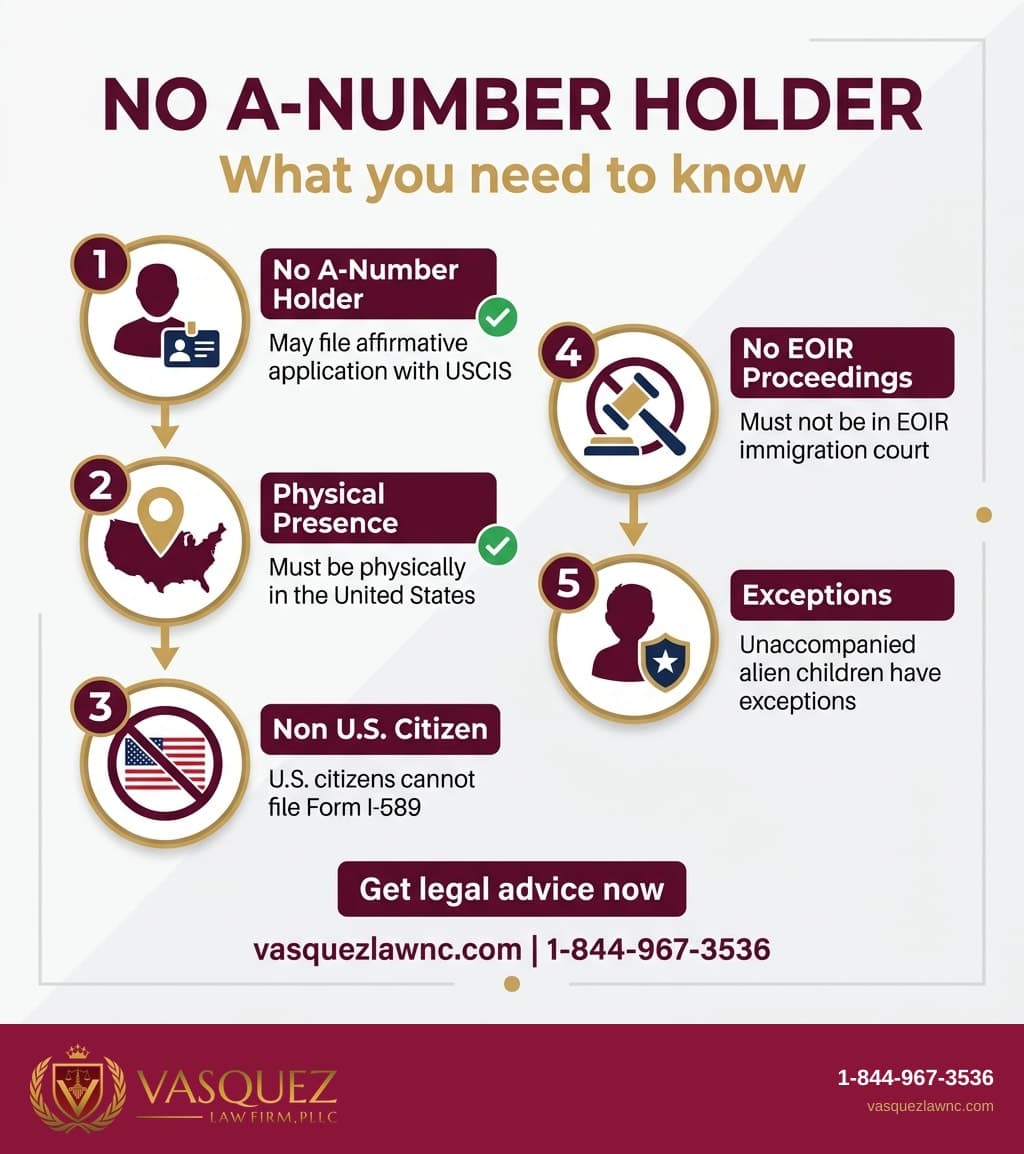
USCIS asylum means an affirmative Form I-589 application filed with USCIS. The applicant must be physically present in the United States. The applicant also must not be in EOIR proceedings, subject to limited exceptions. EOIR proceedings are immigration court proceedings handled by the Executive Office for Immigration Review. A person already in immigration court generally files defensively with EOIR instead.
- Use Form I-589 for asylum and withholding of removal.
- Check EOIR status before choosing a filing location.
- File within the statutory one-year period when applicable.
- Use the current English form edition and sign it.
Who can file USCIS asylum applications?
A person with no A-Number may generally file an affirmative USCIS asylum application. The person must be physically present in the United States. The person also must not be a U.S. citizen. An A-Number holder may also file with USCIS if the person is not currently in proceedings before the Executive Office for Immigration Review, known as EOIR.
Form I-589 is used to apply for asylum in the United States and for withholding of removal (formerly called “withholding of deportation”). USCIS explains that affirmative asylum is for people who are not in EOIR proceedings. Defensive asylum is filed before an immigration judge or the Board of Immigration Appeals.
“You may file for asylum if you are physically present in the United States and you are not a U.S. citizen.”
Applicants in removal proceedings generally must file with EOIR, not USCIS. Removal proceedings are the government process used to ask an immigration judge to decide whether a person may remain in the United States. A current or previously determined unaccompanied alien child is an important exception. The law defines that term in 6 U.S.C. § 279(g)(2). For help assessing the appropriate forum, review the firm’s immigration legal services.
How do you check EOIR proceedings?
An A-Number begins with A and has eight or nine digits. USCIS directs people with an A-Number to use the EOIR Automated Case Information system or hotline. If the system shows a hearing date, the Notice to Appear has been docketed. This means the court has entered the notice into its case system. The asylum application generally belongs with EOIR, unless the applicant is currently, or was previously determined to be, an unaccompanied alien child.
What does the asylum one-year filing rule mean?
USCIS states that a person who fails to file Form I-589 within one year of arrival may not be eligible to apply for asylum under section 208(a)(2)(B) of the Immigration and Nationality Act (INA).
The one-year rule concerns asylum eligibility. Form I-589 also requests withholding of removal. That protection has separate legal standards and procedures. A filing decision should account for the applicant’s entry history and immigration court status. It should also account for the record needed to support each request.
Cases we handle often involve a missed procedural step. This can happen before the merits are even reviewed. The merits are the facts and legal reasons supporting the claim. The document most often needed first is the Notice to Appear or other DHS correspondence. These documents can help show whether EOIR has jurisdiction.
What language must Form I-589 use?
USCIS makes Form I-589 available to read in multiple languages, including Spanish. The official submission must use the English version. The form must be completed in English. Supporting records in another language need an English translation.
USCIS lists the current Form I-589 edition date as 07/28/26. A mailed form should show that edition date. It should also show page numbers at the bottom of every page. All pages should come from the same edition.
How do USCIS asylum filing steps work?
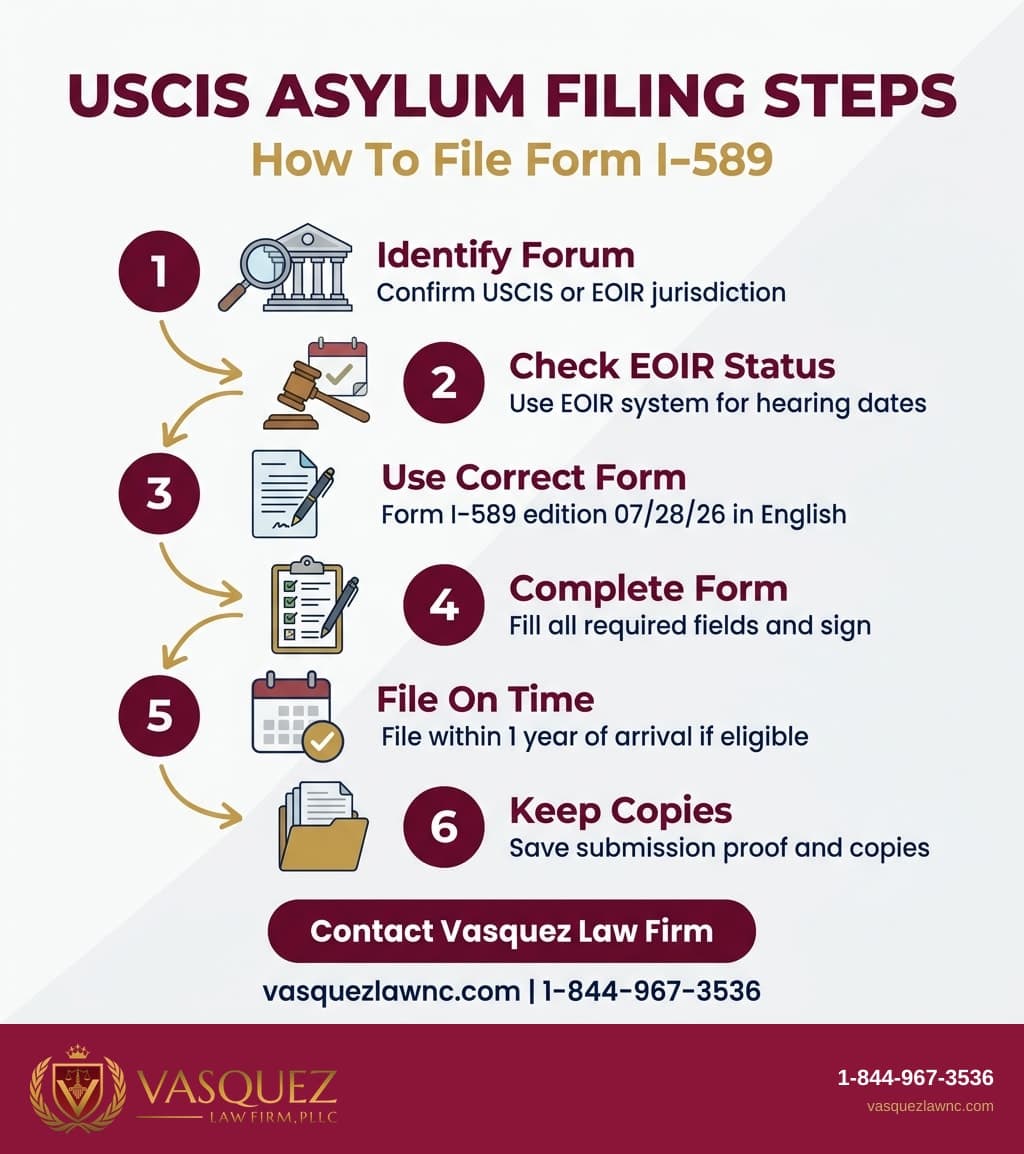
A practical first step is to identify the correct forum. Do this before mailing or submitting anything online. A forum is the government office or court that should receive the filing. USCIS provides a Filing Instructions Tool for applicants who may file affirmatively with USCIS. The tool does not decide asylum eligibility.
- Collect immigration notices, including any A-Number and Notice to Appear.
- Check whether EOIR shows an active hearing.
- Confirm whether USCIS has jurisdiction.
- Use the Form I-589 edition listed by USCIS.
- Complete every required field and explanation.
- Choose online filing or mail filing only if USCIS instructions permit that method.
- Keep copies of the filed package and delivery proof.
People who were previously in removal proceedings may have had those proceedings dismissed or terminated. If they seek to file with USCIS, they must file Form I-589 by mail. Dismissed means the case was ended without a current removal order. Terminated also means the proceedings ended, although the legal reason may differ. Current or former unaccompanied alien children also must file by mail. Our asylum and immigration representation can help review which procedural route fits the record.
Which missing fields can cause rejection?
USCIS may reject Form I-589 if key fields are blank. These fields include the applicant’s complete last name and U.S. residence. Required spouse and child information must be included. The applicant must answer the questions about the application. The applicant must also sign the form.
“We will reject any Form I-589 that is missing the explanation of why you are applying for asylum or that is missing any addendums that you reference in your Form I-589.”
Do not file multiple I-589 applications simply to seek faster processing. USCIS states that another pending Form I-589 will not speed the case. It may instead cause delays.
What documents support an asylum application?
A complete filing starts with the form and its explanations. USCIS specifically requires applicants to complete the form in English. Applicants must provide English translations for supporting documents written in another language.
- Current Form I-589, using the correct edition.
- A clear explanation of the basis for the application.
- Every addendum referenced on the form.
- Immigration notices that help establish procedural status.
- English translations for non-English supporting records.
- Information about a spouse and children when applicable.
- Supplement A for children beyond the form’s listed spaces.
USCIS says not to submit passport-style photographs with a mailed I-589. Do not submit duplicate forms or duplicate supporting records either. After USCIS accepts the application, additional correspondence or evidence belongs with the local asylum office processing the case. It should not go to the lockbox or Asylum Intake Unit.
What fees and timeline affect USCIS asylum cases?
As of November 2026, Public Law 119-21 generally requires an Annual Asylum Fee for the principal applicant with a pending Form I-589. However, since Feb. 5, 2026, USCIS has paused collection of that fee from Ms. L. Settlement Class members and their Qualifying Additional Family Members. The principal applicant is the person who filed the main application, rather than a spouse or child included in it. USCIS sends a notice that states the amount and payment method. USCIS instructs the principal applicant to pay within 30 days after it sends that notice.
The fee applies to the principal applicant. It cannot be waived. It must be paid online using the A-Number and receipt number shown on the notice. USCIS cannot approve an asylum application while an issued Annual Asylum Fee remains payable.
USCIS processing depends on the form and office. Check the agency’s processing times page for current agency estimates. The page does not decide the merits of any individual asylum claim.
What is the Sileiri Doe reopening process?
On Sept. 28, 2026, the U.S. District Court for the District of Massachusetts issued an order requiring DHS to remediate certain “adverse consequences” for aliens paroled into the United States after scheduling an appointment through the CBP One Mobile App, and whose parole was terminated by the federal government via mass email in April 2025. Eligible class members may request USCIS reopening or reconsideration of an adverse asylum action issued between April 1, 2025 and April 21, 2026.
Reopening means asking USCIS to open the matter again. Reconsideration means asking USCIS to review the decision again under the applicable law and facts. The person must mail a written request to the asylum office with jurisdiction over the current residence. If the class member is currently in removal proceedings before an immigration judge, the judge must first terminate or dismiss those proceedings, unless the class member is an unaccompanied alien child. USCIS can consider the request only if it has jurisdiction over the case. The request must explain how the parole termination affected asylum eligibility. It must also explain why reopening or reconsideration is appropriate. The USCIS I-589 page states there is no deadline for these class members to make that request.
Which USCIS asylum mistakes can delay a case?
A filing sent to the wrong forum can be rejected or delayed. The clearest way to prevent this problem is to check whether EOIR proceedings exist before filing.
- Filing with USCIS while in EOIR proceedings: confirm court status first.
- Using an outdated or mixed form edition: use one complete current edition.
- Leaving the asylum explanation blank: provide the required explanation and addendums.
- Forgetting the signature: review the applicant signature before filing.
- Sending foreign-language records without translation: include English translations.
- Submitting duplicate I-589 forms: avoid duplicate filings while one is pending.
- Mailing later evidence to a lockbox: send it to the local asylum office after acceptance.
If you remember one point, remember this: USCIS asylum jurisdiction and immigration court jurisdiction are different. Jurisdiction means the authority to handle a case. Identify the correct decision-maker before choosing a filing method.
A filing error can affect timing and jurisdiction. Vasquez Law Firm offers free immigration consultations, and Se Habla Español.
When should you request asylum filing help?
A person should seek timely legal review when a court hearing appears in the EOIR system. Review is also important when an I-589 was previously denied or dismissed. It can help when removal proceedings were dismissed or terminated.
Review is also useful if a person received an Annual Asylum Fee notice. It may help if the person lost derivative status, needs to add a spouse or child, or believes the Sileiri Doe order may apply. Derivative status is immigration status based on another person’s application or status.
The Form I-589 page is a USCIS filing resource, not an eligibility determination. A lawyer can review the procedural record. A lawyer can explain the legal standards. A lawyer can also help identify a filing route. See the firm’s discussion of a BIA asylum decision for related immigration-court context.
Frequently Asked Questions
Does USCIS handle asylum cases?
USCIS handles affirmative Form I-589 applications for eligible people who are not in EOIR proceedings. A noncitizen physically present in the United States may qualify to file affirmatively if USCIS has jurisdiction. People in active immigration court proceedings generally file defensively with EOIR, unless they are current or previously determined unaccompanied alien children.
Can I file Form I-589 online?
Some eligible affirmative applicants may file online through USCIS. Current or former unaccompanied alien children must file by mail. People whose removal proceedings were dismissed or terminated also must file by mail if they seek to apply with USCIS. USCIS directs applicants to use its Filing Instructions Tool to identify the proper method.
What happens if I am already in immigration court?
If the EOIR system shows your name and next hearing date, the Notice to Appear has been docketed and you are in EOIR proceedings. USCIS says you must file Form I-589 with EOIR in that situation unless you are a current or previously determined unaccompanied alien child. Filing in the wrong place can result in rejection.
What happens if I file asylum after one year?
INA § 208(a)(2)(B) provides that a person who does not file Form I-589 within one year of arrival may not be eligible for asylum. The filing date and any possible legal issues require careful review. Form I-589 also requests withholding of removal, which is a separate form of protection with its own standards.
Must my Form I-589 be in English?
Yes. USCIS accepts only the official English-language version for submission, and the form must be completed in English. USCIS offers translations for informational use, including Spanish, but they are not official submissions. Supporting documents written in another language must include an English translation.
Can I add a child to a pending asylum case?
USCIS instructs a person seeking to add a spouse or unmarried child under 21 to a pending Form I-589 to mail a request to the asylum office where the case is located. Do not file another I-589 for that purpose. USCIS says an additional lockbox filing will be rejected and returned.
What is the Annual Asylum Fee?
As of November 2026, the Annual Asylum Fee generally applies to the principal applicant with a pending Form I-589 under Public Law 119-21. However, since Feb. 5, 2026, USCIS has paused collection of that fee from Ms. L. Settlement Class members and their Qualifying Additional Family Members. USCIS sends a notice identifying the amount and online payment process. The fee cannot be waived. USCIS states that it cannot approve asylum while an issued fee remains payable.
Can Sileiri Doe class members seek reopening?
Eligible Sileiri Doe class members may mail a written reopening or reconsideration request to the asylum office with jurisdiction over their current residence, but USCIS must also have jurisdiction over the case. If a class member is currently in removal proceedings before an immigration judge, the judge must first terminate or dismiss those proceedings, unless the class member is an unaccompanied alien child. The request must explain how the April 2025 parole termination affected asylum eligibility and why USCIS should reopen or reconsider the case. USCIS reviews these requests case by case, and the page states no deadline applies.
About Vasquez Law Firm
Vasquez Law Firm provides immigration representation with bilingual support. The firm focuses on urgent procedural issues. William J. Vasquez has practiced since 2011. He is admitted to the North Carolina State Bar and Florida Bar. The firm’s Yo Peleo® commitment reflects determined, respectful advocacy.
Immigration services are available nationwide. The firm meets immigration clients in Raleigh, NC and Orlando, FL. It offers free case reviews. Se Habla Español.
Sources and References
For a review of your USCIS asylum filing route, contact Vasquez Law Firm for a free, confidential consultation. Se Habla Español.
Call 1-844-967-3536.
Seeking Asylum in the US?
You must file within 1 year of arrival. Our attorneys can help build your case.
Keep Reading

For how Vasquez Law Firm can help, see our asylum page.
Reviewed by Attorney Vasquez, Managing Attorney

William Vasquez
Founder & CEO, Vasquez Law Firm, PLLC
William Vasquez is the founder and CEO of Vasquez Law Firm, PLLC, a results-driven firm specializing in immigration, criminal defense, personal injury, and workers' compensation. A U.S. Air Force veteran and recipient of the Joint Service Achievement Medal, William is dedicated to fiercely fighting for his clients' rights.
Related Legal Services
Need legal help? Learn more about how our immigration attorneys can help, or contact us for a free evaluation.
You can also visit North Carolina immigration law firm for more information.