BIA Ends Presumption Favoring Continuances for Pending U Visa Petitions
A BIA U visa continuance ruling ends the favorable presumption in removal cases. Review the L-A-B-R factors and request a free evaluation.
Published on October 16, 2026· Updated October 19, 2026
Talk to an immigration attorney
Free call. A clear plan for your case.
Free & confidential · Se habla espanol · Mon-Fri 8am-7pm, Sat 9am-2pm (ET)
Have questions? Talk to an attorney - free evaluation.
Call 1-844-967-3536Worried how the latest immigration news affects you?
Schedule a confidential case review with an immigration attorney - know exactly where you stand.
USCIS Case Status
Check your USCIS case status
Enter your receipt number and get the official status. Free, no registration.
BIA Ends Presumption Favoring Continuances for Pending U Visa Petitions
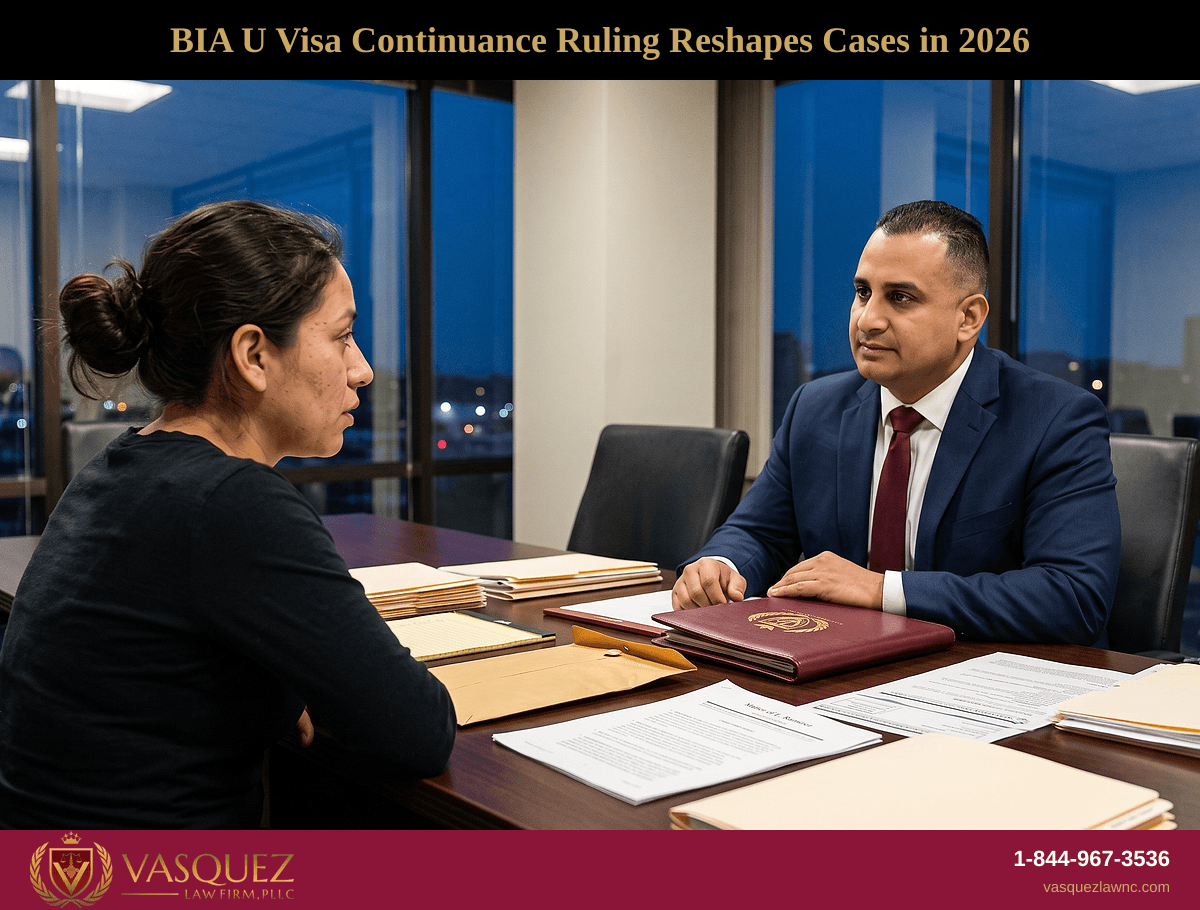
The Board of Immigration Appeals dismissed an appeal on October 16, 2026, in a case involving a respondent who requested a further continuance of removal proceedings while a U visa petition remained pending with USCIS. The immigration attorneys at Vasquez Law Firm are following the BIA U visa continuance ruling because it changes how Immigration Judges evaluate requests to pause removal proceedings while USCIS processes a U visa petition.
In a precedent decision published at 30 I&N Dec. 157 (BIA 2026), the Board overruled its prior favorable presumption for a person with a prima facie approvable U visa petition. A prima facie showing means the filing appears sufficient on its face to meet the basic legal requirements. It does not guarantee approval.
This is general legal information, not legal advice for any individual case. People in removal proceedings should obtain case-specific guidance from nationwide immigration counsel before requesting a continuance, conceding removability, or changing a litigation strategy.
What did the BIA U visa continuance ruling change?
On October 16, 2026, the Board of Immigration Appeals dismissed the appeal in the precedent decision published at 30 I&N Dec. 157. The respondent, a Mexican national, filed a U visa petition and waiver application with USCIS on September 26, 2017. He alleged that he was the victim of an armed robbery on February 23, 2016.
The Department of Homeland Security began removal proceedings in June 2017. At an October 23, 2018 hearing, the Immigration Judge granted time for attorney preparation. The court later granted a continuance at the August 8, 2019 hearing to await USCIS action, despite DHS opposition.
At the January 7, 2020 hearing, USCIS had not adjudicated the petition. The Immigration Judge denied another continuance and ordered removal. The Board found that the later appeal still contained no evidence of USCIS adjudication.
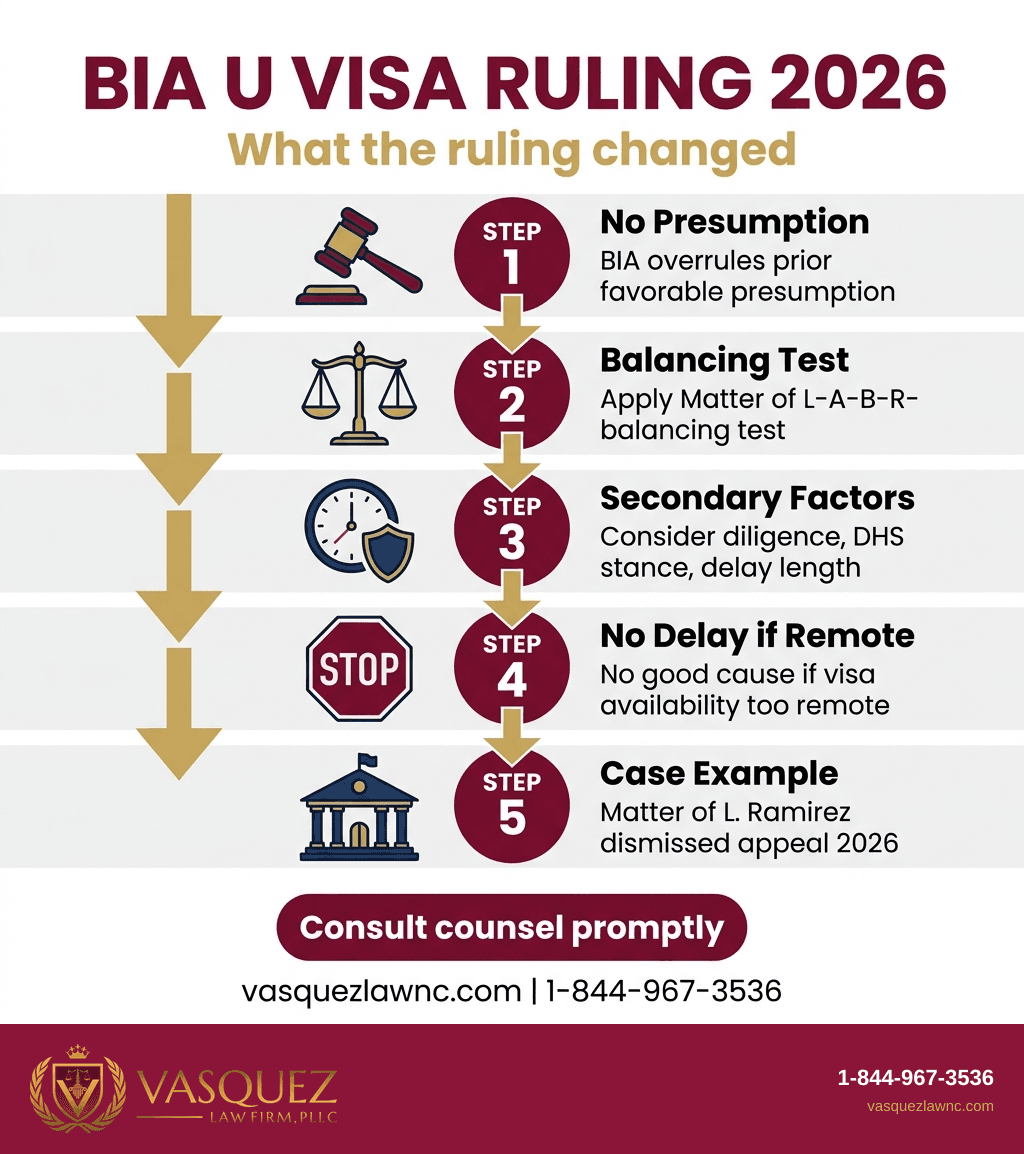
There is no presumption in favor of a continuance for aliens who have filed a prima facie approvable U visa petition with United States Citizenship and Immigration Services.
The BIA U visa continuance ruling overruled Matter of Sanchez Sosa, 25 I&N Dec. 807 (BIA 2012). That earlier decision had recognized a rebuttable presumption favoring a reasonable continuance when a respondent had filed a prima facie approvable U visa application.
The Board instead directed Immigration Judges to use the balancing framework in Matter of L-A-B-R-, 27 I&N Dec. 405 (A.G. 2018). The Board also reaffirmed Matter of Quintero, 18 I&N Dec. 348 (BIA 1982), which holds that respondents are not entitled to delay the completion of removal proceedings while waiting for a visa to become available.
Who can this BIA U visa continuance ruling affect?
The Board stated that the standard for considering a continuance request to await the adjudication of a visa petition or the availability of a visa is the same for any type of visa. There is no special rule for U visas or any other nonpreference category of visa.
In this case, the Board recognized that the respondent appeared prima facie eligible for both a U visa and an inadmissibility waiver. It also recognized that approval would materially affect removal proceedings because he would no longer be removable as charged.
Those favorable points did not end the analysis. The Board concluded that secondary factors weighed strongly against another delay. The request had no proposed timeframe, the petition had already been pending for more than a year by the January 2020 hearing, DHS opposed the request, and the respondent had conceded removability without seeking relief from the Immigration Judge.
In deciding whether an alien has established good cause for a continuance based on the pendency of a visa petition or future visa availability, Immigration Judges should apply the balancing test set forth by the Attorney General in Matter of L-A-B-R-, while keeping in mind the importance of the secondary factors and that good cause does not exist if visa availability is remote.
The Board described the current environment as one in which eligible U visa petitioners may wait many years, even decades, because demand exceeds the number of visas Congress authorized. The decision attributes that wait to the statutory cap and demand, rather than to action or inaction by USCIS.
In our experience, the first question in these cases is often whether a pending USCIS filing automatically pauses immigration court. A pending U visa petition does not automatically pause removal proceedings; whether an Immigration Judge grants a continuance depends on a fact-specific good-cause analysis.
What law governs a continuance in removal court?
Federal regulation 8 C.F.R. § 1003.29 allows an Immigration Judge to grant a continuance for good cause shown. Under Matter of L-A-B-R-, the respondent bears the burden to establish good cause when seeking time for a collateral matter, meaning an immigration benefit being decided by another authority such as USCIS.
What are the primary factors?
The Immigration Judge focuses principally on two questions. First, how likely is the respondent to receive the collateral relief? Second, would that relief materially affect the outcome of removal proceedings? The Board acknowledged that both questions favored the respondent in this case.
What are the secondary factors?
The Board explained that judges must also weigh reasonable diligence, DHS's position, the requested length of delay, and the procedural history. Under Matter of L-N-Y-, 27 I&N Dec. 755 (BIA 2020), strong secondary factors can outweigh favorable primary factors.
The BIA U visa continuance decision emphasized visa availability. A visa that is too remote does not establish good cause under Matter of L-A-B-R-. The Board also cited Matter of J-A-F-S-, 29 I&N Dec. 195 (BIA 2025), for de novo review of the legal question about whether an Immigration Judge erred on a continuance.
Why does the record matter?
A continuance request should address the individual record, not just identify a pending filing. The Board found that the respondent did not explain the year-and-a-half delay between the February 2016 crime and the September 2017 U visa filing. It also gave weight to DHS opposition based on prompt completion of the proceedings.
What should a U visa petitioner do in removal proceedings?
A pending U visa petition remains significant evidence, but the BIA U visa continuance ruling makes preparation for a continuance request more important. Keep copies of the filed Form I-918 petition, the waiver application if one was filed, receipt notices, law-enforcement certification, and every USCIS notice.
Build a clear chronology. Identify the qualifying crime date, filing date, USCIS receipts, requests for evidence, responses, and every immigration court hearing. A precise timeline helps show diligence and helps counsel explain the procedural history to the Immigration Judge.
Ask counsel to assess whether the expected relief would materially affect the removal case. A request should also address the likely time needed, rather than seek an indefinite pause. The Board treated an unknown and potentially lengthy request as a major concern.
Check the USCIS Processing Times page and preserve case-status records relevant to the filing. USCIS processing information may assist case planning, but it does not itself create a right to a continuance under 8 C.F.R. § 1003.29.
Review other forms of relief that may be available in immigration court before relying only on a pending petition. Do not ignore hearing notices or assume USCIS adjudication will stop court proceedings.
Need a case-specific review? Vasquez Law Firm offers a free immigration evaluation for people facing removal proceedings. Our team meets immigration clients in Raleigh, NC and Orlando, FL, and serves clients nationwide. Request a free evaluation. Se Habla Español.
What should you watch after the BIA U visa continuance decision?
The Board held that a prima facie approvable U visa filing no longer carries a presumption favoring a continuance. Immigration Judges will apply the Matter of L-A-B-R- balancing test and evaluate the full record, including the practical likelihood and timing of relief.
Watch the Board of Immigration Appeals and Executive Office for Immigration Review for published precedent decisions interpreting good cause. The official opinion, 30 I&N Dec. 157 (BIA 2026), is the starting point for this change.
One material issue will turn on each person's record: whether the evidence of diligence, a defined requested period, and the expected effect of USCIS relief outweigh the reasons to complete proceedings promptly. The BIA U visa continuance ruling requires that individualized balancing, not an automatic result.
For related removal-court developments, readers can also review our analysis of the 2026 BIA bond hearing ruling and the asylum one-year deadline.
Frequently Asked Questions
Does a pending U visa petition automatically pause removal proceedings?
No. The decision at 30 I&N Dec. 157 holds that there is no presumption favoring a continuance based on a prima facie approvable U visa petition. A respondent must establish good cause under 8 C.F.R. § 1003.29. The Immigration Judge applies the Matter of L-A-B-R- factors to the evidence and procedural record in the individual case.
Can an Immigration Judge still grant a U visa continuance?
Yes. The decision does not eliminate continuances. It requires a good-cause showing through balancing primary and secondary factors. The key primary questions are the likelihood of collateral relief and whether that relief would materially affect removal proceedings. Diligence, DHS's position, requested time, visa availability, and the case history also matter.
What did the BIA overrule?
The Board overruled the continuance standard in Matter of Sanchez Sosa, 25 I&N Dec. 807 (BIA 2012). That standard included a rebuttable presumption for a reasonable continuance after a prima facie approvable U visa filing. The Board found that presumption inconsistent with later guidance in Matter of L-A-B-R- and longstanding precedent in Matter of Quintero.
Why did the Board uphold the Immigration Judge's denial of a further continuance in this case?
The Board found that the request was open-ended and potentially lengthy. It also considered the respondent's delay before filing the U visa petition, DHS opposition, the procedural history, conceded removability, and the absence of a request for relief before the Immigration Judge. Those secondary factors outweighed favorable primary factors.
Does this decision apply only to U visas?
No. The Board stated that the continuance standard for a pending visa petition or future visa availability is the same for any type of visa. There is no special continuance rule for U visas or another nonpreference visa category.
What documents support a continuance request?
Useful records may include USCIS receipt notices, the filed visa petition, waiver materials where applicable, proof of responses to USCIS requests, and a documented hearing timeline. These documents can help show diligence and explain how the collateral relief could affect removability. An attorney can evaluate which records fit the legal issues in a particular proceeding.
Sources
Talk with an immigration attorney before your next hearing. A pending petition deserves a careful record and a tailored legal strategy. Contact Vasquez Law Firm for a free consultation about your immigration matter. Schedule your free consultation.
Disclaimer: This article provides general information, not individualized legal advice. Immigration outcomes depend on the facts, evidence, procedural posture, and applicable law in each case.
Reviewed by Attorney Vasquez, Managing Attorney
Facing Deportation?
Time is critical. Our deportation defense attorneys are available 24/7 for emergency cases.
Keep Reading



William Vasquez
Founder & CEO, Vasquez Law Firm, PLLC
William Vasquez is the founder and CEO of Vasquez Law Firm, PLLC, a results-driven firm specializing in immigration, criminal defense, personal injury, and workers' compensation. A U.S. Air Force veteran and recipient of the Joint Service Achievement Medal, William is dedicated to fiercely fighting for his clients' rights.
Related Legal Services
Need legal help? Learn more about immigration lawyers in North Carolina, or contact us for a free evaluation.
You can also visit statewide immigration legal services for more information.