Can Asylum Applicants Meet the One-Year Filing Deadline?
Need asylum protection? See who may qualify, how the one-year filing deadline works, and what interview rules can affect your case. Request a free evaluation.
Published on October 13, 2026· Updated October 14, 2026
Talk to an immigration attorney
Free call. A clear plan for your case.
Free & confidential · Se habla espanol · 24/7
Have questions? Talk to an attorney - free evaluation.
Call 1-844-967-3536Worried how the latest immigration news affects you?
Schedule a confidential case review with an immigration attorney - know exactly where you stand.
USCIS Case Status
Check your USCIS case status
Enter your receipt number and get the official status. Free, no registration.
Can Asylum Applicants Meet the One-Year Filing Deadline?
Asylum in the U.S. may protect a person who fears persecution. Persecution means serious harm or threats because of race, religion, nationality, political opinion, or membership in a particular social group. The one-year filing deadline can decide whether a person can seek asylum. This guide explains the general filing rule, Form I-589, interview preparation, work authorization, and the serious results of missing USCIS appointments.
Do you need help understanding an asylum filing or deadline? Vasquez Law Firm offers free, confidential immigration evaluations. Se Habla Español.
Call 1-844-967-3536. In-person immigration consultations are available in Raleigh, NC and Orlando, FL.
Quick Answer
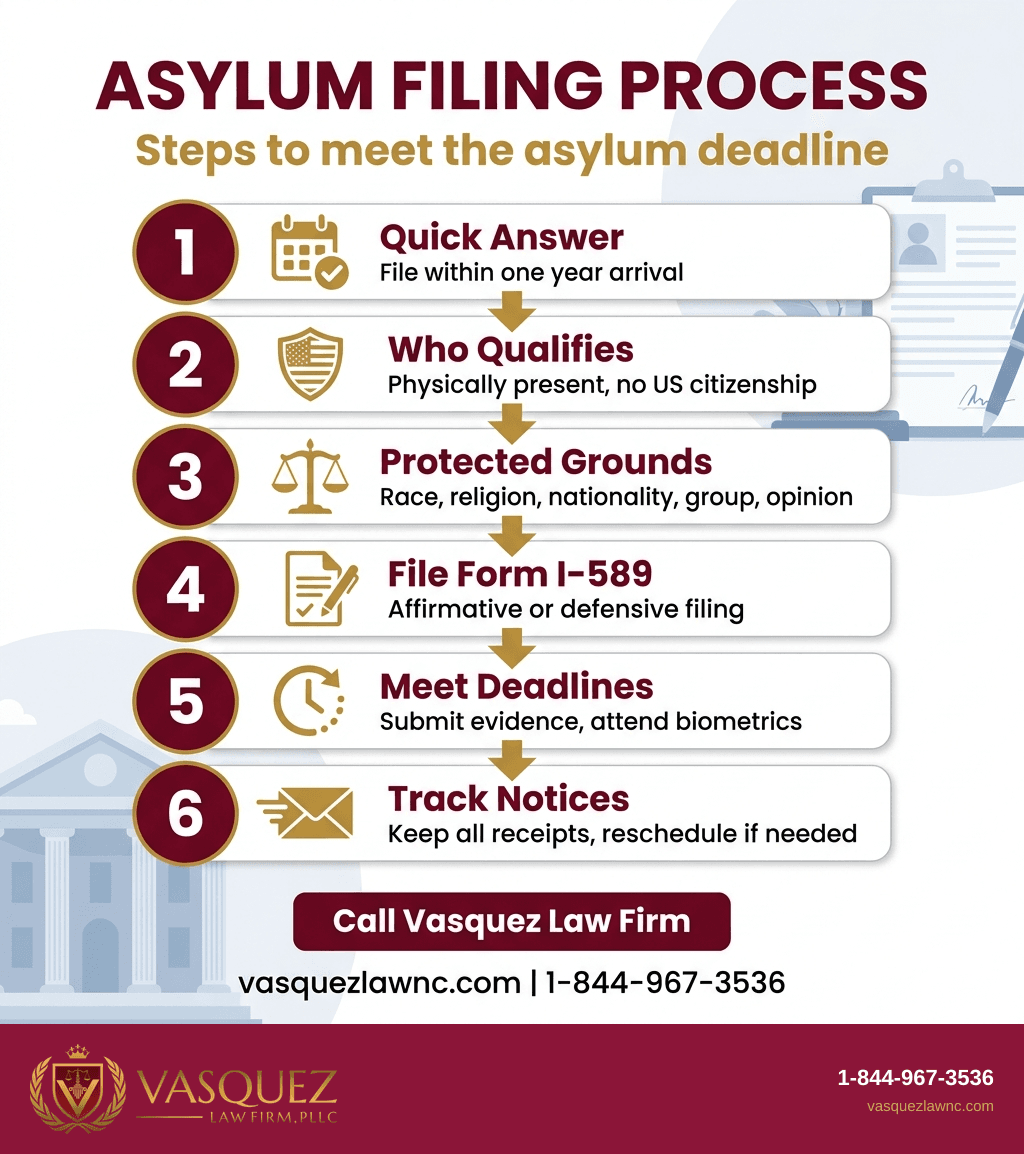
In most cases, a person physically present in the United States who is not a U.S. citizen must file Form I-589 within one year of arrival to seek asylum. The filing must connect the fear of persecution to a protected ground. A protected ground is a legally recognized reason for persecution. Filing, interview, biometric, and evidence deadlines can also affect work authorization.
- File Form I-589, Application for Asylum and for Withholding of Removal.
- Connect past or feared persecution to a protected ground.
- Preserve proof of arrival and supporting evidence.
- Track every USCIS biometrics and interview notice.
- Ask about deadlines that may apply to your facts.
Who can qualify for asylum in the United States?
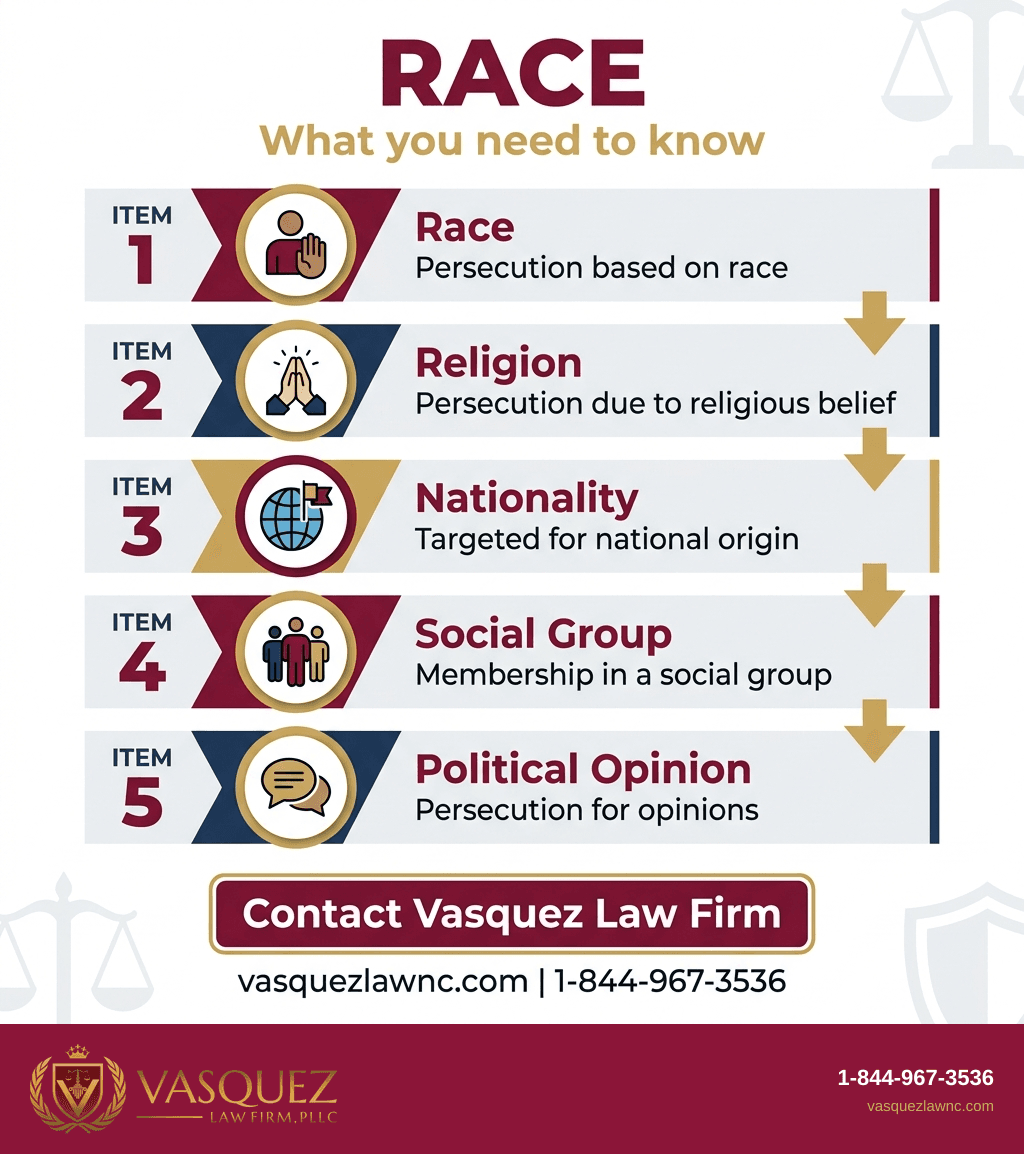
A person who fled threats because of political opinion faces a different legal question than a person who left solely to find work. Asylum in the U.S. is based on persecution suffered or feared. The persecution must relate to race, religion, nationality, membership in a particular social group, or political opinion.
USCIS describes these five protected grounds on its Asylum page. The person must be physically present in the United States. The person also cannot be a U.S. citizen. Eligibility depends on the facts and the evidence. It also depends on whether the feared harm has the required connection to a protected ground.
The process may be affirmative or defensive. Affirmative means USCIS considers Form I-589. Defensive means an immigration judge considers the request in removal proceedings. Removal proceedings are the court process used to decide whether a person may remain in the United States. A person with an affirmative filing should understand how immigration representation for asylum applications can help organize dates, evidence, and notices before important deadlines pass.
The five protected grounds
A strong filing identifies the specific protected ground. It also explains the link between that ground and the harm. A personal statement may matter. Country-condition materials may also matter. Records of threats, witness statements, and identity records may help. The right evidence depends on the person’s own history.
Every year people come to the United States seeking protection because they have suffered persecution or fear that they will suffer persecution due to: Race Religion Nationality Membership in a particular social group Political opinion
This USCIS Asylum page describes eligibility at a high level. It is not enough to use a protected-ground label. The applicant must provide truthful facts. The applicant must also provide supporting materials that explain why protection is sought.
What is the one-year filing deadline for asylum?
Someone arriving on January 10 should treat the next January 10 as a critical date to review. The person should not wait until that date to act. USCIS states that a person seeking asylum affirmatively or defensively files Form I-589 within one year of arrival in the United States.
The general deadline also appears in INA § 208(a)(2)(B), 8 U.S.C. § 1158(a)(2)(B), and 8 C.F.R. § 208.4(a). Arrival records can help establish the arrival date. Passport stamps and travel documents may also help. Other reliable records may matter as well. Keep copies of what was filed. Keep proof that USCIS received it.
This guide covers the general rule. Other deadline issues can apply in some cases. Ask a lawyer about your situation. Do not assume that time spent in the country resolves the issue. A pending application may not resolve it either. A later interview does not automatically resolve a one-year filing deadline asylum question.
Exceptions that change the deadline
The deadline has exceptions. Under INA § 208(a)(2)(D), 8 U.S.C. § 1158(a)(2)(D), and 8 C.F.R. § 208.4(a)(4)-(5), a late application may still be considered if the person shows changed circumstances that materially affect asylum eligibility, or extraordinary circumstances related to the delay in filing. The person must then file within a reasonable period given those circumstances, and the burden of proof is on the applicant. Asylum processing also has separate deadlines for evidence, interviews, and biometrics, which can affect a pending Form I-589.
For an individualized review of possible exceptions or other filing issues, collect the arrival record. Also collect the Form I-589 receipt and all notices. Prepare a timeline of relevant events. William J. Vasquez’s immigration profile explains the firm’s focus on federal immigration matters.
How do you file Form I-589 and prepare the asylum application?
A complete filing begins with a reliable timeline. Include the arrival date, threats or harm, moves, family changes, and every prior immigration filing. Form I-589 is the Application for Asylum and for Withholding of Removal. USCIS says online filing is available only to certain affirmative asylum applicants.
- Confirm whether Form I-589 should be filed affirmatively or in immigration court.
- Prepare a truthful account of past harm and feared future harm.
- Identify the protected ground connected to the harm.
- Gather identity, travel, family, and corroborating evidence.
- Keep the receipt number and monitor case status.
- Update contact information and respond to notices promptly.
USCIS identifies groups that cannot use online filing. These groups include certain applicants with pending Form I-589 applications. They also include some applicants required to file by mail. Filing instructions can depend on the applicant category. Check the current instructions before submitting anything.
In our experience, applicants often arrive for a consultation with a detailed story. However, they may have no date-by-date timeline. They may also lack copies of immigration notices. These documents are essential when evaluating the one-year filing deadline asylum issue. They help identify missed notices. They also help prepare a consistent application.
Can family members be included?
USCIS allows an applicant to include a spouse and children physically present in the United States. They may be included as dependents on an affirmative or defensive asylum application until a final decision. A dependent is a family member included in the main applicant’s case. A child included as a dependent must be unmarried and under age 21.
Family facts should be reviewed carefully before filing. Marriage records, birth certificates, addresses, and prior immigration filings should match the application when accurate. Inconsistencies can create avoidable questions later.
What interview and evidence rules should asylum applicants track?
Missing a scheduled interview can now have immediate consequences. As of October 2026, USCIS requires exceptional circumstances to reschedule an affirmative asylum interview. Exceptional circumstances are serious reasons that may justify missing the appointment. A person who misses the interview must submit a rescheduling request before the interview date. The person may also submit it within 10 calendar days after the missed interview date.
Starting Aug. 21, 2026, you must establish exceptional circumstances for USCIS to reschedule your asylum interview.
If a person maintains a lawful basis to remain in the United States and fails to appear, USCIS may dismiss the application. This may happen without a timely rescheduling request. If the person does not maintain a lawful basis, USCIS may refer the case to an immigration judge. USCIS also evaluates parole situations case by case. Parole is temporary permission to remain in the United States.
As of October 2026, USCIS says supporting evidence must reach the asylum office 14 calendar days before the scheduled interview. Late evidence may not be included. USCIS may instead reschedule the interview. Use a dated document checklist. Preserve delivery confirmation.
- Form I-589 receipt notice and all USCIS notices.
- Identity and travel records.
- A clear personal declaration.
- Records supporting threats, harm, or reporting.
- Witness statements where available.
- Translations and interpreter planning when required.
For help preparing an affirmative asylum filing, review the firm’s federal immigration legal services. This is general information. Each filing requires a review of its specific facts.
What if biometrics are missed?
Biometrics are identifying information, such as fingerprints or a photograph. As of October 2026, a person seeking a new biometric appointment after missing one must request rescheduling within 10 calendar days. The person must provide evidence of exceptional circumstances. USCIS says a missed biometrics appointment without the required request and evidence may lead to dismissal or referral. The result depends on lawful status.
When can a pending asylum applicant request a work permit?
A pending applicant may file Form I-765 for an employment authorization document, commonly called an EAD. The applicant may file after Form I-589 has been pending for 150 days. USCIS generally cannot grant the EAD until the asylum application has been pending for 180 days. This is often called the 180-Day Asylum EAD Clock.
Applicant-caused delays do not count toward the 180 days. USCIS lists several examples. They include requesting a case transfer, rescheduling an interview, and missing biometrics. They also include failing to provide a competent interpreter when required. Seeking to submit additional evidence at or after an interview is another example.
Use the official USCIS processing times tool for current form-specific information. Processing estimates vary by form and location. Do not confuse an EAD eligibility clock with a prediction of the final asylum decision.
What happens after an asylum grant?
USCIS states that an asylee is immediately authorized to work after asylum is granted. An asylee is a person who has received asylum. A person granted asylum may petition for a qualifying spouse or child through Form I-730 within two years of the grant. Humanitarian reasons may excuse the deadline.
USCIS also states that an asylee may be approved for a Green Card one year after the asylum grant by filing Form I-485. Each family member who received derivative asylum needs a separate Form I-485 packet. Derivative asylum is asylum given through a qualifying family relationship.
Which asylum filing mistakes can delay or damage a case?
A late evidence packet can change more than an interview date. USCIS warns that a rescheduled interview caused by late evidence can affect EAD eligibility. The safest approach is to treat every deadline as a document-management task. Do not treat it as a reminder to act later.
- Waiting near the one-year mark: Build the filing timeline early.
- Giving inconsistent dates: Compare the declaration with travel and immigration records.
- Missing a notice: Keep addresses current and open every USCIS mailing.
- Skipping biometrics: Request rescheduling within the stated 10-day period if an appointment is missed.
- Sending evidence late: Aim to deliver it at least 14 calendar days before the interview.
- Ignoring interpreter requirements: Plan for a competent interpreter if USCIS requires one.
- Assuming an EAD is automatic: File Form I-765 when eligible and protect the EAD clock.
If you remember one point, remember this: the asylum filing date requires attention. The interview date also requires attention. The biometrics date requires attention too. A written calendar with copies of every notice reduces preventable errors.
How does federal asylum law apply nationwide?
Asylum is a federal immigration benefit. Federal means that national law controls the benefit. The eligibility standards, Form I-589 process, and USCIS procedures discussed here apply nationwide. An individual’s court location, asylum office, and procedural history can still affect how the case proceeds.
The USCIS Asylum page, last reviewed August 26, 2026, includes alerts on affirmative interview rescheduling, evidence submission, and biometric rescheduling. It also explains that the Circumvention of Lawful Pathways rule may remain applicable, where appropriate, to certain people who entered through the southwest land border or adjacent coastal borders between May 12, 2023, and May 11, 2025.
A person facing removal proceedings should not assume an affirmative process remains available. The procedural setting matters. The USCIS Policy Manual is another official resource for immigration benefit guidance.
When should you call about an asylum deadline now?
A calendar date can become urgent quickly. This is especially true when it involves a missed interview or biometrics appointment. Request a free evaluation promptly if any of these situations applies:
- Your one-year arrival anniversary is approaching or has passed.
- You received a Form I-589 receipt or notice you do not understand.
- You missed an asylum interview.
- You missed a biometrics appointment.
- You need to submit evidence for an upcoming interview.
- You have questions about an EAD clock or Form I-765.
- You received a referral to immigration court.
Vasquez Law Firm can review documents. The firm can explain the next procedural questions in a free immigration evaluation. Se Habla Español.
Deadlines deserve prompt attention. Speak with Vasquez Law Firm about your asylum filing, notices, or interview preparation.
Call 1-844-967-3536. Se Habla Español.
About Vasquez Law Firm
Vasquez Law Firm handles immigration, personal injury, workers’ compensation, criminal defense, and traffic matters. For immigration clients, the firm provides federal immigration representation nationwide. It also offers in-person consultations in Raleigh, NC and Orlando, FL.
William J. Vasquez is admitted to the North Carolina State Bar and the Florida Bar. The firm’s Yo Peleo® commitment reflects direct, compassionate advocacy. Bilingual support staff are available for clients who prefer Spanish.
Attorney Trust and Experience
William J. Vasquez has practiced for more than 15 years. A consultation can help a person identify the documents, deadlines, and immigration notices that deserve immediate attention. A consultation cannot predict a result.
Frequently Asked Questions
Is there a one-year filing deadline for asylum applications?
Yes. In most cases, USCIS states that a person seeking asylum affirmatively or defensively files Form I-589 within one year of arrival in the United States. INA § 208(a)(2)(B) and 8 C.F.R. § 208.4(a) address the general rule. Other deadline issues can apply in some cases, so obtain advice about your particular facts.
Who qualifies for asylum in the United States?
A person may seek asylum if they suffered persecution or fear persecution because of race, religion, nationality, membership in a particular social group, or political opinion. The applicant must be physically present in the United States and not be a U.S. citizen. A complete assessment requires the person’s facts, evidence, and immigration history.
What happens if I miss an asylum interview?
As of October 2026, USCIS requires exceptional circumstances to reschedule an affirmative asylum interview. A request should be made before the interview or within 10 calendar days after the missed date. USCIS may dismiss an application for a person with a lawful basis to remain, or refer the matter to an immigration judge if the person lacks one.
When must evidence be submitted before an asylum interview?
As of October 2026, USCIS says evidence supporting an affirmative asylum application must be submitted to the asylum office 14 calendar days before the scheduled interview. Evidence sent later may not be included, or USCIS may reschedule the interview. A rescheduling caused by late evidence may also affect employment authorization eligibility.
When can I apply for an asylum work permit?
A pending asylum applicant may file Form I-765 under category (c)(8) after Form I-589 has been pending for 150 days. USCIS generally cannot issue the EAD until the application has been pending for 180 days. Applicant-caused delays, such as missed appointments or requested interview rescheduling, may stop time from counting toward that period.
Can I include my spouse and children on my asylum application?
USCIS allows an applicant to include a spouse and children physically present in the United States as dependents on an affirmative or defensive asylum application before a final decision. A child must be unmarried and under 21 to be included as a dependent. Family relationships and immigration records should be documented accurately in the filing.
Sources and References
Asylum in the U.S. depends on truthful facts, evidence, and strict attention to the one-year filing deadline. Contact Vasquez Law Firm for a free, confidential evaluation.
Start your free evaluation now
Call 1-844-967-3536. Se Habla Español.
Seeking Asylum in the US?
You must file within 1 year of arrival. Our attorneys can help build your case.
Keep Reading

For how Vasquez Law Firm can help, see our asylum page.
Reviewed by Attorney Vasquez, Managing Attorney

William Vasquez
Founder & CEO, Vasquez Law Firm, PLLC
William Vasquez is the founder and CEO of Vasquez Law Firm, PLLC, a results-driven firm specializing in immigration, criminal defense, personal injury, and workers' compensation. A U.S. Air Force veteran and recipient of the Joint Service Achievement Medal, William is dedicated to fiercely fighting for his clients' rights.
Related Legal Services
Need legal help? Learn more about immigration case consultation, or contact us for a free evaluation.
You can also visit NC immigration legal help for more information.