BIA Asylum Decision Reshapes Nationwide Claims in 2026
The BIA asylum decision creates a presumption against asylum claims from EU and named democracies. Review your options in a free evaluation today online.
Published on October 12, 2026
Talk to an immigration attorney
Free call. A clear plan for your case.
Free & confidential · Se habla espanol · 24/7

Have questions? Talk to an attorney - free evaluation.
Call 1-844-967-3536Worried how the latest immigration news affects you?
Schedule a confidential case review with an immigration attorney - know exactly where you stand.
USCIS Case Status
Check your USCIS case status
Enter your receipt number and get the official status. Free, no registration.
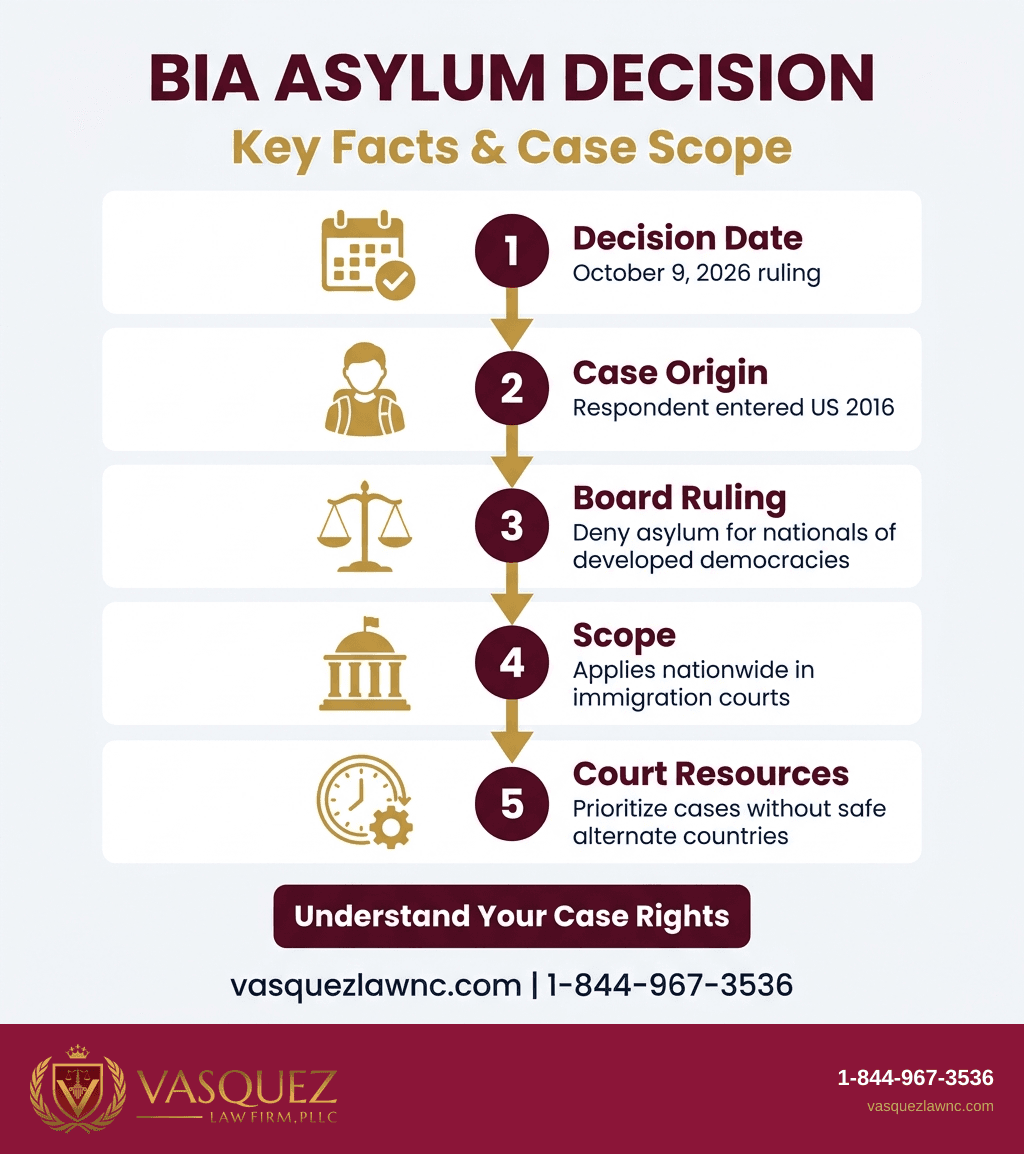
October 9, 2026 changed the starting point for certain asylum cases in immigration court. In Matter of B-S-A-N-, 30 I&N Dec. 145 (BIA 2026), the Board of Immigration Appeals, or BIA, said Immigration Judges should usually deny asylum applications from nationals of highly developed democratic countries that broadly protect human rights. The BIA asylum decision applies nationwide in the immigration court system.
The ruling came from a case involving a dual citizen of France and Gabon. She sought protection from removal to France. For people with asylum claims involving France, another European Union country, or another country named in the decision, early case review now matters more than ever. Our immigration attorneys can explain the federal asylum framework. They can also review the records in a particular case.
Legal disclaimer: This article gives general legal information. It is not legal advice for any person or case. Asylum facts, nationality, country conditions, and procedural history can change the analysis. Speak with qualified counsel about your circumstances.
What did the BIA asylum decision hold?
On October 9, 2026, the Board dismissed the appeal in Matter of B-S-A-N-, 30 I&N Dec. 145 (BIA 2026). The respondent entered the United States as a student in August 2016. She filed for asylum with USCIS in July 2018. She entered removal proceedings in July 2019.
She said that people linked to Gabon’s former governing party could harm her in France. She based this fear on her family’s political opposition. The Board found that she had not shown an objectively reasonable fear of persecution in France. It also noted that her sisters had lived there unharmed for years.
“Immigration Judges should generally deny asylum applications filed by nationals of highly developed, democratic countries that broadly respect and protect human rights, except in extraordinary circumstances involving national security or foreign policy considerations.”
The BIA asylum decision says judges may generally pretermit these applications at the master calendar stage. Pretermit means to decide a case without a full merits hearing. The Board connected this approach to limited court resources. In its view, courts should save those resources for people who cannot safely turn elsewhere.
The countries named by the Board
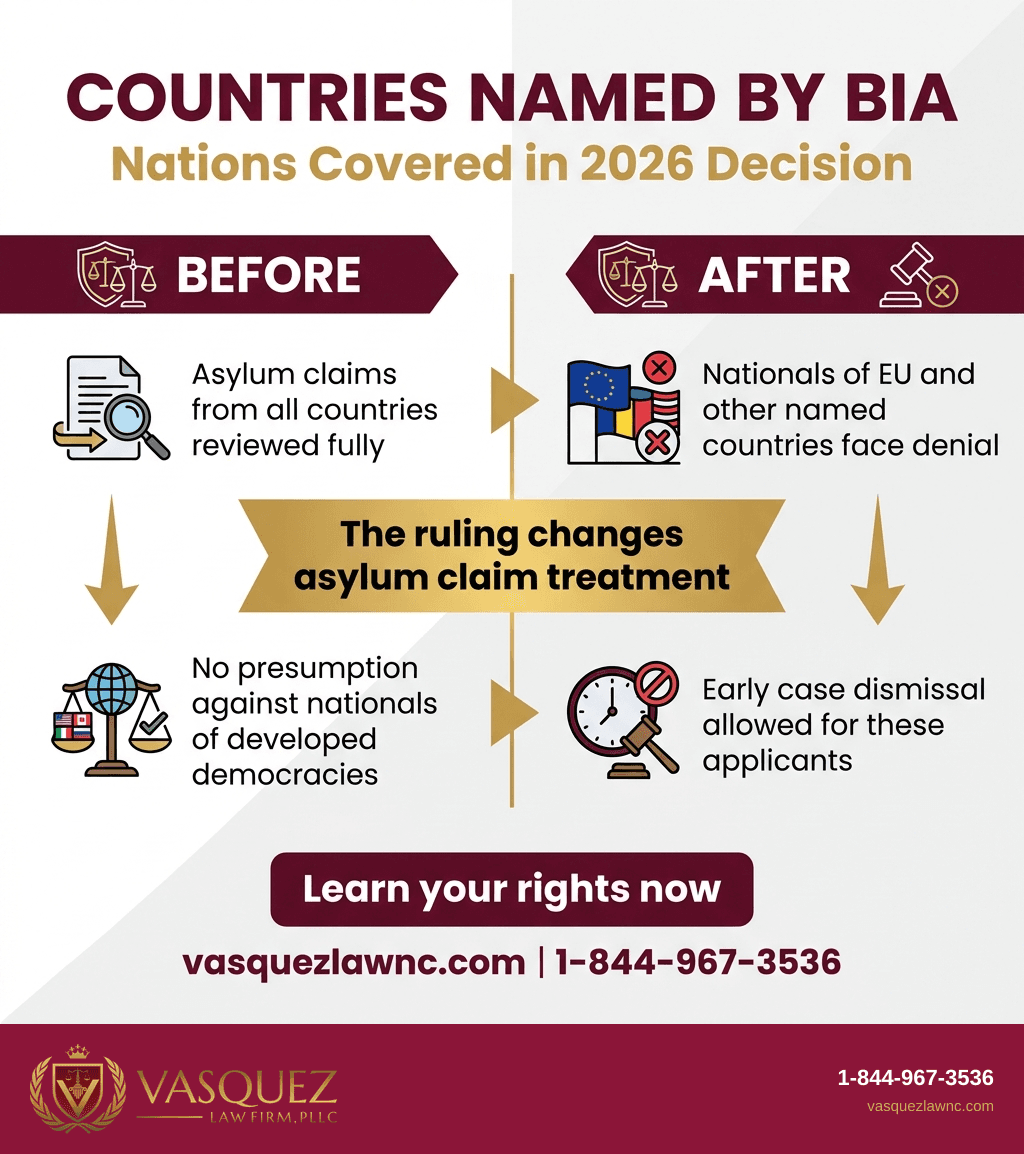
The opinion identifies all European Union member states. It also names Iceland, Liechtenstein, Norway, Switzerland, Monaco, Andorra, San Marino, the United Kingdom, Canada, Australia, New Zealand, Japan, and South Korea.
The decision also reaches statutory withholding of removal and Convention Against Torture protection claims from nationals of those countries. Statutory withholding of removal is protection that can stop removal when a person faces a required level of harm. Convention Against Torture protection is protection from removal when a person faces torture. The Board reasoned that these protections require a greater likelihood or degree of harm than asylum.
The ruling is not a new statute. It is a published BIA decision. Immigration Judges will face it in cases within its stated scope. A person facing proceedings should not assume that a prior asylum strategy will receive the same treatment after October 9.
Who can the BIA asylum decision affect?
The BIA asylum decision directly addresses nationals of the countries the Board described as highly developed democracies. It says those countries broadly respect and protect human rights. For European Union citizens, the decision adds a separate discretionary analysis based on EU free movement rights.
That difference matters. The case involved a person who held citizenship in both France and Gabon. Under Matter of B-R-, 26 I&N Dec. 119 (BIA 2013), which the Board cited, a dual national generally must show persecution and a lack of protection in each country of nationality to qualify for asylum.
EU citizens face an additional presumption
The Board held that EU citizens are presumptively ineligible for a discretionary asylum grant. The reason is that they can lawfully live indefinitely in another EU member state. Under the EU Directive discussed in the opinion, residence may depend on employment, self-employment, sufficient resources and health insurance, or enrollment in school with health insurance and resources.
“EU citizens are presumptively ineligible for a discretionary grant of asylum in the United States because they are entitled to indefinitely reside lawfully in any EU member state and thereby obtain safe haven.”
The opinion says national security or foreign policy considerations may overcome this presumption. It also recognizes that country conditions can change. Countries may later be added to or removed from the category described in the ruling.
Applicants from the named countries should focus on evidence that is personal, current, and independently confirmed. General accounts of crime or discrimination may not establish persecution. An unresolved police report may not establish it either. The Board repeated that persecution is an extreme concept. It also said that a government need not prevent every risk of private harm.
In our experience, the cases we handle often turn first on one question. Can the applicant connect the feared harm to specific evidence? That evidence must show that government protection is unavailable.
What the ruling does not erase
The BIA asylum decision does not remove the statutory right to apply for asylum under INA § 208(a)(1), 8 U.S.C. § 1158(a)(1). It instead sets out the Board’s approach to claims from the countries it names. Individual evidence remains central. This is especially true when nationality, prior residence, or a claimed place of removal creates a complicated record.
What asylum law still applies after this ruling?
Federal asylum law begins with the refugee definition in INA § 101(a)(42), 8 U.S.C. § 1101(a)(42). A refugee is generally a person who cannot or will not return to a country of nationality. The reason must be past persecution or a well-founded fear of persecution. That harm must relate to race, religion, nationality, political opinion, or membership in a particular social group.
INA § 208(b)(1)(A), 8 U.S.C. § 1158(b)(1)(A), permits a grant of asylum to an applicant who qualifies as a refugee. The word “may” matters. Asylum remains discretionary even after a person proves eligibility. Statutory withholding of removal uses a different and higher likelihood standard.
Under 8 C.F.R. § 1208.13(b)(1), past persecution can create a presumption of future persecution. A presumption is a rule that accepts a fact unless the other side rebuts it. Without that presumption, an applicant must establish a genuine fear. The applicant must also show an objectively reasonable basis for that fear. The BIA applied that framework to France in this case.
Country of removal also matters. The Board explained that the respondent’s withholding and Convention Against Torture claims were evaluated as to France. DHS designated France as the country of removal. Under 8 C.F.R. § 1240.11(c)(1), courts consider protection claims for countries to which the person may be removed. The countries are identified in the proceedings.
The Convention Against Torture regulations appear at 8 C.F.R. §§ 1208.16(c), 1208.17, and 1208.18. CAT protection concerns a likelihood of torture. The Board described this as a higher standard than the persecution showing required for asylum.
People who filed affirmatively with USCIS before entering court follow a different procedure. This differs from defensive asylum litigation before an Immigration Judge. The USCIS Policy Manual is an official source for USCIS adjudication policies. The BIA asylum decision concerns the immigration court framework.
What should an asylum applicant do now?
Applicants connected to a named country should first confirm every nationality they hold. They should also confirm every country DHS identifies as a possible place of removal. A passport, national identity record, birth certificate, prior visas, and immigration filings can each affect that analysis.
Next, organize evidence by the legal issue it proves. Helpful records may include threats, police reports, medical documents, messages, witness statements, and reliable country-condition materials. Explain what each item shows. Connect the evidence to a protected ground. Also explain why government protection would be unavailable in the relevant country.
EU citizens should document facts about residence in another member state. The Board’s opinion discusses employment, school enrollment, health insurance, financial resources, registration, and family-based residence rights. A claim that relocation is difficult needs evidence. Broad conclusions are not enough.
Review the procedural history as carefully as the fear claim. Identify whether the matter is an affirmative asylum case, a defensive asylum case, an appeal, or a case with a final order. Keep copies of every hearing notice and filing receipt. The immigration court hearing guide may help readers track court-related changes.
Do not create or change evidence. The BIA described fraudulent conduct as an adverse discretionary factor. A clear timeline and authentic records give counsel a stronger basis for reviewing available arguments.
Need to assess how this BIA asylum decision fits your record? Vasquez Law Firm offers a free immigration evaluation. Se Habla Español.
What should applicants watch next?
The October 9 ruling says country conditions can change over time. Applicants should watch for later published EOIR BIA decisions. Those decisions may apply, limit, or revisit Matter of B-S-A-N-. Applicants should also watch for changes in the conditions of countries named in the opinion.
The practical question is whether a person can present individualized evidence strong enough to meet the asylum standard. For an EU citizen, the question also includes whether that person can overcome the discretionary presumption described by the Board. Answering these questions requires close review of nationality, the designated country of removal, and supporting proof.
People with pending USCIS matters can check the agency’s processing times page for general case-processing information. People in immigration court should preserve notices. They should also check case communications through official EOIR channels.
Readers can also review our updates on the USCIS asylum office process and third-country removal issues. Those subjects involve different procedural questions. They still show why the destination country and case posture must be examined early.
Frequently Asked Questions
Does the BIA asylum decision automatically deny every claim from a named country?
No. The Board said Immigration Judges should generally deny these applications, with an exception for extraordinary national security or foreign policy circumstances. The decision also recognizes that country conditions may change. Applicants should still assess their individual evidence, nationalities, and the country or countries relevant to removal.
Which countries does Matter of B-S-A-N- name?
The decision includes every European Union member state, Iceland, Liechtenstein, Norway, Switzerland, Monaco, Andorra, San Marino, the United Kingdom, Canada, Australia, New Zealand, Japan, and South Korea. Its reasoning centers on the Board’s assessment of democratic institutions, human rights protections, and effective justice systems.
Why does EU citizenship matter in this ruling?
The Board found that EU citizens are presumptively ineligible for discretionary asylum because they can lawfully reside indefinitely in other EU member states. The opinion discusses EU rules allowing residence through work, self-employment, sufficient resources and insurance, or qualifying study. Family members may also have related residence rights.
Can a dual citizen qualify for asylum?
Dual citizenship can create an added burden. The BIA cited Matter of B-R- for the rule that a dual national generally must show a well-founded fear of persecution and lack of protection in each country of nationality. In this case, the respondent did not establish an objectively reasonable fear in France.
Does this decision affect withholding of removal and CAT protection?
Yes. The Board said its holding also applies to statutory withholding and CAT claims from nationals of the identified countries. It reasoned that withholding requires a greater likelihood of harm, while CAT requires torture and a greater degree of government involvement than asylum’s government-protection analysis.
Are BIA decisions relevant to USCIS asylum cases?
Published BIA decisions address immigration law questions that can affect asylum analysis across federal immigration adjudication. Procedure still matters. USCIS handles affirmative asylum filings, while Immigration Judges hear defensive cases in removal proceedings. A pending case should be evaluated based on its filing history, current posture, and the evidence already submitted.
Do not make high-stakes asylum decisions from a headline alone. Contact Vasquez Law Firm for a free consultation with an immigration team that meets clients in Raleigh, NC and Orlando, FL.
Request your free consultation
Legal disclaimer: Past outcomes do not guarantee a result. This information is general and does not create an attorney-client relationship.
References
Reviewed by Attorney Vasquez, Managing Attorney
Seeking Asylum in the US?
You must file within 1 year of arrival. Our attorneys can help build your case.
Keep Reading


William Vasquez
Founder & CEO, Vasquez Law Firm, PLLC
William Vasquez is the founder and CEO of Vasquez Law Firm, PLLC, a results-driven firm specializing in immigration, criminal defense, personal injury, and workers' compensation. A U.S. Air Force veteran and recipient of the Joint Service Achievement Medal, William is dedicated to fiercely fighting for his clients' rights.
Related Legal Services
Need legal help? Learn more about get immigration legal help today, or contact us for a free evaluation.
You can also visit immigration lawyers serving all of North Carolina for more information.