Fourth Circuit Remands Asylum Reopening Request for Reconsideration in 2026
In 2026, the Fourth Circuit remanded a family's asylum reopening request for reconsideration of death-threat evidence. Request a free evaluation.
Published on October 15, 2026· Updated October 15, 2026
Talk to an immigration attorney
Free call. A clear plan for your case.
Free & confidential · Se habla espanol · Mon-Fri 8am-7pm, Sat 9am-2pm (ET)

Have questions? Talk to an attorney - free evaluation.
Call 1-844-967-3536Worried how the latest immigration news affects you?
Schedule a confidential case review with an immigration attorney - know exactly where you stand.
USCIS Case Status
Check your USCIS case status
Enter your receipt number and get the official status. Free, no registration.
The Fourth Circuit found that the Board of Immigration Appeals gave too little weight to death threats against a Honduran mother and daughter’s family. The court granted the petition for review, vacated the Board’s order denying the motion to reopen, and remanded the matter for further proceedings. The decision may still be reviewed by the U.S. Supreme Court.
The ruling matters because an asylum claim can depend on a difficult legal question. The question is whether the harm happened because of a protected ground, such as family membership. People in removal proceedings can speak with our immigration attorneys. They can discuss how their evidence, case history, and available relief fit together.
Legal information disclaimer: This article provides general information. It is not legal advice for any person’s case. A court remand means that a court sends a case back. A remand is not an asylum approval. Each claim depends on its own evidence, filing record, and immigration posture. Immigration posture means the person’s current position in the immigration process. Our immigration legal team represents clients in federal immigration matters nationwide.
What happened in the Fourth Circuit asylum decision?
A petition for review asks a higher court to review an agency decision. The court vacated the Board’s February 28, 2025 order and remanded the case. The published opinion came from a mother’s request to reopen her asylum proceedings after threatening notes were delivered to her mother in Honduras.
The record described several acts of violence against the family. The applicant’s brother-in-law was shot on April 2, 2015. He was shot after opposing a local gang. One month later, men posing as police officers removed her husband from the family home at gunpoint. She reported the abduction. She then fled Honduras with her daughter.
An immigration judge found her testimony credible. Credible means believable. The judge still denied asylum. The judge decided that the earlier evidence did not sufficiently connect the harm to the protected group she identified. That group was the immediate members of her husband’s family. The Board affirmed that result.
Later, the applicant submitted two threatening notes, a police report, and sworn affidavits with her motion to reopen. An affidavit is a written statement sworn to be true. The notes called her a snitch. They threatened her, her daughter, and family members. Her mother recognized tattoos on the people who delivered the notes. The tattoos were associated with the gang described in the record.
“We grant the Petition for Review, vacate the BIA’s order, and remand for further proceedings consistent with this opinion.”
The Board first denied reopening on August 4, 2022. The Fourth Circuit vacated that order. The Board denied reopening again in 2025. The court concluded that the BIA placed too little weight on the evidence of nexus put forth by the petitioners.
Who can this Fourth Circuit asylum decision affect?
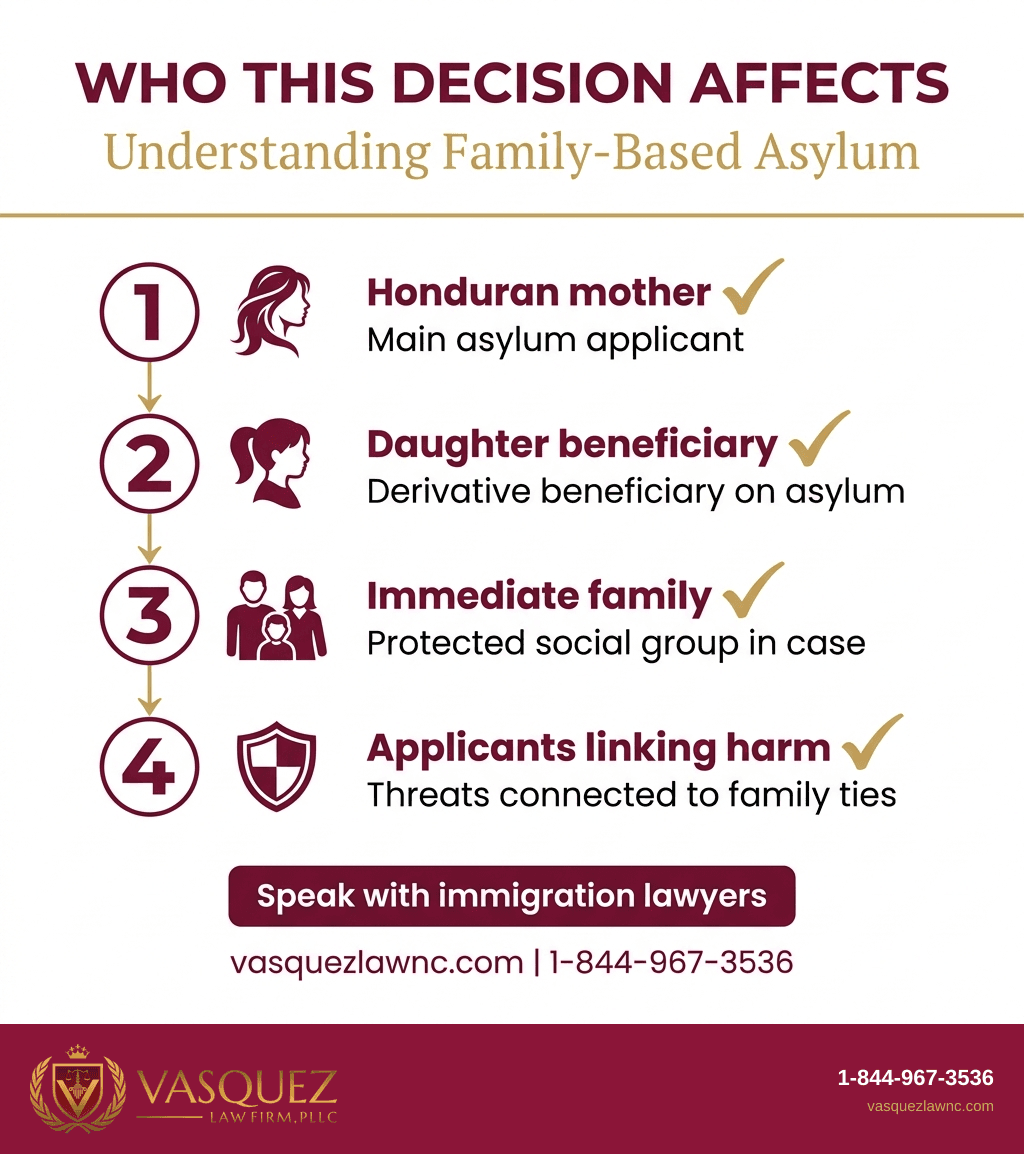
The immediate parties are a Honduran mother and her daughter. The daughter was listed as a derivative beneficiary on her mother’s asylum application. A derivative beneficiary is a family member who may receive a benefit through the main applicant.
The reasoning is most relevant to asylum applicants who claim persecution connected to family membership. Persecution means serious harm or threats because of a protected reason. The Immigration and Nationality Act recognizes persecution based on membership in a particular social group. A particular social group is a defined group of people recognized under asylum law. Under Fourth Circuit precedent discussed by the court, an immediate family can qualify as that type of group.
Family membership does not need to be the only reason for the feared harm. It must be at least one central reason. The court explained that an agency cannot look only at a threat’s stated purpose. It must also consider the family relationship. That relationship may explain why the person became a target.
That distinction drove this case. The government described the threats as retaliation because the applicant reported the abduction. Retaliation means punishment or harm for taking a particular action. The court concluded that her relationship to her husband was central. That relationship helped explain why she reported his disappearance. It also helped explain why she became caught up in the violence affecting the family. It helped explain why she received the later threats.
“Her relationship to [her husband] ‘was a central reason why she, and not another person,’ reported his abduction to the police, triggering retaliation.”
The court also emphasized a difference between two situations. In one, a relative is targeted as part of a broader pattern. In the other, a person is threatened only because they witnessed a crime. The notes here allegedly targeted the applicant, her daughter, and other relatives. The court held that the new evidence established the required nexus to her family membership. Nexus means the required connection between persecution and a protected ground.
In our experience, the cases we handle often turn on whether the records tell one consistent story. Threats, affidavits, and prior testimony must also fit that story. Together, these materials may help show why a person was targeted.
Why the family connection mattered
The court found that the Board relied too heavily on an earlier finding. That finding came before the death threats. The newer evidence could support an inference about the family’s experience. An inference is a conclusion drawn from the facts. The evidence could show that the violence, police report, and later threats formed one connected pattern involving the family.
The Fourth Circuit asylum decision also relied on earlier family-nexus cases. The court discussed prior decisions involving threats connected to family relationships and distinguished cases where the evidence did not show family-focused targeting.
What asylum law governed the court’s ruling?
Federal asylum law requires an applicant to show past persecution. The applicant may instead show a well-founded fear of persecution. The harm must be on account of a protected ground. The Fourth Circuit cited 8 U.S.C. § 1101(a)(42)(A). This law includes race, religion, nationality, political opinion, and membership in a particular social group.
The court also applied 8 U.S.C. § 1158(b)(1)(B)(i). That provision requires a protected ground to be at least one central reason for the persecution. The court called this required connection nexus. In plain terms, nexus asks whether the protected ground helped cause the harm.
This was also a motion-to-reopen case. A motion to reopen asks the Board to look again at a completed case. The motion relies on material evidence that was previously unavailable. Material evidence is evidence that could affect the result. The opinion explained that these motions face a demanding standard. The legal system has an interest in finality. Finality means that a case should eventually reach a final end.
Still, finality does not allow the agency to ignore important evidence. The Fourth Circuit applied the reasonable-likelihood test discussed in Mouns v. Garland. This test asks whether the new evidence makes relief reasonably likely at a new hearing. Relief means an immigration benefit or protection from removal.
What the court did not decide
The court did not decide whether the family will receive asylum. It sent the motion to reopen back to the Board for further proceedings. It also said it did not need to decide whether any part of the Board’s earlier 2022 decision, which the court had vacated, is relevant to this proceeding.
What should you do if new threats support your asylum case?
Preserve new evidence in its original form. Keep threatening notes, envelopes, photographs, messages, police reports, witness affidavits, medical records, and documents showing family relationships. Record how each item was received. Also record who can verify the item.
Organize the facts as a timeline. Separate the underlying harm from the reports made to authorities. Then list later threats and evidence showing why family membership mattered. The Fourth Circuit’s analysis shows why context can matter as much as one document.
Review prior immigration filings and decisions closely. A motion to reopen must address the prior record. It must explain why the evidence was unavailable earlier. It must also show why the new facts could change the result. A mismatch between old findings and later evidence may require careful legal analysis.
Do not alter documents. Do not submit information that cannot be supported. Ask relatives or witnesses with direct knowledge to provide truthful, detailed affidavits. If documents are in another language, immigration filings commonly require an English translation. They commonly also require a translator certification.
Build the evidence before presenting it
Start with the immigration judge’s decision, the Board order, and the asylum application. Collect every exhibit previously filed. Then compare the new evidence with the specific reason relief was denied. For asylum claims, the central question is often more than whether threats occurred. The question is also why the persecutor targeted that person.
Need to understand whether new evidence could matter in your immigration case? Vasquez Law Firm offers free immigration evaluations. Se Habla Español.
What should you watch after this asylum remand?
The court remanded the case so the Board could reconsider the motion to reopen in light of the new evidence and the continuity reflected in the full story.
It is not yet settled whether the Board will grant the motion to reopen after reconsideration. Readers tracking federal immigration adjudication can consult the USCIS Policy Manual for USCIS policy materials. Board appeals and federal court petitions follow their own procedures.
The practical rule remains clear. Credible new evidence may matter when it changes the explanation for who was targeted and why. The Fourth Circuit asylum decision reminds readers to consider an asylum record as one complete account. It should not be treated as a series of disconnected events.
Frequently Asked Questions
Did the Fourth Circuit grant asylum in this case?
No. The court granted the petition for review, vacated the Board’s denial of reopening, and remanded the matter.
What is a motion to reopen in an asylum case?
A motion to reopen asks the Board of Immigration Appeals to revisit a completed proceeding based on previously unavailable evidence. In No. 25-1280, the applicant submitted threatening notes, a police report, and affidavits as new evidence. The Fourth Circuit applied a reasonable-likelihood standard to assess whether the evidence could justify further proceedings.
Can family membership support an asylum claim?
It can. The Fourth Circuit explained that an immediate family may be a particular social group under asylum law. The applicant must still show nexus, meaning that family membership was at least one central reason for the persecution. A family relationship cannot be assumed from harm alone. The evidence must show the required connection.
What does nexus mean in asylum law?
Nexus is the connection between feared harm and a protected ground under the Immigration and Nationality Act. In this case, the court found that the Board gave insufficient weight to evidence that the threats were intertwined with the applicant’s relationship to her husband and his family. A persecutor can have more than one motive, but the protected ground must be central.
Why did the death threats matter to the court?
The court treated a credible threat of death as persecution and found that the later threats changed the evidentiary picture. The notes allegedly targeted the applicant, her daughter, and other family members after the applicant reported her husband’s abduction. The court concluded that the Board did not adequately consider what those threats suggested about the broader family-related pattern.
Can new evidence change a prior asylum denial?
New evidence can support a motion to reopen when it was unavailable during the earlier proceeding and creates a reasonable likelihood of relief. The evidence must be relevant to the reason the claim was denied. The Fourth Circuit found that the Board should have considered whether later threats supported a new inference about the gang’s role and the family-based nexus.
Every asylum record has its own facts, deadlines, and risks. Contact Vasquez Law Firm for a free evaluation of your immigration options. We meet immigration clients in Raleigh, NC and Orlando, FL, and serve immigration clients nationwide.
Attorney advertising. This article is general legal information and is not individualized legal advice.
Sources
Reviewed by Attorney Vasquez, Managing Attorney
Seeking Asylum in the US?
You must file within 1 year of arrival. Our attorneys can help build your case.

Keep Reading


William Vasquez
Founder & CEO, Vasquez Law Firm, PLLC
William Vasquez is the founder and CEO of Vasquez Law Firm, PLLC, a results-driven firm specializing in immigration, criminal defense, personal injury, and workers' compensation. A U.S. Air Force veteran and recipient of the Joint Service Achievement Medal, William is dedicated to fiercely fighting for his clients' rights.
Related Legal Services
Need legal help? Learn more about get immigration legal help today, or contact us for a free evaluation.
You can also visit our NC immigration team for more information.