DHS Finalizes Earlier End of Certain Automatic EAD Extensions
DHS finalizes the end of certain automatic EAD extensions for renewals filed on or after Oct. 30, 2025, with exceptions. Request a free evaluation.
Published on October 15, 2026· Updated October 15, 2026
Talk to an immigration attorney
Free call. A clear plan for your case.
Free & confidential · Se habla espanol · Mon-Fri 8am-7pm, Sat 9am-2pm (ET)
Have questions? Talk to an attorney - free evaluation.
Call 1-844-967-3536Worried how the latest immigration news affects you?
Schedule a confidential case review with an immigration attorney - know exactly where you stand.
USCIS Case Status
Check your USCIS case status
Enter your receipt number and get the official status. Free, no registration.
DHS Finalizes Earlier End of Certain Automatic EAD Extensions
Legal disclaimer: This article provides general immigration information, not legal advice for any individual case. Employment authorization depends on the category, filing history, and underlying immigration status.
An Employment Authorization Document (EAD) is a card that shows a person has permission to work in the United States. In DHS's example, an adjustment applicant whose EAD expired on May 30, 2026 and whose February 4, 2026 renewal remained unadjudicated could not continue working on or after May 31, 2026 unless authorized to work on a separate basis. This example appears in DHS's final rule. The rule became effective October 14, 2026. It makes final the earlier end of the automatic EAD extension.
The immigration attorneys at Vasquez Law Firm help people review work-authorization records and renewal choices under federal law.
DHS estimated that, in a single 18-month period beginning in May 2027, roughly 20,000 to 33,000 EADs could lapse under its assumptions. The agency also estimated $312.1 million in possible employer labor-turnover costs during that period.
What happened to automatic EAD extensions?
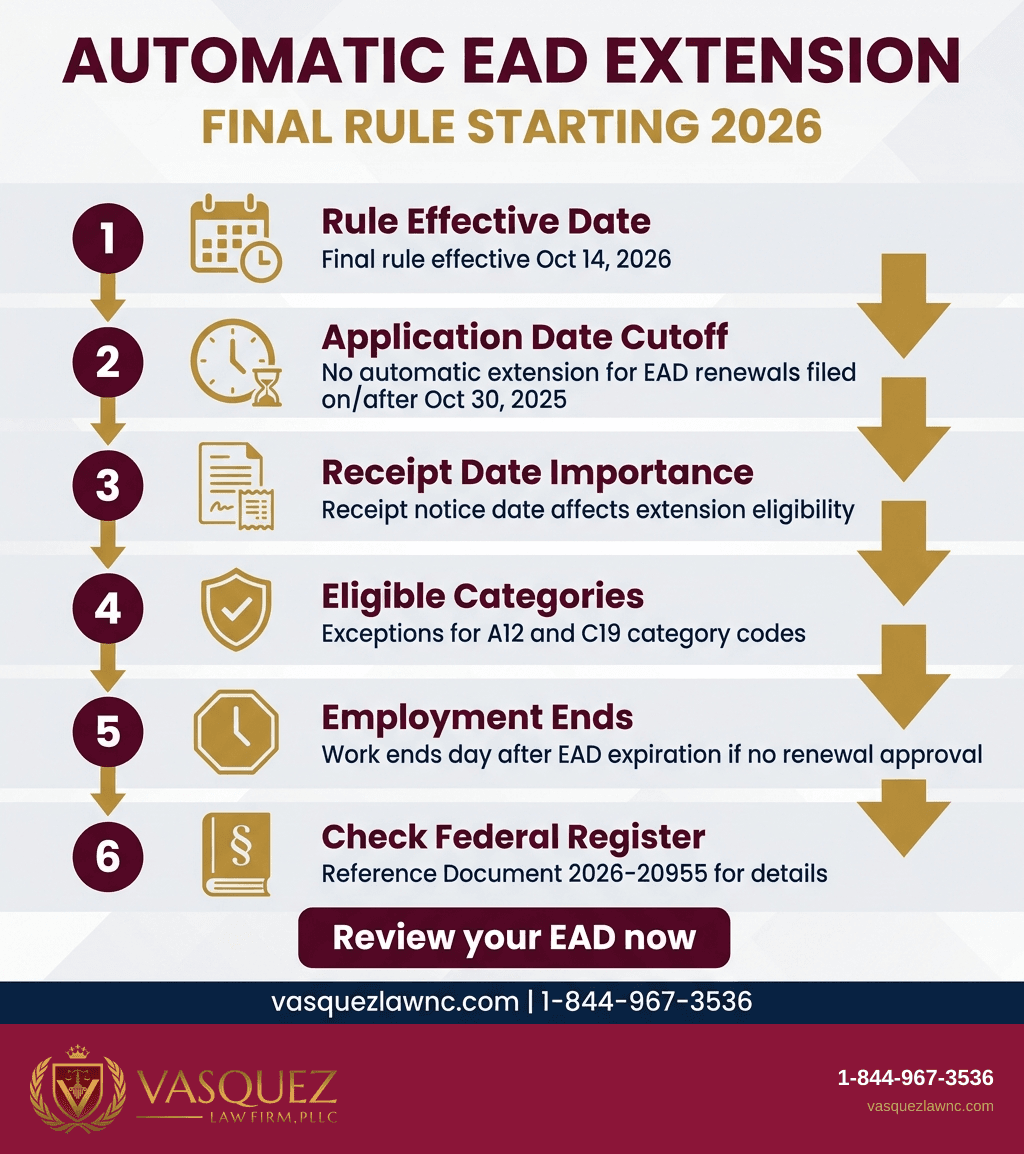
On October 14, 2026, a final rule from USCIS became effective. The rule concerns the removal of automatic extensions for certain Employment Authorization Documents. The rule follows an interim final rule published October 30, 2025.
This difference is important. The automatic EAD extension ended for many renewal applications filed on or after October 30, 2025. The October 2026 action makes that earlier regulatory change final. It does not create a new automatic extension end date for those later filings.
This final rule adopts as final, without change, the amendments to 8 CFR 274a.13(d) and (e) in the IFR, published on October 30, 2025, at 90 FR 48799.
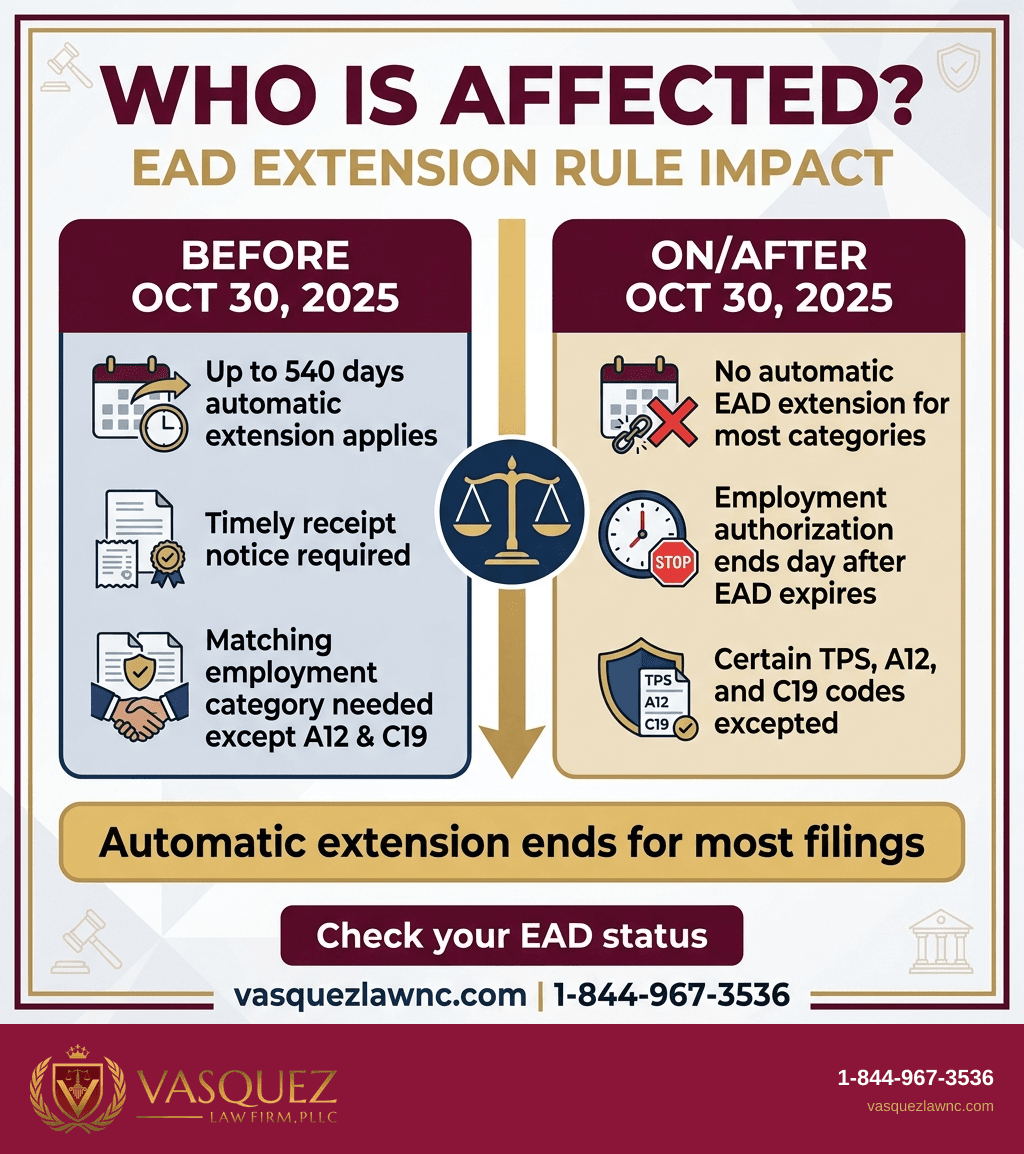
Under 8 CFR 274a.13(e), the validity period of an expired or expiring Employment Authorization Document and/or employment authorization will not be automatically extended by a renewal EAD application filed on or after October 30, 2025, unless otherwise provided in 8 CFR 274a.13(d), by law, or through a Federal Register notice for Temporary Protected Status-related employment documentation.
DHS says it ended automatic extensions for several reasons. The agency wants vetting, screening, eligibility review, and a discretionary determination where applicable before it issues a new period of employment authorization. DHS received 653 public comments during the 33-day post-promulgation comment period. It then finalized the interim rule without changes.
Why the date on the receipt notice matters
For a qualifying renewal filed before October 30, 2025, the older up-to-540-day automatic extension may still apply. The applicant needs a timely Form I-797C receipt notice. The applicant also needs an EAD based on the same employment eligibility category, subject to the regulatory rules. A12 and C19 category codes receive a stated exception to the matching-category requirement.
A receipt notice is a notice from USCIS that confirms it received a filing. The date on that notice can affect which rule applies. Read the Federal Register final rule, Document 2026-20955, alongside the applicant's EAD and receipt notice. Those three items establish the core timeline.
Who is affected by the automatic EAD extension end?
The end of automatic EAD extensions affects people who must obtain employment authorization from USCIS and who file an EAD renewal on or after October 30, 2025. Examples include people with a pending adjustment of status application or a pending asylum application.
An adjustment of status application asks USCIS to approve permanent residence from inside the United States. An asylum application asks for protection from persecution or a well-founded fear of persecution. These descriptions explain the examples. They do not change the rule.
For these applicants, the EAD expires and employment authorization terminates the day after the end-validity date shown on the card, unless an applicable exception or separate basis for employment authorization applies. If USCIS later approves the renewal, the person may again work during the validity period printed on the new EAD.
Therefore, renewal EAD applicants no longer receive an up to 540-day automatic extension of their employment authorization and/or EAD validity if they file their application on or after October 30, 2025.
Certain individuals are employment authorized incident to status under 8 CFR 274a.12(a). This means their employment authorization is tied to their immigration status.
DHS uses an L-2 spouse as an example. An L-2 spouse who remains in valid L-2 status can remain employment-authorized even after an EAD used as evidence expires. The expired card, however, no longer proves authorization.
Temporary Protected Status, or TPS, is a temporary immigration protection for nationals of certain designated countries. TPS-related employment documentation may follow an applicable Federal Register notice under INA section 244, 8 U.S.C. 1254a, and 8 CFR part 244.
Employment verification has immediate consequences
Employment verification is the process employers use to confirm that workers may work in the United States. Employers must follow employment-verification rules under INA section 274A, 8 U.S.C. 1324a. INA means the Immigration and Nationality Act.
An employee whose authorization has lapsed cannot keep working solely because a renewal remains pending.
In our experience, the first question is usually whether a pending I-765 receipt alone permits continued work. The answer depends on the filing date, category, and any separate authorization basis.
What law governs EAD renewal and work authorization?
Congress gave the Secretary of Homeland Security authority to administer and enforce immigration laws in INA section 103(a), 8 U.S.C. 1103(a). The Secretary is the head of DHS.
INA section 274A(h)(3), 8 U.S.C. 1324a(h)(3), recognizes authority to grant employment authorization to noncitizens in the United States. A noncitizen is a person who is not a U.S. citizen.
Before November 2016, 8 CFR 274a.13(d) stated that USCIS would adjudicate an EAD application within 90 days of receipt. If USCIS did not adjudicate the EAD application within that timeframe, the alien was eligible to request an interim EAD with a validity period not to exceed 240 days.
An interim EAD is temporary work authorization issued while USCIS decides an application. A 2016 rule replaced interim EADs with a maximum 180-day automatic extension for certain renewal applicants.
DHS later increased the extension period temporarily in May 2022 and April 2024. A December 2024 final rule indefinitely increased the automatic extension to up to 540 days for covered applications. The current final rule keeps that framework only for qualifying renewal applications filed before October 30, 2025.
Work authorization is not the same as an EAD card
An EAD, Form I-766, is evidence of employment authorization. It is proof of work permission in situations where the law requires that proof. Work authorization itself is the legal permission to work.
For individuals whose employment authorization is based on their immigration status, that status determines whether they may work. For others, USCIS determines the length of the period of employment authorization and issues an EAD reflecting the validity period.
DHS states that asylum applicants may receive employment authorization under INA section 208(d)(2), 8 U.S.C. 1158(d)(2), after 180 days have passed since the asylum application was filed. That statutory authority remains separate from whether a renewal applicant receives an automatic extension.
A statute is a law passed by Congress. A regulation is a rule issued by a federal agency under authority given by law. These two types of rules can affect work authorization in different ways.
For related asylum procedure context, see our discussion of the asylum one-year filing deadline. That filing rule and EAD renewal timing are different legal questions.
What should you do before your EAD expires?
Start by reading the expiration date on the front of the EAD. Then compare it with the receipt date on any Form I-797C for the Form I-765 renewal. Preserve copies of the EAD, receipt notice, Form I-765 filing materials, and the immigration document that supports the work-authorized category.
Form I-765 is the USCIS application used to request an EAD. Form I-797C is a USCIS notice commonly used to confirm receipt of a filing. Keep these records together because the filing date and category may determine whether an automatic extension applies.
- Identify whether the renewal was properly filed before October 30, 2025 or on or after that date.
- Confirm the EAD category code and whether the category is employment-authorized incident to status or requires USCIS approval.
- Check the case through the official USCIS Processing Times page and retain every USCIS notice.
- Tell an employer only what employment-verification rules require, using valid documents and accurate information.
- Seek legal review before working after the printed EAD expiration date if no automatic extension or separate work-authorization basis applies.
Do not assume that every pending renewal has the same result. The cases we handle often turn on a small record detail. The EAD category or the date USCIS received the renewal can be especially important.
A review by our federal immigration legal team can identify the relevant rule and documents. The review does not assume that every pending renewal qualifies for an extension.
Concerned about an EAD expiration? Request a free evaluation with Vasquez Law Firm. We offer in-person immigration consultations in Raleigh, NC and Orlando, FL. Se Habla Español.
What should you watch next?
Watch USCIS updates to the EAD automatic-extension guidance, I-9 Central, and the Handbook for Employers, M-274. DHS states that USCIS updated its website, I-9 Central, and the M-274 after the interim final rule.
I-9 Central provides information about Form I-9 employment verification. The Handbook for Employers, M-274, gives employers instructions for completing that process.
TPS holders and applicants should also watch for Federal Register notices governing TPS-related employment documentation. Those notices can provide exceptions recognized by 8 CFR 274a.13(e).
The final rule contains a severability provision. This provision states DHS intends unaffected provisions to remain in place to the greatest extent possible if a court limits part of the rule.
For current agency guidance, consult the USCIS Policy Manual and your own case notices. People with pending asylum matters may also find our overview of an asylum referral without interview useful for understanding a separate procedural issue.
Frequently Asked Questions
Does a pending Form I-765 renewal automatically allow me to work?
Not for a renewal filed on or after October 30, 2025, unless an exception applies. The final rule reaffirmed and finalized the interim rule's earlier removal of the general automatic extension for those filings. USCIS approval, a qualifying earlier filing, status-based authorization, or an applicable TPS notice can change the analysis.
Does this rule cancel my underlying immigration application?
No. DHS states the rule does not eliminate employment authorization or prevent eligible people from obtaining renewed authorization. It ends an intermediate automatic extension while USCIS reviews a renewal. A pending adjustment or asylum matter remains legally distinct from the EAD renewal question.
What documents should I keep?
Keep the EAD, I-797C receipt notice, Form I-765 filing record, and documents showing the underlying category or status. These documents help determine whether the older up-to-540-day provision applies and whether a separate authorization basis exists.
Can an employer accept an expired EAD with a receipt notice?
Only if an automatic extension or other exception still applies, for example a qualifying renewal filed before October 30, 2025. For renewal EAD applications filed on or after October 30, 2025, the general automatic extension of employment authorization and/or EAD validity does not apply, subject to exceptions under 8 CFR 274a.13(d), by law, or through an applicable Federal Register notice for TPS-related employment documentation. Employers should use USCIS I-9 guidance for document-review obligations.
Does TPS have the same rule?
TPS-related employment documentation can be governed by an applicable Federal Register notice under INA section 244 and 8 CFR part 244. The final rule expressly preserves that route. The exact notice and the individual's TPS situation control the analysis.
Where can I get case-specific help?
Bring the EAD, receipt notice, immigration filings, and any employer communication to a qualified immigration attorney. Do not rely on a pending receipt alone without checking the filing date and category. Each work-authorization question needs an individualized review.
Legal disclaimer: This information is general and does not create an attorney-client relationship. For guidance on your documents and options, contact Vasquez Law Firm for a free evaluation.
Protect your ability to work lawfully. Vasquez Law Firm can review your EAD renewal record and explain your options under the final rule.
Sources
Reviewed by Attorney Vasquez, Managing Attorney
Need legal help?
Immigration in NC and FL. Personal injury and workers compensation across NC. Criminal defense in Johnston, Harnett, Pitt and Cumberland counties, and traffic tickets in 11 NC counties. Tell us your county and we will tell you exactly what we can do.
Keep Reading


William Vasquez
Founder & CEO, Vasquez Law Firm, PLLC
William Vasquez is the founder and CEO of Vasquez Law Firm, PLLC, a results-driven firm specializing in immigration, criminal defense, personal injury, and workers' compensation. A U.S. Air Force veteran and recipient of the Joint Service Achievement Medal, William is dedicated to fiercely fighting for his clients' rights.
Related Legal Services
Need legal help? Learn more about immigration lawyers in North Carolina, or contact us for a free evaluation.
You can also visit immigration legal services throughout NC for more information.