How to Get a Green Card If Born to a Foreign Government Employee?
If you were born in the United States to a foreign government employee, you are not a U.S. citizen at birth under the 14th Amendment. However, as of September 4, 2026, USCIS allows you to register for lawful permanent resident status and obtain a Green Card under a new interim final rule. This article explains who qualifies, the application process, and what to expect.
Published on October 31, 2026· Updated October 31, 2026
Talk to an immigration attorney
Free call. A clear plan for your case.
Free & confidential · Se habla espanol · Mon-Fri 8am-7pm, Sat 9am-2pm (ET)
Have questions? Talk to an attorney - free evaluation.
Call 1-844-967-3536Free Tool
Check Your USCIS Case Status Now
Enter your receipt number - get the official USCIS status in English or Spanish. No registration.
This article gives general legal information. It is not legal advice for your specific situation. Reading it does not create an attorney-client relationship. For advice about your situation, contact Vasquez Law Firm.
What changed with USCIS rules about Green Cards for children born to foreign government employees?
Filing or renewing a green card?
Adjustment-of-status timing, RFEs, and travel risks all change with new policy. 15-min review of your specific case.
On September 4, 2026, USCIS published an Interim Final Rule (IFR). An IFR is a federal rule that takes effect before the usual full rulemaking process ends. The rule is titled "Registration of Lawful Permanent Residence for Children Born to Foreign Government Employees in the United States."
The USCIS page describes a process for eligible people to register for lawful permanent residence. It allows them to register for lawful permanent residence, which means permanent immigration status. A lawful permanent resident receives a Green Card. According to the USCIS page, these children are not U.S. citizens at birth under the 14th Amendment if neither parent was a U.S. citizen at the time of birth.
USCIS also released a new edition of Form I-485. This form supports the application process. However, DHS states that it will not implement the IFR or the new form edition for certified class members, or otherwise act contrary to the preliminary injunction, unless and until the government obtains relief from that injunction. A preliminary injunction is a court order that temporarily stops government action. The order is in Casa Inc. v. Trump, No. 8:25-cv-00201 (D. Md Sep. 2, 2026).
On Sept. 4, 2026, USCIS published the Registration of Lawful Permanent Residence for Children Born to Foreign Government Employees in the United States, Interim Final Rule and a new 09/04/26 edition of the Form I-485, Application to Register Permanent Residence or Adjust Status. Given the injunction currently in place in Casa Inc. v. Trump, No. 8:25-cv-00201 (D. Md Sep. 2, 2026), DHS will not take actions to implement the IFR or the 09/04/26 edition of Form I-485 specifically to any member of the certified class, or otherwise conflict with the preliminary injunction, unless and until the government obtains relief from the injunction.
DHS will not take actions to implement the IFR or the 09/04/26 edition of Form I-485 specifically to any member of the certified class, or otherwise conflict with the preliminary injunction, unless and until the government obtains relief from the injunction. If the government obtains timely relief from the injunction, DHS will implement the rule accordingly.
If you were born in the United States to a foreign government employee and at the time of birth, neither parent was a U.S. citizen, you are not a U.S. citizen at birth under the 14th Amendment to the U.S. Constitution. However, you may be eligible to register for lawful permanent resident status and receive a Green Card.
USCIS states:
"If you were born in the United States to a foreign government employee and at the time of birth, neither parent was a U.S. citizen, you are not a U.S. citizen at birth under the 14th Amendment to the U.S. Constitution. However, you may be eligible to register for lawful permanent resident status and receive a Green Card." (Source: USCIS, https://www.uscis.gov/green-card/green-card-eligibility/green-card-for-a-person-born-in-the-united-states-to-a-foreign-government-employee)
Who is affected by the new USCIS Green Card registration rule for children of foreign government employees?
The rule applies to people born in the United States to a foreign government employee. If at the time of birth, neither parent was a U.S. citizen, you are not a U.S. citizen at birth under the 14th Amendment to the U.S. Constitution.
At birth, a parent must have fallen within a qualifying foreign-government-employee category. These categories include accredited foreign diplomatic officers, qualifying embassy or consulate employees, people employed by a foreign government in an official capacity, and employees of international organizations possessing international organization immunity.
Specifically, the rule covers parents who were:
- Foreign diplomatic officers accredited to the United States, including ambassadors, ministers, chargés d'affaires, counselors, secretaries, attachés of embassies and legations, and members of the Delegation of the Commission of the European Communities.
- Parents with comparable diplomatic status and immunities accredited to the United Nations or the Organization of American States.
- Persons employed by a foreign embassy or consulate who are nationals of that foreign country.
- Persons employed by a foreign government in an official capacity.
- Persons employed by an international organization possessing international organization immunity.
The rule also excludes certain categories. These exclusions matter because not every foreign government worker qualifies.
Subject to individualized determinations of employment status, visa class, and purpose of travel, and except for employees in the accredited foreign diplomatic officer category, exclusions include personal employees or attendants of foreign government or international officials, such as chauffeurs and housecleaners, and employees of state-owned enterprises other than those in A or G nonimmigrant status.
Subject to the same diplomatic-officer exception and individualized determinations, exclusions also include third-country nationals working for foreign governments; contractors of foreign missions, international organizations, or governments, except those in A or G nonimmigrant status; and foreign government employees visiting the United States in a personal rather than official capacity.
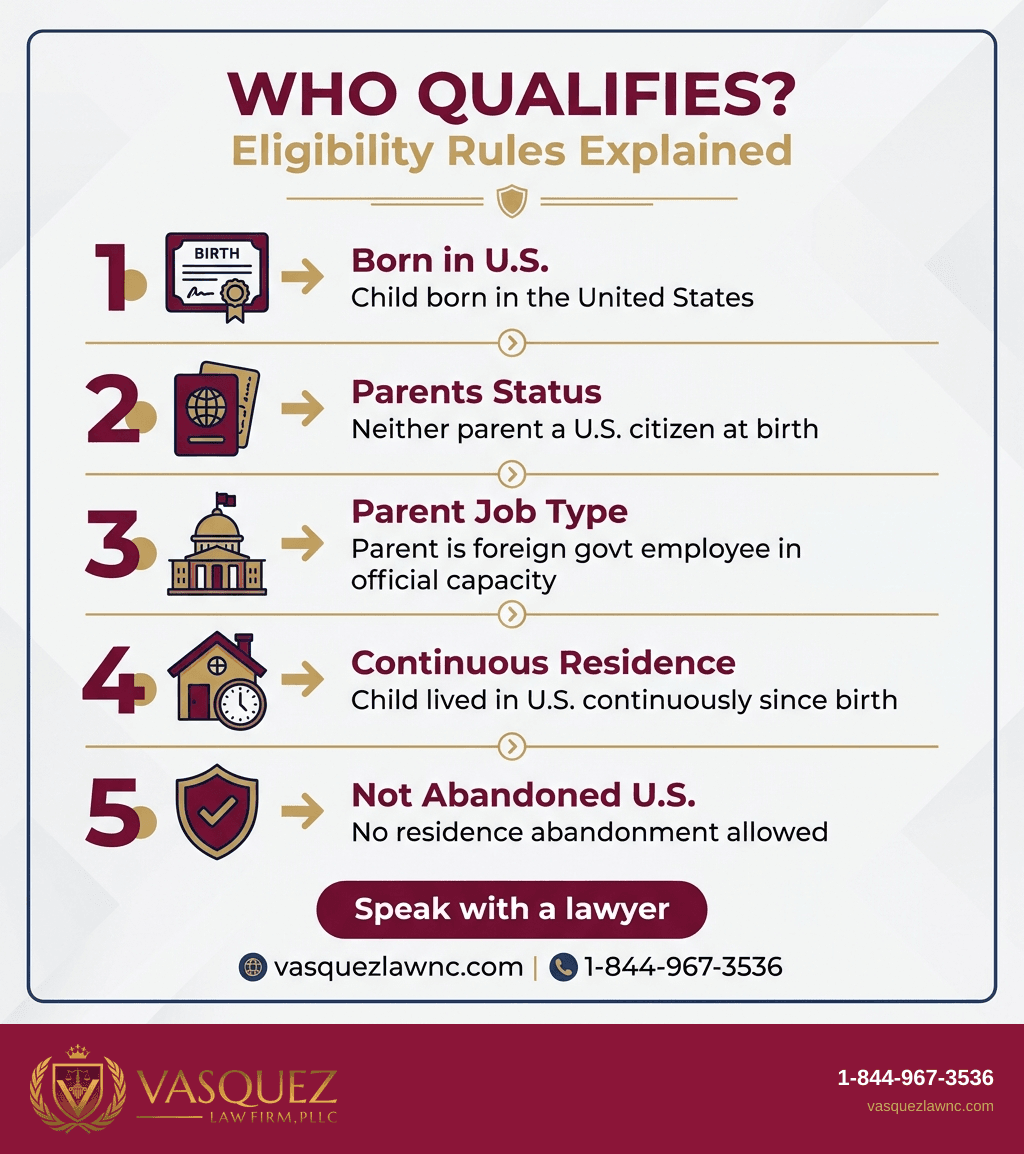
To qualify, the child must have had continuous residence in the United States since birth. The page requires continuous residence since birth; it does not define this as uninterrupted physical presence. The child must not have abandoned residence in the U.S.
In practical terms, the child must have lived in the U.S. from birth until now. A person should carefully review any long trips outside the country. Travel records may help show whether residence continued.
USCIS clarifies:
"You may be eligible to register as a lawful permanent resident and receive a Green Card if you meet all of the following conditions: You were born in the United States to a foreign government employee; Neither of your parents was a U.S. citizen; You have had continuous residence in the United States since birth; and You have not abandoned your residence in the United States." (Source: USCIS, https://www.uscis.gov/green-card/green-card-eligibility/green-card-for-a-person-born-in-the-united-states-to-a-foreign-government-employee)
What does the law say about Green Card eligibility for children born to foreign government employees?
The legal basis for this rule comes from the 14th Amendment and immigration statutes. The 14th Amendment grants citizenship to people born in the United States. It has an exception for children born to foreign diplomats or people with diplomatic immunity.
Diplomatic immunity is legal protection from some U.S. laws and court actions. According to the USCIS page, children born in the United States to qualifying foreign government employees are not U.S. citizens at birth under the 14th Amendment if neither parent was a U.S. citizen at the time of birth.
The Immigration and Nationality Act (INA) is the main federal immigration law. USCIS cites INA sections 101(a)(20), 103, 262, and 264 for further information.
Regulations at 8 CFR 101.3, 101.4, and 264.2 also provide relevant definitions and rules.
If applicable, applicants must relinquish any rights, privileges, exemptions, or immunities available to them as children of foreign government employees before permanent residency provisions apply. Relinquishment means giving up those protections.
Applicants must relinquish any applicable rights, privileges, exemptions, or immunities available to them as children of foreign government employees before permanent residency provisions apply. This requirement can be especially important for people who still hold protected status.
USCIS explains the scope of foreign government employees:
"With the exception of employees who fall under the category of foreign diplomatic officers accredited to the United States, the term ‘foreign government employee’ does not include the following based on individualized determinations of employment status, visa class, and purpose of travel: Personal employees or attendants of foreign government or international officials, such as personal assistants, chauffeurs, and housecleaners and others hired by individual foreign government employees; Employees of state-owned enterprises except those in A or G nonimmigrant status; Third-country nationals working for a foreign government; Employees of international organizations beyond those designated by executive order as enjoying immunity in the United States under the International Organizations Immunities Act; Contractors of foreign missions, international organizations or governments except those in A or G nonimmigrant status; and Foreign government employees visiting the United States in a personal rather than official capacity." (Source: USCIS, https://www.uscis.gov/green-card/green-card-eligibility/green-card-for-a-person-born-in-the-united-states-to-a-foreign-government-employee)
Eligibility depends on a parent's qualifying employment at the time of birth and the other listed conditions; diplomatic immunity is not stated as a universal requirement for every employment category. The framework follows U.S. constitutional and immigration law.
A person should not assume that a parent’s government job is enough. The parent’s exact position, visa class, and purpose of travel may matter. USCIS may review those facts individually.
What should you do to apply for a Green Card if born to a foreign government employee?
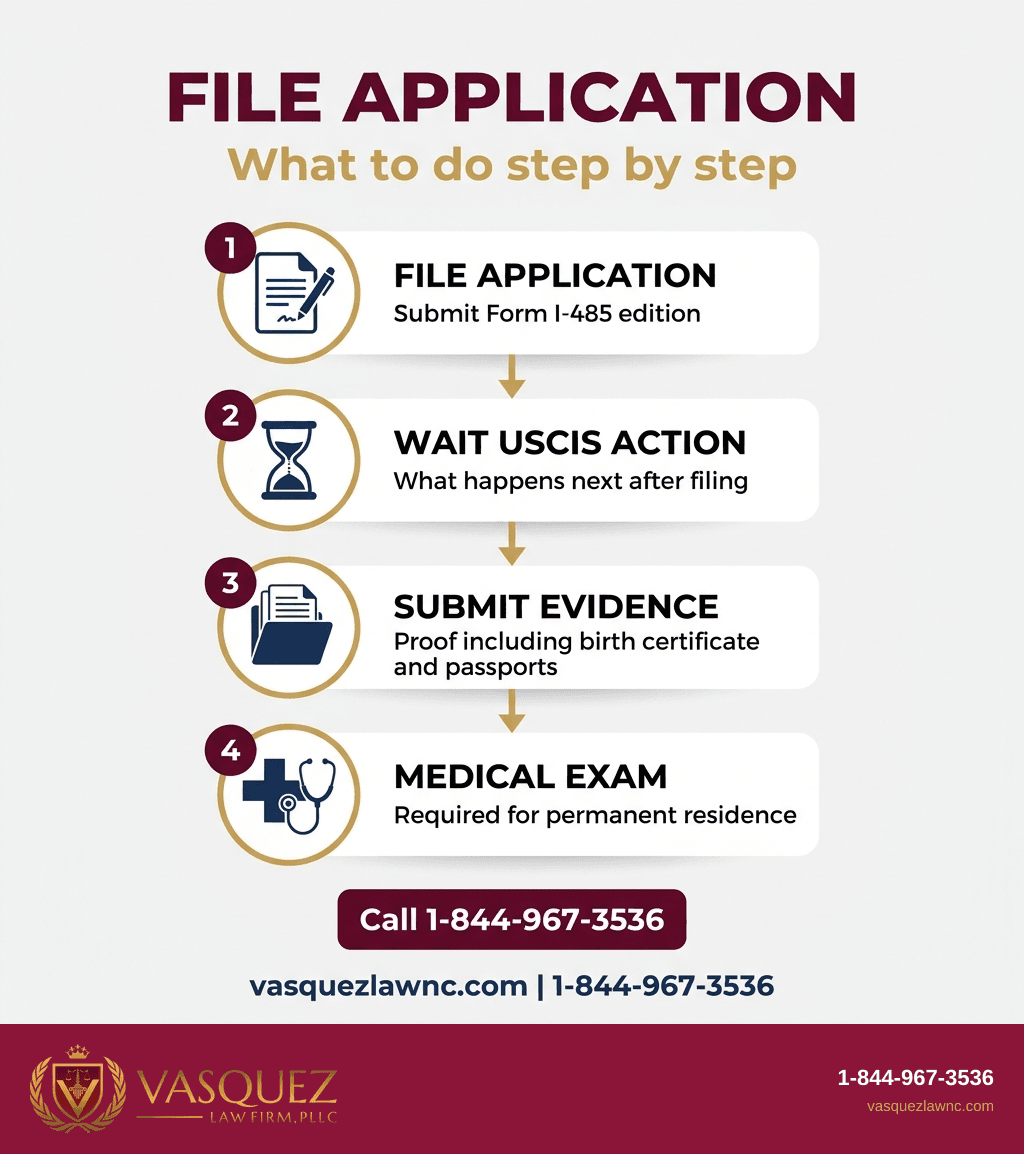
If you meet the eligibility criteria, you may voluntarily register as a lawful permanent resident. You do this by filing Form I-485, Application to Register Permanent Residence or Adjust Status. Check current USCIS instructions for the applicable edition; DHS states that it will not implement the 09/04/26 edition for certified class members, or otherwise conflict with the injunction, unless and until the government obtains relief.
You must include supporting evidence with the application. This evidence should prove your birth in the U.S. It should also prove your parent's foreign government employment.
You must show continuous residence since birth. If applicable, you must show that you relinquished diplomatic privileges. The documents should be clear and complete.
Supporting documents include:
- Two passport-style photos
- Government-issued photo ID
- U.S. birth certificate
- Passport pages with visa and admission stamps (if applicable)
- Form I-94, Arrival/Departure Record (if applicable)
- List of all arrivals in and departures from the United States, if not shown in the documents above
- Form I-508, Waiver of Rights, Privileges, Exemptions, and Immunities (if applicable)
- Form I-566, Interagency Record of Request for A, G, or NATO Dependent Employment Authorization or Change/Adjustment To/From A, G, or NATO Status (if applicable)
- Certified court records if arrested previously
You are not required to undergo a medical exam for this application. A medical exam is therefore not part of this filing requirement.
You also cannot apply for employment authorization or travel documents based on your pending I-485. Employment authorization is permission to work in the United States. Travel documents can support travel while another immigration application is pending.
Work and travel authorization depends on your current nonimmigrant status, if any. Nonimmigrant status is temporary immigration permission for a specific purpose.
In our experience with immigration cases, applicants are often confused about diplomatic immunities. Some do not realize that, if applicable, they must relinquish those protections before the provisions of permanent residency apply to them.
This step is crucial and often overlooked. We advise clients to collect documents carefully. The documents should prove continuous residence and parental employment status.
Complete evidence can help avoid delays or denials. A delay means USCIS takes longer to decide the case. A denial means USCIS does not approve the application.
Here are practical steps to follow:
- Confirm your eligibility: born in the U.S. to a foreign government employee with no U.S. citizen parent.
- Gather all required evidence, including birth certificate, parental employment proof, and residence history.
- Complete Form I-485 using the edition applicable under current USCIS instructions and the injunction's restrictions.
- If applicable, complete Form I-508 to waive diplomatic privileges.
- Submit the application package with applicable fees to USCIS.
- Maintain your current lawful status or residence while your application is pending.
- Consult an immigration attorney to review your case and documents before filing.
Keep copies of everything you send to USCIS. Also keep delivery information and any USCIS notices. These records can help you track the application.
What's Your Immigration Situation?
Answer 3 questions - we'll tell you your options
Question 1 / 3
What best describes your situation?
Keep Reading
What happens next after filing the Green Card application under this rule?
To register as a lawful permanent resident and obtain a Green Card, you need to file Form I-485, Application to Register Permanent Residence or Adjust Status.
USCIS requires evidence of continuous residence since birth and evidence that the applicant was born to a foreign government employee.
USCIS states that applicants are not entitled to apply for employment authorization or travel documents based on this pending I-485. They may, however, be eligible to work and travel based on their nonimmigrant status, if any.
The preliminary injunction limits implementation: DHS will not implement the rule for certified class members or otherwise act contrary to the injunction unless and until the government obtains relief. The injunction is in Casa Inc. v. Trump. DHS will not take actions to implement the IFR or the new Form I-485 edition for members of the certified class unless the government obtains relief from the injunction.
A certified class is a group of people covered by a court’s class-action order. The court’s order may protect everyone in that group.
USCIS states:
"Given the injunction currently in place in Casa Inc. v. Trump, No. 8:25-cv-00201 (D. Md Sep. 2, 2026), DHS will not take actions to implement the IFR or the 09/04/26 edition of Form I-485 specifically to any member of the certified class, or otherwise conflict with the preliminary injunction, unless and until the government obtains relief from the injunction." (Source: USCIS, https://www.uscis.gov/green-card/green-card-eligibility/green-card-for-a-person-born-in-the-united-states-to-a-foreign-government-employee)
If the government obtains timely relief from the injunction, DHS says it will implement the rule accordingly. Applicants should monitor USCIS announcements. They should also consult legal counsel about timing and procedure.
The process may change after court action. Applicants should use the correct Form I-485 edition and follow current USCIS instructions. They should not rely only on older guidance.
What are common questions about Green Card eligibility for children born to foreign government employees?
Can a child born in the U.S. to a foreign diplomat automatically get U.S. citizenship?

According to the USCIS page, a child born in the United States to a qualifying foreign government employee is not a U.S. citizen at birth under the 14th Amendment if neither parent was a U.S. citizen at that time. The child may be eligible to register for permanent residence if the other conditions are met. Implementation of the September 2026 rule remains subject to the injunction.
What evidence is needed to prove eligibility for the Green Card application?
You must submit a copy of your U.S. birth certificate, proof your parent was a foreign government employee at birth, and evidence of continuous residence in the United States. Forms waiving applicable rights, privileges, exemptions, or immunities are required only if applicable. Other required evidence includes two passport-style photos and a copy of government-issued photo ID; passport pages and Form I-94 are required if applicable.
Do I need a medical exam to apply for permanent residence under this rule?
No. USCIS does not require a medical examination for creating a record of permanent resident status for children born to foreign government employees under this rule.
Can I work or travel while my Green Card application is pending?
You cannot apply for employment authorization or travel documents based on this pending I-485. You may nevertheless be eligible to work and travel based on your nonimmigrant status, if any.
Is applying for this Green Card mandatory?
No. Registration for lawful permanent residence under this rule is entirely voluntary. You may choose whether to apply based on your circumstances.
This article provides general legal information, not individualized legal advice. Reading does not create an attorney-client relationship. For advice specific to your situation, contact Vasquez Law Firm.
If you need legal assistance, learn more about speak with an immigration lawyer, or call us at 1-844-967-3536 for a free evaluation.
Reviewed by William Vasquez, Founder & CEO, Vasquez Law Firm, PLLC.
Related Topics

William Vasquez
Founder & CEO, Vasquez Law Firm, PLLC
William Vasquez is the founder and CEO of Vasquez Law Firm, PLLC, a results-driven firm specializing in immigration, criminal defense, personal injury, and workers' compensation. A U.S. Air Force veteran and recipient of the Joint Service Achievement Medal, William is dedicated to fiercely fighting for his clients' rights.
Related Legal Services
Need legal help? Learn more about speak with an immigration lawyer, or contact us for a free evaluation.
You can also visit our North Carolina immigration practice for more information.