F-1 Students Can Protect Status After Graduation
F-1 student visas require full-time study and approved work. Understand graduation options, OPT rules, and status risks. Call for a free evaluation.
Published on October 30, 2026· Updated October 30, 2026
Talk to an immigration attorney
Free call. A clear plan for your case.
Free & confidential · Se habla espanol · Mon-Fri 8am-7pm, Sat 9am-2pm (ET)
Have questions? Talk to an attorney - free evaluation.
Call 1-844-967-3536Worried how the latest immigration news affects you?
Schedule a confidential case review with an immigration attorney - know exactly where you stand.
USCIS Case Status
Check your USCIS case status
Enter your receipt number and get the official status. Free, no registration.
F-1 Students Can Protect Status After Graduation
An F-1 student visa requires more than going to school. Students must stay enrolled full time, make academic progress, work only when allowed, and act before the program end date. This guide explains these duties and choices after graduation.
Do you have questions about F-1 student visas or choices after graduation? Vasquez Law Firm offers a free immigration evaluation by phone or Zoom. Se Habla Español.
Call 1-844-967-3536.
Quick Answer
F-1 students must follow the study purpose for which the visa was issued. Before graduation, speak with the designated school official, keep records current, and get approval before working or beginning practical training.
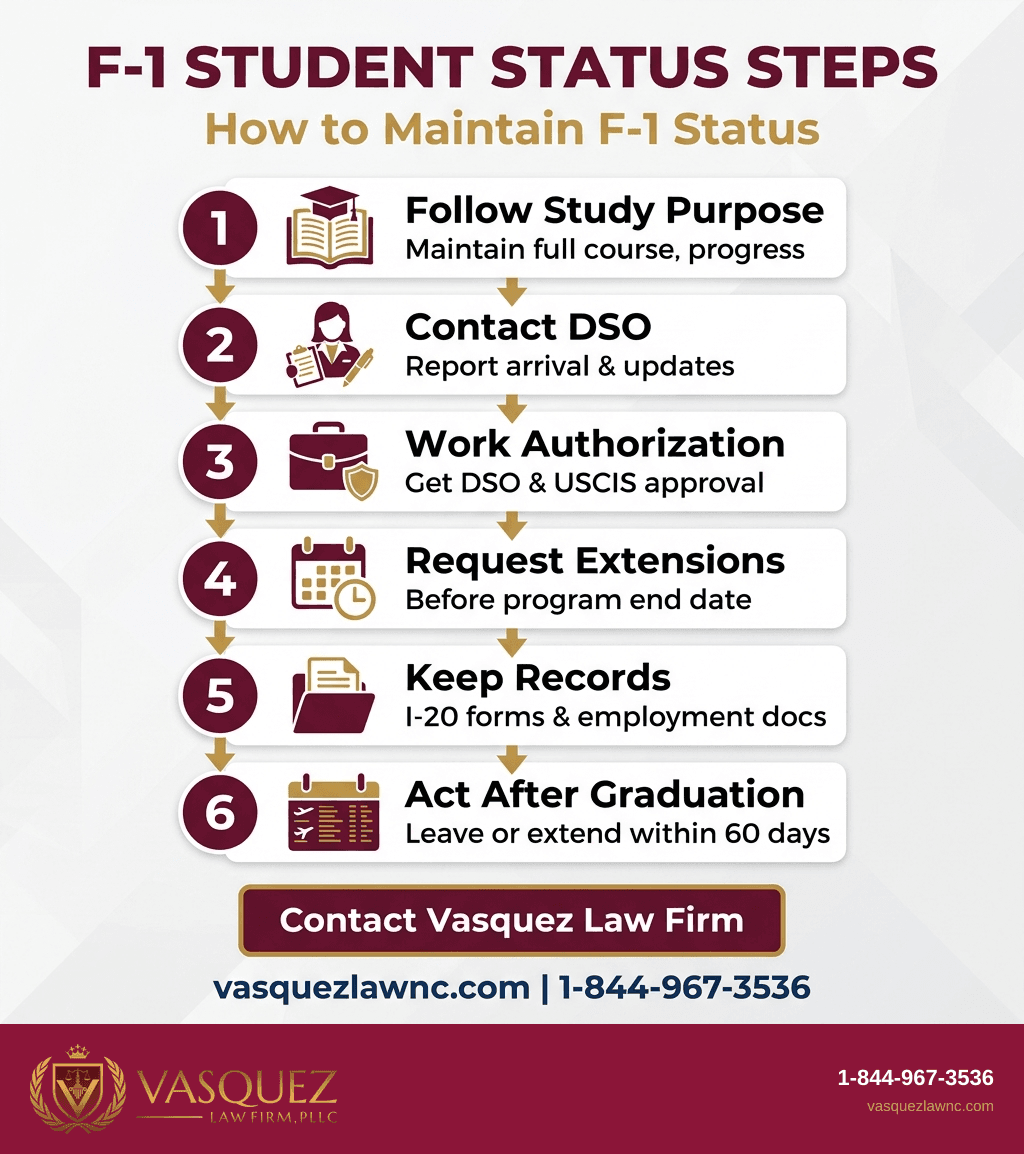
- Keep a full course of study.
- Attend classes and make normal academic progress.
- Work only when authorized by your designated school official (DSO) and, if required, U.S. Citizenship and Immigration Services (USCIS).
- Request a program extension before your program end date if you will not complete your program of study on time.
How do F-1 student visas maintain lawful status?
Lawful status means following the rules that allow a person to stay in the United States. A student who drops a class without first discussing it with a designated school official may create a serious status problem. A designated school official is the school employee who handles student immigration records. The Department of Homeland Security page titled Maintaining Status tells F and M students to attend classes, make normal academic progress, and keep a full course of study each term.
“Maintaining your status means: Fulfilling the purpose for why the Department of State issued you your visa. Following the regulations associated with that purpose.”
F-1 status is for traditional academic programs. M-1 status is for vocational programs. These categories have different benefits and different periods of stay. For help reviewing student-status concerns, see the firm’s immigration legal services for visa holders .
Arrival and school reporting
Students may enter no more than 30 days before a program begins. They must immediately contact the designated school official when they enter the United States. They must also make contact no later than the program start date shown on Form I-20.
Can an F-1 student work off campus or use OPT?
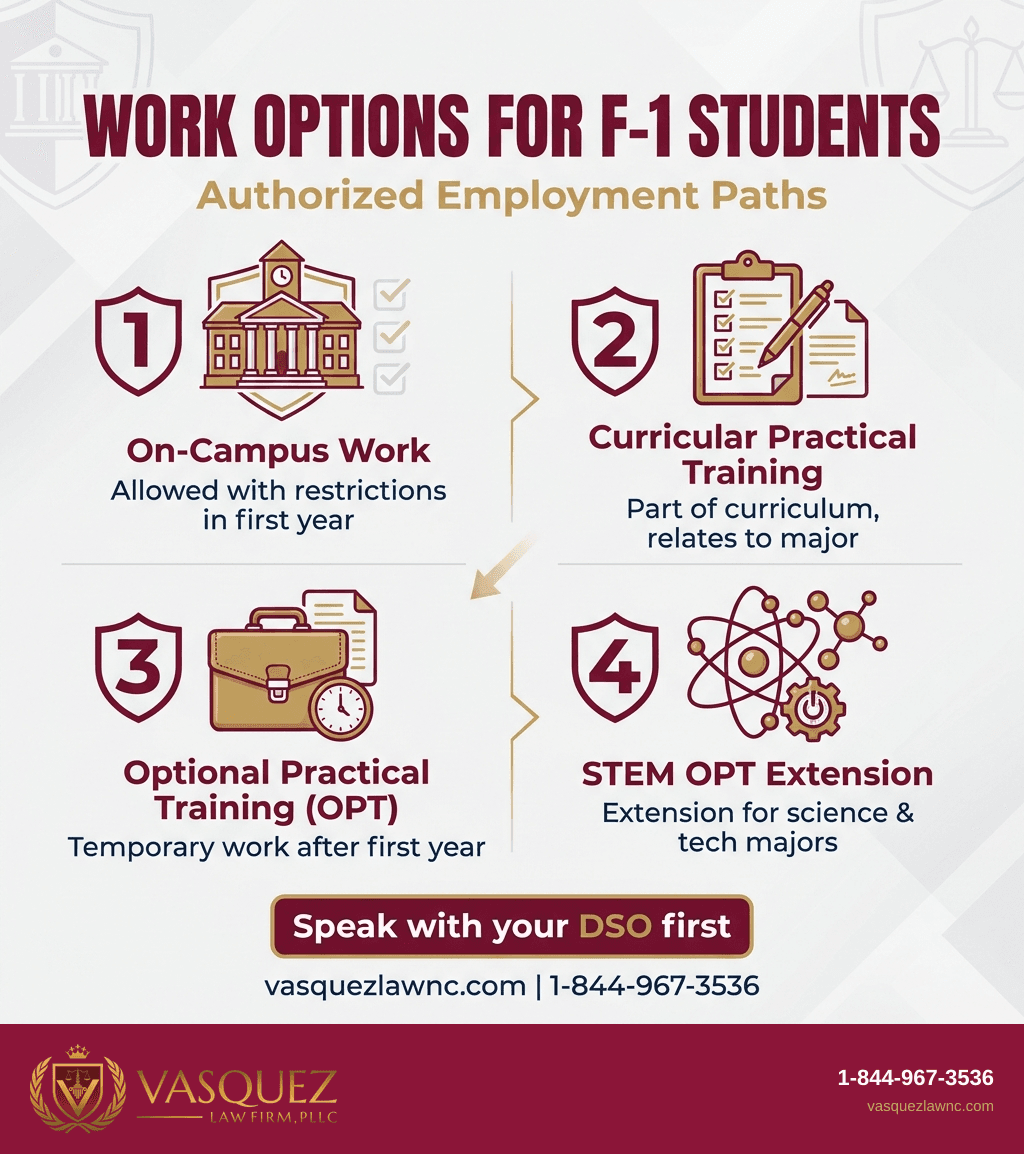
Getting a paid job offer does not give a student permission to start work. The USCIS page Students and Employment explains that F-1 students may not work off campus during the first academic year. On-campus work may be available, but conditions and restrictions apply.
After the first academic year, USCIS identifies three possible off-campus paths. They are curricular practical training, optional practical training, and the STEM optional practical training extension. Curricular practical training, or CPT, must be an integral part of an established curriculum. It must also relate directly to the student’s major. Optional practical training, or OPT, is temporary employment that relates directly to the program of study. The STEM optional practical training extension is an extension for qualifying science, technology, engineering, and mathematics programs.
“If you choose to work without authorization, you will be forced to leave the United States immediately, and you may not be able to re-enter the United States at a later date.”
Speak with the designated school official before accepting any position. Also speak with that official before beginning training. The USCIS Policy Manual is a useful official reference for immigration benefits. For business immigration matters involving student visas, Vasquez Law Firm consults by Zoom or phone.
Practical-training checklist
- Confirm that the job relates directly to the field of study.
- Ask the designated school official about school policy.
- Obtain authorization from your DSO and, if required, USCIS before starting any off-campus employment or practical training.
- Keep copies of Form I-20, approvals, and employment records.
- Report changes that affect student information promptly.
What can an F-1 student do after graduation?
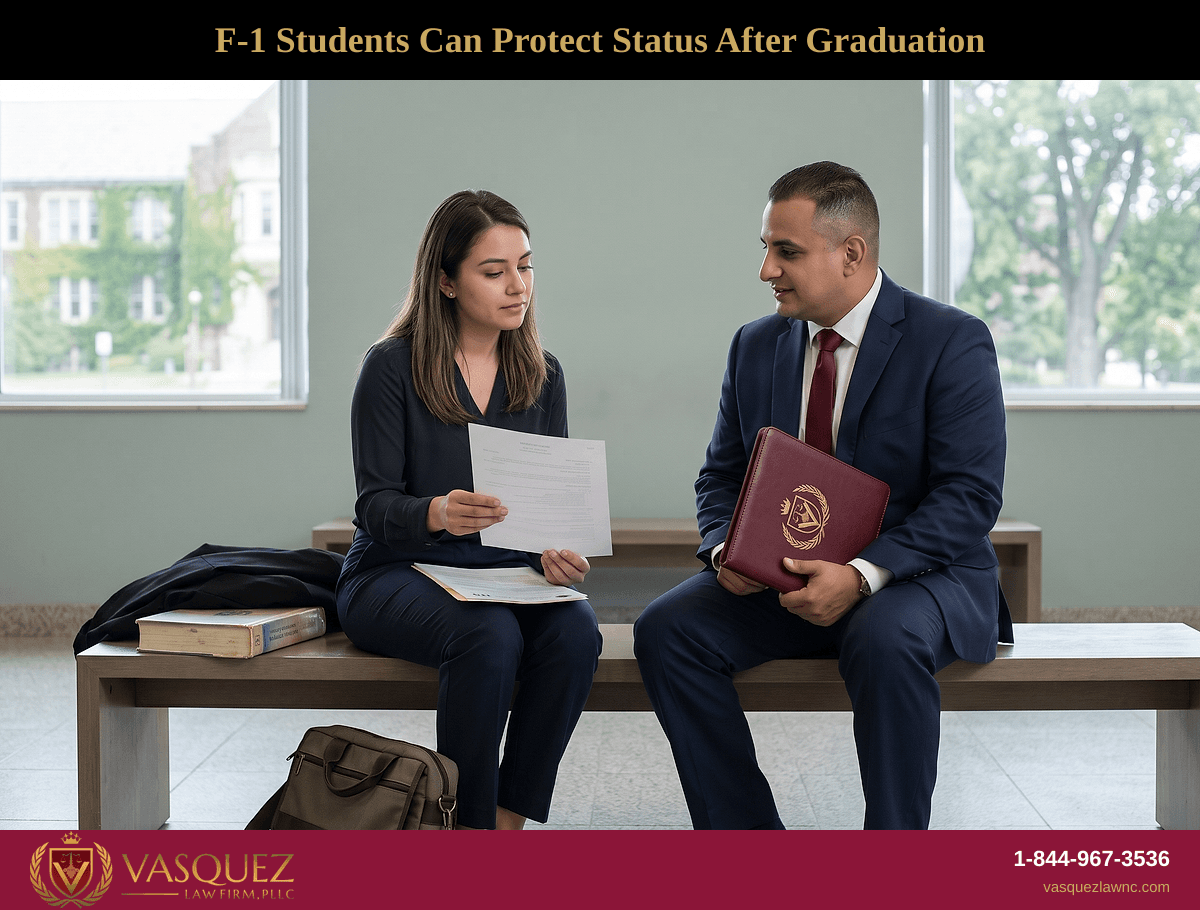
The program end date on Form I-20 is an important date. After completing the program and any authorized practical training, F students have 60 days to leave the United States. They may also take steps to extend their stay through an eligible option.
If you wish to extend your stay in the United States after completing your program of study, talk with your DSO to learn more about transferring to another school, changing your education level, or applying to change status to another visa status. School records and timing can affect the available choices.
Extensions before program completion
A student who does not expect to finish by the Form I-20 end date should discuss a possible program extension with the designated school official. The student must make the request before the program end date. Waiting until the course end date may remove useful options.
In our experience, students most often fail to review the current Form I-20 early enough. A careful review can help find a problem while there is still time to act. Review the program end date, academic plan, and training approval. Then ask the designated school official about available steps.
Do not guess about employment, a school transfer, or a change of status. Request a free immigration evaluation. Se Habla Español.
What records should an F-1 student keep and update?
A change of major, program, degree level, school, address, travel plan, leave of absence, or program end date may require a conversation with the designated school official. Keeping one complete file can help a student answer questions correctly. It can also help protect the immigration record.
Student-status document checklist
- Current and prior Forms I-20.
- Passport, visa, and Form I-94 records.
- Enrollment and academic-progress records.
- Practical-training recommendations and approvals.
- Employment details connected to authorized training.
- Written communications with the designated school official.
F-1 students may travel outside the United States. However, the DHS guide tells them to speak with the designated school official before travel. Students who need immigration-court information can review our article about an immigration court hearing and legal preparation.
Which F-1 status mistakes can create problems?
A student may think a reduced schedule is harmless because the schoolwork feels manageable. The DHS guide says students who cannot study full time should contact the designated school official immediately. A reduced course load may be available only in limited circumstances.
- Dropping a class first: Speak with the designated school official before changing enrollment.
- Starting work early: Get required approval before the first workday.
- Ignoring the Form I-20 date: Discuss an extension before the program ends.
- Missing address changes: Tell the designated school official about a new address.
- Assuming all training is the same: Confirm whether the plan is CPT, OPT, or another authorized option.
- Taking an unplanned leave: Discuss a break from school before it begins.
- Traveling without preparation: Ask the designated school official before leaving the country.
If you remember one point, remember this: Get authorization before taking action. This is especially important before employment or a change in enrollment.
How does the federal student visa framework apply nationwide?
Federal agencies manage F and M student classifications. USCIS describes F-1 students as full-time students at SEVP-certified academic institutions or language programs. M-1 classification covers vocational or other nonacademic programs. It does not cover language training.
Students should begin with their designated school official. The DHS guide also allows F and M students to email SEVP if the designated school official cannot help. It also allows that contact if the student prefers another contact. The firm’s immigration representation for status questions can help a person understand possible legal choices beyond school advising.
Your designated school official (DSO) should be the first person you talk with if you have any questions regarding the legal requirements of your stay in the United States.
When should an F-1 student call an immigration lawyer now?
A consultation may help before a decision becomes hard to fix. Seek legal guidance promptly if any of these situations apply:
- You worked or may have worked without authorization.
- Your Form I-20 program end date is close.
- You are considering a transfer, degree change, or change of status.
- You need to understand a practical-training plan.
- You took or expect to take a break from school.
- You have questions after completing study or authorized training.
- You need to coordinate school information with an immigration filing.
About Vasquez Law Firm
Vasquez Law Firm handles immigration matters with compassionate, direct advocacy. William J. Vasquez leads the firm’s work. Bilingual support staff assist clients in English and Spanish. The firm meets immigration clients in Raleigh, NC and Orlando, FL. It also assists immigration clients nationwide.
The firm’s Yo Peleo® approach means taking each concern seriously. It means explaining practical next steps and preparing carefully. Immigration consultations for student-visa and business-immigration issues are available by Zoom or phone. Read about changing immigration representation during a pending matter when that issue affects your case.
Frequently Asked Questions
How long may an F-1 student remain after graduation?
After completing the program and any authorized practical training, an F-1 student has 60 days after the program completion date on Form I-20 to depart or pursue an identified option. The DHS guide lists transferring schools, changing education level, and applying for another visa status as possible steps. Discuss the plan with the designated school official first.
Can an F-1 student work off campus?
USCIS states that F-1 students may not work off campus during the first academic year. After that period, possible routes include CPT, OPT, and the STEM OPT extension. Off-campus training employment must relate to the area of study and requires authorization before the student begins work.
What is the difference between CPT and OPT?
CPT is employment that is integral to an established curriculum and directly related to the student’s major. OPT is temporary employment directly related to the program of study and may occur during or after study. A designated school official can explain school policy and the appropriate path for the student’s academic program.
What if an F-1 student cannot study full time?
The student should contact the designated school official immediately and before dropping a class. The DHS guide recognizes that a reduced course load may be possible in limited circumstances. The school official can review the facts, explain the school process, and determine whether an option is available under the student rules.
Can an F-1 student extend a program?
A student who does not expect to complete the program by the Form I-20 end date should ask the designated school official about a possible extension. The request must be made before the program end date. Keep copies of the current Form I-20 and communications related to the extension request.
Can an F-1 student take an annual vacation?
An F-1 student must complete at least one full academic year at an SEVP-certified school and intend to register for the next academic term to qualify for annual vacation. During annual vacation, the guide states that students may take as many, as few, or no courses. School policies also apply.
What should an F-1 student do before travel?
The DHS guide directs F-1 students to speak with the designated school official before traveling outside the United States. The student should also keep current immigration and school documents organized. Travel plans can affect enrollment, records, and the ability to continue the educational program upon return.
Who should an F-1 student contact first?
The designated school official should be the first contact for questions about the legal requirements of the student’s stay. If that official cannot assist, or if the student prefers another contact, the DHS guide allows contact with SEVP by email. A lawyer can separately assess legal options tied to the person’s facts.
Sources and References
F-1 student visas can involve urgent choices about school, work, and plans after graduation. Contact Vasquez Law Firm for a free, confidential evaluation by Zoom or phone. Se Habla Español.
Call 1-844-967-3536.
Need a Work Visa or Permit?
H-1B, TN, L-1, and more. We help workers and employers navigate the visa process.
Keep Reading
For how Vasquez Law Firm can help, see our student visa page.
Reviewed by Attorney Vasquez, Managing Attorney
William Vasquez
Founder & CEO, Vasquez Law Firm, PLLC
William Vasquez is the founder and CEO of Vasquez Law Firm, PLLC, a results-driven firm specializing in immigration, criminal defense, personal injury, and workers' compensation. A U.S. Air Force veteran and recipient of the Joint Service Achievement Medal, William is dedicated to fiercely fighting for his clients' rights.
Related Legal Services
Need legal help? Learn more about experienced immigration attorneys in Charlotte, or contact us for a free evaluation.
You can also visit NC immigration legal help for more information.