FY 2027 Immigration Fees Rise in DHS 2026 Notice
By William J. Vásquez · Updated November 9, 2026
FY 2027 immigration fees include a $1,050 parole charge and $40.62 ESTA total. See who pays, prepare documents, and request a free evaluation today online.
Published on November 7, 2026· Updated November 9, 2026
Talk to an immigration attorney
Free call. A clear plan for your case.
Free & confidential · Se habla espanol · Mon-Fri 8am-7pm, Sat 9am-2pm (ET)
Have questions? Talk to an attorney - free evaluation.
Call 1-844-967-3536Worried how the latest immigration news affects you?
Schedule a confidential case review with an immigration attorney - know exactly where you stand.
USCIS Case Status
Check your USCIS case status
Enter your receipt number and get the official status. Free, no registration.
FY 2027 Immigration Fees Rise in DHS 2026 Notice
Starting October 16, 2026, a person granted parole into the United States may face a $1,050 HR-1 parole fee. The Department of Homeland Security announced the Fiscal Year 2027 amounts in a Federal Register notice that affects parole, land-border Form I-94 applications, ESTA travel authorizations, and EVUS enrollment.
Worried About Immigration Policy Changes?
New policies can affect your case. Get current legal advice from an experienced immigration attorney.
These FY 2027 immigration fees matter because payment can become part of a travel or parole process at the moment a person is admitted or receives parole. Families should identify which process applies before travel and review their options with immigration attorneys who understand federal immigration procedures.
Legal disclaimer: This article provides general legal information, not legal advice for any individual case. Immigration outcomes depend on facts, eligibility rules, and agency decisions.
What changed in the FY 2027 immigration fees?
U.S. Customs and Border Protection published Certain DHS Immigration-Related Fees Required by HR-1, Fiscal Year 2027 Adjustments for Inflation, Federal Register Document 2026-20185. CBP, USCIS, and ICE began assessing the FY 2027 parole fee on October 16, 2026. CBP began assessing the FY 2027 I-94, ESTA, and EVUS amounts on that date.
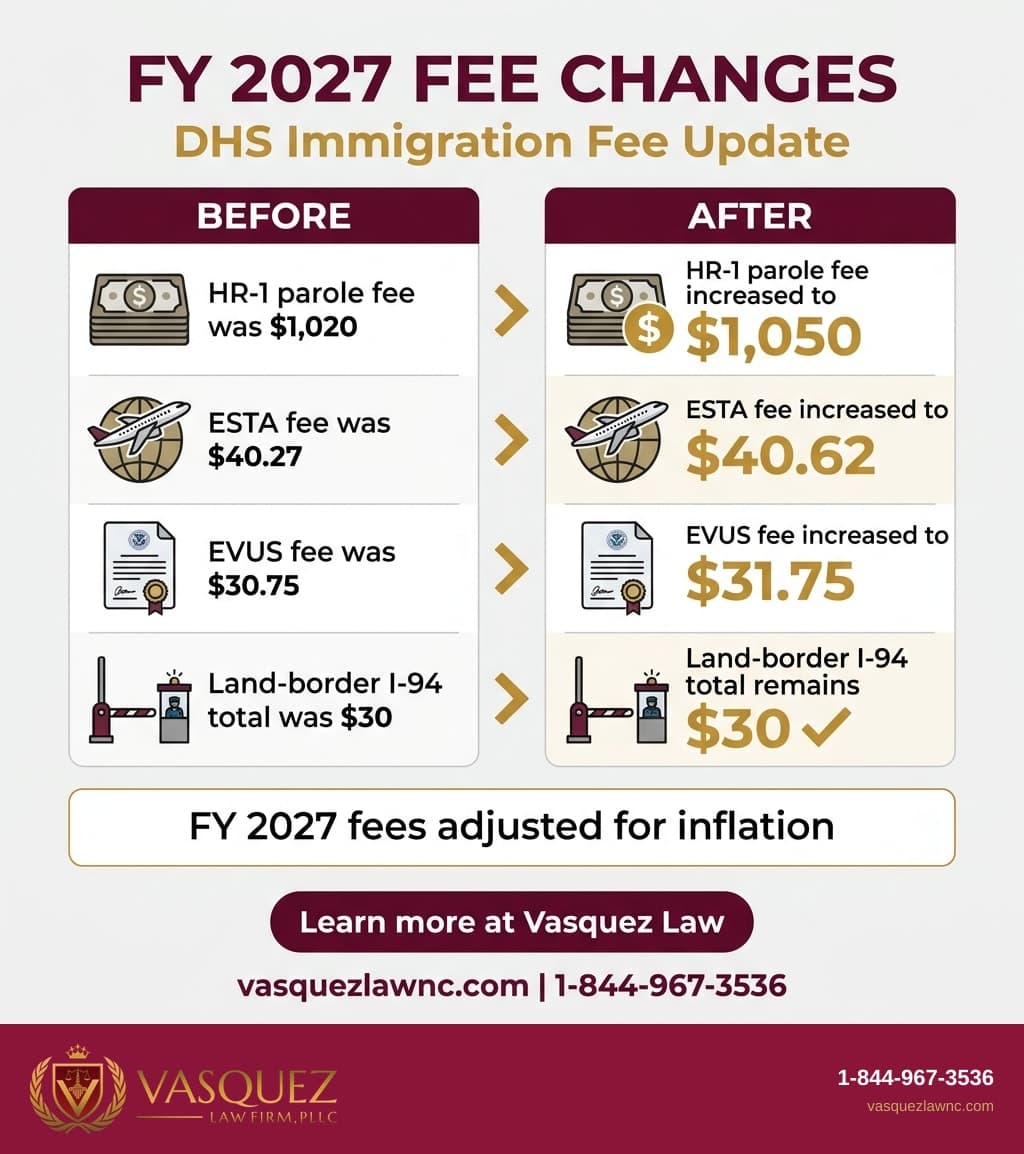
The largest listed change is the HR-1 parole fee. It rose from $1,020 to $1,050. The notice explains that the July 2026 Consumer Price Index for All Urban Consumers was 333.918, compared with 323.048 in July 2025, a 3.36 percent increase.
Accordingly, the inflation-adjusted HR-1 parole fee for FY 2027 will be $1,050 ($1,020 + $30).
The fee for an ESTA authorization rose from $40.27 to $40.62. The EVUS enrollment fee rose from $30.75 to $31.75. The total amount for a land-border Form I-94 application remains $30, consisting of a $6 land-border fee and a $24 HR-1 fee.
The One Big Beautiful Bill Act, Public Law 119-21, signed July 4, 2025, established new immigration fees and increased certain existing fees. The law requires annual inflation adjustments for these categories. The new figures are an agency fee adjustment under that statutory framework, not a new immigration classification or benefit program.
Why the I-94 total did not rise
For FY 2027, the inflation adjustment required by Public Law 119-21 sec. 100008(b)(2)(B) for the HR-1 I-94 fee is $0.81 rounded down to the nearest dollar, which is $0. Thus, the HR-1 I-94 fee for FY 2027 remains at $24 ($24 + $0). The total fee to apply for a CBP Form I-94 at a land border port of entry for FY 2027 continues to be $30, consisting of the $6 land border fee and the $24 HR-1 fee. (Source: Department of Homeland Security Notice of Fee Adjustment for Inflation, printed page 62536)
Who must pay these FY 2027 immigration fees?
Pursuant to HR-1, the Secretary of Homeland Security must require the payment of a fee by any alien who is paroled into the United States, unless an exception in Public Law 119-21 section 100004(b) applies. This fee is required each time an alien is granted parole under sec. 212(d)(5)(A) of the Immigration and Nationality Act (INA), including initial parole from outside the United States, parole in place, re-parole, or parole from DHS custody. (Source: Department of Homeland Security Notice of Fee Adjustment for Inflation, printed page 62536)
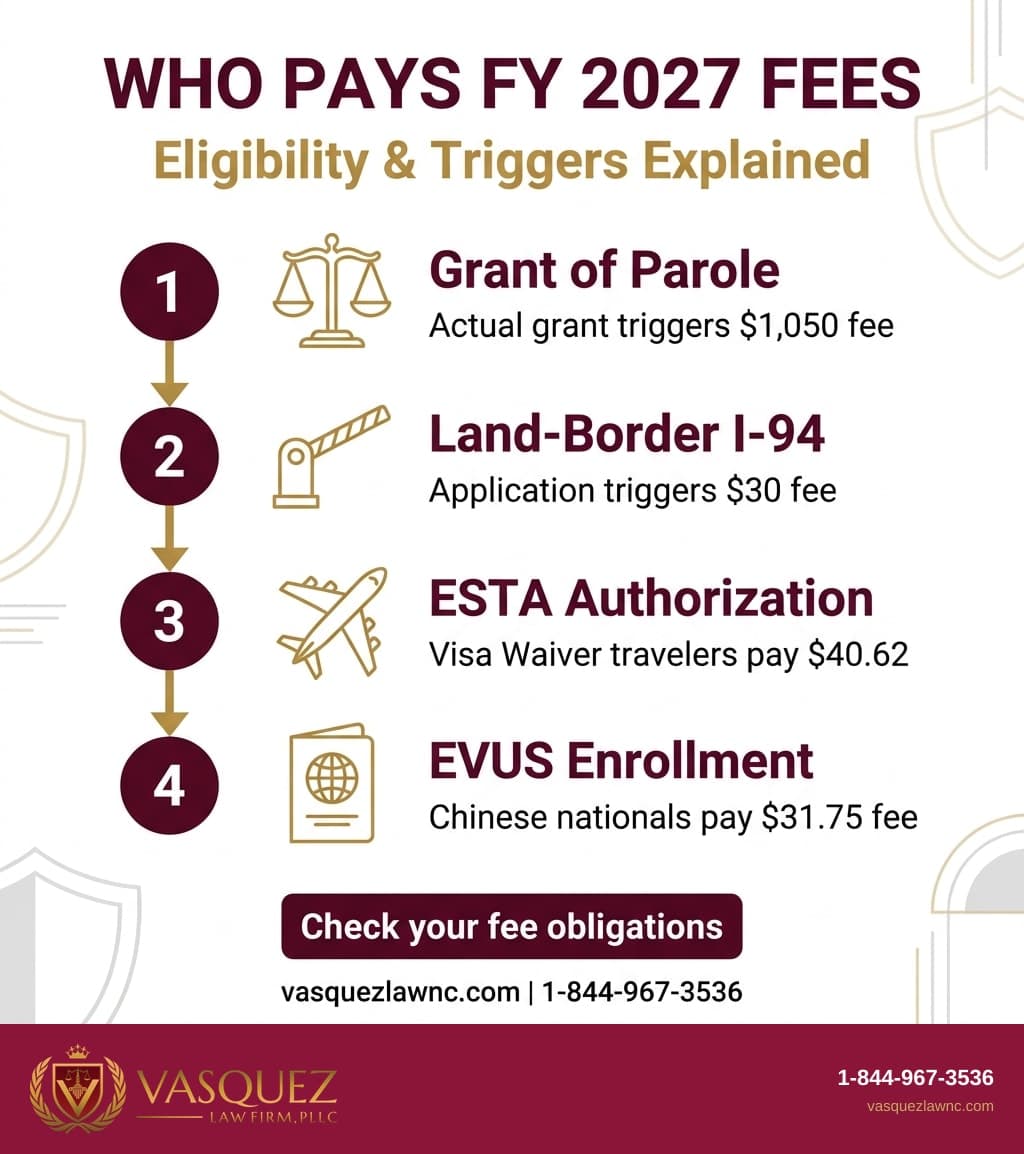
The operative event that triggers the statutory obligation to pay the HR-1 parole fee is the actual grant and effectuation of parole into the United States—not the filing of an application or request.
The operative event that triggers the statutory obligation to pay the HR-1 parole fee is the actual grant and effectuation of parole into the United States—not the filing of an application or request. Thus, unless statutorily excepted, the FY 2027 inflation-adjusted HR-1 parole fee applies to any alien granted parole on or after October 16, 2026, regardless of when the underlying application or request was submitted. (Source: Department of Homeland Security Notice of Fee Adjustment for Inflation, printed page 62536)
Land travelers who are legally required to submit an application for a CBP Form I-94 at a port of entry face the $30 total. CBP does not assess this fee for people arriving at air or sea ports because they do not submit an I-94 application in that setting. An I-94 is the arrival and departure record that generally evidences the terms of admission or parole.
ESTA applies to a person seeking to travel under the Visa Waiver Program by air, sea, or land. The FY 2027 total authorization fee is $40.62. If an ESTA application is denied, the notice sets a $10.62 cost-recovery fee.
EVUS applies to nationals of the People’s Republic of China who hold a 10-year B-1, B-2, or B-1/B-2 visitor visa in the designated categories. They must enroll and provide or update personal and travel information before travel eligibility is determined. The FY 2027 EVUS fee is $31.75.
In our experience, the cases we handle often turn first on identifying whether a person needs admission, parole, a travel authorization, or a visa-related update before money is paid or travel plans are finalized.
Four separate processes, four different triggers
The FY 2027 immigration fees do not apply in the same way. Parole turns on an actual grant of parole. A land-border I-94 charge turns on an application. ESTA involves travel authorization under the Visa Waiver Program. EVUS requires enrollment by covered visa holders.
What laws govern the HR-1 immigration fees?
Public Law 119-21 established the HR-1 parole fee at 8 U.S.C. § 1804. It requires payment each time parole is granted under INA section 212(d)(5)(A), 8 U.S.C. § 1182(d)(5)(A), unless an exception applies. The statute also requires annual inflation adjustments to the parole fee.
The Form I-94 fee appears at 8 U.S.C. § 1807. Federal regulations at 8 C.F.R. §§ 1.4 and 235.1(h) address the issuance of the electronic arrival and departure record.
ESTA is governed by INA section 217, 8 U.S.C. § 1187, and 8 C.F.R. part 217. The FY 2027 ESTA total combines three components: a $17 travel authorization fee, a $10.62 cost-recovery fee, and a $13 fee. Only the cost-recovery component received the inflation adjustment described in the notice.
EVUS is addressed in 8 U.S.C. § 1813 and 8 C.F.R. § 215.24. Its statute requires payment at enrollment. The fee adjustment rounds down to the next lowest multiple of $0.25, which produced a $1 increase for FY 2027.
For broader agency guidance on immigration benefits and adjudication standards, readers can review the USCIS Policy Manual. That manual is distinct from CBP’s fee notice, but it can help explain related immigration processes.
Why annual inflation changes matter
HR-1 uses CPI-U figures from July of consecutive calendar years to calculate yearly changes. Congress also selected different rounding rules for different fees. That is why the parole fee increased by $30, EVUS increased by $1, ESTA increased by $0.35, and the HR-1 portion of the I-94 fee did not change.
What should you do before travel or a parole request?
First, identify the exact immigration process involved. Do not assume that a travel document, visa, parole request, I-94 record, ESTA approval, and EVUS enrollment serve the same legal purpose. Each process has a different trigger for the FY 2027 immigration fees.
Second, retain copies of your passport, visa, travel authorization, parole-related filings, payment confirmations, and any CBP, USCIS, or ICE notice. For a parole matter, preserve documents showing why you seek parole and any evidence relevant to a statutory exception under Public Law 119-21 section 100004(b).
Third, check the date of the agency action, not only the date you filed. The Federal Register notice makes the parole fee depend on the actual grant and effectuation of parole. A filing date alone does not settle the applicable parole fee.
Fourth, travelers should confirm the correct channel before departing. Visa Waiver Program travelers should verify ESTA requirements. Covered PRC visitor visa holders should address EVUS enrollment. Land travelers who need an I-94 application should budget for the continuing $30 total.
For a case-specific review, contact Vasquez Law Firm for a free immigration evaluation. We meet immigration clients in Raleigh, NC and Orlando, FL, and assist people nationwide. Se Habla Español.
What should you watch after the fee adjustment?
Under the notice, CBP, USCIS, and ICE began assessing the FY 2027 parole amount on October 16, 2026. CBP began assessing the FY 2027 I-94, ESTA, and EVUS amounts on that same date.
Watch the Federal Register for future DHS fee-adjustment notices and preserve dated payment records if your matter involves parole or travel authorization. The annual framework matters because HR-1 requires future inflation adjustments, using its category-specific formulas and rounding rules.
What's Your Immigration Situation?
Answer 3 questions - we'll tell you your options
Question 1 / 3
What best describes your situation?
Keep Reading
For immigration benefits that involve a separate USCIS application, the USCIS Processing Times page can help applicants monitor case estimates. Processing times do not determine the HR-1 fees, but they can affect travel and filing planning.
It is not known in an individual case whether a person qualifies for a parole-fee exception until DHS evaluates the circumstances case by case. Prepare supporting evidence early and seek legal guidance before relying on an exception.

Frequently Asked Questions
Does the FY 2027 parole fee apply when I file a parole request?
The operative event that triggers the statutory obligation to pay the HR-1 parole fee is the actual grant and effectuation of parole into the United States—not the filing of an application or request. (Source: Department of Homeland Security Notice of Fee Adjustment for Inflation, printed page 62536)
How much is the ESTA fee for FY 2027?
The total ESTA authorization fee is $40.62. The total includes $17, a $10.62 cost-recovery component, and $13. If ESTA is denied, the FY 2027 fee is $10.62 because that cost-recovery component applies regardless of authorization or denial.
Did the land-border I-94 fee increase?
No. The total fee remains $30 for a land-border Form I-94 application. That total combines the $6 land-border fee with the $24 HR-1 fee. The calculated inflation adjustment to the HR-1 portion was $0.81, but the statute requires rounding down to the nearest dollar.
Who needs EVUS enrollment?
EVUS is used by nationals of the People’s Republic of China holding a 10-year B-1, B-2, or B-1/B-2 visitor visa in the designated categories. They must enroll and provide or update required personal and travel information to receive a travel-eligibility determination. The FY 2027 EVUS fee is $31.75.
Can parole-fee exceptions apply?
DHS will not assess the HR-1 parole fee if the alien establishes, to the satisfaction of DHS, on an individual, case-by-case basis, that the circumstances of the alien's parole align with at least 1 of the 10 exceptions found in HR-1. (Source: Department of Homeland Security Notice of Fee Adjustment for Inflation, printed page 62536)
Where can I get help reviewing an immigration fee issue?
A lawyer can review the immigration process involved, the timing of agency action, and documents relevant to a parole exception or travel requirement. Vasquez Law Firm’s immigration team offers free evaluations for people seeking guidance on federal immigration matters nationwide.
Legal disclaimer: Fee rules and immigration decisions can turn on facts that are unique to each person. Contact Vasquez Law Firm for a free case review about your situation. Our attorneys provide compassionate, determined representation under the Yo Peleo® commitment.
Sources
- Certain DHS Immigration-Related Fees Required by HR-1, Fiscal Year 2027 Adjustments for Inflation, Federal Register Document 2026-20185
- USCIS Policy Manual
Reviewed by Attorney Vasquez, Managing Attorney

William Vasquez
Founder & CEO, Vasquez Law Firm, PLLC
William Vasquez is the founder and CEO of Vasquez Law Firm, PLLC, a results-driven firm specializing in immigration, criminal defense, personal injury, and workers' compensation. A U.S. Air Force veteran and recipient of the Joint Service Achievement Medal, William is dedicated to fiercely fighting for his clients' rights.
Related Legal Services
Need legal help? Learn more about how our immigration attorneys can help, or contact us for a free evaluation.
You can also visit immigration lawyers serving all of North Carolina for more information.