What Happens If You Miss a Voluntary Departure Deadline?
By William J. Vásquez · Updated November 5, 2026
The BIA affirmed the 10-year bar for violating voluntary departure despite a motion to reopen. Contact our attorneys for a free evaluation and help today.
Published on November 5, 2026· Updated November 5, 2026
Talk to an immigration attorney
Free call. A clear plan for your case.
Free & confidential · Se habla espanol · Mon-Fri 8am-7pm, Sat 9am-2pm (ET)
Have questions? Talk to an attorney - free evaluation.
Call 1-844-967-3536Worried how the latest immigration news affects you?
Schedule a confidential case review with an immigration attorney - know exactly where you stand.
USCIS Case Status
Check your USCIS case status
Enter your receipt number and get the official status. Free, no registration.
On November 5, 2026, the Board of Immigration Appeals denied a motion to reopen. The respondent had missed a June 3, 2025 voluntary departure deadline. A motion to reopen is a request to open a finished immigration case again. The BIA voluntary departure 10-year bar means that missing a voluntary departure deadline can block certain immigration relief for 10 years. This can happen even when a person later submits new evidence for cancellation of removal.
The ruling, 30 I&N Dec. 222 (BIA 2026), makes timing central to a serious choice. People considering voluntary departure should understand the terms before accepting them. Voluntary departure is permission to leave the United States instead of receiving a removal order, if the person follows the required conditions. Our immigration attorneys can explain the federal process and review available options.
Need legal help?
Immigration in NC and FL. Personal injury and workers compensation across NC. Criminal defense in select NC counties depending on the charge (DWI in 12 counties), and traffic tickets in 20 NC counties. Tell us your county and we will tell you exactly what we can do.
Do you have a voluntary departure deadline? Contact Vasquez Law Firm for help understanding the BIA voluntary departure 10-year bar and your available immigration options.
Request a Free Evaluation or call 1-844-967-3536.
Legal disclaimer: This article provides general legal information, not legal advice for any person or case. Immigration results depend on the person’s facts, filing history, and deadlines. A person facing removal proceedings should seek legal advice promptly from qualified immigration counsel.
What did the BIA decide about voluntary departure?
In this case, the Board reviewed the respondent’s request. An immigration judge had already denied his request for cancellation of removal. Cancellation of removal is a form of relief that can let a qualifying person stay in the United States. On April 4, 2025, the Board dismissed his appeal. It also reinstated voluntary departure for 60 days. He therefore had to leave on or before June 3, 2025.
He filed a motion to reopen on June 17, 2025. The motion asked to add evidence about his earlier cancellation application. The evidence included school, medical, and mental-health records about his United States citizen children. DHS opposed the request. DHS is the Department of Homeland Security.
“The filing of a motion to reopen . . . after the time allowed for voluntary departure has already expired does not in any way impact the period of time allowed for voluntary departure . . . .”
The Board held that filing after the departure period ended did not erase the consequences of failing to leave. Under INA § 240B(d)(1)(B), codified at 8 U.S.C. § 1229c(d)(1)(B), a person who fails to voluntarily depart within the assigned period is ineligible for certain forms of immigration relief for 10 years. This is the central rule behind the BIA voluntary departure 10-year bar.
Cancellation of removal under INA § 240A(b)(1), 8 U.S.C. § 1229b(b)(1), is one of the affected benefits in this case. The Board rejected the argument that reopening could avoid the bar. The respondent wanted to pursue a form of relief he had requested before. The Board still found that the voluntary departure violation applied.
Why the filing date changed the result
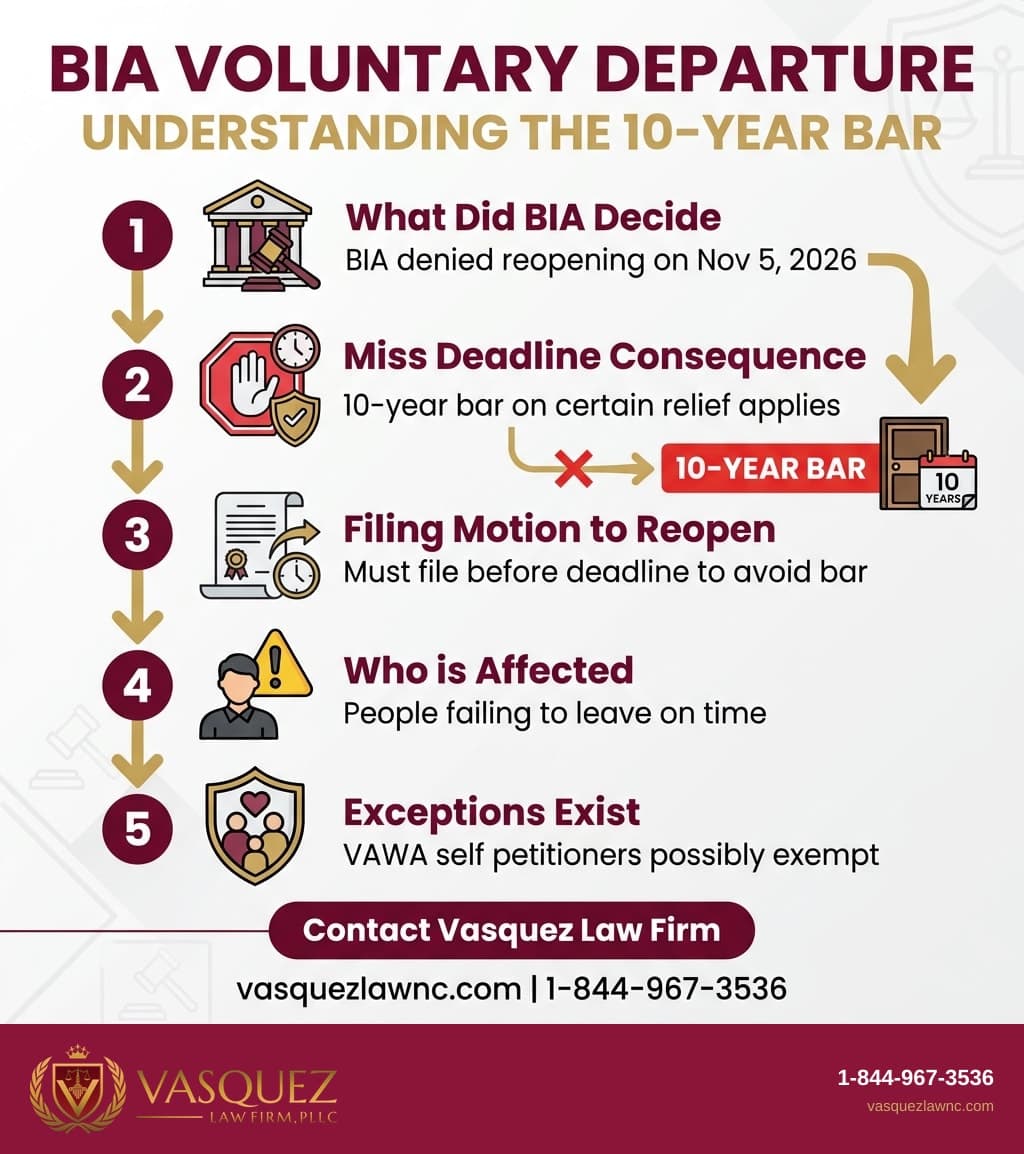
The regulation treats a timely motion differently. A motion to reopen may meet its own filing deadline yet be filed after voluntary departure expires. A motion properly filed before the voluntary departure period expires automatically ends the voluntary departure grant. It also ends the consequences for failing to comply with that grant. See 8 C.F.R. § 1240.26(c)(3)(iii), (e)(1).
The motion arrived after June 3, 2025. The Board also found that the respondent had not shown an involuntary failure to depart. Under the precedent cited by the Board, a failure to depart is not voluntary when, through no fault of the person’s own, the person is unaware of the voluntary departure order or is physically unable to leave.
Who can the voluntary departure bar affect?
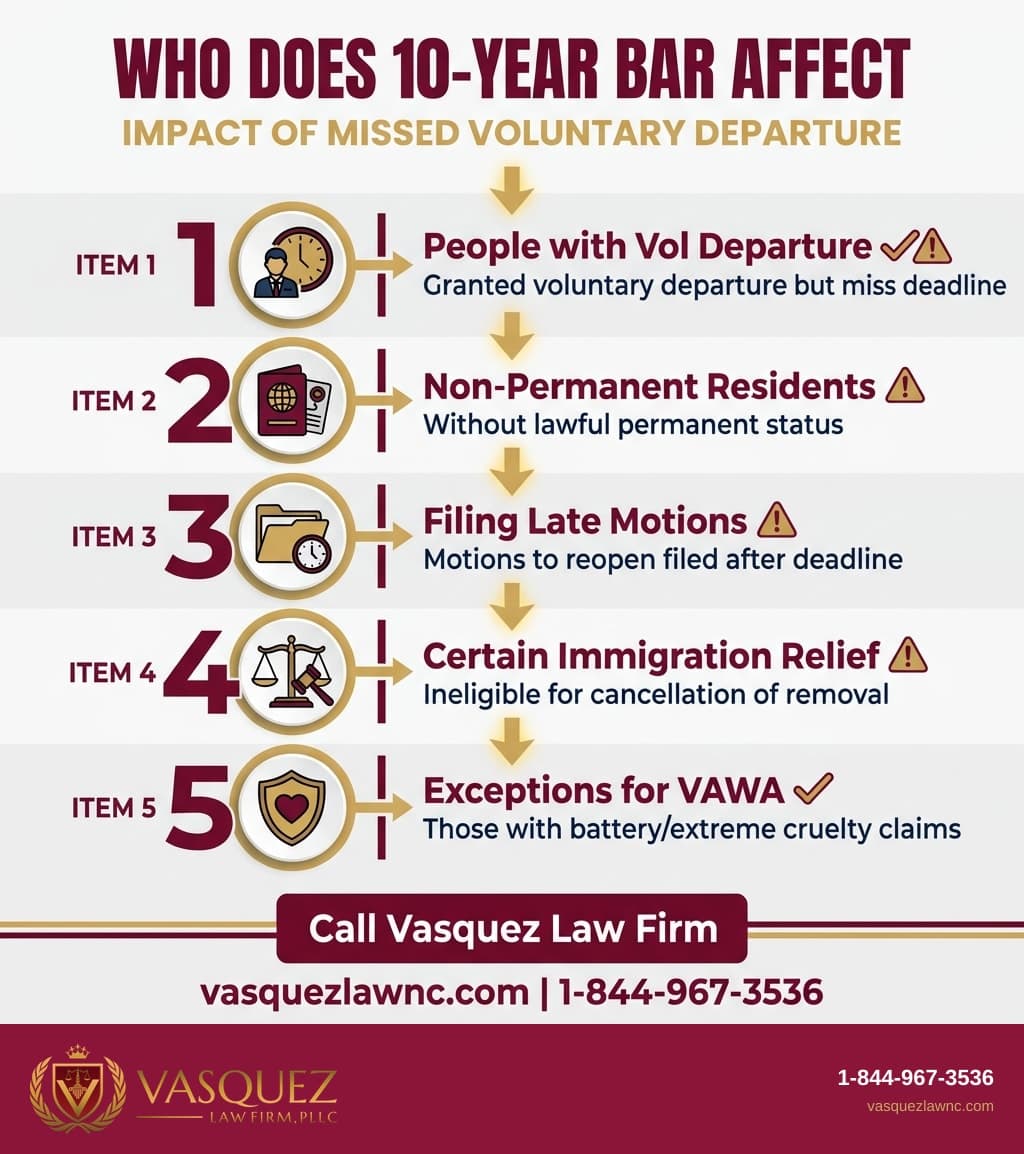
The decision concerns people granted voluntary departure. It affects those who fail to leave during the period ordered. The BIA voluntary departure 10-year bar can affect people who miss that deadline and later seek certain immigration benefits. Voluntary departure is an arrangement under INA § 240B, 8 U.S.C. § 1229c. Under this arrangement, the person agrees to leave. The government agrees not to enter a removal order if the person follows the conditions.
The 10-year consequence applies to certain immigration benefits listed in INA § 240B(d)(1)(B). In this case, it stopped the respondent from pursuing cancellation of removal for nonpermanent residents. Nonpermanent residents are people who do not have lawful permanent resident status. Cancellation of removal may allow a qualifying person in removal proceedings to remain in the United States.
“An alien cannot avoid the consequences of failing to voluntarily depart by filing a motion to reopen.”
The Board’s reasoning matters to people who believe new evidence can revive an earlier cancellation claim. The Board held that reopening the case would not erase the earlier violation of the voluntary departure agreement. The conduct that triggered the consequence was missing the assigned departure deadline.
The law contains a specific exception for certain VAWA self-petitioners. A VAWA self-petitioner is a person who seeks immigration protection under the Violence Against Women Act. Under INA § 240B(d)(2), the restrictions do not apply to cancellation of removal or adjustment of status based on a VAWA self-petition. This exception applies when battery or extreme cruelty was at least one central reason for overstaying voluntary departure.
New evidence still faces a separate test
The Board gave another reason for denying reopening. A motion to reopen must state new facts. It must include important evidence that was previously unavailable. The evidence must establish a prima facie case for relief. A prima facie case is enough initial proof to support the requested relief. See INA § 240(c)(7)(B), 8 U.S.C. § 1229a(c)(7)(B), and 8 C.F.R. § 1003.2(c)(1).
Here, the Board found that the added evidence was similar to material already considered. The immigration judge had reviewed the children’s educational, medical, emotional, and financial needs. The judge found that the required hardship standard was not met. The hardship standard requires the applicant to show the level of harm required by the law. In our experience, families first ask whether a later filing can undo a missed voluntary departure deadline.
For background on agency guidance, the USCIS Policy Manual is an official resource. It provides guidance about immigration benefits. Removal-court procedure is controlled by separate statutes and regulations.
What law governs voluntary departure and reopening?
What's Your Immigration Situation?
Answer 3 questions - we'll tell you your options
Question 1 / 3
What best describes your situation?
Keep Reading
Congress placed voluntary departure in INA § 240B, 8 U.S.C. § 1229c. An immigration judge must give notice of the penalties for violating a voluntary departure agreement. This requirement appears in INA § 240B(d)(3), 8 U.S.C. § 1229c(d)(3).
The main statutory rule is clear. A person who voluntarily fails to leave within the specified period is ineligible for certain relief for 10 years. The Board read the phrase further relief to include a renewed effort to obtain cancellation of removal. It does not apply only to a brand-new application.
INA § 240(c)(7), 8 U.S.C. § 1229a(c)(7), governs a motion to reopen. The motion generally must be filed within 90 days of a final administrative order. The person filing it must present important evidence that was previously unavailable. When seeking reopening to pursue relief previously denied, the person must also show that the new evidence would likely change the result.
Two procedures can collide
The Supreme Court recognized a conflict between voluntary departure and reopening in Dada v. Mukasey. A motion to reopen that is properly filed prior to the expiration of the voluntary departure period automatically terminates the prior grant of voluntary departure and its related consequences for noncompliance.
But 8 C.F.R. § 1240.26(e)(2) treats a late motion differently. The Board relied on that difference. It concluded that it lacked equitable authority to ignore the statutory ineligibility bar after a voluntary departure violation. Equitable authority means power to provide fairness-based relief when the law allows it.

A person with an immigration court matter should understand the difference between voluntary departure and deportation or removal from the United States. Voluntary departure can avoid a removal order when completed as required.
What should I do if I have a voluntary departure order?
Start by getting the written order from the immigration judge or Board. Confirm the exact voluntary departure date. Keep copies of the order and hearing notices. Also keep travel documents, proof of every filing, and every receipt issued by EOIR or USCIS.
Next, determine whether you are considering a motion to reopen before the voluntary departure period ends. Under 8 C.F.R. § 1240.26(c)(3)(iii), a timely qualifying motion can automatically end voluntary departure. The filing date matters. The date documents were prepared alone may not protect you. The BIA voluntary departure 10-year bar makes prompt review especially important.
Then identify the legal basis for reopening. Gather the new evidence. Gather records showing when the evidence became available. Also gather documents showing why the evidence could affect eligibility. For a cancellation claim, records often concern qualifying relatives and claimed hardship. The evidence must still meet the reopening standard.
Do not assume that a pending late motion stops the voluntary departure consequences. This decision makes that risk clear. A person may have been unable to leave through no fault of their own. Documentation of those facts may be important. The Board recognized that an involuntary failure to depart is a separate issue.
For related court-procedure information, review our discussion of a BIA reopening decision. You can also review guidance on working with an immigration court hearing lawyer. Those topics do not replace a case-specific review of a voluntary departure order.
A voluntary departure deadline can affect future relief. Vasquez Law Firm offers free immigration evaluations for people seeking to understand their federal immigration options. We meet immigration clients in Raleigh, NC and Orlando, FL. Se Habla Español.
Request a Free Evaluation or call 1-844-967-3536.
What should I watch after this BIA decision?
The practical rule today is direct. If reopening is the chosen procedure, file a qualifying motion to reopen before voluntary departure expires. A motion filed afterward does not change the period already allowed for voluntary departure. This rule appears in 8 C.F.R. § 1240.26(e)(2).
Readers should watch for future published Board decisions. They should also watch federal court rulings and regulatory changes. These developments may interpret INA § 240B(d). The official decision at 30 I&N Dec. 222 (BIA 2026) contains the Board’s analysis and the cited authorities.
One important question may depend on personal proof. Was the failure to leave involuntary? For example, was the person unaware of the order? Was the person physically unable to depart? Answering that question requires a careful review of the record and supporting evidence.
A final order can create other risks. The Board’s notice explains that a person who willfully fails or refuses to depart under a final order may face a civil monetary penalty. The penalty can be up to $998 for each day of violation. The notice cites INA § 274D, 8 U.S.C. § 1324d, and 8 C.F.R. § 280.53(b)(14).
Frequently Asked Questions
Does a late motion to reopen end voluntary departure?
No. This decision holds that a motion to reopen filed after the voluntary departure period has expired does not affect that period. The Board found that the respondent is subject to the penalties for failing to depart, including ineligibility for certain forms of relief.
Can cancellation of removal be barred after missed voluntary departure?
Yes. The Board held that INA § 240B(d)(1)(B), 8 U.S.C. § 1229c(d)(1)(B), foreclosed the respondent’s application for cancellation of removal after he voluntarily failed to depart. The ruling rejects the view that seeking more evidence for an earlier cancellation application avoids the bar.
What is the timely-motion rule?
A qualifying motion to reopen filed before voluntary departure expires automatically terminates voluntary departure under 8 C.F.R. § 1240.26(c)(3)(iii), (e)(1). This procedural rule is why a person considering reopening must assess the order and filing strategy before the departure period passes.
Is there an exception for VAWA self-petitioners?
Yes, in defined circumstances. INA § 240B(d)(2) excludes certain cancellation of removal and adjustment applications based on a VAWA self-petition when battery or extreme cruelty was at least one central reason for overstaying voluntary departure. Eligibility depends on the statutory requirements and supporting facts.
What must a motion to reopen prove?
A motion must state new facts and be supported by material, previously unavailable evidence demonstrating prima facie eligibility for relief. The Board also described a heavy burden where the person seeks relief previously denied: the new evidence must likely change the result of the case.
Can a final removal order create penalties beyond immigration relief limits?
It can. The Board’s notice states that willful failure or refusal to depart under a final order can lead to a civil monetary penalty of up to $998 for each day of violation. It also cites INA § 276(a), 8 U.S.C. § 1326(a), concerning unlawful entry after removal or departure while an order remains outstanding.
Do not make a filing decision based on general information alone. Contact Vasquez Law Firm for a free evaluation of your immigration record, deadlines, and available options, including issues involving the BIA voluntary departure 10-year bar. This is not individualized legal advice until an attorney reviews your circumstances.
Schedule a Free Immigration Evaluation or call 1-844-967-3536. We meet immigration clients in Raleigh, NC and Orlando, FL.
Sources
Reviewed by Attorney Vasquez, Managing Attorney

William Vasquez
Founder & CEO, Vasquez Law Firm, PLLC
William Vasquez is the founder and CEO of Vasquez Law Firm, PLLC, a results-driven firm specializing in immigration, criminal defense, personal injury, and workers' compensation. A U.S. Air Force veteran and recipient of the Joint Service Achievement Medal, William is dedicated to fiercely fighting for his clients' rights.
Related Legal Services
Need legal help? Learn more about how our immigration attorneys can help, or contact us for a free evaluation.
You can also visit immigration lawyers serving all of North Carolina for more information.