BIA Vacates Asylum Grant, Orders Removal to Guatemala
By William J. Vásquez · Updated November 13, 2026
The BIA vacated an asylum grant and rejected proposed Guatemala social groups. Learn how social-group proof and nexus matter, then contact us today.
Published on November 13, 2026· Updated November 13, 2026
Talk to an immigration attorney
Free call. A clear plan for your case.
Free & confidential · Se habla espanol · Mon-Fri 8am-7pm, Sat 9am-2pm (ET)

Have questions? Talk to an attorney - free evaluation.
Call 1-844-967-3536Worried how the latest immigration news affects you?
Schedule a confidential case review with an immigration attorney - know exactly where you stand.
USCIS Case Status
Check your USCIS case status
Enter your receipt number and get the official status. Free, no registration.
On November 12, 2026, the Board of Immigration Appeals vacated an asylum grant for a Guatemalan woman. It ordered her removal to Guatemala. This BIA asylum decision may affect how applicants develop a Guatemala asylum claim. The immigration attorneys at Vasquez Law Firm closely follow Board of Immigration Appeals decisions. The Board's reasoning can affect how asylum applicants prepare evidence nationwide.
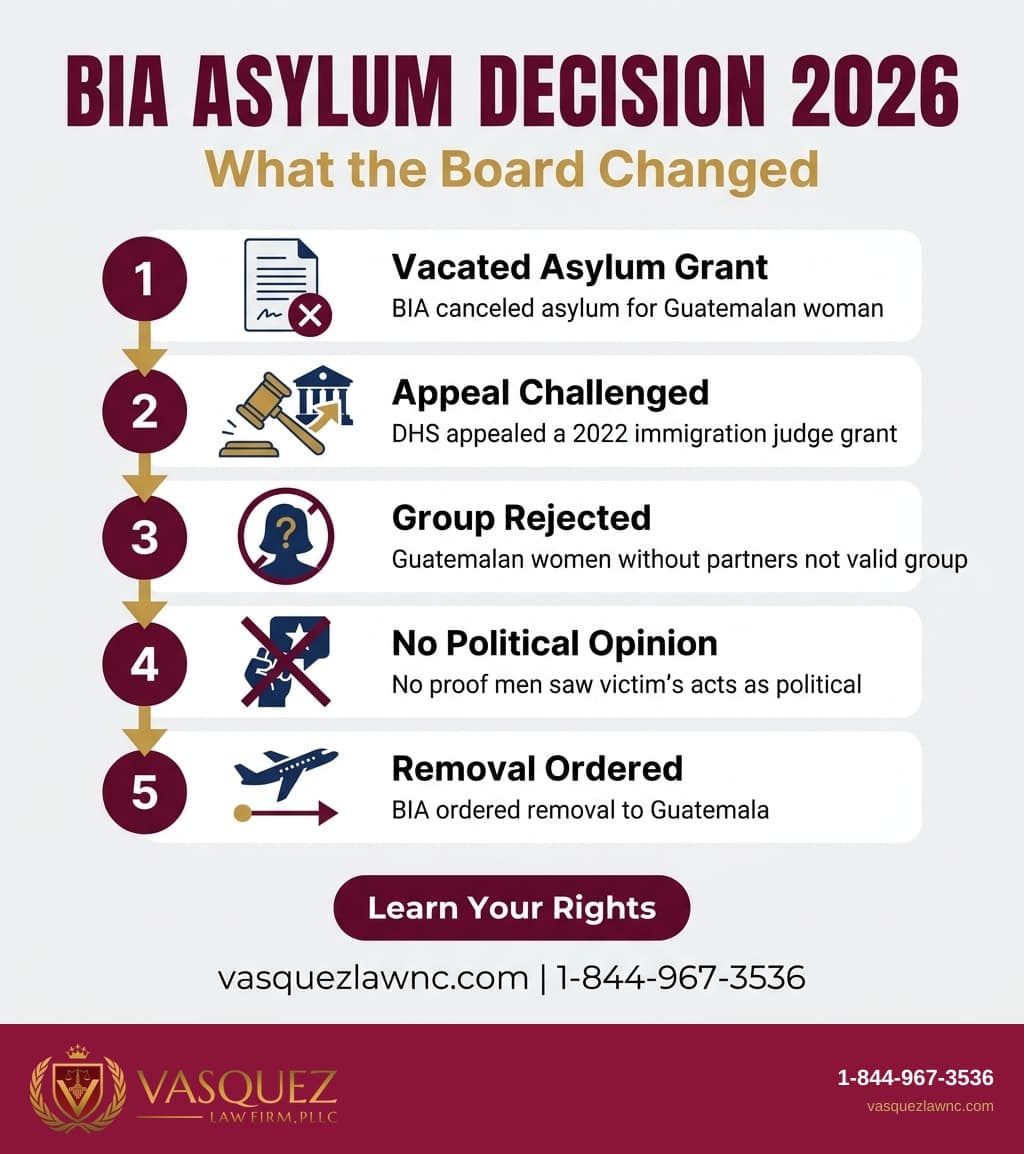
The decision is called Matter of A-C-V-M-, 30 I&N Dec. 236 (BIA 2026). It rejected the proposed group of Guatemalan women without partners. It also found that the record did not prove persecution because of an actual or imputed political opinion.
Legal disclaimer: This article provides general legal information, not legal advice for any person or case. Asylum claims depend on individual facts, testimony, country conditions, and procedural posture.
What did the BIA asylum decision change?
The Board sustained the Department of Homeland Security appeal. The appeal challenged a November 4, 2022, immigration judge decision that had granted asylum. The respondent was a native and citizen of Guatemala. She testified that a man on a motorcycle grabbed her shoulder and waist. He tried to get her onto the motorcycle. Other men tried to hug or touch her without consent.
The immigration judge found past persecution. The judge based that finding on membership in a proposed particular social group, Guatemalan women without partners. The judge also based it on political opinion. The Board vacated the asylum grant under INA section 208(b)(1)(A), 8 U.S.C. § 1158(b)(1)(A), and ordered removal to Guatemala.
The proposed group of “Guatemalan women without partners” lacks particularity and social distinction and is therefore not a cognizable particular social group.
The BIA asylum decision examined two proposed groups. They were Guatemalan women, and Guatemalan women without partners. The Board agreed that the broader group was too broad. It also lacked particularity. The Board then held that the narrower group failed as well. The term partner has no fixed boundary.
The Board gave specific examples. Partner could describe people who are casually dating. It could describe people in a committed relationship. It could describe people sharing a child. It could also describe married people. Marriage has a clear legal definition, the decision explained. Partner, however, can mean different things to different people.
Why the political-opinion finding failed
The Board also rejected the immigration judge's finding about imputed political opinion. The judge had found that the men may have imputed a political opinion to the respondent. The judge reasoned that attending school and resisting harassment could look like independence or defiance. The alleged defiance concerned male-dominated social conventions.
The Board found no evidence that the men knew she was walking to school. It also found no evidence that they viewed education in a political way. The Board concluded that there was no evidence to support the conclusion that the men viewed the respondent’s actions as anything other than a rejection of their advances. This connection is called nexus. Nexus means the link between the harm and a protected ground.
An imputed opinion about social or societal conventions, without any relation to the government, does not qualify as an imputed political opinion.
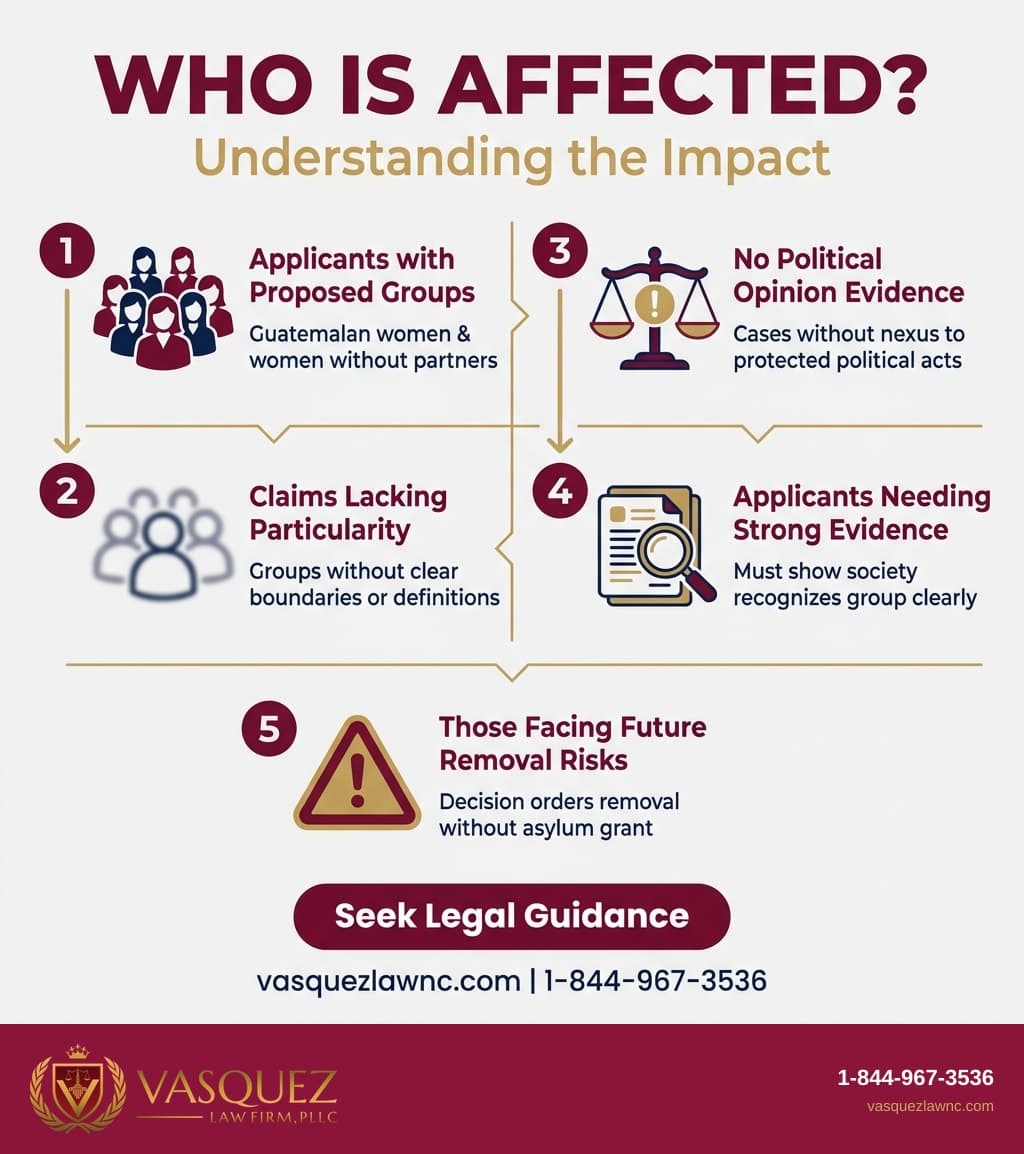
Who may this BIA asylum decision affect?
Matter of A-C-V-M- concerns an asylum applicant who proposed two particular social groups. They were Guatemalan women and Guatemalan women without partners. The decision directly resolves DHS's appeal of the respondent's asylum grant.
Membership in a particular social group is one possible protected ground for asylum. The other protected grounds are race, religion, nationality, and political opinion. Under 8 U.S.C. § 1158(b)(1)(B)(i), an applicant must show that a protected ground was at least one central reason for the persecution or feared persecution.
The decision addresses the specific proposed groups and record before the Board. Applicants may have materially different facts. They may propose a different group. They may have evidence of a different protected ground. They may also have evidence that connects the harm to a persecutor's motive.
What evidence became central
The BIA focused on particularity and social distinction. Particularity asks whether a group has clear, objective boundaries. In other words, it asks whether people can tell who belongs. Social distinction asks whether society in the country recognizes people with the shared characteristic as a group. The Board cited Matter of M-E-V-G-, 26 I&N Dec. 227, 237 (BIA 2014), for these elements.
The Board further explained that social distinction is generally measured across the country. It is not usually measured only in a neighborhood or small location. The immigration judge had not examined how Guatemalan society viewed the proposed group. The respondent also did not make arguments about social distinction before the immigration judge or on appeal.
In our experience, the cases we handle often turn on consistency. Testimony, records, and country-conditions evidence should support the same protected-ground theory. When the evidence points in different directions, the claim may become harder to prove.
Applicants with cases before an immigration judge should not assume that a label alone proves group membership. A well-developed claim needs evidence about several points. It should explain who belongs in the group. It should explain how people can identify the members. It should explain how the relevant society understands the group. It should also explain why the persecutor acted because of that characteristic.
What asylum law governs social-group claims?
Asylum is authorized by INA section 208. That section is codified at 8 U.S.C. § 1158. The Board cited INA section 208(b)(1)(B)(i) when it found no qualifying nexus in this case.
For particular social group claims, the Board applied the three-part framework from Matter of M-E-V-G-. The three parts are a common immutable characteristic, particularity, and social distinction. Particularity requires a clear standard for deciding who belongs in the group.
Social distinction does not require members to be recognizable on sight. Instead, the society in question must generally see the shared characteristic as defining a group. The Board cited Matter of W-G-R-, 26 I&N Dec. 208, 217 (BIA 2014), on this point.
Political opinion requires a governmental connection
The Board reaffirmed Matter of D-G-E-A- & N-G-G-E-, 29 I&N Dec. 570 (BIA 2026). That decision explains the meaning of political opinion under the INA. The opinion must connect to a belief or conviction about a specific cause. The cause must relate to a country's government or de facto government.
This difference matters. Personal resistance can be an important fact. So can independence or rejection of unwanted conduct. Under this BIA asylum decision, however, an applicant using an imputed political opinion theory must prove more. The applicant must show that the persecutor attributed a qualifying political belief to the applicant. The belief must relate to a government or de facto government.
Readers can review the agency's USCIS Policy Manual for general immigration adjudication guidance. Removal-defense cases remain fact-specific. Immigration courts and appellate bodies decide those cases under the applicable law.
What should asylum applicants do now?
Start by identifying the exact protected ground in your claim. Do not rely only on a broad description of danger. Write down the facts that show why the persecutor targeted you. Record what the persecutor said or did. Then explain how those facts connect to race, religion, nationality, political opinion, or a particular social group.
Next, organize supporting records. These records may include a detailed declaration. They may include reports made at the time of the harm. They may include medical or school records when relevant. Other examples include witness statements, communications, and country-conditions materials. Each record should support a specific part of the legal theory. A record should do more than repeat that conditions are dangerous.
For a particular social group claim, define the proposed group precisely. Then prepare evidence about immutable characteristics. Prepare evidence about clear membership boundaries. Also prepare evidence about social recognition across the country. For an imputed political opinion claim, focus on evidence of what the persecutor believed about you. Show why that belief concerned a government or a de facto government.
Preserve immigration-court paperwork, hearing notices, decisions, and appeal records. A person who receives an adverse decision should seek legal advice quickly. Immigration procedures can have strict filing rules, including rules that may affect a BIA appeal. Our nationwide immigration legal team can review the legal theory and procedural record in a free evaluation. Se Habla Español.
You can also read our discussion of a 2026 BIA bond proceedings decision. You can also read our overview of the voluntary departure bar. Those issues differ from asylum eligibility. Each issue, however, shows why the record and procedure matter in removal defense.
What should applicants watch next?
The immediate rule to watch concerns the Board's use of particularity, social distinction, and nexus. Immigration judges decide individual records. Board of Immigration Appeals decisions explain how the Board reviews appeals from those decisions.
Applicants should monitor the EOIR materials connected to their own case. These materials include hearing notices and written decisions. The official text of Matter of A-C-V-M-, 30 I&N Dec. 236 (BIA 2026), is the central record of the November 12 decision.
The decision does not state whether another proposed group would satisfy the social-distinction analysis. The other group could have different countrywide evidence. It could involve another Guatemalan applicant. The applicant has the burden to prove a cognizable group.
Frequently Asked Questions
Does this decision end asylum claims by Guatemalan women?
No. The Board held that the two proposed groups in this case were not cognizable. A claim may involve a different protected ground, different evidence, a differently defined group, or facts that show a qualifying nexus.
What is particularity in an asylum case?
Particularity means a proposed particular social group needs clear benchmarks for determining who belongs. The Board found that partner lacked a stable meaning because it may describe several different types of relationships. A group cannot be amorphous, diffuse, overbroad, or subjective.
What is social distinction?
Social distinction asks whether society generally perceives people sharing the claimed characteristic as a group. It does not require visible identification. In this decision, the Board found no analysis or factfinding showing that Guatemalan society recognized women without partners as a distinct group.
Can unwanted sexual touching support an asylum claim?
Serious harm and fear of harm are important asylum facts, but asylum also requires proof that the harm occurred or would occur because of a protected ground. The Board decided this respondent had not shown the required protected-ground nexus. Other cases depend on their own evidence and legal theories.
What is an imputed political opinion?
An imputed political opinion is a political belief a persecutor attributes to an applicant, whether or not the applicant actually holds it. The Board held that an opinion about social or societal conventions, without relation to government or a de facto government, does not qualify under its analysis.
What happened to the asylum grant in Matter of A-C-V-M-?
The Board sustained DHS's appeal, vacated the immigration judge's asylum grant, and ordered the respondent removed to Guatemala. The respondent had withdrawn applications for withholding of removal and protection under the Convention Against Torture, according to the decision.
Should I get a legal review of my asylum case?
A legal review can help identify the protected ground, assess supporting evidence, and examine procedural options. Vasquez Law Firm offers free immigration evaluations for people nationwide, with in-person immigration consultations available in Raleigh, NC and Orlando, FL.
Legal disclaimer: This information is general and cannot predict an outcome. This BIA asylum decision does not determine every case. To discuss your facts, records, and immigration posture, contact Vasquez Law Firm for a free case review.
Sources
Reviewed by Attorney Vasquez, Managing Attorney
Facing Deportation?
Time is critical. Our deportation defense attorneys are available 24/7 for emergency cases.
Keep Reading

William Vasquez
Founder & CEO, Vasquez Law Firm, PLLC
William Vasquez is the founder and CEO of Vasquez Law Firm, PLLC, a results-driven firm specializing in immigration, criminal defense, personal injury, and workers' compensation. A U.S. Air Force veteran and recipient of the Joint Service Achievement Medal, William is dedicated to fiercely fighting for his clients' rights.
Related Legal Services
Need legal help? Learn more about experienced immigration attorneys in Charlotte, or contact us for a free evaluation.
You can also visit statewide immigration legal services for more information.