T Visa Filing Does Not Automatically Stay Removal
By William J. Vásquez · Updated November 15, 2026
Have a deportation order and a possible T visa claim? Understand USCIS filing, stays, and reopening options. Call for a free evaluation today.
Published on November 15, 2026· Updated November 15, 2026
Talk to an immigration attorney
Free call. A clear plan for your case.
Free & confidential · Se habla espanol · Mon-Fri 8am-7pm, Sat 9am-2pm (ET)
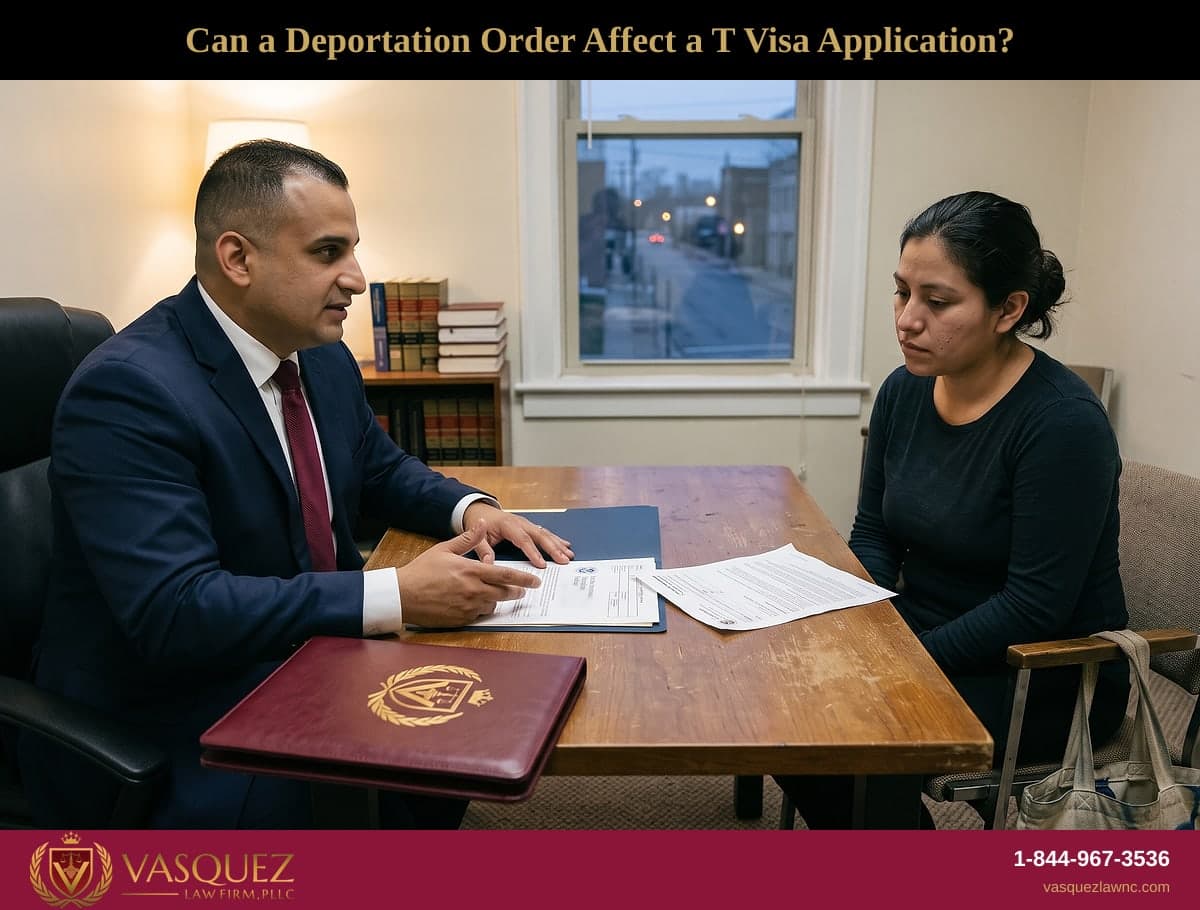
Have questions? Talk to an attorney - free evaluation.
Call 1-844-967-3536Check your case status now
Look up your immigration case below, then talk to an attorney about what it means — free.
Questions about your result?
Talk to an attorney about your case — free, no obligation.
T Visa Filing Does Not Automatically Stay Removal
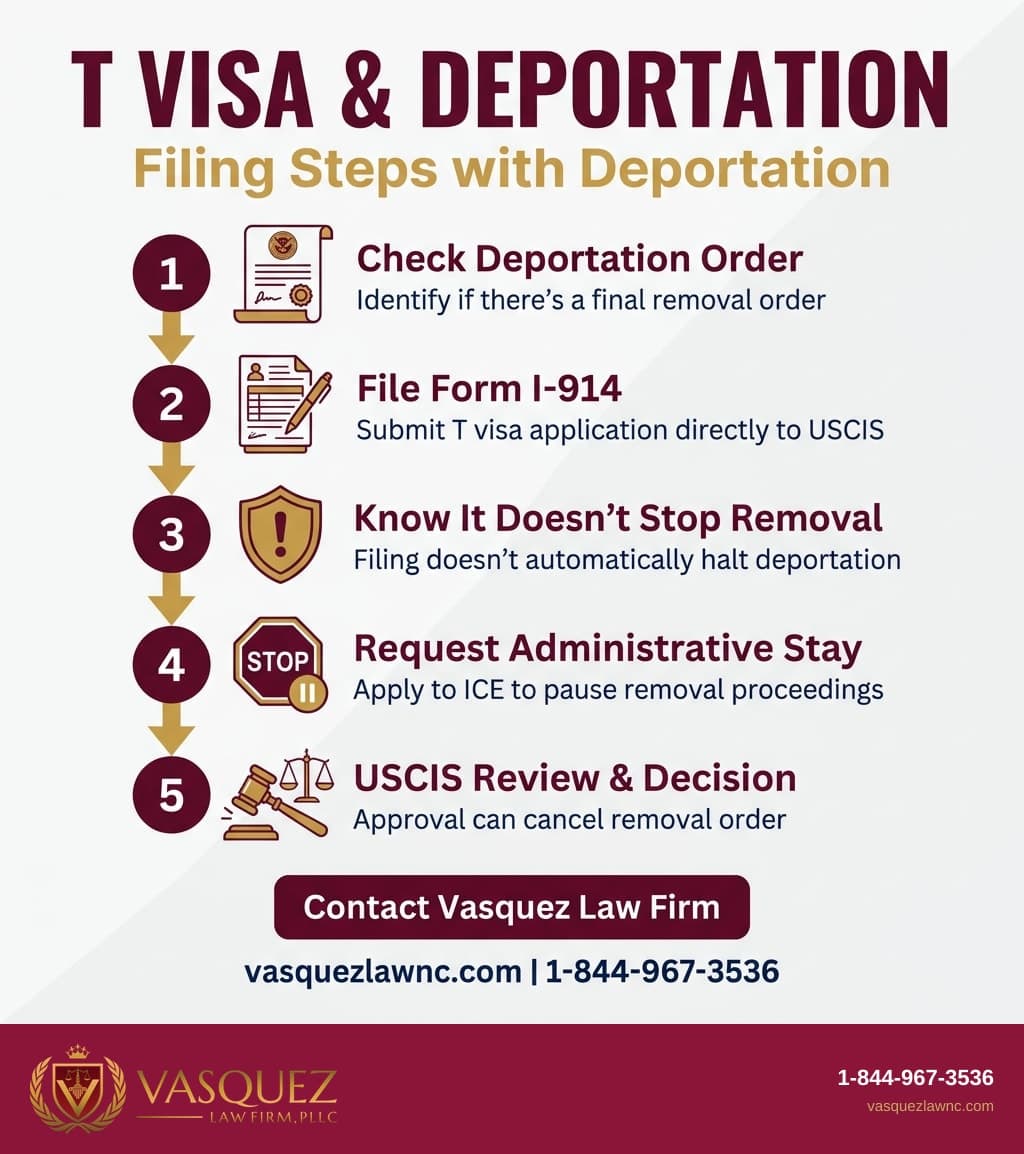
A deportation order does not block every immigration filing. USCIS Policy Manual, Volume 3, Part B, Chapter 9 explains an important rule. A person with a final order of removal, deportation, or exclusion may file Form I-914 directly with USCIS. The person may seek T nonimmigrant status through that filing. The filing itself does not automatically stop removal. Timing and case coordination therefore matter.
If a deportation order involves a possible trafficking-based T visa claim, Vasquez Law Firm offers free, confidential immigration evaluations. Se Habla Español.
Call 1-844-967-3536.
Quick Answer
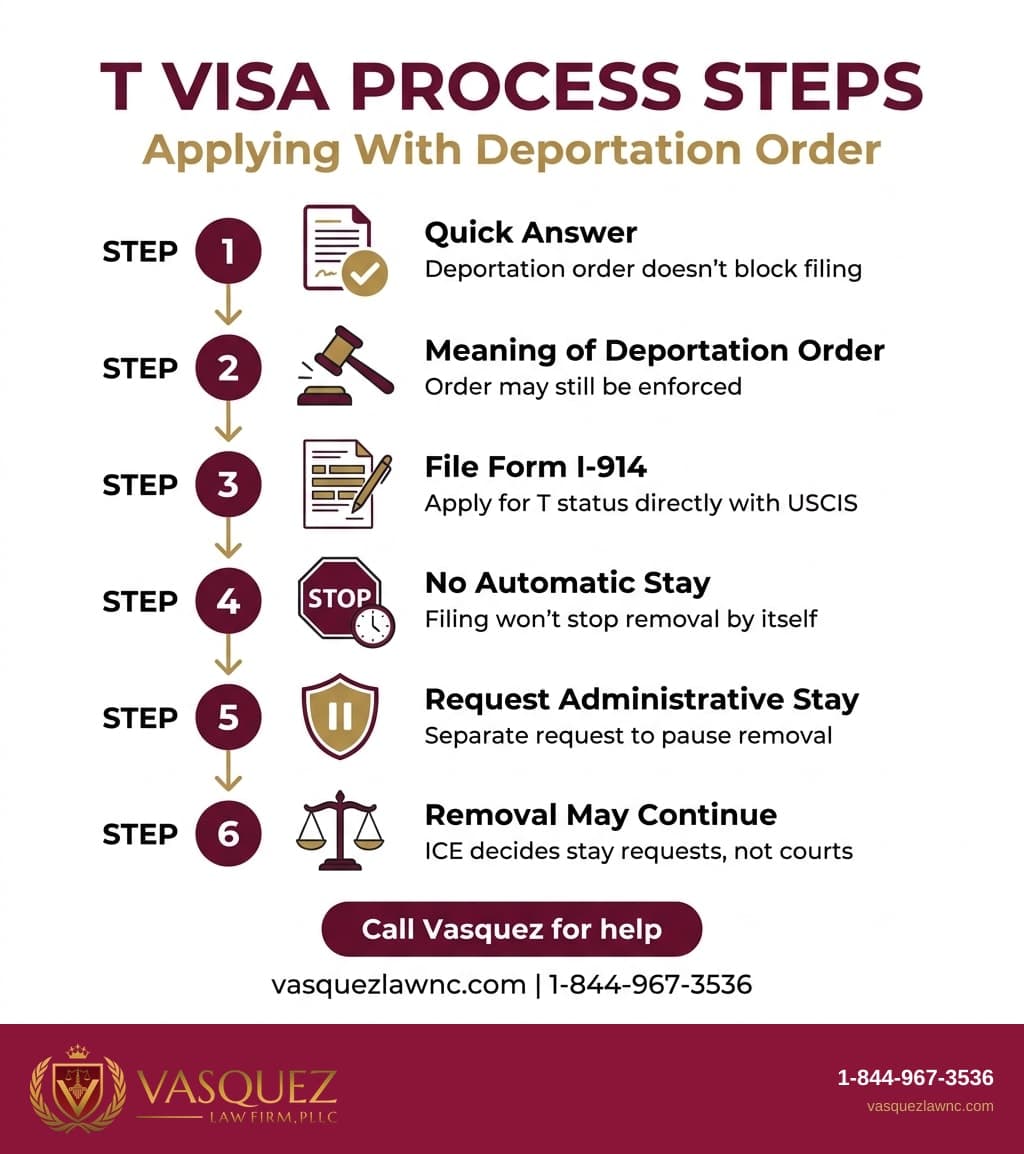
A deportation order can remain enforceable while USCIS reviews a T visa application. In other words, the government may still be able to carry out the order. A person seeking T nonimmigrant status may file Form I-914 with USCIS. This can happen even after a final order. The person may also need a separate administrative stay request. That request seeks protection from removal while the application is pending.
- Form I-914 is filed directly with USCIS.
- A filing does not automatically stay removal.
- Jurisdiction to adjudicate an application for a stay of removal, deportation, or exclusion based on the filing of an application for T nonimmigrant status rests with U.S. Immigration and Customs Enforcement (ICE).
- USCIS approval of T nonimmigrant status automatically cancels any DHS-issued order of removal, deportation, or exclusion as of the approval date.
- An immigration judge or the BIA may consider reopening after approval.
What can a deportation order mean for a T visa applicant?
A final removal, deportation, or exclusion order can create immediate risk. The government may still execute the order. “Execute” means carry out the removal decision. USCIS Policy Manual, Volume 3, Part B, Chapter 9 states a clear rule. A person subject to a final order may file an application for T-1 nonimmigrant status directly with USCIS. This filing is allowed under 8 C.F.R. § 214.204(b)(2).
A person subject to a final order of removal, deportation, or exclusion may file an application for T-1 nonimmigrant status directly with USCIS.
T nonimmigrant status is a humanitarian immigration category. It can protect qualifying victims of severe forms of trafficking in persons. “Humanitarian” means the category is meant to protect people facing serious harm or special circumstances. The filing vehicle for a principal applicant is Form I-914. A principal applicant is the person seeking T status for themselves. A qualifying family member may be included through Form I-914, Supplement A. The family member must meet the applicable eligibility rules.
A removal order is not the same as a decision on a T visa application. USCIS decides the T application directly. This difference is important. Many people search for a deportation order search, a removal order versus deportation order, or how to check removal order immigration status. Those searches do not replace a review of the official case records. The order and the T application are separate matters.
For broader help with federal filings and removal-related strategy, review the firm’s immigration legal services for removal and humanitarian cases. This federal framework applies nationwide. State borders do not change these federal immigration rules.
Filing for T Nonimmigrant Status and Orders of Removal
Submitting Form I-914 does not erase a final order on the day of filing. USCIS describes the application process and the order’s enforceability as separate issues. “Enforceability” means the government may still be able to carry out the order. A person should preserve every immigration court document. The person should also keep every ICE notice and prior order. These records should be collected before anyone assesses available options.
Does filing Form I-914 automatically stop removal?
No. The USCIS Policy Manual explains that filing a T nonimmigrant application has no automatic effect. It has no effect on DHS authority or discretion to execute a final order. DHS means the U.S. Department of Homeland Security. A pending Form I-914 does not itself create an automatic stay. This rule applies to a principal applicant. It also applies to a derivative applicant.
The filing of an application for T nonimmigrant status, whether for a principal or derivative applicant, does not automatically stay a final order of removal and has no effect on DHS’s authority or discretion to execute a final order of removal, although the person who is in proceedings may request an administrative stay of removal. (Source: Chapter 9 - Applicants in Removal Proceedings)
The cited procedure for requesting an administrative stay is 8 C.F.R. § 241.6(a). An administrative stay temporarily pauses removal; requesting a stay does not itself grant that protection. USCIS also identifies INA § 237(d) as the provision placing this stay authority with U.S. Immigration and Customs Enforcement. ICE is the agency commonly called ICE. The immigration judge and Board of Immigration Appeals do not have jurisdiction to decide a stay request based on a T visa filing. “Jurisdiction” means legal power to decide a particular request. See 8 C.F.R. § 214.205(g)(3).
Why an administrative stay request matters
Jurisdiction to adjudicate an application for a stay of removal, deportation, or exclusion based on the filing of an application for T nonimmigrant status rests with U.S. Immigration and Customs Enforcement (ICE). The filing of an application for T nonimmigrant status does not automatically stay a final order of removal and has no effect on DHS’s authority or discretion to execute a final order of removal, although the person who is in proceedings may request an administrative stay of removal.
Cases we handle often involve people who have a copy of an immigration judge’s order. They may lack notices showing later filings. They may also lack ICE communications. Organizing those papers before a consultation can help clarify the case. It can show whether a removal order, a pending application, and a stay request must be addressed separately. It can also help identify urgent deadlines or upcoming enforcement concerns.
Can removal proceedings be paused for a T visa application?
A person in removal proceedings may seek a joint motion with DHS. A joint motion is a request made together by the parties. The motion can ask the immigration judge or Board of Immigration Appeals to administratively close proceedings. It can also ask the decision-maker to terminate proceedings without prejudice. “Without prejudice” means the case may be brought again in the future. The request can apply while USCIS adjudicates the T application. “Adjudicates” means formally reviews and decides the application. USCIS describes this as discretionary action by DHS under 8 C.F.R. § 214.204(b)(1)(ii).
Administrative closure and termination are different requests
The proper request depends on the case’s procedural posture. “Procedural posture” means the case’s current stage and status. The policy manual describes a joint motion for administrative closure or termination without prejudice. The appropriate choice depends on the case. DHS may agree to the request of a person who is in proceedings to file with the immigration judge or the Board of Immigration Appeals (BIA) a joint motion to administratively close or terminate proceedings without prejudice, whichever is appropriate, while USCIS adjudicates an application for T nonimmigrant status.
A person considering this path should keep the I-914 receipt notice. The person should keep copies of all filings. Hearing notices should also be preserved. The person should keep a complete record of any existing order. The firm’s overview of BIA bond proceedings may also help readers understand why the agency handling a request matters in immigration procedure. Different agencies and tribunals have different legal roles.
What happens after USCIS approves a T visa application?
Approval can change the status of a final order. The next step depends on who issued that order. Under 8 C.F.R. § 214.204(o)(1), USCIS approval cancels an order of removal, deportation, or exclusion issued by DHS. The cancellation takes effect as of the approval date.
An immigration judge or the BIA may have issued the order instead. In that situation, USCIS says the approved applicant may seek cancellation. The applicant does so by filing a motion to reopen and terminate removal proceedings. The motion goes to the immigration judge or BIA, as appropriate. A “motion to reopen” asks the decision-maker to review a closed case again. This process is described in 8 C.F.R. § 214.204(o)(2).
Records needed for a motion to reopen
Keep the approval notice and the full removal case record. The tribunal needs enough information to identify the order. It also needs enough information to evaluate the requested reopening and termination. A final denial also has consequences. Any stay issued because of the pending T application is lifted under 8 C.F.R. § 214.204(q)(3).
People seeking help with a humanitarian filing can explore T visa and removal defense immigration support. Consider getting help before making assumptions based on a deportation list of names. An online deportation order search may not show the complete official record. Agency notices and court documents provide more reliable information about the case.
Which documents should you gather for a deportation order review?
A single missing notice can make it hard to determine where a case stands. Build a file before discussing a deportation order. Include documents about a T visa application. Also include documents about a request for an administrative stay.
- Any immigration judge or BIA order.
- ICE notices and custody documents, if applicable.
- Form I-914 and Form I-914 Supplement A copies, if filed.
- USCIS receipt notices and decisions.
- Prior hearing notices and case filings.
- Identity and travel documents available to the applicant.
- Evidence relevant to the T nonimmigrant status application.
Do not rely on a U.S. deportation list PDF. Do not rely on a deportation list of names. Those sources may not show the status of an individual case. Official notices and agency records are more useful. They can help evaluate the next procedural steps. They can also show which agency or tribunal currently controls a request.
What deportation order mistakes should you avoid?
The most serious error is assuming that filing Form I-914 automatically prevents removal. The filing of an application for T nonimmigrant status does not automatically stay a final order of removal and has no effect on DHS’s authority or discretion to execute a final order of removal, although the person who is in proceedings may request an administrative stay of removal.
- Waiting to collect orders: keep every order and notice together.
- Confusing USCIS and ICE roles: USCIS adjudicates the T application, while ICE has authority over the administrative stay request.
- Sending a stay request to the wrong tribunal: immigration judges and the BIA lack jurisdiction over a stay based on the T filing.
- Assuming approval ends all court work: a judge-issued or BIA-issued order may require a motion to reopen and terminate.
- Ignoring a final denial: a stay tied to the pending T application is lifted after final denial.
If you remember one point: a pending T visa filing and a deportation order can exist at the same time, so each procedural issue needs focused review.
How does the federal deportation process apply nationwide?
Removal proceedings, T nonimmigrant status applications, and administrative stay procedures arise under federal immigration law. USCIS policy guidance discusses filings made directly with USCIS. It also discusses motions before the immigration judge or BIA. These rules therefore concern cases throughout the United States.
The USCIS Policy Manual page, including Chapter 9, is available through the USCIS Policy Manual. Readers can also review the agency’s USCIS processing times tool for form-specific updates. Processing times can change. The tool does not replace legal advice or a review of the case record.
When should you request immigration help now?
Acting promptly is especially important when an enforceable deportation order overlaps with a possible T visa application. A legal review may be useful if any of these facts apply:
- You have a final order of removal, deportation, or exclusion.
- You are considering Form I-914 or Form I-914 Supplement A.
- You need to assess an administrative stay request.
- You have proceedings before an immigration judge or the BIA.
- You received a T visa approval and need to evaluate reopening procedures.
- You have an ICE notice or detention-related document.
Vasquez Law Firm can review the relationship between a deportation order and a possible T visa filing. Free evaluations are available. Se Habla Español.
About Vasquez Law Firm
Vasquez Law Firm handles immigration matters with bilingual support. The firm takes an urgent, practical approach. William J. Vasquez leads the firm’s commitment to the Yo Peleo® principle, meaning I Fight, while treating clients with respect and care.
For immigration matters, the firm serves clients nationwide. It offers in-person consultations in Raleigh, NC and Orlando, FL. Our bilingual support staff helps clients communicate clearly throughout the legal process. Read about William J. Vasquez or request a free evaluation.
Frequently Asked Questions
Can someone with a final deportation order file Form I-914?
Yes. USCIS Policy Manual, Volume 3, Part B, Chapter 9 states that a person subject to a final order of removal, deportation, or exclusion may file an application for T-1 nonimmigrant status directly with USCIS. The application is Form I-914. Filing eligibility does not mean the order is automatically stayed while USCIS reviews the application.
Does a T visa application automatically stop deportation?
No. USCIS states that filing a T nonimmigrant status application does not automatically stay a final order and does not affect DHS authority or discretion to execute that order. A person in proceedings may request an administrative stay of removal. The cited procedure is 8 C.F.R. § 241.6(a).
Who decides an administrative stay request?
USCIS identifies ICE as the agency with jurisdiction over a stay request connected to a T nonimmigrant status filing. The immigration judge and the BIA do not have jurisdiction to adjudicate that stay request. This allocation of authority matters because submitting a request to the wrong decision-maker may not address the immediate removal concern.
Can proceedings be administratively closed during a T visa case?
USCIS explains that DHS may, in its discretion, agree to a joint request for administrative closure or termination without prejudice while USCIS adjudicates an application for T nonimmigrant status. The request is made to the immigration judge or the BIA, whichever is appropriate.
What happens to a DHS-issued removal order after T visa approval?
Under 8 C.F.R. § 214.204(o)(1), USCIS approval of T nonimmigrant status cancels an order of removal, deportation, or exclusion issued by DHS as of the approval date. Orders issued by an immigration judge or the BIA involve a separate reopening and termination process described by USCIS.
What if an immigration judge issued the removal order?
After USCIS approves T nonimmigrant status, an applicant subject to an immigration judge or BIA order may seek cancellation by filing a motion to reopen and terminate proceedings with the immigration judge or BIA, as appropriate. USCIS identifies this option in 8 C.F.R. § 214.204(o)(2). Keep the approval notice and complete court record.
Can a derivative family member with an order be included?
USCIS states that when an eligible derivative family member is subject to a final order of removal, deportation, or exclusion, the principal applicant may file an application for derivative T nonimmigrant status directly with USCIS. The derivative filing uses Form I-914, Supplement A, subject to the governing eligibility requirements.
What happens if USCIS finally denies the T visa application?
USCIS states that any stay of removal, deportation, or exclusion issued because of the pending T nonimmigrant status application is lifted upon a final denial. That result makes it important to understand the procedural status of both the T application and any stay request. Individual circumstances can affect available next steps.
Sources and References
A deportation order can require prompt attention, particularly where a T visa application or stay request may be relevant. Contact Vasquez Law Firm for a free, confidential evaluation. Se Habla Español.
Call 1-844-967-3536.
ICE encounter or deportation risk?
Time-sensitive cases need quick action. We answer 24/7 for emergency immigration matters. Free 15-min call.
Keep Reading

For how Vasquez Law Firm can help, see our deportation defense page.
Reviewed by Attorney Vasquez, Managing Attorney

William Vasquez
Founder & CEO, Vasquez Law Firm, PLLC
William Vasquez is the founder and CEO of Vasquez Law Firm, PLLC, a results-driven firm specializing in immigration, criminal defense, personal injury, and workers' compensation. A U.S. Air Force veteran and recipient of the Joint Service Achievement Medal, William is dedicated to fiercely fighting for his clients' rights.
Related Legal Services
Need legal help? Learn more about NC immigration legal team, or contact us for a free evaluation.
You can also visit NC immigration legal help for more information.