BIA Asylum Abandonment Ruling Reshapes Travel in 2026
BIA asylum abandonment can end asylum, withholding, and CAT claims after return travel. Protect your case with legal guidance, request a free evaluation today.
Published on October 12, 2026
Talk to an immigration attorney
Free call. A clear plan for your case.
Free & confidential · Se habla espanol · 24/7
Have questions? Talk to an attorney - free evaluation.
Call 1-844-967-3536Worried how the latest immigration news affects you?
Schedule a confidential case review with an immigration attorney - know exactly where you stand.
USCIS Case Status
Check your USCIS case status
Enter your receipt number and get the official status. Free, no registration.
BIA Asylum Abandonment Ruling Reshapes Travel in 2026
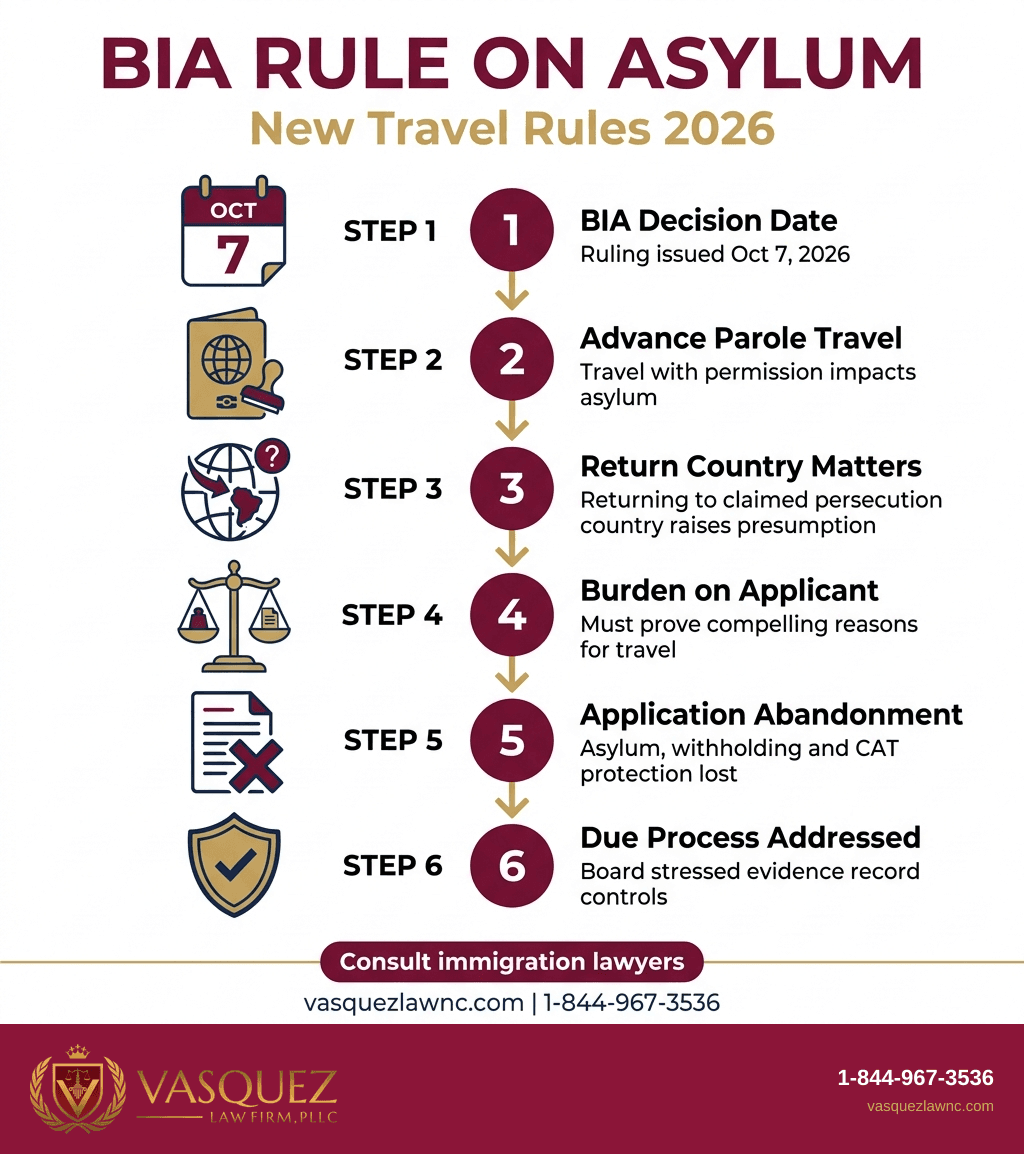
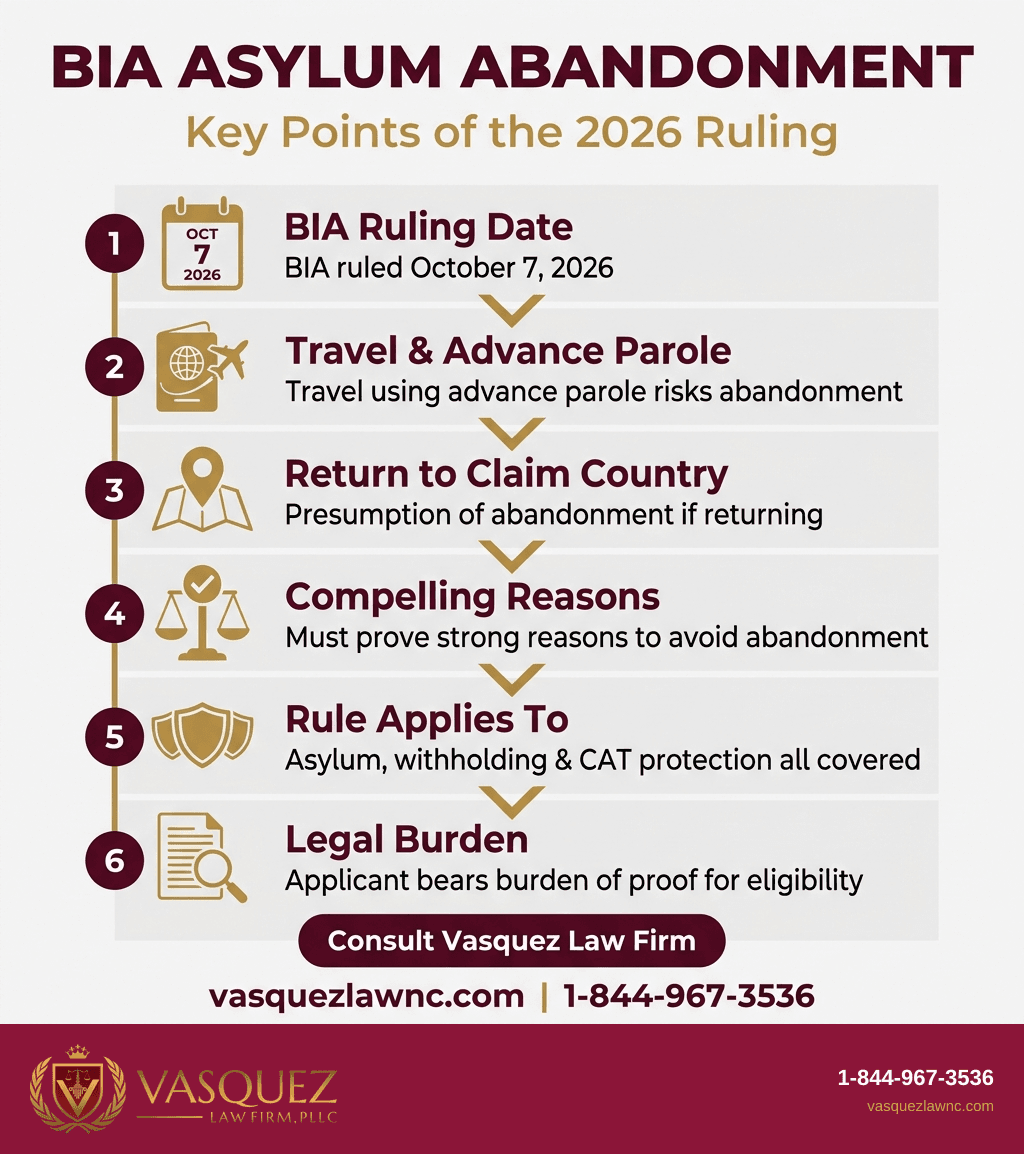
On October 7, 2026, the Board of Immigration Appeals (BIA) ruled on a major travel issue. An applicant who uses advance parole, which is permission to seek return to the United States after travel, may abandon the entire application for asylum, withholding of removal, and Convention Against Torture protection. The decision, Matter of M-R-I-, 30 I&N Dec. 137 (BIA 2026), makes travel a central issue in removal proceedings.
For someone waiting for an immigration court hearing, a trip may start with a family emergency. It may involve a parent’s illness or an urgent need to see loved ones. Yet the BIA asylum abandonment ruling shows that an advance parole document is not a promise that travel will leave a pending protection case unchanged. Our immigration attorneys review travel history with the facts supporting each application before advising on case strategy.
This article gives general legal information. It is not legal advice for any person’s case. Immigration consequences depend on the record, travel history, and procedural posture of the case. The procedural posture means the stage and status of a case. Readers with a pending matter can speak with our immigration legal team about their specific facts.
What did the BIA asylum abandonment ruling decide?
The BIA dismissed an appeal on October 7. It reviewed a Nepalese respondent’s two advance parole trips while his protection case remained pending. The respondent returned to Nepal for about two months in 2016. He later traveled to India for about two months in 2018. There, he met family members who had traveled from Nepal.
The immigration judge had denied asylum and withholding of removal on June 17, 2020. The judge found that the 2016 Nepal trip triggered the abandonment rule in 8 C.F.R. § 1208.8(b). The respondent said he missed family. He also said he worried about his mother’s health and his family after Nepal’s 2015 earthquake.
The immigration judge found the timing important. The decision says that the mother’s last hospitalization was about four years before the Nepal trip. The earthquake occurred one year before the travel. The judge also found that the later India meeting showed an alternative to returning to Nepal.
An alien who, under a grant of advance parole, returns to a country of claimed persecution has abandoned his or her application for asylum, withholding of removal, and protection under the Convention Against Torture, absent compelling reasons for the return.
The BIA agreed with that result. It held that the regulation creates a presumption of abandonment. This presumption arises when an applicant travels under advance parole and returns to the country where the applicant claims persecution. The applicant must establish compelling reasons for the return. Compelling reasons are strong reasons that meet the legal standard for an exception.
The ruling also rejected an argument about a delayed service of the Department of Homeland Security closing argument. The respondent argued that the delay prevented the immigration judge from deciding abandonment. The BIA found that the respondent had notice and an opportunity to object. It stressed that the evidentiary record, not an advocate’s argument, controls whether a bar to relief applies. The evidentiary record is the evidence properly before the court.
Why does the record matter so much?
The BIA stated that asylum applicants bear the burden to establish eligibility. This means applicants must prove that they qualify. Once the travel record showed a voluntary return to Nepal, the respondent had to present compelling reasons for that travel. The Board found that the explanation did not meet that burden on these facts.
Who can the BIA asylum abandonment rule affect?
The rule reaches an applicant who leaves the United States under advance parole. It applies when the applicant returns to the country of claimed persecution. The BIA asylum abandonment analysis focuses on the return country, the claimed fear, the reason for travel, and the proof offered to explain why the trip was necessary.
Advance parole is permission from the Department of Homeland Security to seek parole back into the United States after travel. Parole is a temporary permission to enter or remain for a stated purpose. Advance parole can permit travel. It does not erase the regulatory presumption described in 8 C.F.R. § 1208.8(b). That presumption applies when a person returns to the place connected to the persecution claim.
Matter of M-R-I- is especially important for people seeking several forms of protection in one immigration court case. The BIA concluded that abandonment applies to the application as a whole. That includes asylum, statutory withholding of removal, and protection under the Convention Against Torture, often called CAT.
The application of a mandatory bar to relief is not triggered by the argument of counsel but is governed by the evidentiary record.
That conclusion matters when preparing for a hearing. Travel records, advance parole approvals, passports, entry and exit stamps, testimony, and documents about the reason for travel can shape the evidentiary record. A person should not assume that a family-based reason will automatically qualify as compelling.
The cases we handle often show that the first critical question is not whether travel was authorized. It is whether the person can prove why returning to the claimed country of persecution was necessary. Address that question carefully before a hearing. Do not wait until after an immigration judge raises it.
What did the BIA decide about CAT protection?
The BIA held that the abandonment conclusion covered CAT protection. It also covered asylum and withholding. The BIA reasoned that 8 C.F.R. § 1208.1(a)(1) applies the relevant regulatory subpart to asylum, withholding, and CAT applications. The Board also concluded that CAT deferral was not available to this respondent after abandonment.
In a separate analysis, the BIA upheld the denial of CAT deferral. It cited the respondent’s earlier return to Nepal. It also cited the time since the last claimed encounter with Maoists. The BIA considered the immigration judge’s findings about police assistance during a prior incident.
What law governs travel back to a country of claimed persecution?
Section 208(b)(1)(A) of the Immigration and Nationality Act authorizes asylum for a person who qualifies as a refugee. A refugee is a person who meets the legal definition for protection from persecution. INA § 101(a)(42)(A), 8 U.S.C. § 1101(a)(42)(A), defines a refugee in relevant part as a person unable or unwilling to return to the country of nationality because of persecution or a well-founded fear of persecution.
The BIA connected that statutory language to 8 C.F.R. § 1208.8(b). The regulation states that an applicant who leaves under advance parole and returns to the country of claimed persecution is presumed to have abandoned the application. The applicant can avoid that result by establishing compelling reasons for returning.
Withholding of removal has a separate statutory framework. INA § 241(b)(3)(A), 8 U.S.C. § 1231(b)(3)(A), protects a person whose life or freedom would be threatened in a qualifying country. CAT protection is implemented through regulations, including 8 C.F.R. § 1208.16(c). These forms of relief have different legal standards. Still, the BIA’s decision treats abandonment under § 1208.8(b) as reaching the combined application.
How did the Board address due process?
The respondent argued that DHS served its closing argument several days after filing. He also argued that signatures were missing. The BIA cited the need to show prejudice for a due process violation. Prejudice means harm that could have affected the result. The BIA found that the respondent objected in writing and orally. It also found that the immigration judge considered the objection.
The Board relied on the settled principle that attorneys’ arguments are not evidence. Under 8 C.F.R. § 1240.8(d), evidence may indicate that a ground for mandatory denial applies. In that situation, the applicant must prove by a preponderance of the evidence that the ground does not apply. A preponderance of the evidence means that the claim is more likely true than not true.
What should I do before travel could affect my asylum case?
Before leaving the United States, identify the proposed destination. Ask whether it is the country named in the asylum application. Also ask whether it is another country connected to the claimed fear. That is the threshold issue in the BIA asylum abandonment ruling. Do not treat an approved advance parole request as an answer to the separate abandonment question.
Next, collect records that explain the reason for any proposed or completed trip. Relevant materials may include advance parole documents, passport pages, travel itineraries, medical records, and communications about an emergency. They may also include proof of family circumstances. Gather evidence showing why another location could not meet the need.
Then compare those records with the facts in the filed asylum application and prior testimony. In Matter of M-R-I-, the gap between the cited family events and the Nepal trip weakened the claimed need to return. Consistency and timing can matter as much as the reason itself.
If travel already occurred, disclose it accurately to counsel. Prepare to address it in immigration court. Do not alter records or minimize a trip. A clear timeline, supported by authentic documents, gives the immigration judge a basis to assess the claimed compelling reasons.
People with applications before USCIS should also keep copies of every filing and agency notice. The USCIS Policy Manual is an official resource for USCIS adjudication policies. Immigration court cases require attention to the regulations and hearing record at issue.
Travel may affect more than a return date. Vasquez Law Firm offers a free immigration evaluation for people reviewing a pending protection case. Se Habla Español.
What should asylum applicants watch for after Matter of M-R-I?
For now, applicants can rely on the BIA’s stated rule. Travel under advance parole back to a country of claimed persecution creates a presumption of abandonment. That presumption remains unless compelling reasons are established. The decision is identified as Matter of M-R-I-, 30 I&N Dec. 137 (BIA 2026), Interim Decision #4258.
Immigration court litigants should watch how immigration judges apply the decision to their evidence. The key practical issue is whether the record supports compelling reasons for the return. The official Matter of M-R-I-, 30 I&N Dec. 137 (BIA 2026) decision contains the Board’s full reasoning and citations.
Applicants should also monitor notices and filings in their own proceedings. A travel choice can interact with pending hearings, requests for relief, and the burden of proof. Careful preparation gives a person the best chance to present the actual reasons for travel in an organized record.
Frequently Asked Questions
Does advance parole protect my pending asylum application?
No. Advance parole allows a person to seek parole back into the United States after travel, but Matter of M-R-I- holds that returning under advance parole to the country of claimed persecution creates a presumption of abandonment. The applicant must establish compelling reasons for that return under 8 C.F.R. § 1208.8(b).
Does this BIA asylum abandonment decision apply to withholding and CAT?
Yes. The BIA concluded that abandonment covered asylum, withholding of removal, and CAT protection because the regulations apply to the application as a whole. The decision also found that CAT deferral was unavailable to the respondent after abandonment under the regulatory framework discussed by the Board.
What counts as a compelling reason to return?
The regulation uses the phrase compelling reasons, and the BIA evaluated the respondent’s evidence in context. In this case, the Board agreed that time gaps after a mother’s health incident and an earthquake weakened the explanation. It also considered that the respondent later met family in India rather than Nepal.
Can DHS arguments alone cause abandonment?
No. The BIA stated that the application of a bar to relief is governed by the evidentiary record, not counsel’s argument. Still, applicants bear the burden of proof. When the record shows a return to the claimed country of persecution, the applicant must explain why that travel did not amount to abandonment.
Why did the respondent’s India trip matter?
The BIA noted that the respondent’s family traveled from Nepal to India, where they met during a later trip. The immigration judge viewed that meeting as evidence of an alternative to returning to Nepal. The Board agreed that this fact undermined the claim that a Nepal return was compelled by family circumstances.
Can new country-condition evidence reopen an abandonment finding?
Not on the facts of this case. The BIA denied the motion to remand because the additional country-condition evidence did not relate to the earlier abandonment determination. A motion to reopen requires material evidence that was previously unavailable and could not have been discovered or presented at the former hearing.
Sources
A return trip can create serious questions in a pending protection case. Contact Vasquez Law Firm for a free evaluation tailored to your travel history and immigration record. This information is general and is not individualized legal advice.
Reviewed by Attorney Vasquez, Managing Attorney
Seeking Asylum in the US?
You must file within 1 year of arrival. Our attorneys can help build your case.
Keep Reading


William Vasquez
Founder & CEO, Vasquez Law Firm, PLLC
William Vasquez is the founder and CEO of Vasquez Law Firm, PLLC, a results-driven firm specializing in immigration, criminal defense, personal injury, and workers' compensation. A U.S. Air Force veteran and recipient of the Joint Service Achievement Medal, William is dedicated to fiercely fighting for his clients' rights.
Related Legal Services
Need legal help? Learn more about experienced immigration attorneys in Charlotte, or contact us for a free evaluation.
You can also visit immigration legal services throughout NC for more information.