How Does the Asylum Process Move From Filing to Hearing?
Need to understand the asylum process? See how Form I-589, USCIS interviews, credible fear, and immigration court hearings work. Request a free evaluation.
Published on October 19, 2026· Updated October 19, 2026
Talk to an immigration attorney
Free call. A clear plan for your case.
Free & confidential · Se habla espanol · Mon-Fri 8am-7pm, Sat 9am-2pm (ET)
Have questions? Talk to an attorney - free evaluation.
Call 1-844-967-3536Worried how the latest immigration news affects you?
Schedule a confidential case review with an immigration attorney - know exactly where you stand.
USCIS Case Status
Check your USCIS case status
Enter your receipt number and get the official status. Free, no registration.
How Does the Asylum Process Move From Filing to Hearing?
The asylum process may start with Form I-589. It may also start with a credible fear screening or a removal case in immigration court. The route matters. It determines whether USCIS or an immigration judge first decides the claim. This guide explains the affirmative asylum process. It also explains the Asylum Merits Interview path and the defensive asylum process. The guide uses USCIS guidance. It covers the filing deadline, the role of a Notice to Appear, and what may happen after an asylum hearing.
Need help preparing for the asylum process? William J. Vasquez and Vasquez Law Firm offer free immigration consultations. Se Habla Español.
Call 1-844-967-3536.
Quick Answer
The asylum process has three main routes. A person may file affirmatively with USCIS. A person may receive an Asylum Merits Interview after a positive credible fear determination. A person may also request asylum defensively before an immigration judge. Form I-589 and the person’s procedural posture determine the route. Procedural posture means the person’s current position in the immigration process.
- Affirmative applicants must be physically present in the United States.
- A positive credible fear determination can lead to an Asylum Merits Interview or immigration court.
- Defensive asylum is decided in removal proceedings before EOIR.
How does the affirmative asylum process begin?
A person physically present in the United States may seek asylum through the affirmative asylum process. This is true regardless of how the person arrived or the person’s current immigration status. The application is Form I-589, Application for Asylum and for Withholding of Removal. The applicant files it with USCIS under the filing instructions for that form.
To obtain asylum through the affirmative asylum process you must be physically present in the United States. You may apply for asylum regardless of how you arrived in the United States or your current immigration status. You must apply for asylum within 1 year of the date of your last arrival in the United States, unless you can show: Changed circumstances that materially affect your eligibility for asylum or extraordinary circumstances relating to the delay in filing; and You filed within a reasonable amount of time given those circumstances.
Form I-589 starts the application
Form I-589 is used for an affirmative asylum application. It also seeks withholding of removal. Withholding of removal is protection that may prevent the government from sending a person to a country where the person faces the required harm. The form should match the applicant’s history and supporting materials. A filing is incomplete when it leaves out required information. A filing is inconsistent when its statements do not match other records or testimony. Either problem can make an interview or later court proceeding harder.
USCIS states:
You may apply for affirmative asylum by submitting Form I-589, Application for Asylum and for Withholding of Removal, to USCIS.
Applicants may remain in the United States while Form I-589 is pending before USCIS. Work authorization is separate from the asylum application. USCIS states that asylum applicants are not authorized to work unless they meet specific requirements. Review the agency’s USCIS Policy Manual for agency guidance. Also consider immigration representation for asylum applicants before filing a statement. That statement will become part of the record. The record is the collection of applications, evidence, notices, and testimony that agencies or courts may review.
What happens after a credible fear screening?
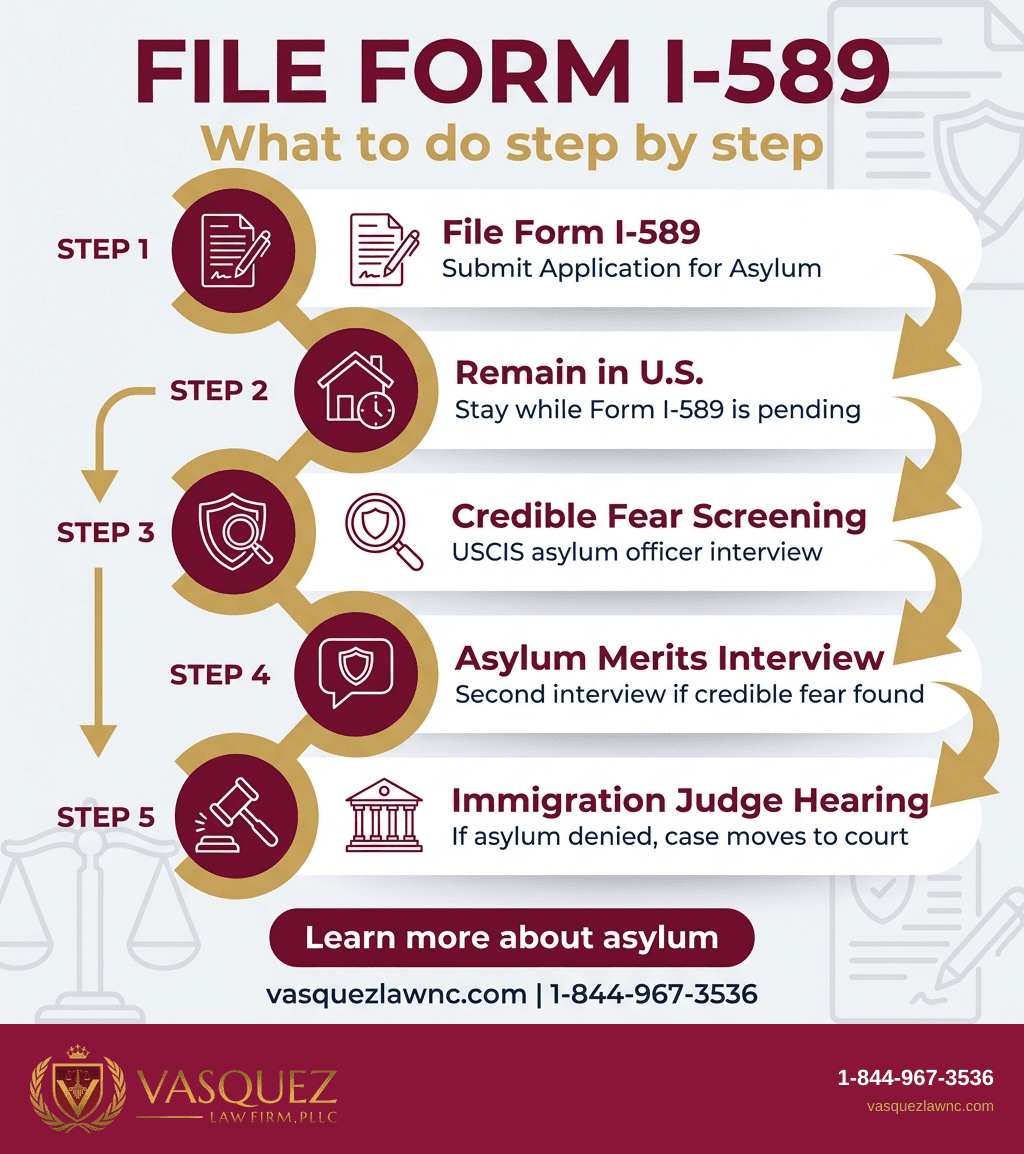
A person in expedited removal proceedings may say that they intend to seek asylum. The person may also say that they fear persecution or torture. The person may fear return to the home country. In these situations, the person will be referred to USCIS for a credible fear screening. Expedited removal is a faster removal process. A USCIS asylum officer conducts the screening interview. The officer decides whether there is a credible fear of persecution or torture. Credible fear means a significant possibility that the person can establish eligibility for protection.
If an asylum officer finds that you have a credible fear of persecution or torture, USCIS may either: Retain and consider your application for asylum and also consider your eligibility for withholding of removal and protection under the Convention Against Torture (CAT) in a second interview. This is known as an Asylum Merits Interview. An asylum officer will decide whether you are eligible for asylum. If necessary, an asylum officer will also determine whether you demonstrated eligibility for withholding of removal or protection under CAT based on the record before USCIS; or Issue a Notice to Appear before an immigration judge for consideration of your asylum, withholding of removal, and CAT protection claims.
The Asylum Merits Interview route
Under the USCIS guidance titled Obtaining Asylum in the United States, the written record of a positive credible fear determination is treated as the asylum application for this route. The person does not need to file Form I-589 with USCIS for that initial agency process. This does not mean the person automatically receives asylum. The person must still present the facts and evidence needed for the officer to decide eligibility.
USCIS provides a qualified interpreter for the Asylum Merits Interview. A qualified interpreter can accurately translate between the person’s language and English. The interview is non-adversarial. This means it is not a courtroom contest between two opposing sides. If USCIS does not grant asylum after that interview, it places the person into streamlined proceedings under INA § 240 before an immigration judge. Streamlined proceedings are a court process that follows the agency interview under the applicable rules.
Cases we handle often involve applicants who have documents but have not organized them around the sequence of events, the fear of return, and the procedural notices already issued. The sequence of events is the order in which important events happened. Bringing every immigration notice, screening record, identity document, and available supporting evidence to a consultation helps identify which asylum process applies. It also helps identify missing information before an interview or hearing.
How does the defensive asylum process work in immigration court?
The defensive asylum process applies when a person requests asylum as a defense against removal from the United States. Removal means the government’s process for sending a person out of the country. The person must be in removal proceedings before the Executive Office for Immigration Review, commonly called EOIR. EOIR is the federal office that oversees immigration courts and related appeals.
If USCIS does not approve an affirmative asylum application and the applicant lacks legal immigration status, USCIS will issue a Notice to Appear and refer the case to an immigration judge. ICE or CBP may also place someone in removal proceedings after an immigration violation. They may also do so after a positive credible fear determination. The immigration judge then considers asylum and other possible relief from removal. Relief from removal means legal protection that may allow the person to remain in the United States.
USCIS describes the court setting this way:
Immigration judges hear defensive asylum cases in adversarial (courtroom-like) proceedings, as necessary.
Why the Notice to Appear matters
If your case is not approved and you do not have a legal immigration status, USCIS will issue a Form I-862, Notice to Appear (NTA), and refer your case to an immigration judge with the Department of Justice's Executive Office for Immigration Review (EOIR). The immigration judge conducts a “de novo” hearing of the case. This means that the judge conducts a new hearing and issues a decision that is independent of the decision made by USCIS. In certain circumstances, if USCIS does not have jurisdiction over your case, the asylum office will issue a Form I-863, Notice of Referral to Immigration Judge, for an asylum-only hearing.
The immigration judge then decides whether you are eligible for asylum. If the immigration judge finds you eligible, they will grant asylum. If the immigration judge finds you ineligible for asylum, they will determine whether you are eligible for any other forms of relief from removal. If the immigration judge finds you ineligible for other forms of relief, they will order you to be removed from the United States. Either party can appeal the immigration judge’s decision.
For information on court administration, consult the Executive Office for Immigration Review. People facing removal proceedings can also review asylum developments in the Fourth Circuit as background. Court decisions still depend on their facts and legal issues. A general court decision does not guarantee the same result in another case.
How can the Circumvention of Lawful Pathways rule affect asylum?
The USCIS page includes an alert about the Circumvention of Lawful Pathways Final Rule. The rule sunsetted on May 12, 2025. Sunsetted means that the rule ended as a general rule at that time. Its provisions remain applicable, where appropriate, to people who entered through the southwest land border or adjacent coastal borders between May 12, 2023, and May 11, 2025.
On April 10, 2025, the Ninth Circuit vacated its prior order staying proceedings and the district court’s judgment and remanded the case to the district court for further proceedings. The Ninth Circuit’s ruling may still be subject to review by the U.S. Supreme Court. According to the USCIS alert, USCIS will continue to apply the CLP rule where appropriate until the district court renders a decision. Although the CLP rule sunsetted on May 12, 2025, its provisions remain applicable to those who entered the United States between May 12, 2023, and May 11, 2025. Under the rule, certain individuals who entered the United States through its southwest land border or adjacent coastal borders are presumed to be ineligible for asylum, unless they can demonstrate an exception to the rule or rebut the presumption.
Timing, location of entry, and the particular procedural record can matter under this alert. Do not assume that an affirmative Form I-589 filing means this issue is irrelevant. A careful review of entry records and notices may be necessary before choosing how to present the claim. The facts may show whether the rule applies. They may also show whether an exception or rebuttal is available.
What documents should support an asylum application or hearing?
A well-prepared asylum record starts with documents that confirm identity, immigration history, and the facts supporting the fear claim. Identity documents help show who the applicant is. Immigration records help show how and when the person entered. Other evidence may help explain why the person fears return. USCIS and immigration court may review the written application, interview record, notices, and supporting material in different settings.
- Form I-589 or the credible fear record, depending on the process.
- Passport, identity records, travel documents, and entry records that are available.
- Form I-862, Form I-863, interview notices, and other USCIS or EOIR notices.
- A personal declaration that is consistent with the application and testimony.
- Supporting records relevant to the claimed fear of persecution or torture.
- Translations and original-language materials when needed for accuracy.
The key is not volume alone. Each document should help explain a material fact. It should confirm a date or identity detail. It may also address an issue that could arise at an interview or hearing. Keep copies of every filing and notice. The firm’s asylum and removal defense services can help applicants understand how their documents fit their process. The goal is a clear record that connects the evidence to the person’s claim.
What are the stages of the asylum procedure?
The time it takes to process an asylum application can vary depending on the path and case posture. Applicants should follow the instructions under the “Where to File” section on the Form I-589 page for more information.
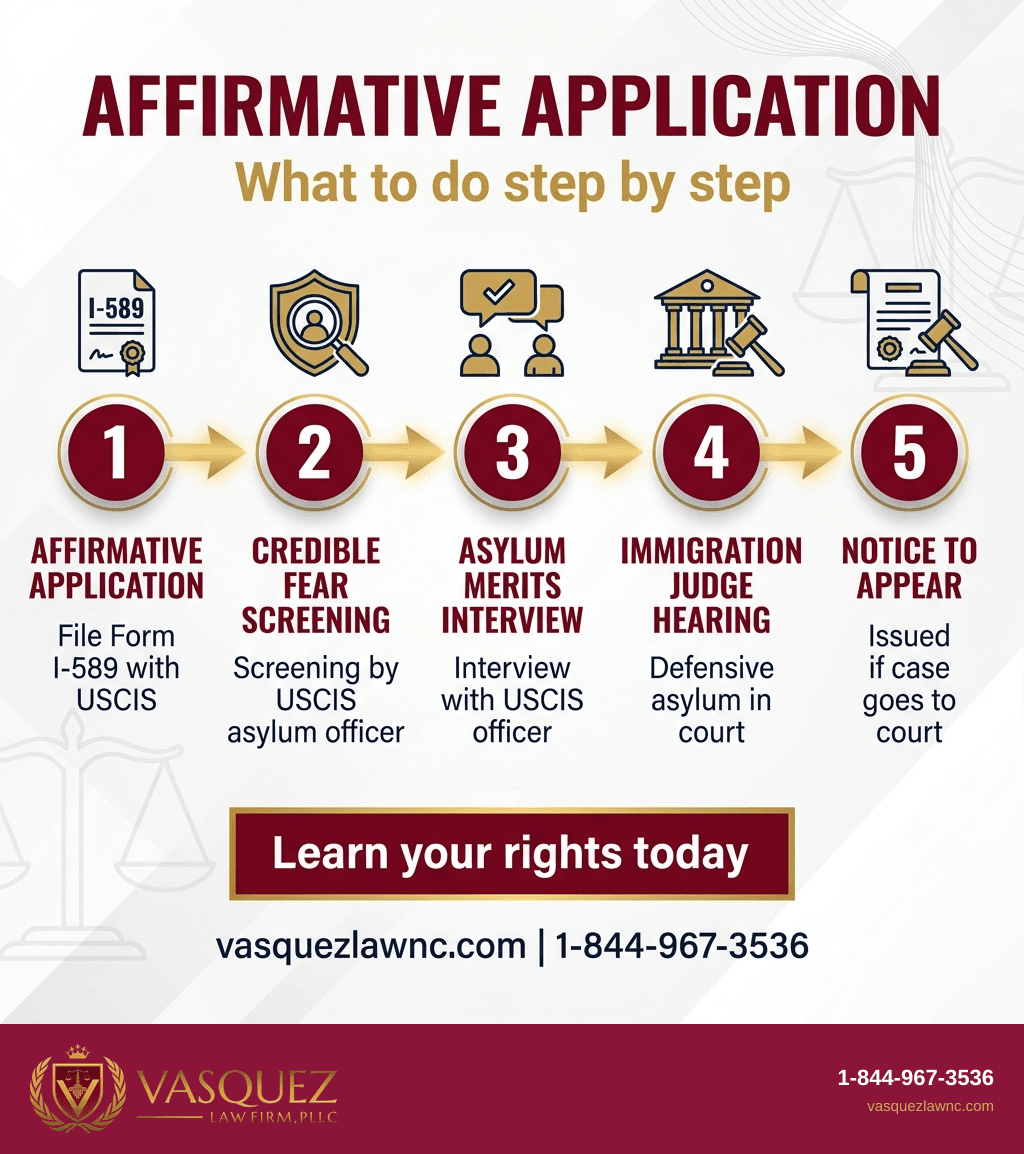
- Identify the process: affirmative filing, credible fear screening and possible merits interview, or defensive court case.
- Prepare the record: complete Form I-589 if required and gather supporting documents.
- Attend the assigned proceeding: an affirmative interview, credible fear screening, Asylum Merits Interview, or immigration court hearing.
- Receive a decision: USCIS or the immigration judge decides asylum eligibility.
- Address the next procedural step: a USCIS referral can lead to a new hearing before an immigration judge, and either party may appeal an immigration judge’s decision.
Immigration judges hear defensive asylum cases in adversarial (courtroom-like) proceedings, as necessary. The judge will hear arguments from both of the following parties: You (and your attorney, if represented) and the U.S. government, which is represented by an attorney from U.S. Immigration and Customs Enforcement (ICE). The immigration court provides a qualified interpreter for the asylum hearing and all other court proceedings. This differs from the affirmative interview, where the applicant usually must provide a qualified interpreter.
Facing an asylum interview, a Notice to Appear, or a court hearing? Request a free evaluation with Vasquez Law Firm. Se Habla Español.
Get a Free Immigration Evaluation
Call 1-844-967-3536.
What mistakes can complicate an asylum case?
- Waiting without reviewing the one-year rule: assess timing promptly, including possible changed or extraordinary circumstances.
- Using the wrong process: a person already in removal proceedings generally pursues defensive asylum before EOIR.
- Ignoring a Notice to Appear: court notices can determine the next required appearance.
- Submitting inconsistent accounts: compare the application, declaration, prior immigration records, and testimony.
- Assuming credible fear is final approval: a positive determination can lead to an Asylum Merits Interview or court process.
- Arriving without interpreter planning: affirmative interview applicants usually must provide a qualified interpreter.
- Leaving out immigration documents: prior notices and filings can affect which agency has jurisdiction.
If you remember one point: the asylum process is not one single hearing. Your current immigration posture determines whether USCIS, an asylum officer, or an immigration judge considers the claim first. Missing a notice or deadline can affect the case. Review the documents and the next required step as soon as possible.
How does the federal asylum framework apply nationwide?
The facts, notices, filing instructions, and assigned court or asylum office may differ by individual case. A person should use the instructions connected to that person’s case. The person should also check each notice for the correct location and date.
Federal process notes
USCIS handles affirmative asylum processing. USCIS may also conduct credible fear screenings and Asylum Merits Interviews. EOIR immigration judges decide defensive asylum claims in removal proceedings. If a person was previously issued an NTA that was not filed and docketed with the EOIR immigration court, or that was filed and docketed with EOIR either shortly before (within 21 days) or after the person filed Form I-589 with USCIS, USCIS will refile the NTA if necessary and send Form I-589 to the immigration court for adjudication. Adjudication means the formal decision process. The court, rather than USCIS, may then decide the claim.
When should you call about asylum now?
- You received Form I-862 or Form I-863.
- You have an upcoming USCIS interview or immigration court hearing.
- You had a credible fear screening and received a positive determination.
- You are concerned about the one-year filing deadline.
- You filed Form I-589 and later received court paperwork.
- Your entry dates may fall within the Circumvention of Lawful Pathways rule period.
- You need to confirm whether USCIS or the immigration court has your application.
About Vasquez Law Firm
Vasquez Law Firm provides immigration representation for people seeking to understand federal immigration procedures. William J. Vasquez leads the firm with a direct, compassionate approach. That approach is reflected in the firm’s motto, Yo Peleo®.
The firm offers in-person immigration consultations in Raleigh, NC and Orlando, FL, and serves immigration clients nationwide. Our bilingual support staff helps clients communicate clearly in English or Spanish. To learn about William J. Vasquez, visit William J. Vasquez’s attorney profile.
Frequently Asked Questions
Can I apply for affirmative asylum if I entered without a visa?
USCIS states that a person may apply for affirmative asylum if physically present in the United States, regardless of how the person arrived or current immigration status. The person generally files Form I-589 with USCIS. The case may follow a different path if removal proceedings are already pending or USCIS lacks jurisdiction over the matter.
What is the one-year asylum filing rule?
You must apply for asylum within 1 year of the date of your last arrival in the United States, unless you can show: Changed circumstances that materially affect your eligibility for asylum or extraordinary circumstances relating to the delay in filing; and You filed within a reasonable amount of time given those circumstances.
What is defensive asylum?
Defensive asylum is a request for asylum made as a defense against removal from the United States. It is considered in removal proceedings before an EOIR immigration judge. A person may reach that process after a USCIS referral, an immigration enforcement action, or a positive credible fear determination followed by a Notice to Appear.
Does a positive credible fear decision grant asylum?
No. A positive credible fear determination means USCIS may retain the application for an Asylum Merits Interview or issue a Notice to Appear for an immigration judge to consider asylum, withholding of removal, and Convention Against Torture protection. The later agency interview or immigration court process determines eligibility for asylum.
What happens if USCIS does not grant affirmative asylum?
If USCIS does not approve an affirmative asylum case and the applicant lacks lawful immigration status, USCIS will issue Form I-862, Notice to Appear, and refer the case to an immigration judge. The judge conducts a de novo hearing, meaning a new hearing with an independent decision rather than a review limited to USCIS’s result.
Who provides an interpreter in an asylum proceeding?
USCIS says affirmative asylum applicants usually must provide a qualified interpreter for the affirmative interview. USCIS provides a qualified interpreter for an Asylum Merits Interview after a positive credible fear determination. The immigration court provides a qualified interpreter for asylum hearings and other immigration court proceedings.
Can an immigration judge’s asylum decision be appealed?
USCIS explains that either party may appeal an immigration judge’s decision in a defensive asylum case. An immigration judge first decides asylum eligibility and, if the applicant is ineligible for asylum, will determine whether the applicant is eligible for other forms of relief from removal. The precise appellate steps depend on the procedural posture and the decision entered in the case.
How can the Circumvention of Lawful Pathways rule matter?
The USCIS alert states that the rule’s provisions remain applicable where appropriate to certain people who entered through the southwest land border or adjacent coastal borders during the period identified in the alert. Those individuals may be presumed ineligible for asylum unless they demonstrate an exception or rebut the presumption.
Sources and References
Understanding the asylum process early can help you prepare for the correct agency interview or hearing. Contact Vasquez Law Firm for a free, confidential immigration evaluation. Se Habla Español.
Start Your Free Evaluation Now
Call 1-844-967-3536.
Seeking Asylum in the US?
You must file within 1 year of arrival. Our attorneys can help build your case.
Keep Reading

For how Vasquez Law Firm can help, see our asylum page.
Reviewed by Attorney Vasquez, Managing Attorney
Regulatory Analysis: Hearing Requirements for Commercial Drivers
Federal hearing requirements for commercial drivers directly affect immigrant communities who rely on driving jobs for economic stability.
These regulations ensure road safety while providing pathways for qualified drivers to maintain their commercial licenses.
Understanding exemption processes is crucial for immigrant drivers who may have different medical standards or documentation from their home countries.

William Vasquez
Founder & CEO, Vasquez Law Firm, PLLC
William Vasquez is the founder and CEO of Vasquez Law Firm, PLLC, a results-driven firm specializing in immigration, criminal defense, personal injury, and workers' compensation. A U.S. Air Force veteran and recipient of the Joint Service Achievement Medal, William is dedicated to fiercely fighting for his clients' rights.
Related Legal Services
Need legal help? Learn more about how our immigration attorneys can help, or contact us for a free evaluation.
You can also visit North Carolina immigration lawyers for more information.