How T Visa Survivors Seek Protection and Work Permits
T visa survivors may seek protection, work authorization, and a future Green Card. Review Form I-914 requirements and request a free evaluation today.
Published on October 23, 2026· Updated October 24, 2026
Talk to an immigration attorney
Free call. A clear plan for your case.
Free & confidential · Se habla espanol · Mon-Fri 8am-7pm, Sat 9am-2pm (ET)
Have questions? Talk to an attorney - free evaluation.
Call 1-844-967-3536Free Tool
Check Your USCIS Case Status Now
Enter your receipt number - get the official USCIS status in English or Spanish. No registration.
How T Visa Survivors Seek Protection and Work Permits
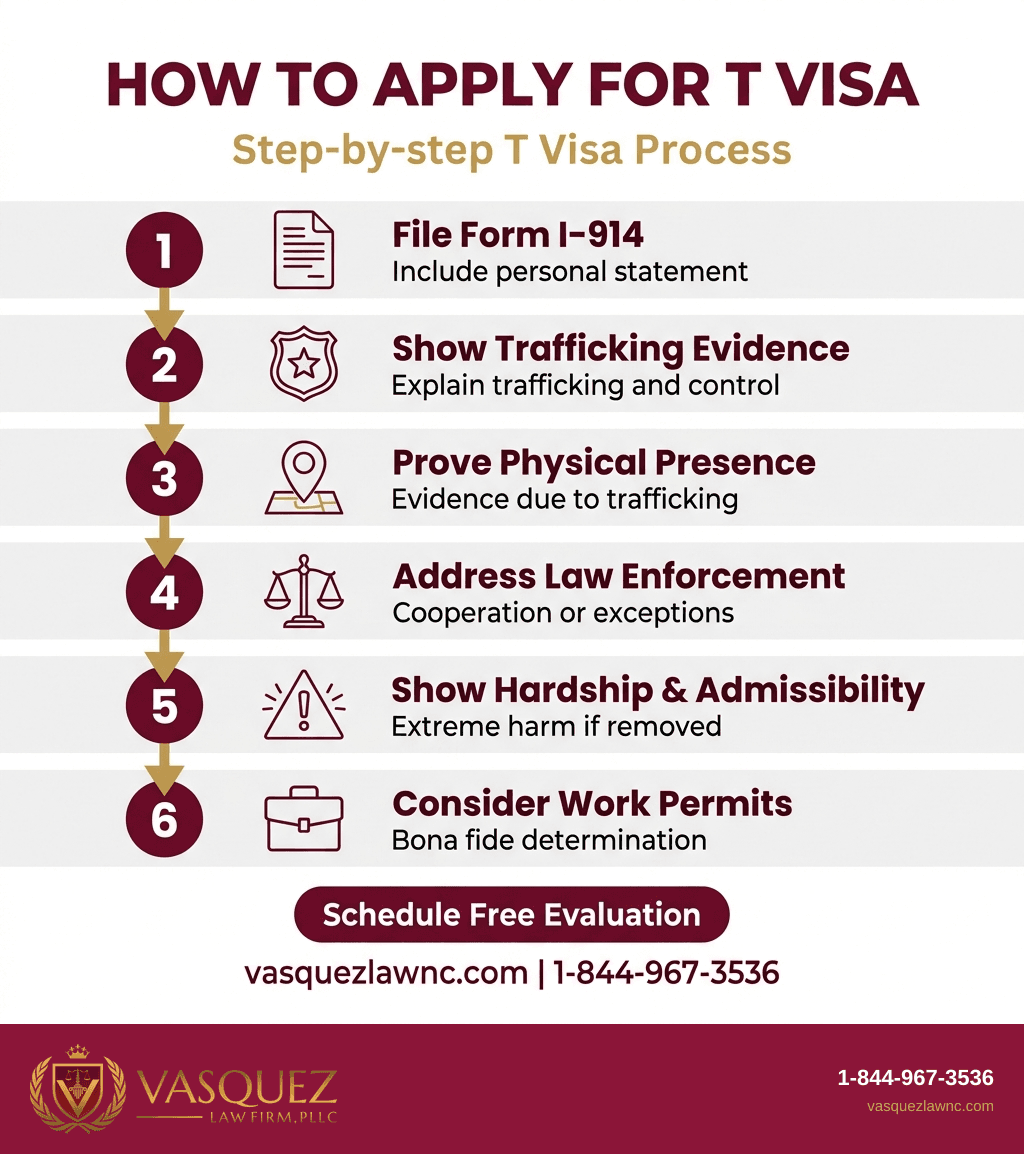
A T-Visa can help human trafficking survivors get temporary immigration protection. It can also provide permission to work and a possible path to a Green Card. USCIS reviews Form I-914 and evidence of trafficking. It also reviews physical presence, cooperation with reasonable law enforcement requests or an exception, hardship, and admissibility. This guide explains the federal process, family options, confidentiality, and practical evidence issues.
Do you need confidential help reviewing immigration options? Vasquez Law Firm offers free immigration evaluations. Se Habla Español.
Call 1-844-967-3536. In-person immigration consultations are available in Raleigh, NC and Orlando, FL.
Quick Answer
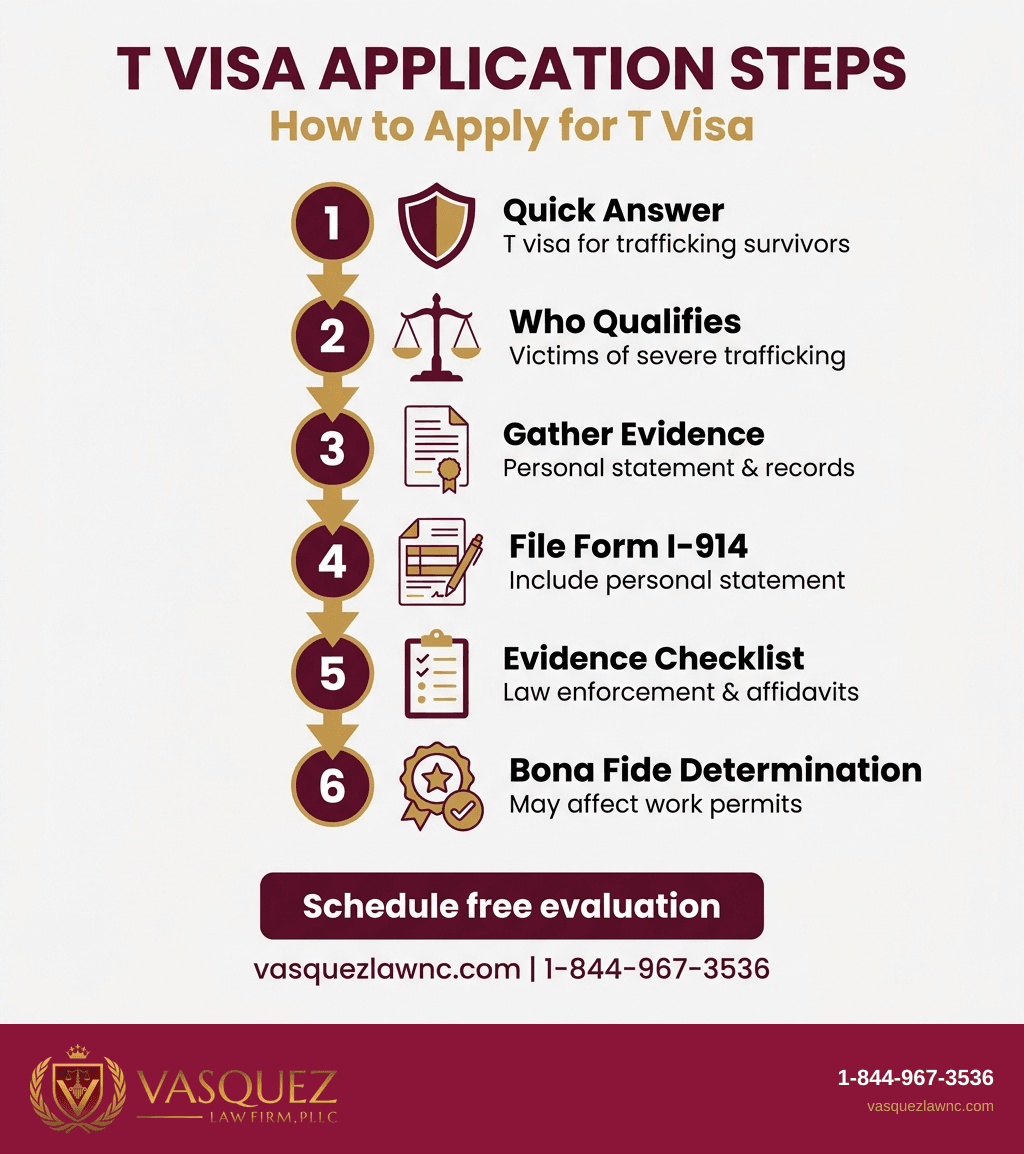
A T visa is a temporary federal immigration benefit for certain victims of a severe form of trafficking in persons. A qualified applicant may stay in the United States. The applicant may also receive work authorization and seek certain benefits. The person may later apply for permanent residence.
- File Form I-914 with a personal statement.
- Show qualifying trafficking and physical presence.
- Address law enforcement cooperation, hardship, and admissibility.
- Consider Form I-765 for a bona fide determination.
- Eligible relatives may use Form I-914 Supplement A.
Who qualifies for T visa protection after human trafficking?
A worker may be recruited through fraud. The worker may then be forced to provide labor through threats or debt. This may be labor trafficking. A person may be pushed into a commercial sex act through force, fraud, or coercion. This may be sex trafficking. Federal law also includes a person under age eighteen who was induced to perform a commercial sex act. In that situation, proof of force, fraud, or coercion is not required.
USCIS describes trafficking as a crime. Traffickers use force, fraud, or coercion to compel labor, services, or commercial sex.
T nonimmigrant status is a temporary immigration benefit.
For T visa USCIS eligibility, the applicant must be, or have been, a victim of a severe form of trafficking. The applicant must also be physically present in the United States, American Samoa, the Commonwealth of the Northern Mariana Islands, or at a port of entry because of trafficking. The applicant must show extreme hardship involving unusual and severe harm if removed. The person must also be admissible or request a waiver when one is available through Form I-192.
Cooperation with law enforcement matters. However, there are limits and exceptions. A person generally must comply with a reasonable request from law enforcement. The request must concern detecting, investigating, or prosecuting the trafficking. Someone under eighteen when at least one trafficking act occurred may qualify for an exception. A person who cannot cooperate because of physical or psychological trauma may also qualify for an exception. Federal immigration representation for trafficking survivors can help organize the facts. It can do so without minimizing trauma or overstating the evidence.
Labor and sex trafficking facts
Labor trafficking can include involuntary servitude, peonage, debt bondage, or slavery. USCIS focuses on whether force, fraud, or coercion was used. The purpose must have been to obtain labor or services for one of those prohibited purposes.
What evidence supports a Form I-914 T visa application?
A personal statement is required with Form I-914. It should explain the trafficking in a careful, truthful, and organized way. The statement can describe recruitment and control. It can also describe labor or services, threats, fraud, coercion, escape, current physical presence, and expected harm from removal.
USCIS permits a Form I-914 Supplement B, Declaration for Trafficking Victim, from law enforcement. That declaration can help show victimization and cooperation. It is not the only possible evidence. USCIS permits other credible evidence instead of, or in addition to, the declaration.
You may submit Form I-914, Supplement B, Declaration for Trafficking Victim, to demonstrate that you are a victim of trafficking and that you have complied with any reasonable request to assist law enforcement. However, you may also choose to submit other evidence instead of or in addition to the Form I-914, Supplement B, such as records of your communication with law enforcement, trial transcripts, court documents, police reports, news articles, affidavits, or other relevant credible evidence. (Source: Victims of Human Trafficking: T Nonimmigrant Status)
Evidence checklist
- Form I-914 and a detailed personal statement.
- Law enforcement communications, reports, records, or court materials.
- Affidavits and other credible evidence supporting trafficking facts.
- Evidence of physical presence because of trafficking.
- Evidence about reasonable cooperation, an exemption, or an exception.
- Evidence of extreme hardship involving unusual and severe harm.
- Admissibility evidence or Form I-192 for applicable inadmissibility grounds.
Our cases often show that a person has useful records. The person may not have gathered them in one place. Messages, police contact records, court papers, and a timeline can help counsel review the case. These materials can show support for each legal element. The goal is accuracy. A perfect document package is not required.
A related guide to U visa options for crime victims may explain another humanitarian category. A U visa is different from a T visa. Whether either category fits depends on the facts and required evidence.
How does a bona fide determination affect T visa work authorization?
USCIS may provide deferred action and employment authorization to applicants with pending, bona fide T nonimmigrant status applications. An applicant with a bona fide application may receive deferred action and employment authorization through USCIS procedures. Deferred action is a temporary decision not to pursue removal. Employment authorization is official permission to work.
The modified bona fide determination process generally applies to applications filed on or after August 28, 2024. It applies to principal applicants and eligible family members in the United States.
To be considered for deferred action and employment authorization through this process, file Form I-765 under 8 C.F.R. § 274a.12(c)(40). If you wait to file Form I-765, it will take longer to process.
Work permit paths
A principal applicant granted T status receives an Employment Authorization Document when USCIS approves Form I-914. A principal applicant seeking work authorization after a bona fide determination must submit Form I-765. A derivative family member in the United States must also submit Form I-765 to request an Employment Authorization Document.
Family members outside the United States should not file Form I-765 before lawful admission. USCIS states that a person outside the United States is not eligible for an Employment Authorization Document until lawfully admitted. Check the USCIS processing times tool for the relevant form. Processing information changes.
Questions about Form I-914, Form I-765, or a trafficking-related waiver need careful review. Se Habla Español.
Get a Free Immigration Evaluation
Call 1-844-967-3536.
Which family members can receive derivative T visa status?
A principal applicant under twenty-one may seek derivative T status for a spouse, unmarried children under twenty-one, parents, and unmarried siblings under eighteen. A principal applicant who is twenty-one or older may seek derivative status for a spouse and unmarried children under twenty-one.
There is also a category based on retaliation risk. It applies regardless of the principal applicant's age. Parents, unmarried siblings under eighteen, and children of any age or marital status of eligible family members who have been granted derivative T nonimmigrant status may qualify. They must face present danger of retaliation because of the escape from trafficking or cooperation with law enforcement.
Use Form I-914 Supplement A for an eligible family member. It may be filed with Form I-914. It may also be filed while the principal application is pending or while the principal has T status. For this reason, review family relationships early. Do not wait until the principal case advances.
For help reviewing derivative eligibility and federal humanitarian relief, see our immigration legal services. The review should separate eligibility facts from assumptions. Relevant facts include a relative's age, marital status, location, and safety risk.
How long can T visa status last and lead to a Green Card?
USCIS generally grants T nonimmigrant status for four years. Certain situations may allow an extension through Form I-539, Application to Extend or Change Nonimmigrant Status. The correct approach depends on the reason for the extension. It also depends on the applicant's continuing circumstances.
A T nonimmigrant who qualifies may seek lawful permanent residence after three years of continuous physical presence since lawful admission as a T nonimmigrant. USCIS also identifies an earlier route. That route may apply when the person maintained continuous physical presence in the United States during the investigation or prosecution of the trafficking, and that investigation or prosecution is now complete.
A practical process sequence
- Identify facts that may meet the severe trafficking definition.
- Collect credible evidence and prepare the required personal statement.
- Review law enforcement cooperation, exceptions, and exemptions.
- Assess admissibility and whether Form I-192 may be needed.
- File Form I-914 and, where appropriate, Form I-765 and Supplement A.
- Track notices and respond carefully to USCIS requests.
- After approval, assess continued status, work authorization, and later permanent residence eligibility.
The USCIS Policy Manual is a useful agency resource. It contains immigration policy materials. Preserve every receipt notice. Keep a safe mailing address current through the special change-of-address procedures for VAWA, T, U, and certain Form I-751 cases.
What confidentiality and safety protections apply to T visa cases?
A safe mailing address can be listed on a T visa application. This option may help when receiving mail at home is unsafe. The applicant does not have to live at that mailing address. This choice may reduce the risk that immigration notices reveal sensitive case information at an unsafe location.
USCIS states that information about a T visa applicant and application is strictly confidential. The law protects that information. DHS may share it only in limited circumstances. USCIS also may not deny an application based only on evidence provided by the trafficker. A statutory exception may change this rule.
For immediate safety support or to report suspected trafficking, the National Human Trafficking Hotline is available at 1-888-373-7888. It operates twenty-four hours a day, seven days a week, in more than two hundred languages. A federal law enforcement agency may request Continued Presence. USCIS describes Continued Presence as temporary relief from removal for an initial period of two years for qualifying trafficking victims.
Mistakes that can weaken preparation
- Leaving out key facts from the personal statement. Fix: prepare a dated timeline before drafting.
- Assuming only a Supplement B can prove trafficking. Fix: gather other credible evidence.
- Ignoring an admissibility issue. Fix: review whether Form I-192 may be appropriate.
- Waiting to file Form I-765 after a bona fide filing. Fix: consider concurrent filing under category (c)(40).
- Forgetting eligible family members. Fix: review Supplement A categories early.
- Using an unsafe address. Fix: identify a safe mailing address where needed.
- Missing USCIS mail. Fix: retain receipt numbers and update address information properly.
If you remember one point, remember this: T-Visa for human trafficking survivors cases require evidence matched to each eligibility element, not just proof that a harmful event occurred.
Frequently Asked Questions
What is a T visa?
A T visa is temporary immigration protection for certain victims of a severe form of trafficking in persons. It can permit an eligible person to remain in the United States for an initial period of up to four years. T nonimmigrants may receive employment authorization and certain federal and state benefits and services. Qualifying individuals may later be able to seek permanent residence.
Must a T visa applicant cooperate with law enforcement?
An applicant generally must comply with reasonable law enforcement requests for help detecting, investigating, or prosecuting trafficking. A person under eighteen when at least one trafficking act occurred may not need to show cooperation. A person unable to cooperate because of physical or psychological trauma may also qualify without showing compliance with reasonable requests.
Can someone apply without a Form I-914 Supplement B?
Yes. Form I-914 Supplement B can support an application by documenting trafficking victimization and cooperation with law enforcement. USCIS permits applicants to submit other evidence instead of, or in addition to, that declaration. Examples include communication records, police reports, court records, trial transcripts, news articles, affidavits, and other credible evidence relevant to the eligibility requirements.
Can T visa applicants receive work authorization before approval?
A pending applicant with a bona fide T visa application may be considered for deferred action and employment authorization. To receive deferred action and employment authorization, you must file Form I-765, Application for Employment Authorization, under 8 CFR 274a.12(c)(40). A principal applicant granted T status receives an Employment Authorization Document with Form I-914 approval.
Can family members qualify for derivative T status?
Yes, eligible relatives can use Form I-914 Supplement A. The qualifying family group depends on the principal applicant's age and other conditions. USCIS also provides a retaliation-based category for certain relatives in present danger because of escape from trafficking or cooperation with law enforcement. The relationship, age, marital status, location, and danger facts all matter.
What if the applicant has an inadmissibility issue?
Admissibility is an eligibility requirement for T nonimmigrant status. USCIS explains that an applicant who is inadmissible may be eligible for a waiver of certain inadmissibility grounds. Form I-192, Application for Advance Permission to Enter as a Nonimmigrant, is the form identified for seeking a waiver of applicable grounds in this context.
How can a T visa applicant receive USCIS mail safely?
An applicant who does not feel safe receiving mail at home may provide a safe address in the mailing-address field of the application. The person does not need to reside at that address. If an address changes after filing, the applicant should use USCIS procedures for VAWA, T, U, and Form I-751 abuse waiver address changes.
When can a T nonimmigrant seek a Green Card?
A qualifying T nonimmigrant may seek lawful permanent residence after three years of continuous physical presence in the United States since lawful admission in T status. USCIS also identifies an earlier point where continuous physical presence was maintained during the trafficking investigation or prosecution and that investigation or prosecution is complete. Individual eligibility requires careful review.
About Vasquez Law Firm
Vasquez Law Firm handles immigration matters nationwide. The firm offers bilingual support for people seeking humanitarian immigration relief. William J. Vasquez has practiced since 2011. He is admitted to the North Carolina State Bar and the Florida Bar. The firm handles sensitive immigration matters with compassion and preparation. It also brings the resolve reflected in Yo Peleo®.
Our bilingual support staff helps clients communicate clearly throughout the process. The firm offers in-person immigration consultations in Raleigh, NC and Orlando, FL. It serves immigration clients nationwide. Read about William J. Vasquez before requesting a free evaluation.
Sources and References
A T-Visa for human trafficking survivors may involve protection, work authorization, relatives, and a future Green Card. Contact Vasquez Law Firm for a free, confidential evaluation. Se Habla Español.
Start Your Free Evaluation Now
Call 1-844-967-3536.
Ready to Apply for a Green Card?
Family-based, employment-based, or other paths — we guide you through every step.
Keep Reading
For how Vasquez Law Firm can help, see our T visa page.
Reviewed by Attorney Vasquez, Managing Attorney

William Vasquez
Founder & CEO, Vasquez Law Firm, PLLC
William Vasquez is the founder and CEO of Vasquez Law Firm, PLLC, a results-driven firm specializing in immigration, criminal defense, personal injury, and workers' compensation. A U.S. Air Force veteran and recipient of the Joint Service Achievement Medal, William is dedicated to fiercely fighting for his clients' rights.
Related Legal Services
Need legal help? Learn more about speak with an immigration lawyer, or contact us for a free evaluation.
You can also visit immigration lawyers serving all of North Carolina for more information.