North Carolina Immigration Law Requires ICE Cooperation
North Carolina immigration law requires ICE cooperation and benefit checks. Review your records and request a free evaluation today.
Published on October 28, 2026· Updated October 28, 2026
Talk to an immigration attorney
Free call. A clear plan for your case.
Free & confidential · Se habla espanol · Mon-Fri 8am-7pm, Sat 9am-2pm (ET)

Have questions? Talk to an attorney - free evaluation.
Call 1-844-967-3536Worried how the latest immigration news affects you?
Schedule a confidential case review with an immigration attorney - know exactly where you stand.
USCIS Case Status
Check your USCIS case status
Enter your receipt number and get the official status. Free, no registration.
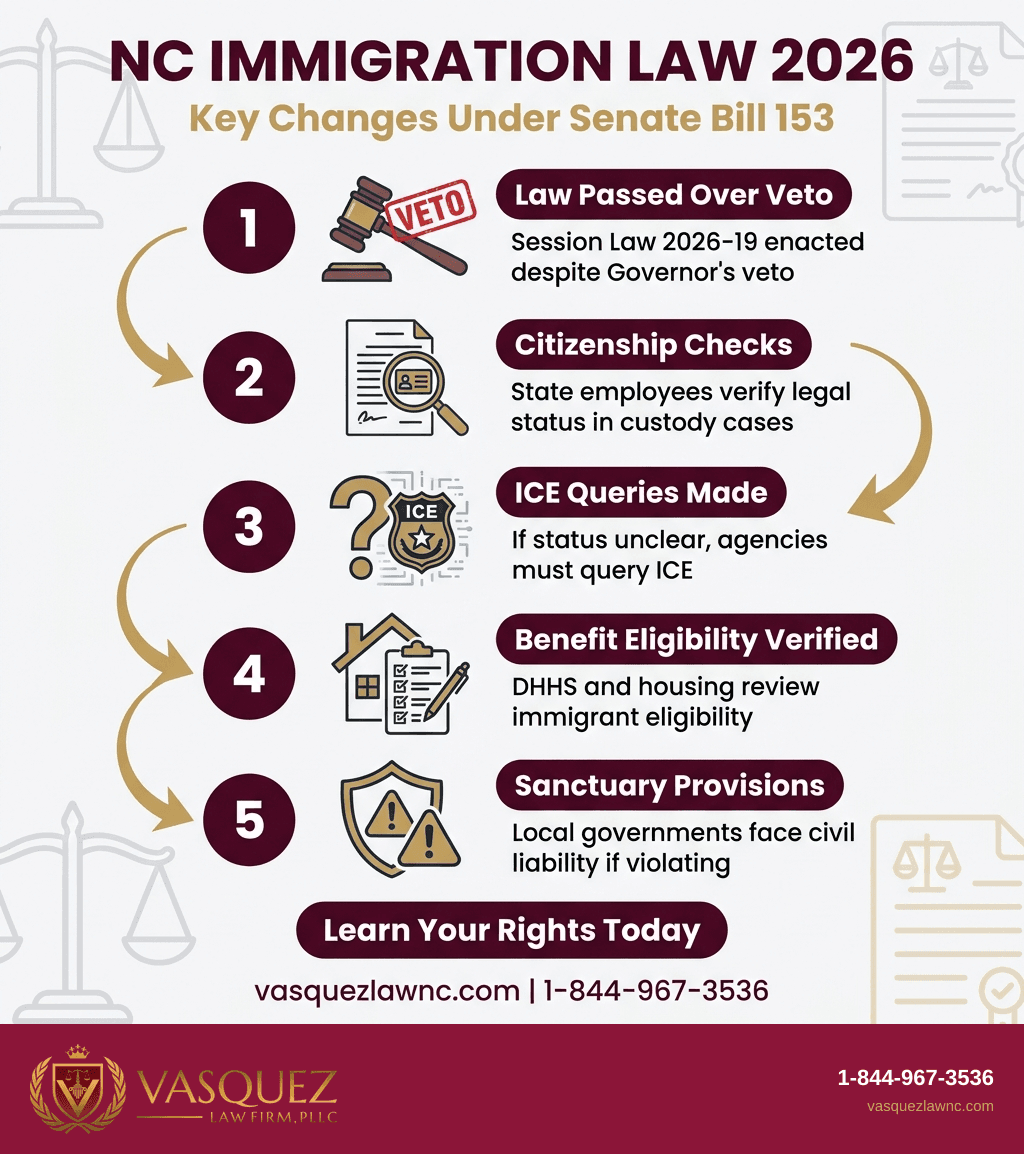
North Carolina Session Law 2026-19 became law over the Governor's veto. This North Carolina immigration law directs the leaders of four state law enforcement bodies to enter into agreements with ICE under INA Section 287(g). ICE means U.S. Immigration and Customs Enforcement. The law also orders immigration-status checks for several public-benefit systems.
For a person held by a state agency, a question about citizenship or lawful residence can now cause an ICE inquiry. The law requires each agency to create policies for these inquiries. Families with pending immigration matters should keep identity, immigration, and court records together. Our immigration attorneys can explain possible federal immigration effects after a state encounter.
Worried About Immigration Policy Changes?
New policies can affect your case. Get current legal advice from an experienced immigration attorney.
Session Law 2026-19 is also called Senate Bill 153. It affects state agencies, public-benefit administrators, local governments, and UNC constituent institutions in different ways. It does not replace federal immigration law. It creates new North Carolina duties. These duties can affect how information moves from state custody to federal immigration officials.
Legal information disclaimer: This article gives general information. It is not legal advice for any person or case. Immigration consequences depend on the facts, a person's status, criminal history, and federal procedure.
What changed under the North Carolina immigration law?
Session Law 2026-19 became law over the Governor's veto. The Governor vetoed it. The legislature then enacted it notwithstanding that objection. This means the legislature enacted it despite the Governor's veto.
Part I directs four state leaders to enter Memoranda of Agreement with ICE. The four leaders are the Secretary of Public Safety, the Secretary of Adult Correction, the State Highway Patrol Commander, and the State Bureau of Investigation Director. A Memorandum of Agreement, or MOA, is a written agreement between agencies. The agreements must follow 8 U.S.C. § 1357(g).
People commonly call these agreements 287(g) agreements. They allow selected state officers to perform certain immigration-law enforcement functions. The officers must first receive ICE training. They must also work under ICE supervision.
The designated State law enforcement officers shall be required to receive appropriate training as provided by ICE and shall function under the supervision of ICE officers when performing under the MOA.
The law also requires policies for each named state body. Employees must try to determine whether a person in custody or under supervision is a legal resident or citizen of the United States or its territories. If employees cannot decide, they must query ICE. To query ICE means to ask ICE for information. If employees decide that the person is not a legal resident or citizen, they must give ICE the requested information.
Part I sets reporting requirements for certain agencies and the State Auditor. The law itself remains the operative enactment. An operative enactment is the law currently controlling the issue. Its general effective-date clause applies unless a part says otherwise.
What else did Senate Bill 153 change?
The North Carolina immigration law also directs DHHS, housing agencies, and the Division of Employment Security to review eligibility. They must verify immigration status to the extent federal law permits. The law adds civil-liability consequences for local governments that violate existing sanctuary-ordinance prohibitions. Civil liability means possible legal responsibility for harm. The law also prohibits UNC constituent institutions from adopting sanctuary status.
Who can the North Carolina immigration law affect?
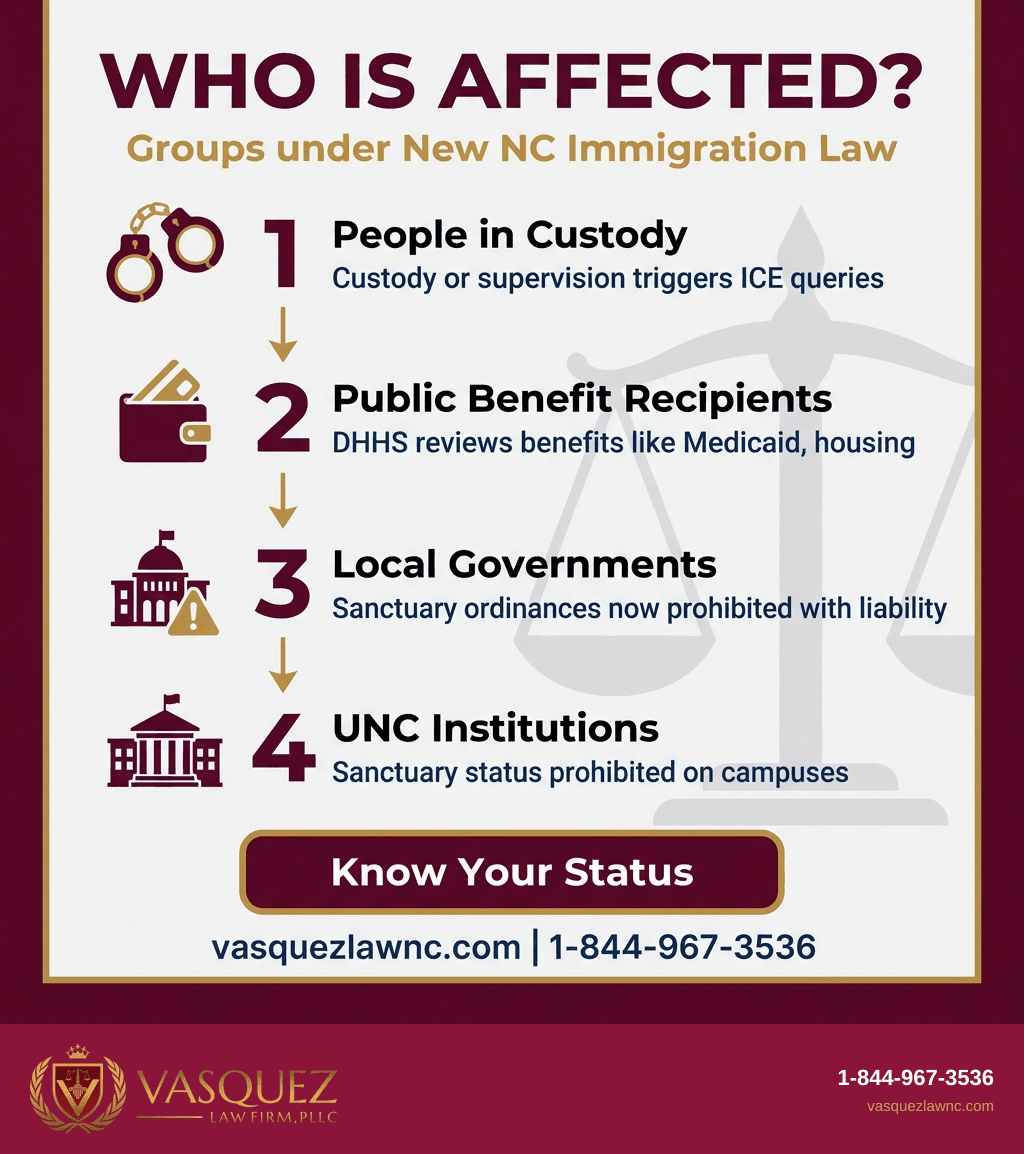
The immediate custody rules apply to people in the custody of, or under the supervision of, four state bodies. They are the Department of Public Safety, Department of Adult Correction, State Highway Patrol, and State Bureau of Investigation. The text requires an inquiry or review of relevant documents. It then requires an ICE query if the agency cannot determine citizenship or legal residency.
This framework matters most when a state encounter leads to custody or agency supervision. It does not say that every contact with a state employee creates an ICE query. The required query happens after the employee cannot determine whether the person is a legal resident or citizen. The employee may use questions, documents, or both.
Part II concerns noncitizens determined to be living in the United States without legal permission. A noncitizen is a person who is not a U.S. citizen. Part II directs DHHS, to the extent federal law permits, to stop state-funded benefits for that group. It also directs DHHS to create a verification method before benefits begin.
The listed programs include Work First, early intervention services, rental or housing assistance, medication assistance, child care subsidies, Medicaid, refugee assistance, energy assistance, and several care programs. The law does not remove any listed program from the text.
The statute excludes benefits or services under those programs that help eligible beneficiaries get food or meals. Its DHHS reporting requirement included identifying benefits that federal law prevents the agency from changing. This means federal law may limit what DHHS can do with some benefits.
Which housing and unemployment programs are involved?
Part III gives similar instructions to the Department of Commerce, the Housing Finance Agency, and local housing authorities created under Chapter 157. It lists rental assistance, transitional housing, Housing Choice Vouchers, HOME assistance, emergency solutions grants, and other publicly funded housing benefits.
Part IV directs the Division of Employment Security to verify that unemployment applicants are legally authorized to reside in the United States. This check must occur before the first payment. It applies to the extent federal law permits. A benefit applicant should not assume that a state eligibility rule answers a separate federal immigration question.
Our North Carolina immigration legal team can review how submitted records fit a person's existing federal filing or status history. A federal filing is an application or other submission to a federal immigration agency or court. Status history means the person's past and current immigration categories.
In our experience, the first concern after an agency request is often a document mismatch. A mismatch could affect a pending immigration case. Accurate records can help a family respond without guessing. Prompt, case-specific review can also help the family choose a safer response.
How does 287(g) fit into federal immigration law?
Congress created the 287(g) framework in 8 U.S.C. § 1357(g). It authorizes the Secretary of Homeland Security to enter written agreements with state or local entities. The agreements allow trained officers to perform specified immigration-officer functions. Federal officials must direct and supervise those functions.
That federal statute supplies the legal mechanism cited in Session Law 2026-19. A legal mechanism is the legal process that makes an action possible. North Carolina's enactment orders the named state leaders to enter into Memoranda of Agreement with the ICE Director. It also uses the limiting phrase “to the extent permitted by federal law” for benefits, housing, and unemployment provisions. This phrase matters because federal program rules may control eligibility and verification requirements.
Federal immigration status is determined under the Immigration and Nationality Act, not by a state official's first inquiry. A person may have proof of citizenship, lawful permanent residence, a visa classification, parole, employment authorization, a pending application, or another federal immigration record. Lawful permanent residence means permission to live permanently in the United States. Parole is temporary permission to enter or remain for a specific purpose. The right response to an information request depends on the person's individual record.
What do sanctuary provisions change for local governments?
Part V addresses North Carolina's county and city sanctuary-ordinance prohibitions and includes provisions regarding waiver of governmental immunity for counties and cities that do not comply with these prohibitions.
Under those sections, a county or city that does not follow the applicable prohibition waives governmental immunity from tort liability. Governmental immunity is legal protection that can block certain lawsuits against a government. Tort liability is legal responsibility for a civil wrong, such as injury or property damage. The waiver applies if an unauthorized alien commits a crime against a person or property within the county or city's limits.
Part VI adds G.S. 116-40.14. It prohibits a UNC constituent institution from having a policy or regulation that limits federal immigration-law enforcement. The limit cannot be below the full extent federal law permits. To the extent federal law permits, it also prohibits institutions from preventing law enforcement officials or agencies from gathering immigration-status information or preventing communication of that information to federal law enforcement agencies.
For broader federal definitions and procedures, readers can consult the USCIS Policy Manual. It is useful background information. It does not replace advice based on a person's documents and procedural posture. Procedural posture means the current stage of a case or application.
What should you do if this law may affect you?
Start by identifying the agency and the issue. A State Highway Patrol custody matter involves different records from a Department of Adult Correction matter. A benefits application and a housing application also raise different records questions under Session Law 2026-19.
Gather copies of documents that show identity and immigration history. These may include a passport, permanent resident card, employment authorization document, I-94 record, visa documents, USCIS notices, immigration-court paperwork, prior ICE correspondence, and certified criminal-court records where relevant. Do not alter documents. Do not submit inconsistent information.
Next, compare every application answer with prior federal filings. A discrepancy may be a clerical issue. It may be a status issue. It may also require legal analysis. Keep agency letters, interview notices, benefit notices, and paperwork received during a custody encounter.
If ICE seeks information after a state encounter, ask for a copy of the paperwork. Identify the agency involved. A person with an immigration court case should keep the hearing notice. The person should communicate with qualified immigration counsel before making decisions that could affect the case.
People with humanitarian-protection concerns may also need to consider a separate federal remedy. Humanitarian protection is immigration protection based on danger, abuse, or another serious hardship. Our articles on U visa protections for crime victims and VAWA self-petition relief explain two distinct forms of possible federal immigration relief.
A state-agency request can carry federal immigration consequences. Vasquez Law Firm offers a free immigration evaluation to review your records and options. Se Habla Español.
What should families watch next under the North Carolina immigration law?
The next practical developments will involve agency implementation. Implementation means the steps an agency takes to put a law into practice. The law calls for ICE Memoranda of Agreement and departmental policies within the named law-enforcement bodies. It also calls for eligibility-review and verification plans at DHHS, the Department of Commerce, the Housing Finance Agency, and local housing authorities. Separately, the Division of Employment Security must adopt a policy to verify that unemployment-benefit applicants are legally authorized to reside in the United States before the first payment.
What's Your Immigration Situation?
Answer 3 questions - we'll tell you your options
Question 1 / 3
What best describes your situation?
Keep Reading
The General Assembly assigned reporting on several benefit and housing provisions for January 15, 2026. That date has passed. Families should instead focus on the written notices and procedures used by the agency handling their current custody, benefit, housing, or unemployment matter.
It is not yet settled whether a particular agency process will accept a specific federal immigration document as enough proof in an individual application. Keep notices. Use only accurate information. Get individualized advice before responding to a dispute about immigration status.
For case-specific federal filing updates, USCIS maintains its Processing Times page. People in removal proceedings should also follow their hearing notices. They should follow instructions issued in their own cases. The state statute's effective date does not change federal filing deadlines or immigration-court obligations.

Frequently Asked Questions
Does the law require the State Highway Patrol to join 287(g)?
Yes. Section 1(c) of Session Law 2026-19 directs the State Highway Patrol Commander to enter a Memorandum of Agreement with the ICE Director under 8 U.S.C. § 1357(g). Designated officers must receive ICE training and act under ICE supervision when performing functions under that agreement.
Does the law cover the State Bureau of Investigation?
Yes. Section 1(d) directs the SBI Director to enter a 287(g) Memorandum of Agreement with ICE. It also requires SBI policies for reviewing citizenship or legal residency of people in SBI custody or under its supervision, querying ICE when the agency cannot determine that status, and providing requested information in specified circumstances.
Can North Carolina verify immigration status for state-funded benefits?
Session Law 2026-19 directs DHHS to develop a method for verifying the immigration status of noncitizen applicants for state-funded benefits before benefits begin. The direction applies to the extent federal law permits. The statute lists programs including Medicaid, Work First, child care subsidies, rental assistance, and refugee assistance.
Does the law affect publicly funded housing benefits?
Yes. To the extent federal law permits, Part III directs the Department of Commerce, the Housing Finance Agency, and Chapter 157 local housing authorities to review eligibility criteria for publicly funded housing benefits and develop methods to verify noncitizen applicants' immigration status before benefits begin. The statute lists rental assistance, transitional housing, Housing Choice Vouchers, HOME assistance, and emergency solutions grants.
What happens to cities or counties that violate sanctuary-ordinance rules?
Part V provides that a county or city violating the applicable sanctuary-ordinance prohibition waives governmental immunity from tort liability when an unauthorized alien commits a crime against a person or property within the county or city. The waiver applies even if the local government has not purchased insurance under the statutes identified in the act.
Can a UNC constituent institution adopt a sanctuary policy?
No. Section 6 of the act prohibits a constituent institution from having any policy or regulation that limits or restricts the enforcement of federal immigration laws to less than the full extent permitted by federal law. It also prohibits, to the extent permitted by federal law, preventing law enforcement officials or agencies from gathering or communicating information regarding the immigration status of any individual to federal law enforcement agencies.
Legal information disclaimer: This North Carolina immigration law analysis is general information, not a promise of results or individualized advice. Contact Vasquez Law Firm for a free consultation. We meet immigration clients in Raleigh, NC and Orlando, FL, and serve immigration clients nationwide.
Do not make assumptions about your status based on a state-agency request. A careful review of your immigration documents can identify the right next step.
Sources
Reviewed by Attorney Vasquez, Managing Attorney

William Vasquez
Founder & CEO, Vasquez Law Firm, PLLC
William Vasquez is the founder and CEO of Vasquez Law Firm, PLLC, a results-driven firm specializing in immigration, criminal defense, personal injury, and workers' compensation. A U.S. Air Force veteran and recipient of the Joint Service Achievement Medal, William is dedicated to fiercely fighting for his clients' rights.
Related Legal Services
Need legal help? Learn more about our immigration legal services, or contact us for a free evaluation.
You can also visit North Carolina immigration law firm for more information.