Adjustment of Status or Consular Processing: Which Applies?
Adjustment of Status or Consular Processing? Compare Form I-485, visa availability, interviews, and next steps. Request a free evaluation today.
Published on October 28, 2026· Updated October 28, 2026
Talk to an immigration attorney
Free call. A clear plan for your case.
Free & confidential · Se habla espanol · Mon-Fri 8am-7pm, Sat 9am-2pm (ET)
Have questions? Talk to an attorney - free evaluation.
Call 1-844-967-3536Free Tool
Check Your USCIS Case Status Now
Enter your receipt number - get the official USCIS status in English or Spanish. No registration.
Adjustment of Status or Consular Processing: Which Applies?
A family-based immigrant may have an approved petition. The person may still need to choose the right path to permanent residence. Adjustment of Status vs. Consular Processing mainly depends on where the applicant is and whether a visa is available. This guide explains both paths. It also explains the forms, notices, and documents to prepare before the next step.
Vasquez Law Firm offers free, confidential consultations about immigration options. Attorney William J. Vasquez and our bilingual support staff serve immigration clients nationwide. Se Habla Español.
Call 1-844-967-3536.
Quick Answer
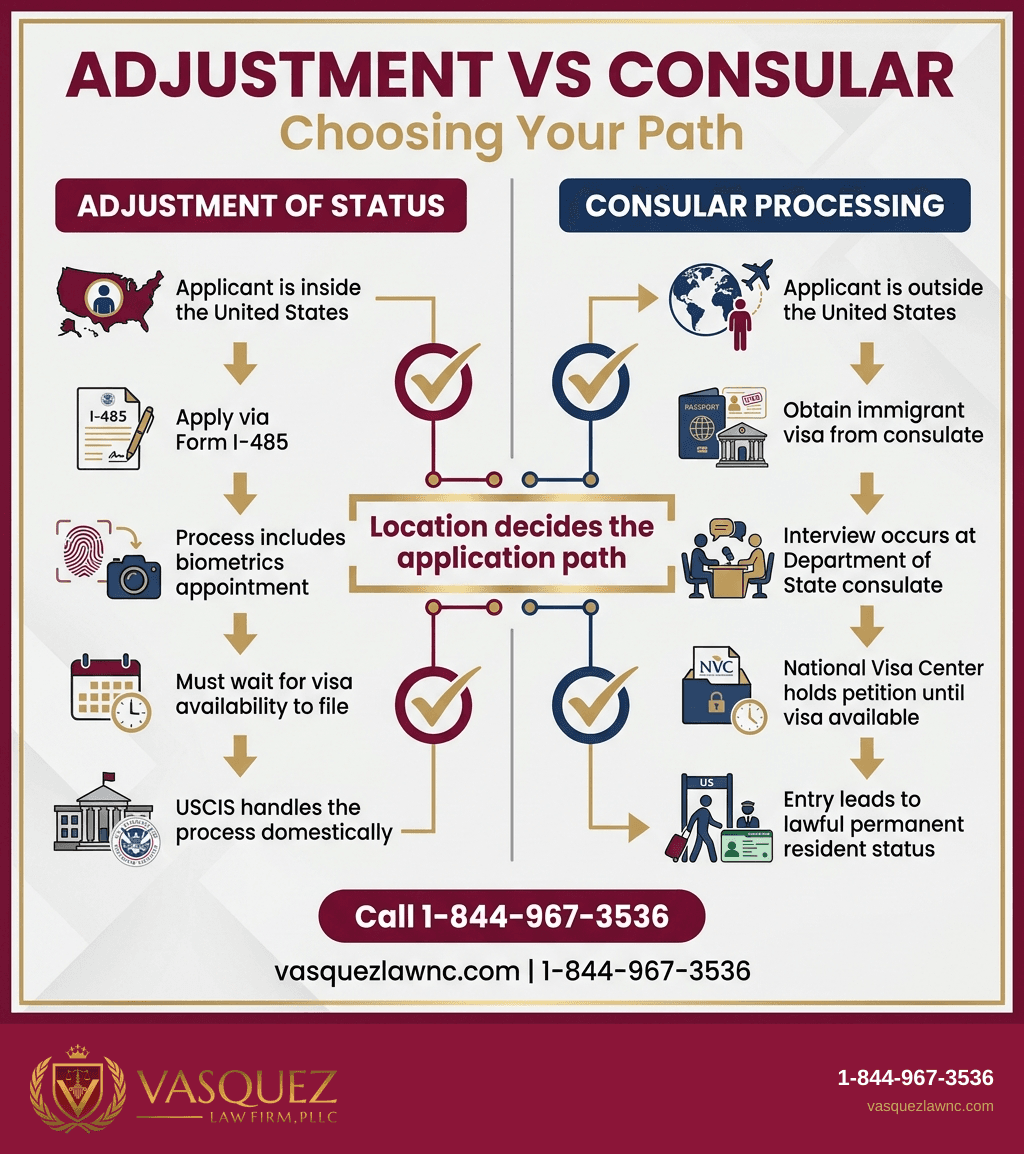
Adjustment of Status vs. Consular Processing means choosing between two paths to lawful permanent resident status. If you are present in the United States, you may apply for lawful permanent resident (LPR) status through adjustment of status. If you are not inside the United States, you must obtain your visa outside the United States through consular processing.
- Adjustment uses Form I-485.
- Consular processing leads to an immigrant visa interview abroad.
- Most categories require an immigrant petition.
- Visa availability can control when a filing may occur.
- The right route depends on the applicant's facts and category.
What is adjustment of status versus consular processing?
One applicant is already in the United States. That person seeks permanent residence without leaving the country. Another applicant is abroad after an approved family petition. USCIS describes adjustment of status as the process for applying for lawful permanent resident status while in the United States.
Adjustment of status is the process that you can use to apply for lawful permanent resident (LPR) status (also known as applying for a Green Card) when you are present in the United States.
Our immigration representation services can help review the immigration category, supporting records, and procedure. The federal rules apply nationwide. However, the applicant's individual record determines which option may be available.
Consular processing applies when a beneficiary is outside the United States. The beneficiary seeks an immigrant visa through a Department of State consulate. After admission with that immigrant visa, the person becomes a lawful permanent resident. The USCIS Adjustment of Status page explains that a person outside the country must obtain the visa abroad through consular processing.
The petition comes first in many cases
Most applicants need two things. They need an immigrant petition and a green card application. For a family relationship, the common petition is Form I-130, Petition for Alien Relative. The adjustment application is Form I-485, Application to Register Permanent Residence or Adjust Status.
Some categories permit concurrent filing. Concurrent filing means filing the immigrant petition and Form I-485 together. It can also mean filing Form I-485 while the petition remains pending. Other categories have different rules. Applicants should identify the category before choosing a route.
How does the Visa Bulletin affect adjustment of status?
A person may be in the United States. The person still may not be able to file Form I-485 immediately. This can happen when an immigrant visa is not available in that category. USCIS directs applicants to visa availability information, adjustment filing charts, and the Department of State Visa Bulletin.
The Visa Bulletin matters for both adjustment and consular processing. USCIS explains that, in general, Form I-485 cannot be filed until a visa is available. During consular processing, the National Visa Center keeps the approved petition until an immigrant visa number becomes available.
A practical visa availability checklist
- Identify the immigration category supporting the petition.
- Confirm whether an immigrant petition is required.
- Check whether visa availability applies to that category.
- Review the appropriate filing information before submitting Form I-485.
- Keep petition notices and priority-date records together.
Do not treat an approved petition as the final green card decision. Approval is a separate step from adjustment or immigrant visa processing. For more information about family-based filings and relationship evidence, see our guide to immigration issues involving marriage and I-751 filings.
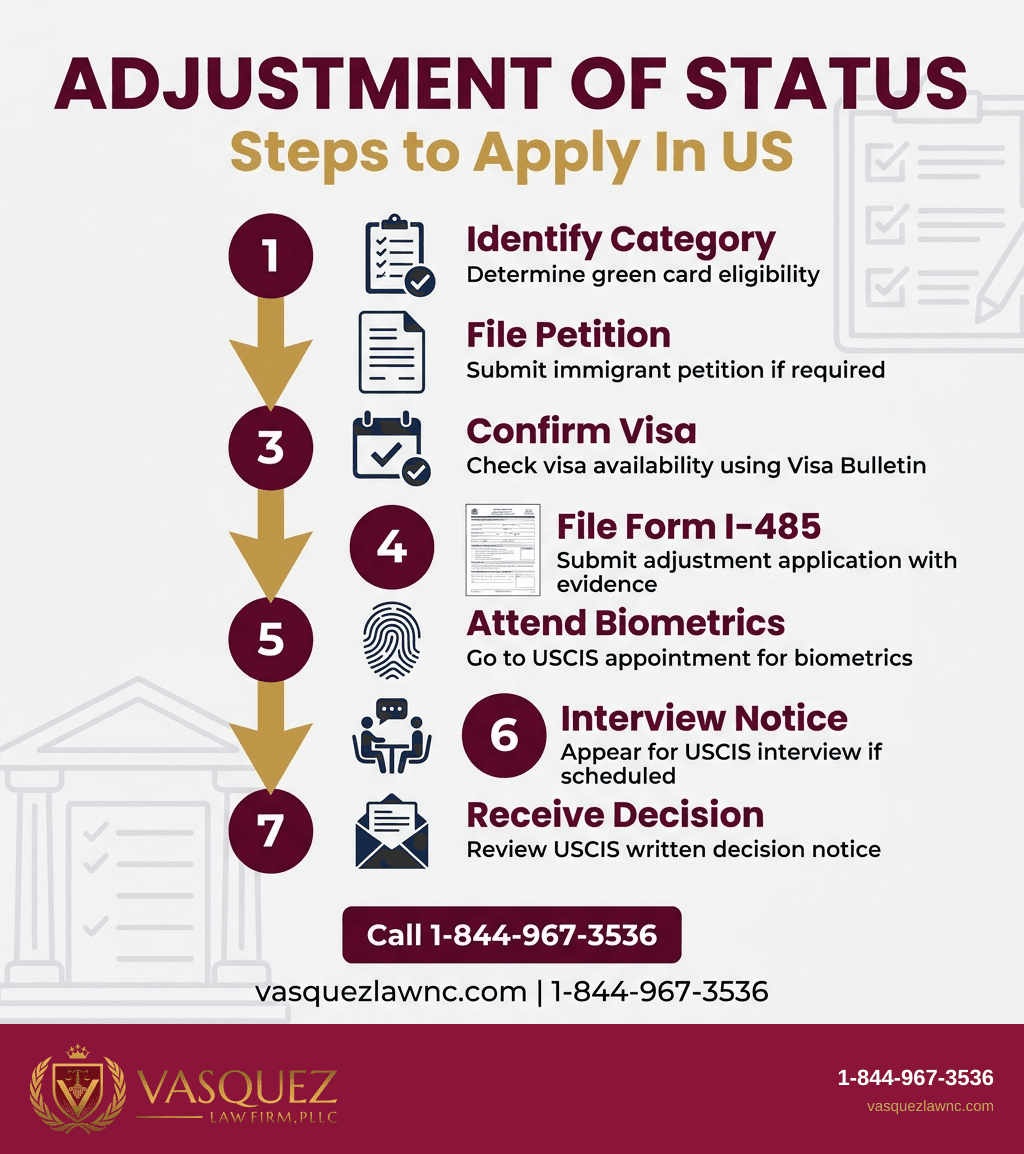
How does Form I-485 adjustment of status proceed?
A typical adjustment case starts with a qualifying category. It also starts with an immigrant petition when one is required. Visa availability may also be required. The next filing is Form I-485. Applicants using INA § 245(i) must complete Form I-485 and Form I-485 Supplement A, according to USCIS.
- Determine the green card category and eligibility.
- File the required immigrant petition, unless the category does not require one.
- Confirm visa availability where required.
- File Form I-485, including required supporting evidence.
- Attend the biometrics appointment after USCIS sends notice.
- Attend an interview if USCIS schedules one.
- Respond on time to any request for evidence.
- Review the written decision notice.
USCIS says it uses biometrics to verify the applicant's identity and to conduct required background and security checks.
The biometrics notice gives the appointment date, time, and location. USCIS states that missing the appointment can result in denial of Form I-485. This may happen if the applicant does not properly notify the agency and request rescheduling.
What to bring to an adjustment interview
If USCIS schedules an interview, the applicant must appear. The applicant must answer questions under oath or affirmation. USCIS says the applicant must bring originals of documents submitted with Form I-485. The petitioning family member must also bring originals when applicable. These documents include passports, official travel documents, and Form I-94 records, even if expired.
Adjustment of Status vs. Consular Processing is more than a choice between forms. It affects where the interview occurs.
What happens during consular processing abroad?
A beneficiary abroad usually starts with an approved immigrant petition. USCIS sends an approved petition to the National Visa Center when the beneficiary lives outside the United States. USCIS also sends it when the beneficiary chooses immigrant visa processing abroad.
The National Visa Center collects immigrant visa processing fees. It also collects supporting documents. The center contacts the petitioner and beneficiary when the petition arrives. It also contacts them when a visa number is approaching availability. The center contacts them when documents or fees are needed.
The consular interview and admission
When a visa is available, the consular office schedules an interview. The same applies when the priority date is current under the monthly Visa Bulletin. The consular office decides whether the person qualifies for an immigrant visa.
If the office grants an immigrant visa, the person receives a Visa Packet. The person should not open it. USCIS explains that the traveler presents the packet to a Customs and Border Protection officer at the port of entry. The officer inspects the traveler. The officer decides whether to admit the person as a lawful permanent resident.
Cases we handle often involve applicants with a petition approval notice. Those applicants may not have organized the civil records, travel documents, or prior immigration paperwork needed for the next stage. A complete record helps identify whether Form I-485 or consular processing fits the procedural posture. For immigration support suited to the process, review our federal immigration legal services.
Choosing between I-485 filing and consular processing can affect your next filing step. Request a free evaluation with Vasquez Law Firm. Se Habla Español.
Get a Free Immigration Evaluation
Call 1-844-967-3536.
Which documents support an immigrant visa or I-485 application?
A missing record can cause USCIS to request more evidence. USCIS may issue a request for evidence for several reasons. Required evidence may not have been submitted. Submitted evidence may no longer be valid. The officer may need more information to decide eligibility.
- Immigrant petition receipt or approval notice, when applicable.
- Form I-485 and category-specific supporting materials for adjustment applicants.
- Passports, official travel documents, and Form I-94 records for an adjustment interview.
- National Visa Center notices and requested supporting documentation for consular cases.
- Address updates and changes in marital status when relevant to the case.
- Copies of every filing and every agency notice.
USCIS requires an address change report within ten days after moving. Keeping the address current helps ensure that notices reach the applicant. Applicants can also use the USCIS case-status system. They need a receipt number and identifying information.
What affects I-485 consular processing time and costs?
Two applicants can have approved petitions. They can still move at different times. Visa availability may differ. The immigration category may differ. Requested evidence, biometrics, interviews, and document collection may also differ. Check consular processing wait times and an I-485 timeline through the agencies handling the case. Do not estimate them from another person's experience.
Applicants can check the status of their application online or call the USCIS Contact Center for information about their case.
Costs also vary by pathway. Consular cases involve immigrant visa processing fees collected by the National Visa Center. They also involve a USCIS Immigrant Fee after an immigrant visa is granted. Adjustment applicants should follow the Form I-485 instructions. They should also follow the page for their specific eligibility category.
How to check the case record
For Form I-485, USCIS says applicants may check case status online. They may also contact the USCIS Contact Center. Keep the receipt number, A-Number, name, and date of birth available. An applicant who receives a request for evidence should read the notice closely. The applicant should respond by the date listed on that notice.
Which adjustment of status mistakes can delay a green card case?
A common mistake is filing before confirming the immigration category and visa availability. Another mistake is treating an interview notice as optional. USCIS can require an applicant to appear. USCIS also requires original documents at the interview.
- Filing the wrong route: Confirm whether the applicant is in the United States or abroad.
- Skipping visa availability: Check the Visa Bulletin and USCIS filing information when applicable.
- Submitting incomplete evidence: Organize category-specific records before filing.
- Missing biometrics: Follow the notice or request rescheduling properly.
- Ignoring an evidence request: Send the requested material by the notice deadline.
- Failing to preserve originals: Bring original documents to a scheduled interview.
- Not updating an address: Report the move within the required period.
- Assuming a petition approval ends the process: Complete the required adjustment or consular stage.
If you remember one point: Choose Adjustment of Status vs. Consular Processing after confirming the applicable category, location, visa availability, and filing requirements.
Why is immigration procedure federal and nationwide?
USCIS handles the review and decision of Form I-485 and the immigrant petitions described in this guide. The National Visa Center and U.S. consular offices handle parts of the immigrant visa route.
USCIS policy materials can explain agency procedures. Its Policy Manual is a useful agency reference. The specific category page and the notices in the applicant's case also remain important.
When should you seek immigration counsel about your filing route?
Legal review is especially useful before a filing that cannot be easily corrected. Contact the firm promptly if you need to choose between pathways. Contact the firm if you receive an evidence request or interview notice. Contact the firm if your address or marital status changes. Either change may affect processing.
- You are unsure whether Form I-485 may be filed now.
- You have an approved petition and need the next procedural step.
- You received a biometrics, interview, or evidence notice.
- You are considering consular processing after petition approval.
- You need to update information connected to the immigration case.
- You received a Form I-485 denial notice and need to assess available options.
About Vasquez Law Firm
Vasquez Law Firm provides immigration representation with a caring, direct approach. The firm's Yo Peleo® commitment means taking each legal concern seriously. It also means giving clients clear information about the process. Our bilingual support staff assists clients in English and Spanish.
For immigration matters, the firm meets clients in Raleigh, NC and Orlando, FL. It serves clients nationwide. William J. Vasquez is admitted to the North Carolina State Bar and the Florida Bar. The firm also handles personal injury, workers' compensation, criminal defense, and traffic matters within the applicable service areas.
Attorney trust and experience
William J. Vasquez has practiced for more than fifteen years. A consultation can help a prospective client understand the record. It can also explain the available procedure. It can identify questions that require a fact-specific review.
Frequently Asked Questions
What is adjustment of status?
Adjustment of status is the USCIS process for applying for lawful permanent resident status while present in the United States. The principal application is Form I-485. Eligibility varies by immigrant category, and many applicants also need an immigrant petition. In general, visa availability must exist before Form I-485 can be filed when that requirement applies.
What is consular processing?
Consular processing is the immigrant visa route for a person outside the United States. After petition approval, the National Visa Center notifies the petitioner and beneficiary when fees and supporting documentation must be submitted. A U.S. consular office schedules the immigrant visa interview. If the visa is granted and the person is admitted at entry, that person becomes a lawful permanent resident.
Can I file Form I-485 with an immigrant petition?
Some immigrant categories allow concurrent filing. USCIS uses that term when Form I-485 may be filed at the same time as the immigrant petition or while the petition remains pending. Many categories require petition approval first. The category page and Form I-485 instructions control the filing approach, along with visa availability where applicable.
What happens after I file Form I-485?
USCIS mails a biometrics appointment notice after Form I-485 is filed. The agency may schedule an interview, request additional evidence, or issue a decision after reviewing the record. If an interview is scheduled, the applicant must appear and bring original documents submitted with the application, including passports, travel documents, and Form I-94 records.
What if USCIS requests additional evidence?
USCIS may issue a request for evidence when required materials are missing, submitted evidence is no longer valid, or the officer needs more information to decide eligibility. The notice identifies the requested evidence, the submission location, and the response date. A timely, organized response is important because USCIS may deny Form I-485 if the applicant does not respond timely.
How can I check USCIS case status?
USCIS allows an applicant to check Form I-485 case status online or contact its Contact Center. The applicant should have the receipt number, A-Number, name, and date of birth ready.
Do I need to report an address change?
Yes. USCIS says an applicant who changes address must tell the agency within ten days of moving to the new address. A missed notice can create avoidable problems, so applicants should update the address and retain confirmation of the change.
Can I appeal a Form I-485 denial?
USCIS explains that, generally, an adjustment of status denial cannot be appealed. A person may still be eligible to file a motion to reopen or reconsider using Form I-290B, Notice of Appeal or Motion. The denial notice explains the reasons for the decision and whether appeal rights exist, so it should be reviewed carefully with the complete case record.
Sources and References
Ready to discuss Adjustment of Status vs. Consular Processing? Contact Vasquez Law Firm for a free, confidential consultation. Se Habla Español.
Start Your Free Evaluation Now
Call 1-844-967-3536.
Need a Work Visa or Permit?
H-1B, TN, L-1, and more. We help workers and employers navigate the visa process.
Keep Reading
For how Vasquez Law Firm can help, see our adjustment of status page.
Reviewed by Attorney Vasquez, Managing Attorney

William Vasquez
Founder & CEO, Vasquez Law Firm, PLLC
William Vasquez is the founder and CEO of Vasquez Law Firm, PLLC, a results-driven firm specializing in immigration, criminal defense, personal injury, and workers' compensation. A U.S. Air Force veteran and recipient of the Joint Service Achievement Medal, William is dedicated to fiercely fighting for his clients' rights.
Related Legal Services
Need legal help? Learn more about our immigration legal services, or contact us for a free evaluation.
You can also visit immigration lawyers serving all of North Carolina for more information.