Immigration Civil Penalty Rule Becomes Final in 2026
Immigration civil penalties now carry a 15-business-day appeal window and fines up to $998 daily. Review your notice and seek a free evaluation.
Published on October 14, 2026· Updated October 14, 2026
Talk to an immigration attorney
Free call. A clear plan for your case.
Free & confidential · Se habla espanol · 24/7

Have questions? Talk to an attorney - free evaluation.
Call 1-844-967-3536Worried how the latest immigration news affects you?
Schedule a confidential case review with an immigration attorney - know exactly where you stand.
USCIS Case Status
Check your USCIS case status
Enter your receipt number and get the official status. Free, no registration.
On October 14, 2026, a federal final rule took effect nationwide. It preserves a fast internal appeal system for immigration civil penalties. It also adds one narrow protection for documented mail delays. A person who receives a Notice and Violation of Order must open it promptly. Quick action can decide whether a fine becomes final.
The rule is called Imposition and Collection of Civil Penalties for Certain Immigration-Related Violations. It is Federal Register Document 2026-21024. It finalizes procedures first used on June 27, 2025. The rule covers certain penalties. These penalties involve final removal orders, voluntary departure orders, and apprehension while entering or attempting to enter unlawfully. Our immigration attorneys can explain how a civil fine relates to a removal case, an appeal, or an existing immigration benefit.
Legal disclaimer: This article provides general legal information, not advice for any individual case. A penalty notice, removal order, travel record, and pending immigration filing can change the analysis. Readers should review their documents with qualified counsel before choosing a response.
What changed in the immigration civil penalties rule?
The Department of Homeland Security and the Department of Justice issued the final rule on October 14, 2026. It took effect that same day. The agencies kept the streamlined process created by the June 27, 2025 interim final rule. They then added a way for ICE to accept a late appeal. This applies when documented mail delivery delays were beyond the person’s control.
“This final rule addresses comments and finalizes the IFR with one change: it permits acceptance of a late-filed appeal based on documented mail delivery delays that ICE finds were beyond the alien's control.”
The rule changed the procedure. It did not change the basic categories of fines that Congress authorized. A DHS officer may issue a written decision and order imposing a penalty. The order must identify the legal basis, penalty type and amount, and a brief explanation. It must also explain appeal rights, representation rights, and the chance to submit written arguments and evidence.
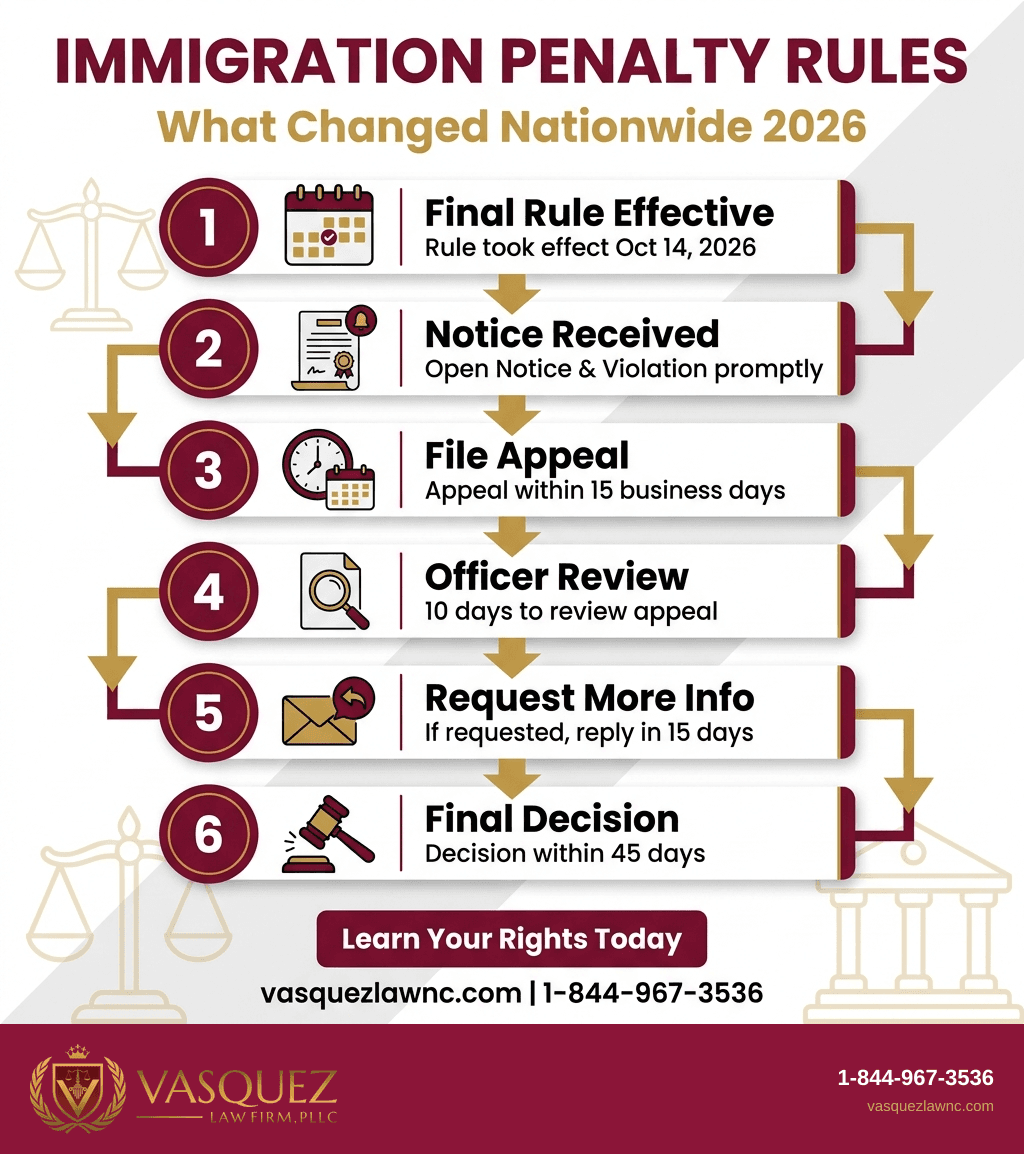
Service means formal delivery of the order. Service may happen in person or by regular mail. An appeal normally must reach DHS within 15 business days after service. A supervisory immigration officer reviews the appeal. This officer must not have issued the initial order. The officer reviews the case anew. That means the officer independently reviews the record instead of simply accepting the first decision.
How the immigration civil penalties process now moves
The reviewing officer generally has 10 days to review an appeal after receiving it. The officer may request more written material. If the officer asks for it, that material is due within 15 days of the request. The officer issues a final decision within 45 days. The final rule removes Board of Immigration Appeals review for these penalties. It also provides no in-person interview.
Agency data in the Federal Register notice show the size of this change. ICE issued about 110,000 failure-to-depart civil penalties from June 27, 2025, through September 14, 2026. CBP issued another 66,000 unlawful-entry civil penalties during that period. The agencies reported that people won 25 percent of adjudicated post-interim-rule appeals.
Who can receive immigration civil penalties under this rule?
The rule reaches three categories described in 8 CFR 281.1(a). First, it reaches people who willfully fail or refuse to depart after a final removal order. It also covers certain actions that thwart departure or removal. Second, it reaches people who voluntarily fail to depart within the period granted under a voluntary departure order. Third, it reaches people apprehended while entering or attempting to enter the United States unlawfully.
“The IFR did not require the imposition of any new penalties or otherwise change the substantive criteria for issuing civil penalties.”
A final removal order is an Immigration Court order requiring removal once it is executable. Executable means the government can carry out the order. Voluntary departure is permission to leave within the period set by an Immigration Judge or the Board of Immigration Appeals. The person leaves under that permission instead of leaving under a removal order. Both types of orders have separate legal consequences. The civil penalty procedure does not replace the underlying immigration case.
For failure-to-depart penalties, ICE says its officers review government records before issuing a fine. The notice describes a review for a departure record. It also describes a review for an automatic stay from a motion to reopen, certain VAWA benefits, and deferred action. The review includes a court or agency stay of removal, temporary protected status, Convention Against Torture protection, and withholding of removal when no alternative country is available.
That review makes documentation important. A person with a stay, approved protection, or proof of departure should preserve those records. A person should also preserve facts showing that nondeparture was not willful. Willful means intentional or done on purpose. The cases we handle often begin with a client’s first question. The client wants to know whether an earlier court order remains executable after a later filing or protection request.
What are the possible fine amounts?
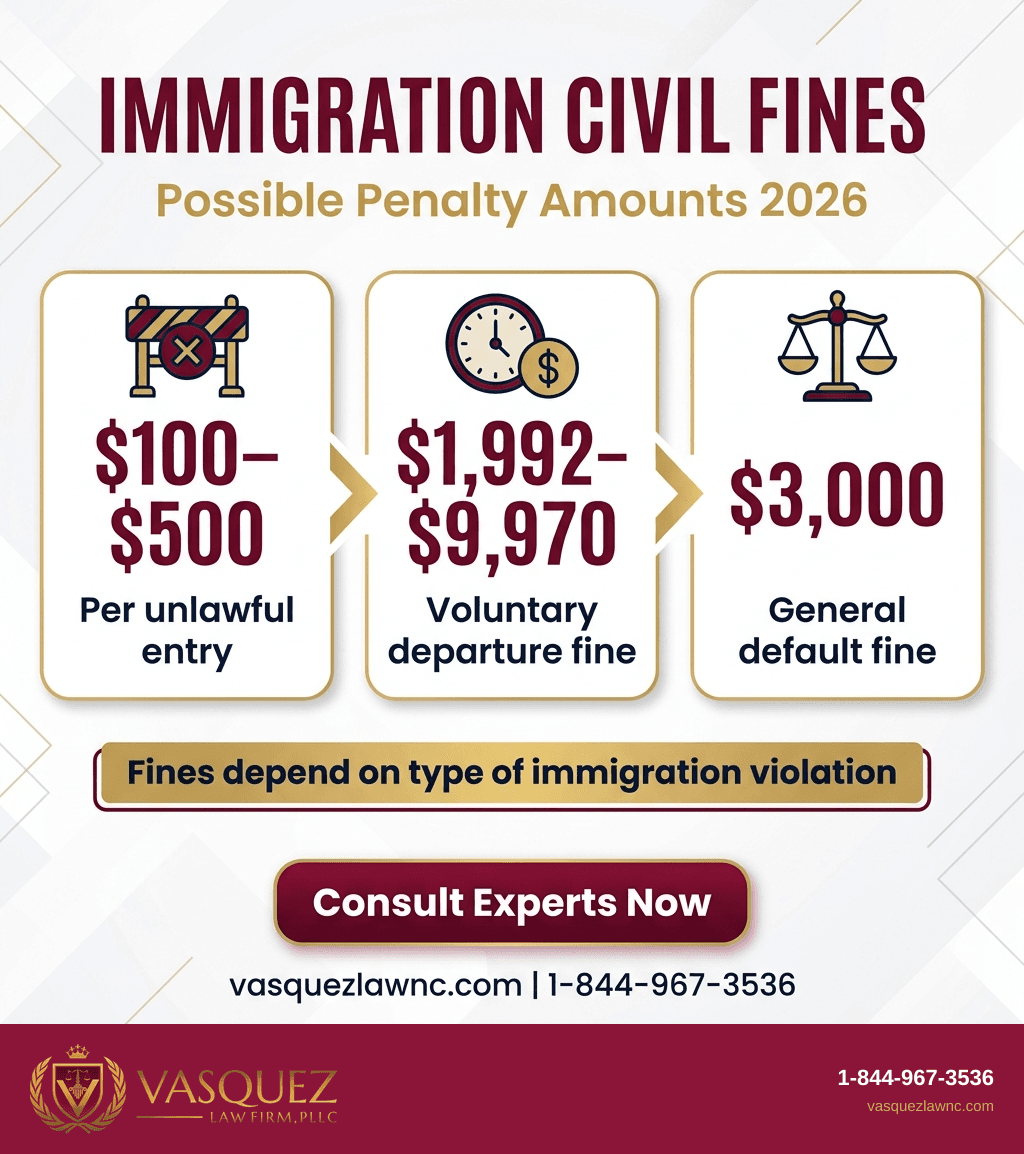
Congress set the statutory penalty structure. Inflation adjustments affect the listed amounts. The notice states that an unlawful-entry penalty ranges from $100 to $500 per entry or attempted entry. A voluntary-departure penalty may range from $1,992 to $9,970. The general default amount is $3,000. For willfully failing to comply with a removal order, DHS may impose up to $998 for each day.
These are civil fines. They are not criminal convictions. Entering at an improper place or time can create separate criminal and immigration consequences under other law. This rule concerns civil monetary penalties under the Immigration and Nationality Act. A person should review a fine notice with any charging document or Immigration Court order. The person should not confuse these documents.
What law governs immigration civil penalties and appeals?
Three Immigration and Nationality Act provisions provide the legal background. INA section 274D(a)(1), 8 U.S.C. 1324d(a)(1), authorizes civil penalties for willfully failing or refusing to depart after a final removal order. It also covers certain related conduct. INA section 240B(d)(1)(A), 8 U.S.C. 1229c(d)(1)(A), addresses failure to follow voluntary departure conditions. INA section 275(b)(1), 8 U.S.C. 1325(b)(1), addresses a civil penalty for apprehension while entering or attempting to enter unlawfully.
The final rule works through 8 CFR part 281. Under 8 CFR 281.1(c), the initial order must identify the statutory basis. It must also explain appeal rights. Under 8 CFR 281.1(e), a person may submit a written defense with supporting evidence. The person may instead submit a written notice of appeal. The written record may include the initial order, DHS administrative-file evidence, and timely submissions.
Why Immigration Court orders matter
Removal proceedings under INA section 240, 8 U.S.C. 1229a, are the process in which an Immigration Judge may order removal or consider relief. Relief means permission to remain under a legal benefit. The notice explains that judges must advise people about departure duties and consequences. For voluntary departure, INA section 240B(d)(3), 8 U.S.C. 1229c(d)(3), requires notice of applicable penalties.
The final rule does not decide whether a person qualifies for asylum, cancellation of removal, adjustment of status, or another benefit. It governs how ICE and CBP assess and review these specific civil fines. People with pending proceedings can follow related developments through our discussion of BIA remand jurisdiction and the recent BIA asylum decision.
What should I do if I receive an immigration civil penalty notice?
Start by saving the envelope, the full notice, and every page of the decision and order. The date and method of service matter. The ordinary appeal window is 15 business days. If delivery was delayed, keep tracking records and postal notices. Keep photographs of the envelope and other documents that could show circumstances outside your control.
Next, gather records that directly answer the alleged violation. These may include proof of departure, an Immigration Court order, a Board decision, an approved stay, and a motion to reopen. They may also include proof of TPS or other protection, travel-document correspondence, and immigration filings. Do not assume that a pending filing alone resolves a penalty issue.
Then compare the notice with your immigration history. Check the stated statute, amount, factual basis, and appeal instructions. A written defense should identify the important facts. It should attach records that show why the person is not subject to the penalty. The records may show that the person had permission to remain, departed, or did not willfully or voluntarily fail to depart.
Build a written record before the appeal is decided
The review is decided on paper. The final rule eliminated in-person interviews for these fines. A focused written submission can therefore be central to the case. Keep copies of everything sent. Keep proof of delivery. Do not discard correspondence after filing. A supervisory officer may ask for more written evidence.
For a case-specific review, request a free evaluation with our nationwide immigration legal team. Vasquez Law Firm offers in-person immigration consultations in Raleigh, NC and Orlando, FL. Se Habla Español. Schedule a free evaluation.
What should I watch next after the final rule?
The settled rule today is that appeals of these three immigration civil penalties are handled inside DHS. The Board of Immigration Appeals does not handle them. A supervisory immigration officer reviews a timely written appeal. The decision is final agency action. The Secretary of Homeland Security may still review it as a matter of discretion.
One important question concerns late appeals. ICE must decide whether documented delivery circumstances were sufficiently beyond a person’s control. That decision will depend on the records submitted. It will also depend on ICE’s assessment under the new final-rule language.
Watch the Federal Register page for Imposition and Collection of Civil Penalties for Certain Immigration-Related Violations for formal agency updates. For separate USCIS benefit questions, consult the USCIS Policy Manual and obtain advice tailored to the actual notice and procedural posture.
Frequently Asked Questions
Does the final rule create new immigration fines?
No. The final rule says it does not require new penalties or change the substantive criteria for these penalties. It finalizes a faster process for assessing and internally reviewing fines Congress already authorized. The change that accompanied finalization lets ICE accept a late appeal based on documented mail delays it finds were beyond the person’s control.
Can I appeal an immigration civil penalty?
Yes. Under 8 CFR 281.1, a person may file a written defense and supporting evidence or a written notice of appeal. The usual deadline is 15 business days after service. A different supervisory immigration officer reviews the record anew. A late appeal based on qualifying, documented delivery delays may be accepted by ICE under the final rule.
Can I appeal the fine to the Board of Immigration Appeals?
No. The rule removes Board of Immigration Appeals review for these three categories of DHS-issued civil penalties. The appeal is reviewed within DHS. The final decision is final agency action, though the Secretary of Homeland Security retains discretionary authority to review it. That structure does not replace appeals available in the underlying removal proceeding.
What evidence can help contest a failure-to-depart fine?
Relevant records can include proof of departure, a stay of removal, an automatic stay connected to a motion to reopen, approved deferred action, qualifying VAWA benefits, TPS, Convention Against Torture protection, withholding of removal, or records showing nondeparture was not willful. The useful evidence depends on the statutory basis listed in the notice and the person’s immigration record.
What is the fine for failing to leave after a removal order?
The notice states that DHS may impose up to $998 for each day that a person willfully fails to comply with a removal order. Liability depends on the statutory elements and the facts of the individual record. ICE states that officers review accessible records for information indicating the person departed or had legal permission to remain.
Are these immigration civil penalties criminal convictions?
No. This rule addresses civil monetary penalties. The agencies distinguish these fine procedures from the underlying immigration proceedings and from other potential legal consequences. Still, a notice can carry serious financial and immigration implications. A person should review it promptly with the removal order, travel records, and any pending immigration filings.
Legal disclaimer: Every immigration record has its own facts. Vasquez Law Firm can assess a notice, relevant deadlines, and available written evidence during a free evaluation. Contact Vasquez Law Firm to discuss your situation.
Reviewed by Attorney Vasquez, Managing Attorney
Worried About Immigration Policy Changes?
New policies can affect your case. Get current legal advice from an experienced immigration attorney.
Keep Reading


William Vasquez
Founder & CEO, Vasquez Law Firm, PLLC
William Vasquez is the founder and CEO of Vasquez Law Firm, PLLC, a results-driven firm specializing in immigration, criminal defense, personal injury, and workers' compensation. A U.S. Air Force veteran and recipient of the Joint Service Achievement Medal, William is dedicated to fiercely fighting for his clients' rights.
Related Legal Services
Need legal help? Learn more about learn about our immigration practice, or contact us for a free evaluation.
You can also visit immigration legal services throughout NC for more information.