What the Fourth Circuit Green Card Ruling Means in 2026
By William J. Vásquez · Updated November 5, 2026
The Fourth Circuit held that previously admitted applicants seeking adjustment as relief from removal must prove admissibility by a preponderance of the evidence. Contact us for a free evaluation.
Published on November 3, 2026· Updated November 5, 2026
Talk to an immigration attorney
Free call. A clear plan for your case.
Free & confidential · Se habla espanol · Mon-Fri 8am-7pm, Sat 9am-2pm (ET)
Have questions? Talk to an attorney - free evaluation.
Call 1-844-967-3536Free Tool
Check Your USCIS Case Status Now
Enter your receipt number - get the official USCIS status in English or Spanish. No registration.
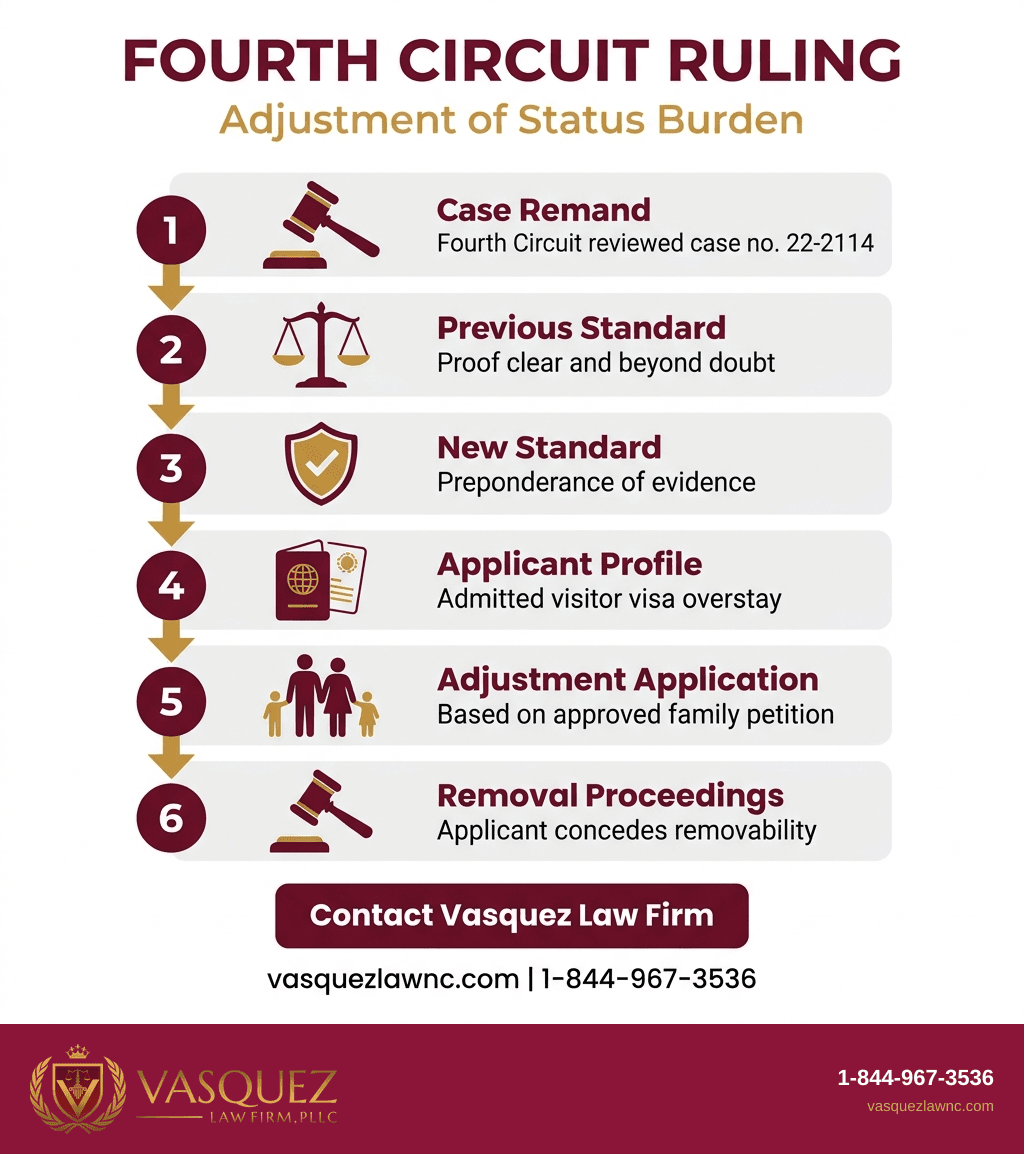
November 2, 2026 changed the proof question at the center of one adjustment of status case. In a published decision, the U.S. Court of Appeals for the Fourth Circuit ruled on that question. This Fourth Circuit adjustment of status ruling said that a previously admitted applicant seeking adjustment of status during removal proceedings must prove admissibility by a preponderance of the evidence. Admissibility means being legally eligible for admission to the United States; it does not itself establish a right to remain. The case is Fourth Circuit No. 22-2114, decided after a Supreme Court remand.
The difference can matter when people dispute the evidence. The earlier standard required proof that was clear and beyond doubt. People with pending immigration court matters should understand how this Fourth Circuit adjustment of status ruling may affect the legal burden in their own record.
Facing Deportation?
Time is critical. Our deportation defense attorneys are available 24/7 for emergency cases.
This article provides general legal information. It does not provide legal advice for any individual case. Adjustment applications can turn on admission history, visa availability, family petitions, admissibility grounds, and the evidence before the immigration judge. Our immigration attorneys can review those facts in a free evaluation.
Need help with a Fourth Circuit adjustment of status case? Contact Vasquez Law Firm for a free immigration evaluation.
What did the Fourth Circuit decide about adjustment of status?
The Fourth Circuit granted a petition for review on November 2, 2026. The court then returned the case for further proceedings. This appellate decision may still be reviewed by the U.S. Supreme Court. It held that the immigration judge and Board of Immigration Appeals used the wrong burden. They required the applicant to establish admissibility clearly and beyond doubt.
Upon reconsideration, we conclude that adjustment of status applicants like Petitioner bear the burden of proving admissibility by a preponderance of the evidence.
The petitioner is a citizen of the Dominican Republic. She entered with B-1/B-2 visitor visas in 2000. She later remained after the visas expired. Her son naturalized through honorable U.S. Army service in 2014. He filed a Form I-130 petition for her. USCIS denied her first adjustment application in March 2016. USCIS found that she had falsely claimed U.S. citizenship on an employment eligibility form.
During removal proceedings, she conceded removability. She conceded removability based on the visa overstay. She also renewed her request to adjust status.
At an October 2018 evidentiary hearing, the form was admitted into evidence. Neither side had filed it before the hearing. She clarified that she had filled out only “the top part” and, upon questioning by the IJ, admitted that she recognized her handwriting. But Petitioner testified that she did not remember checking the box indicating that she was “[a] citizen of the United States.” A workplace administrator testified that the applicant never claimed citizenship. The administrator believed another employee probably made the mark.
The immigration judge found the evidence inconclusive. The judge denied adjustment in November 2018 under the higher standard. The Board affirmed in October 2022. The Fourth Circuit initially denied review. It deferred to Board reasoning under Chevron. The Supreme Court later vacated that decision and remanded the case after Loper Bright Enterprises v. Raimondo. That decision instructed reviewing courts to interpret relevant legal questions themselves.
On remand, the court concluded that the earlier statement in Dakura v. Holder about the higher burden was dicta. Dicta means a court statement that was not necessary to the result in that case. The ruling did not decide whether this applicant is admissible. Instead, it decided which evidentiary standard applies when that question is reconsidered.
Who can use this Fourth Circuit adjustment of status ruling?
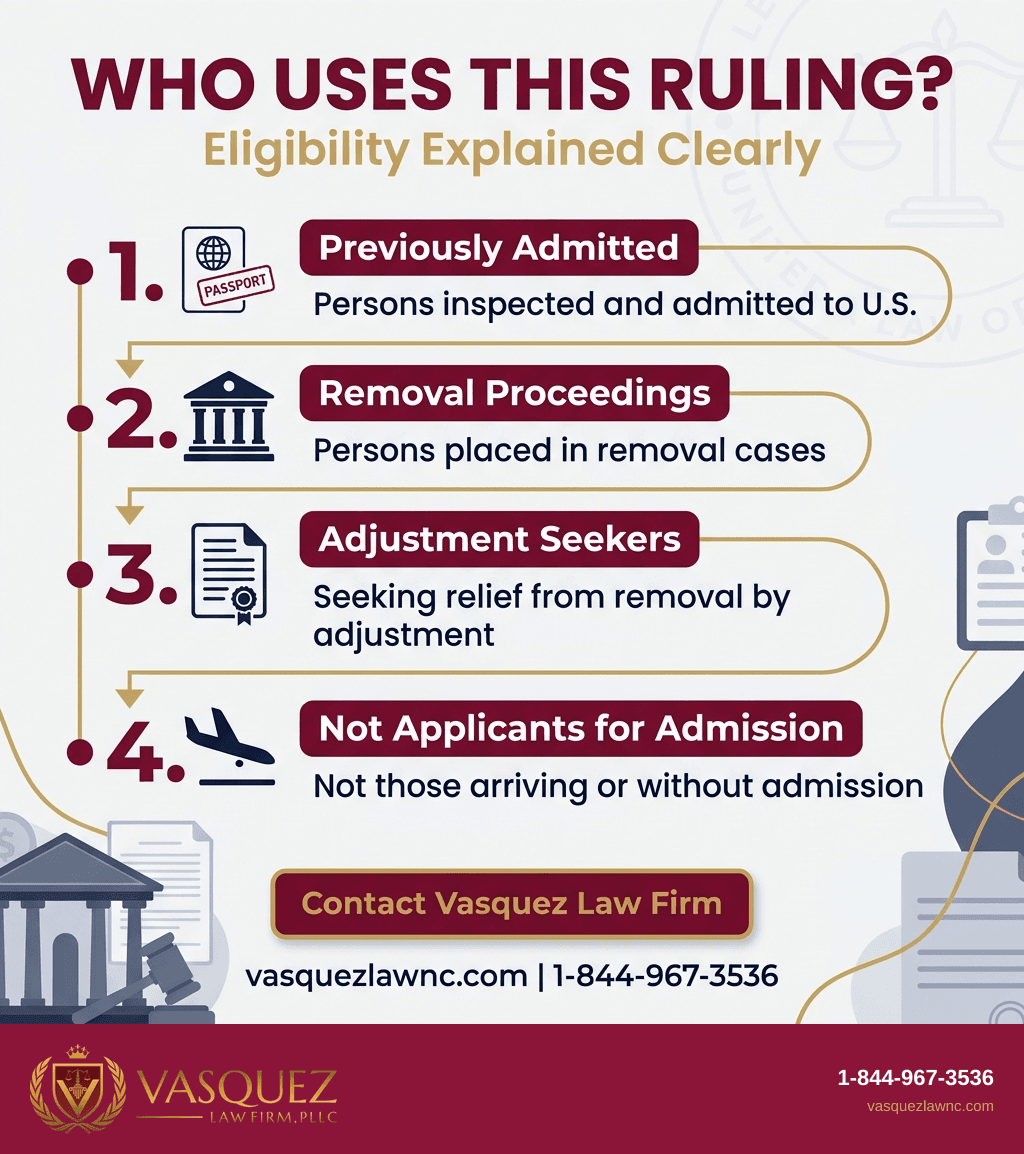
The ruling concerns a person who was previously inspected and admitted into the United States. It also concerns a person placed in removal proceedings who seeks adjustment of status as relief from removal. Relief from removal includes remedies available in removal proceedings; some allow a person to remain, while voluntary departure allows departure instead of removal. The court focused on an applicant who conceded removability after overstaying a visitor visa. She then pursued lawful permanent resident status through an approved family petition.
That procedural posture matters. Procedural posture means the stage and setting of a case. Removal proceedings have two stages. First, an immigration judge decides whether the person is removable. Second, a person found removable, or a person who concedes removability, may seek relief. Possible relief includes adjustment of status, cancellation of removal, withholding of removal, asylum, or voluntary departure.
The court distinguished this group from people treated as applicants for admission under 8 U.S.C. § 1225(a)(1). That statute covers a noncitizen present in the United States who has not been admitted. It also covers a noncitizen who arrives in the United States. Under 8 C.F.R. § 1240.8(b)-(c), the clear-and-beyond-doubt burden applies to arriving noncitizens. It also applies to noncitizens present without admission or parole.
Why prior admission changes the analysis
The Fourth Circuit reasoned that adjustment is not itself a physical entry into the country. The Immigration and Nationality Act defines admission as lawful entry after inspection and authorization by an immigration officer. A person can be required to prove admissibility for permanent residence. That person does not become an applicant for admission under that statutory definition simply by seeking adjustment.
For the people described by the decision, the question is whether they can show they are not inadmissible under 8 U.S.C. § 1182. They must make that showing by a preponderance of the evidence. This remains a serious evidentiary task. It does not erase an alleged false citizenship claim. It also does not erase any other inadmissibility issue.
In our experience, the first question in a disputed adjustment case is often whether the government record actually proves who made the disputed statement or mark. The cases we handle also show why applicants should preserve forms, translations, witness information, and prior immigration filings before a hearing. These records can help explain what happened and who had personal knowledge of it.
What immigration law governs adjustment of status in court?
8 U.S.C. § 1255(a) provides that, once inspected and admitted, the noncitizen’s status may be adjusted to that of a lawful permanent resident if: (1) the noncitizen makes an application for such adjustment, (2) the noncitizen is eligible to receive an immigrant visa and is admissible to the United States for permanent residence, and (3) an immigrant visa is immediately available to her at the time her application is filed.
If granted, adjustment records the person as lawfully admitted for permanent residence under 8 U.S.C. § 1255(b). Lawful permanent resident status can later create eligibility to apply for naturalization. The person must separately meet the applicable requirements for naturalization.
Burden of proof during removal proceedings
Congress assigned the burden of proof for relief from removal to the applicant in 8 U.S.C. § 1229a(c)(4). The regulation at 8 C.F.R. § 1240.8(d) generally requires an applicant for relief from removal to establish eligibility by a preponderance of the evidence. The Fourth Circuit held that this general standard includes admissibility for previously admitted people seeking adjustment in the circumstances before it.
Rather, because she is seeking relief from removal in the form of adjustment of status, Petitioner is required to prove she satisfies all of the applicable eligibility requirements, including admissibility, by a preponderance of the evidence.
An alleged false claim to citizenship can make a person inadmissible if the legal facts are established. The court held that the evidence supporting admissibility must be evaluated under the correct standard for this type of adjustment application.
Family-based pathways still depend on proof. An approved I-130 establishes a qualifying family relationship. Readers can review how a green card and immigrant visa pathway fits into a broader case before making assumptions about eligibility.
What should you do with an adjustment case in immigration court?
Start by identifying the procedural stage of the case. Keep the notice to appear, immigration court hearing notices, any immigration judge decisions, Board decisions, and all Form I-485 and I-130 filings together. A complete timeline can show whether adjustment is being sought as relief from removal. It can also show whether there was a prior lawful admission.
Build the evidence around the actual dispute
If a record contains a disputed form or alleged statement, preserve every available version of that record. Gather affidavits from people with direct knowledge. Gather proof of identity and immigration history. Keep translation records where relevant. Also gather documents that place the disputed event in context. Do not alter records. Do not submit information that is inaccurate.
Review the charging document and the immigration judge’s reasoning carefully. The Fourth Circuit adjustment of status ruling concerns the burden of proof. A person may still need to establish visa availability. The person may also need to prove the qualifying relationship, admissibility, and each other requirement under 8 U.S.C. § 1255(a).
For a pending immigration court matter, ask counsel to assess whether Fourth Circuit No. 22-2114 affects the standard used in the case. People considering a change in representation can also read about switching immigration lawyers during a case before deciding how to protect the record.
Need clarity about an adjustment application in removal proceedings? Vasquez Law Firm offers a free immigration evaluation for people seeking guidance. Se Habla Español.
What should applicants watch after this ruling?
The court granted review because the prior decisions used a different standard. A higher court may still review this decision. If it stands, the immigration judge on remand must assess the adjustment request under the preponderance standard described in the decision.
Applicants should watch their immigration court notices and filings for developments in their own proceeding. The USCIS Policy Manual remains an official agency reference for USCIS adjudication guidance. Immigration court cases may involve separate litigation procedures.
The court held that a previously admitted adjustment applicant seeking relief from removal must prove admissibility by a preponderance of the evidence.
What's Your Immigration Situation?
Answer 3 questions - we'll tell you your options
Question 1 / 3
What best describes your situation?
Keep Reading
For matters pending with USCIS rather than an immigration judge, the USCIS Processing Times page is the official place to check agency processing information. Case posture, evidence, and procedural history remain central to any adjustment analysis.
Frequently Asked Questions
Does this ruling mean an I-485 will be granted?
No. The Fourth Circuit adjustment of status ruling changes the burden of proof for admissibility in the situation before the court. An applicant must still prove the requirements in 8 U.S.C. § 1255(a), including eligibility for an immigrant visa, admissibility, and visa availability.
What does preponderance of the evidence mean?
Preponderance of the evidence means the applicant must show that a fact is more likely true than not. The Fourth Circuit held that this is the standard for admissibility when a previously admitted person seeks adjustment as relief from removal. The decision contrasts that test with proof that is clear and beyond doubt, the standard previously used in this case.
Can an immigration judge adjust status?
Yes, an immigration judge can consider adjustment of status as relief from removal during the second stage of removal proceedings. The court explained that adjustment is among common forms of relief, along with cancellation of removal, withholding of removal, asylum, and voluntary departure. Eligibility remains fact-specific and depends on the statutory requirements for the particular application.
Does an approved I-130 automatically solve admissibility issues?
No. The case involved an I-130 filed by the petitioner’s naturalized son, yet the applicant still had to prove the requirements for adjustment. An I-130 can establish a qualifying family relationship.
Why did the Supreme Court remand this case?
The Fourth Circuit had previously deferred to Board reasoning under Chevron. The Supreme Court vacated that earlier decision and remanded for reconsideration in light of Loper Bright Enterprises v. Raimondo. On reconsideration, the Fourth Circuit interpreted the relevant Immigration and Nationality Act provisions and reached a different conclusion about the evidentiary burden.
What records should an adjustment applicant preserve?
Keep the notice to appear, hearing notices, immigration judge and Board decisions, I-485 and I-130 materials, and records tied to any disputed claim of inadmissibility. The court’s opinion shows why the details of a form, testimony, handwriting, and witness knowledge can matter. An attorney can assess how those records fit the legal burden in a particular proceeding.
Legal disclaimer: This article is general information, not individualized legal advice. Immigration outcomes depend on the facts, evidence, and procedural posture of each case. Contact Vasquez Law Firm for a free evaluation with an immigration attorney. The firm meets immigration clients in Raleigh, NC and Orlando, FL, and serves immigration clients nationwide.
Have questions about a Fourth Circuit adjustment of status issue? A careful review of your admission history, court record, and adjustment evidence can identify the next lawful step.
Sources
Reviewed by Attorney Vasquez, Managing Attorney

William Vasquez
Founder & CEO, Vasquez Law Firm, PLLC
William Vasquez is the founder and CEO of Vasquez Law Firm, PLLC, a results-driven firm specializing in immigration, criminal defense, personal injury, and workers' compensation. A U.S. Air Force veteran and recipient of the Joint Service Achievement Medal, William is dedicated to fiercely fighting for his clients' rights.
Related Legal Services
Need legal help? Learn more about learn about our immigration practice, or contact us for a free evaluation.
You can also visit statewide immigration attorneys for more information.