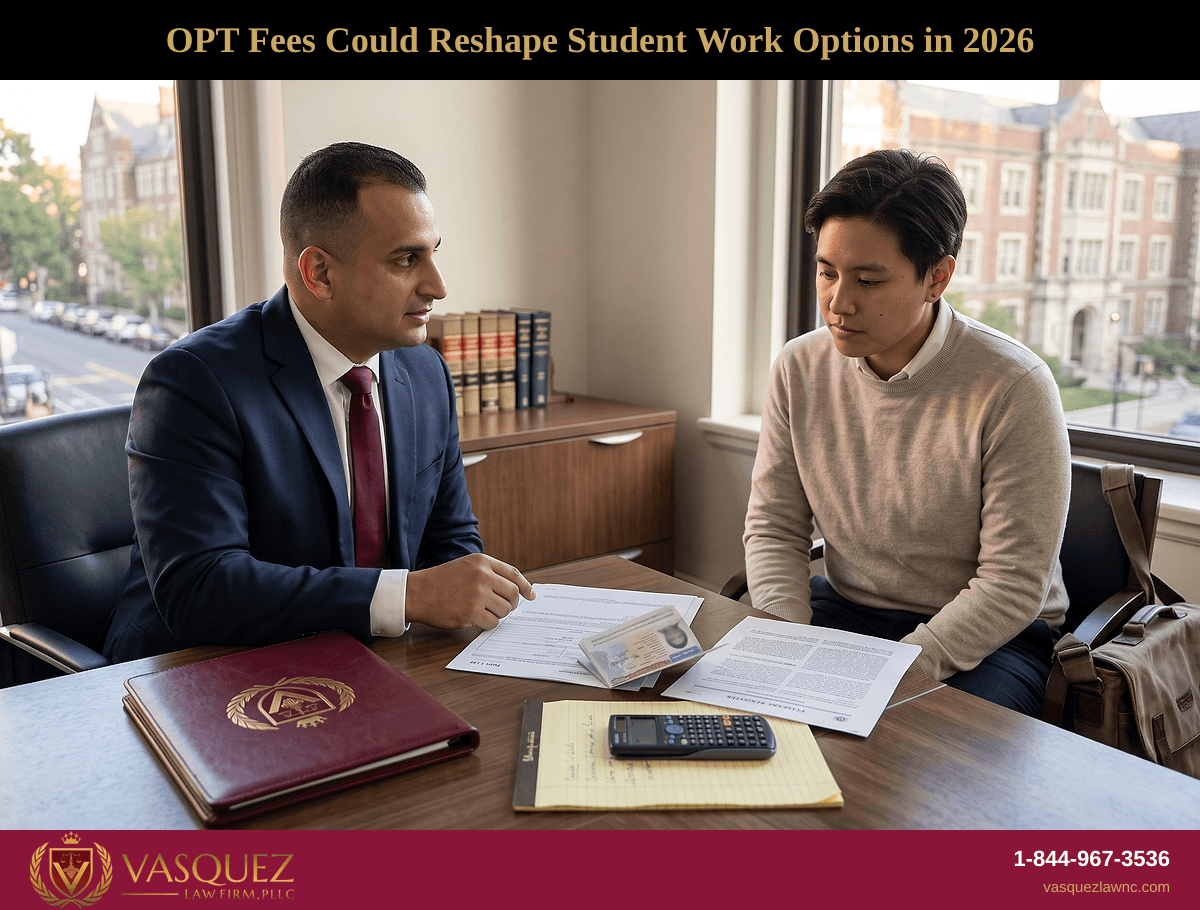
OPT Fees Could Reshape Student Work Options in 2026
Proposed OPT fees of $70,000 and $30,000 could alter F-1 work plans. Review your OPT request and seek a free evaluation today.
Published on October 12, 2026
Talk to an immigration attorney
Free call. A clear plan for your case.
Free & confidential · Se habla espanol · 24/7
Have questions? Talk to an attorney - free evaluation.
Call 1-844-967-3536Worried how the latest immigration news affects you?
Schedule a confidential case review with an immigration attorney - know exactly where you stand.
USCIS Case Status
Check your USCIS case status
Enter your receipt number and get the official status. Free, no registration.
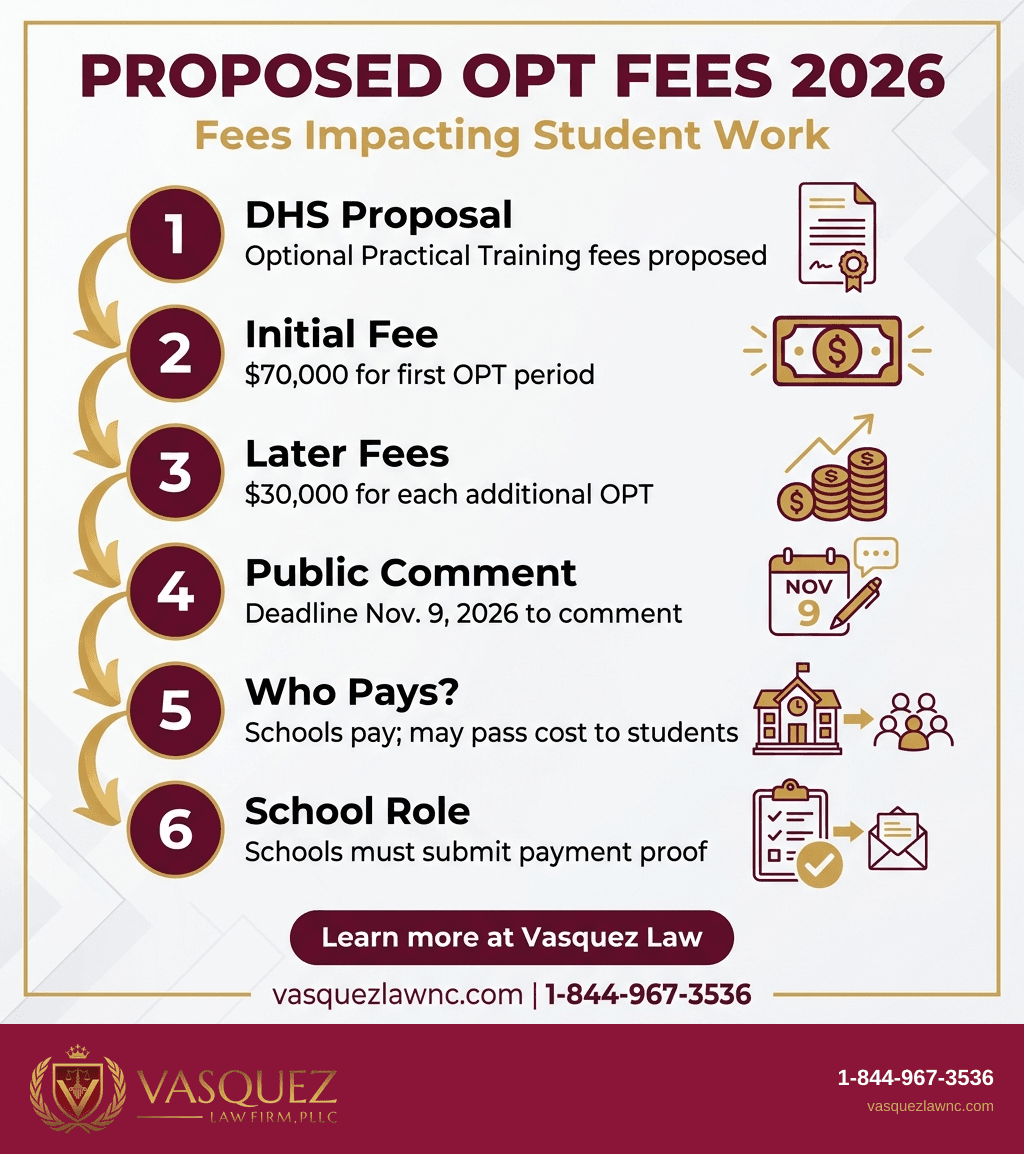
Federal Register Document 2026-20660 proposes OPT fees of $70,000 for initial Optional Practical Training. It also proposes $30,000 for each later OPT period. The October 8, 2026 notice could change how F-1 students, SEVP-certified schools, and employers plan student work authorization across the country.
Optional Practical Training, or OPT, is permission to work for qualifying F-1 students. The work must connect directly to the student’s major. Students considering an OPT request should know the most important fact now. These are proposed fees, not charges due today. Our immigration attorneys review federal immigration changes that affect students and families nationwide.
Disclaimer: This article provides general legal information, not legal advice for any individual case. A student’s status, Form I-20 history, travel, and work plans can change the analysis.
What did DHS propose for OPT fees in 2026?
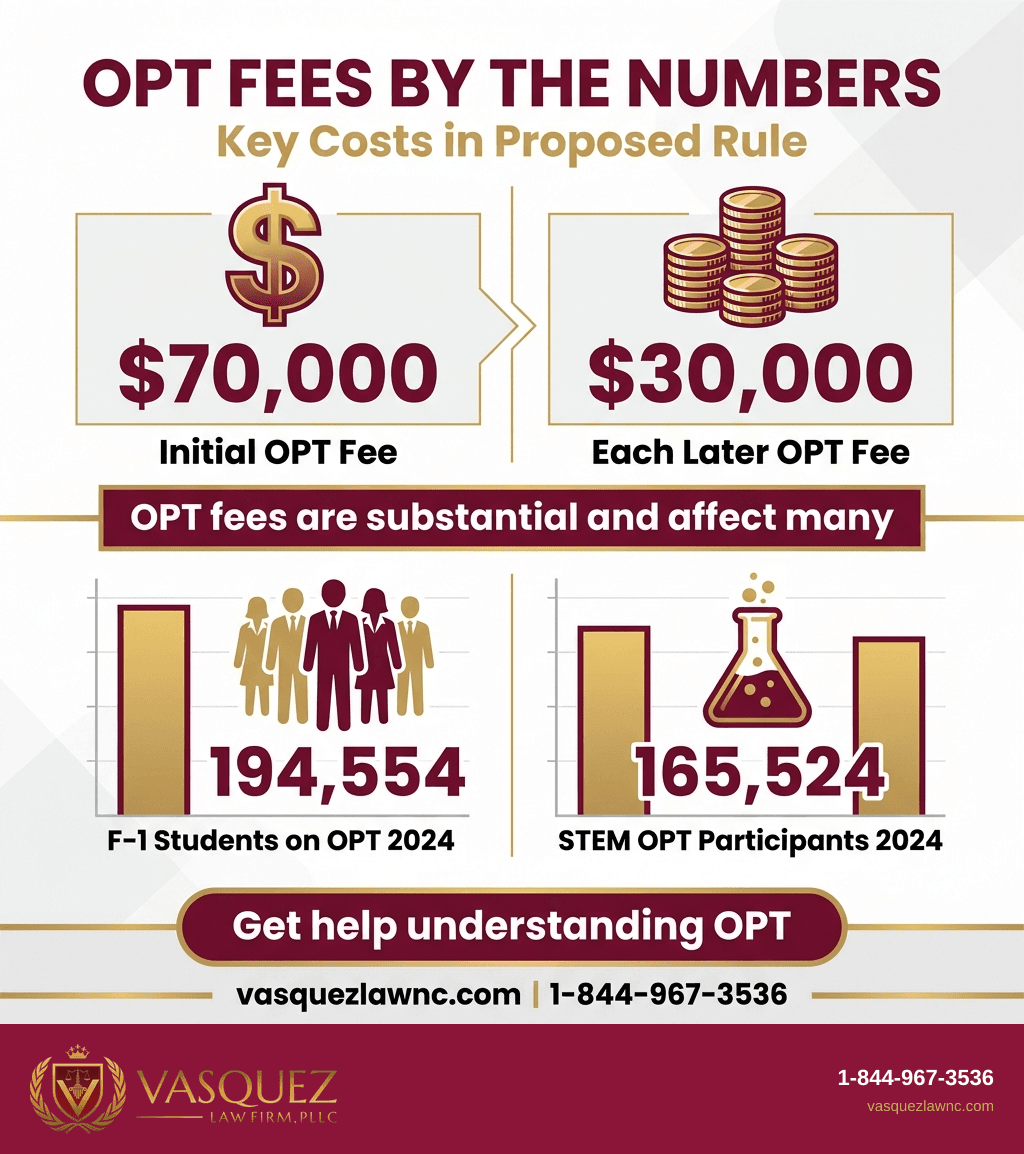
On October 8, 2026, U.S. Immigration and Customs Enforcement published a notice of proposed rulemaking. Its title is Optional Practical Training Fees, Federal Register Document 2026-20660. A notice of proposed rulemaking is a government proposal that invites public comments before a final rule. The proposal would require a $70,000 fee for initial OPT. It would also require a $30,000 fee for any later OPT for each F-1 student through an SEVP-certified institution.
The proposal puts the payment duty on the educational institution. DHS says a school could pass that cost to F-1 students, all students, or employers. Other laws could still apply. This difference matters when students review an offer letter or school policy. Under the proposal’s stated framework, the student would not be the direct payer.
This rule proposes new fees for Optional Practical Training (OPT) to combat fraud, strengthen the integrity of the immigration system, and protect U.S. workers.
DHS says the fees would encourage schools to review OPT recommendations more closely. The fees would also aim to reduce fraud. They would focus participation on training connected directly to a student’s field. The notice also says DHS may end the program completely. That could happen if OPT cannot operate consistently with its fraud-prevention and worker-protection goals.
What is the public-comment deadline?
Comments on the proposed rule must reach DHS by November 9, 2026. Comments about the information collection part have a separate deadline. That deadline is December 7, 2026. DHS tells commenters to submit through Regulations.gov under Docket No. ICEB-2026-0100. Comments must be in English or include an English translation.
A commenter should identify the docket number. The commenter should cite the specific part at issue. The commenter should explain the requested change. The commenter should also provide supporting data, information, or authority. DHS warns that email or letter comments sent to the Department will not count in the rulemaking.
Who could the proposed OPT fees affect?
The proposal covers each F-1 nonimmigrant student seeking OPT through an SEVP-certified institution. A nonimmigrant is a person admitted to the United States for a temporary purpose. The proposal would cover initial OPT and later OPT. It would apply whether the student got F-1 status through admission or through a change of status inside the United States.
It would also apply whether USCIS granted the student an extension of stay. An extension of stay lets a person remain longer in the United States without leaving. The proposal would also apply if the student returned from travel and sought a new admission period through Customs and Border Protection. The proposal is federal. It would apply nationwide.
OPT includes pre-completion and post-completion practical training. Pre-completion training happens before a student finishes the program. Post-completion training happens after the student finishes. Current rules require the training to connect directly to the student’s major area of study. The proposed OPT fees do not address Curricular Practical Training, or CPT. CPT is a separate type of practical training tied to an established curriculum.
The scope of this proposed rule is specific to OPT and does not address CPT.
Students seeking a STEM OPT extension could face the later-fee framework. STEM OPT follows an initial period of post-completion OPT. STEM OPT is available to qualifying students with eligible STEM degrees. The degrees must come from accredited U.S. institutions. Students must also meet separate requirements.
Why does the school’s role matter?
Under the proposal, schools would need proof of payment when they submit an OPT recommendation. DHS expects the financial duty to make schools more selective. It also expects stronger internal compliance reviews. Compliance means following the applicable rules.
A Designated School Official, or DSO, already reviews eligibility. The DSO recommends OPT in SEVIS before the student files Form I-765 with USCIS. SEVIS is the federal student-record system used for F-1 records.
The notice reports that 194,554 F-1 students held OPT employment authorization documents and reported working in calendar year 2024. That number rose from 160,627 in 2023. The notice also reports 165,524 participants in STEM OPT during 2024. DHS uses these figures to show its concern about program growth. DHS says oversight resources have not kept pace with that growth.
In our experience, students first ask whether a school recommendation guarantees work permission. It does not. USCIS still decides the Form I-765. Other eligibility requirements also remain in place.
What law governs OPT and STEM OPT today?
INA § 101(a)(15)(F)(i), codified at 8 U.S.C. § 1101(a)(15)(F)(i), creates the F-1 classification. This classification covers qualifying students who enter temporarily and solely to pursue a full course of study. INA § 214(a), 8 U.S.C. § 1184(a), authorizes the Secretary of Homeland Security to set the time and conditions of nonimmigrant admission.
Current OPT rules appear at 8 CFR § 214.2(f)(10). They allow practical training for eligible F-1 students. The student must have completed at least one full academic year of full-time post-secondary study. The school must be an SEVP-certified college, university, conservatory, or seminary. The student must also maintain status.
How does an OPT application proceed now?
A DSO decides whether the student qualifies for the requested OPT period. The DSO enters a recommendation in SEVIS. The school then issues a signed Form I-20. The student files Form I-765, Application for Employment Authorization, with USCIS.
Students seeking an initial 12-month OPT period do not need a training opportunity before the DSO makes a recommendation. In other words, the student does not need a job or training placement at that stage.
A qualifying STEM graduate may seek a 24-month STEM OPT extension after post-completion OPT. That application requires Form I-765. It also requires Form I-983, the Training Plan for STEM OPT Students. The employer confirms the training plan. DHS may conduct site visits at the employment location.
For status questions beyond OPT, readers can also review our coverage of the October 2026 Visa Bulletin. Visa availability rules are separate from F-1 practical-training eligibility.
What should F-1 students do about proposed OPT fees?
Students should start with their own records. They should not assume who will pay a proposed cost. Save every Form I-20. Also save each prior employment authorization document, I-765 receipt, passport, I-94 record, degree document, and DSO communication about OPT.
Next, ask the DSO whether the school has issued a policy about future OPT recommendations or payment planning. Keep the question focused on written school guidance. Do not sign an employer reimbursement agreement without understanding its terms. The student should also understand how the agreement fits the school’s policies.
- Confirm whether the requested work is OPT or CPT.
- Verify that the proposed work is directly related to the major area of study.
- Review the Form I-20 for the correct OPT recommendation.
- For STEM OPT, prepare Form I-983 and confirm the employer can meet training-plan duties.
- Track the federal docket for the proposed rule and preserve copies of relevant school notices.
Students considering comments can use Regulations.gov. Search for Docket No. ICEB-2026-0100. Comments become public. DHS advises commenters to limit personal information they choose to provide. Comments based on evidence are more useful than general reactions. They should address a specific provision.
For an individualized review of F-1 status, OPT timing, travel, or a STEM extension, contact our nationwide immigration legal team for a free evaluation. Student-visa consultations are available by Zoom or phone. Se Habla Español.
What should students watch before OPT fees change?
November 9, 2026 is the key date for comments on the proposed OPT fee rule. After the comment period, DHS may review the submissions. DHS may then issue a final rule, change the proposal, or take another rulemaking step. The proposal itself says DHS may change the rule based on public comments.
Students should watch the Regulations.gov docket for ICEB-2026-0100. This includes posted comments and any final-rule publication. The Federal Register page for Optional Practical Training Fees, Document 2026-20660 is the official publication of the proposal.
For an OPT application already under review, USCIS processing updates still matter. Check the agency’s USCIS Processing Times page. Use the applicable form and service-center information.
The practical rule readers can rely on today is simple. Existing OPT eligibility procedures remain in place unless and until DHS completes a rulemaking change. Plan early. Keep accurate records. Check official updates. These steps can protect options while the proposal moves forward.
Frequently Asked Questions
Are the 2026 OPT fees in effect now?
No. ICE published a notice of proposed rulemaking on October 8, 2026. A proposal begins the public rulemaking process and invites comments. The notice sets a November 9, 2026 comment deadline for the proposed rule. Existing OPT procedures under 8 CFR § 214.2(f)(10) remain the framework students use while the proposal is pending.
What are the proposed OPT fee amounts?
The proposal would establish a $70,000 fee for initial OPT and a $30,000 fee for any subsequent OPT. The amounts are proposed for each F-1 student engaging in OPT through an SEVP-certified institution. DHS says the financial obligation would rest with the school, although a school could choose to pass costs to students, all students, or employers.
Would the proposed OPT fees apply to STEM OPT?
The proposal covers subsequent OPT, while STEM OPT is a 24-month extension available after an initial period of post-completion OPT for qualifying students. Students seeking STEM OPT still must meet current extension requirements, including an eligible STEM degree, Form I-765, Form I-983, and an employer training plan.
Does this proposal change CPT?
No. The rule proposal is limited to OPT. CPT, or Curricular Practical Training, is governed by a different framework and is tied to an established curriculum. A student should confirm the correct category with the DSO because OPT and CPT have different eligibility rules and consequences for later post-completion OPT.
Who files the OPT application with USCIS?
The student files Form I-765 with USCIS after receiving a DSO recommendation and signed Form I-20. USCIS adjudicates the employment authorization application. The school maintains the student’s SEVIS record during authorized OPT. A school recommendation is an essential step, but it does not replace USCIS adjudication.
How can I submit a comment on the proposed rule?
Submit through Regulations.gov by searching Docket No. ICEB-2026-0100. DHS asks commenters to identify the relevant section, explain each recommendation, and include supporting data, information, or authority. Comments must be in English or include an English translation. DHS states that comments sent by email or mail to the Department will not be considered.
Disclaimer: Immigration outcomes depend on individual facts and agency decisions. This article is not a substitute for legal advice.
OPT fees could affect a student’s academic and employment plan long before a final rule arrives. Contact Vasquez Law Firm for a free consultation with an immigration attorney about your specific circumstances. We meet immigration clients in Raleigh, NC and Orlando, FL, and provide nationwide virtual guidance.
Schedule Your Free Evaluation | Meet Attorney Vasquez
Sources
Reviewed by Attorney Vasquez, Managing Attorney
Need legal help?
Immigration in NC and FL. Personal injury and workers compensation across NC. Criminal defense in Johnston, Harnett, Pitt and Cumberland counties, and traffic tickets in 11 NC counties. Tell us your county and we will tell you exactly what we can do.
Keep Reading


William Vasquez
Founder & CEO, Vasquez Law Firm, PLLC
William Vasquez is the founder and CEO of Vasquez Law Firm, PLLC, a results-driven firm specializing in immigration, criminal defense, personal injury, and workers' compensation. A U.S. Air Force veteran and recipient of the Joint Service Achievement Medal, William is dedicated to fiercely fighting for his clients' rights.
Related Legal Services
Need legal help? Learn more about our immigration law practice, or contact us for a free evaluation.
You can also visit our NC immigration team for more information.