Fourth Circuit Denies Petition for Review of Asylum and CAT Denials
Fourth Circuit asylum decision denied relief after nexus and future torture findings. See the legal standards and request a free evaluation today for your case.
Published on October 21, 2026· Updated October 22, 2026
Talk to an immigration attorney
Free call. A clear plan for your case.
Free & confidential · Se habla espanol · Mon-Fri 8am-7pm, Sat 9am-2pm (ET)
Have questions? Talk to an attorney - free evaluation.
Call 1-844-967-3536Worried how the latest immigration news affects you?
Schedule a confidential case review with an immigration attorney - know exactly where you stand.
USCIS Case Status
Check your USCIS case status
Enter your receipt number and get the official status. Free, no registration.
Fourth Circuit Denies Petition for Review of Asylum and CAT Denials
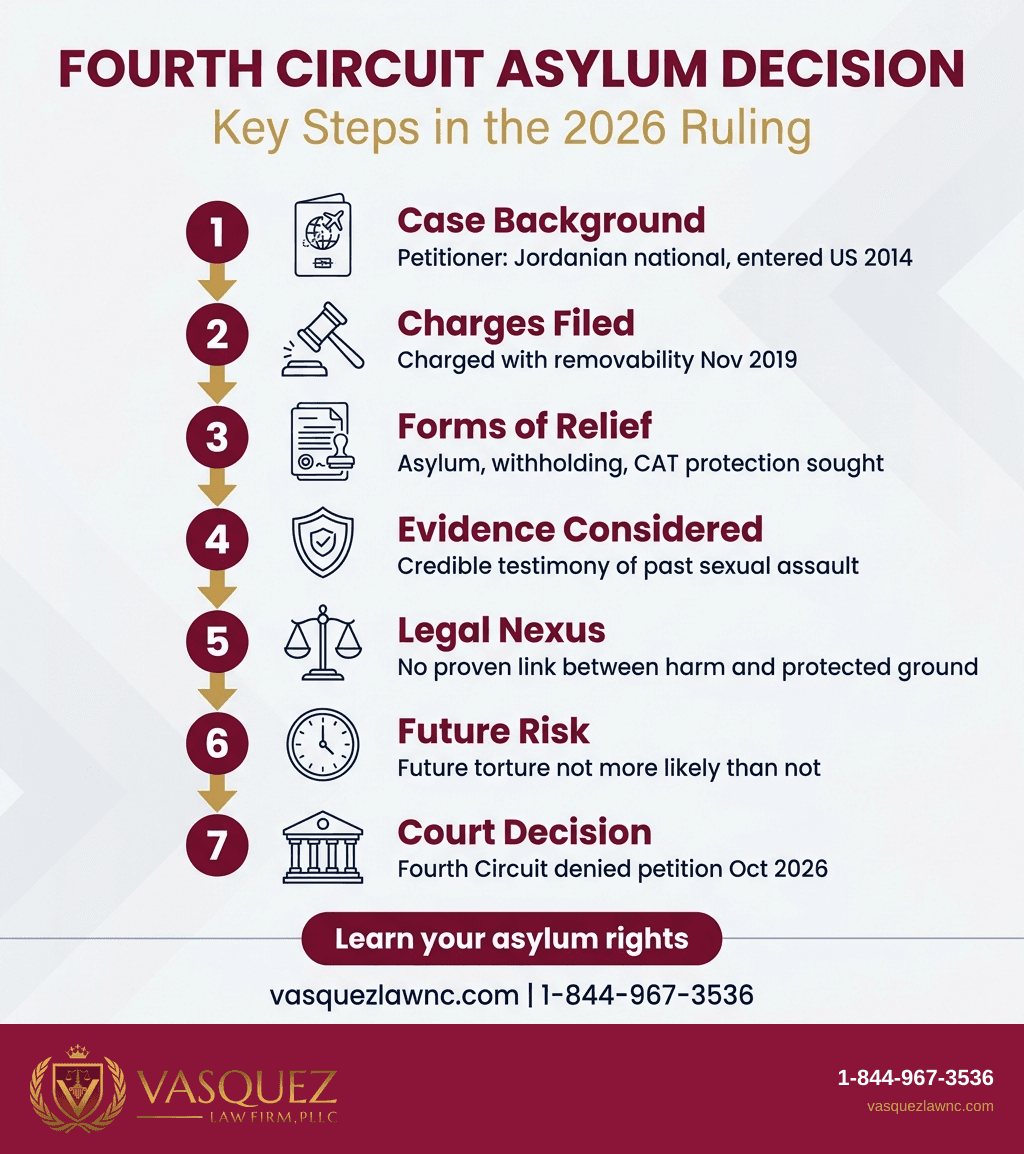
On October 19, 2026, the Fourth Circuit denied a Jordanian national’s petition for review. Immigration agencies had rejected his requests for asylum, humanitarian asylum, withholding of removal, and Convention Against Torture protection. The Fourth Circuit asylum decision turned on two demanding findings. First, the applicant did not prove that a protected ground was a central reason for the persecution he feared. Second, he did not prove that future torture was more likely than not.
The court accepted the seriousness of the applicant’s reported past abuse. Still, its ruling shows why believable testimony alone may not satisfy every legal requirement for immigration relief. This article provides general legal information. It is not advice for any individual case.
People facing removal can review their options with Vasquez Law Firm’s immigration attorneys. An attorney can also explain what evidence may connect harm to a protected ground. The decision, Fourth Circuit No. 24-1099 , applies the same federal asylum standards that arise in removal proceedings.
What happened in the Fourth Circuit asylum decision?
On October 19, 2026, the United States Court of Appeals for the Fourth Circuit denied a petition for review of a final order of the Board of Immigration Appeals. The petitioner, a native and citizen of Jordan, lawfully entered the United States in 2014 as the unmarried child of a U.S. citizen. In November 2019, the Department of Homeland Security charged him with removability following a Virginia conviction for obtaining money by false pretenses.
Before the immigration judge, the applicant requested four forms of protection. They were asylum, humanitarian asylum, withholding of removal, and protection under the regulations implementing the Convention Against Torture. People often call that protection CAT. He testified that two men sexually assaulted him in Jordan. He also testified that he feared harm if he returned.
The immigration judge found the account of the assaults credible. In other words, the judge believed the account. The judge still concluded that the applicant had not shown the required connection between the harm and his proposed social group. That connection is called a nexus. The proposed group was imputed homosexuals. This term described people whom others perceived as homosexual. The Board of Immigration Appeals affirmed the immigration judge’s decision.
“We do not diminish the severity of the abuse [the petitioner] has suffered or the grievousness of the crimes against him. But asylum and withholding of removal are available only when persecution is on account of a protected ground.”
The Fourth Circuit reviewed the Board’s order under 8 U.S.C. § 1252(a)(1). The Board adopted the immigration judge’s decision. It also added its own reasoning. For that reason, the court reviewed both decisions. The review covered the portions that the Board adopted.
Why did the court defer to the agency?
Under 8 U.S.C. § 1252(b)(4)(B), agency factual findings are conclusive unless any reasonable adjudicator would be compelled to conclude to the contrary. The court described this review as highly deferential.
In this Fourth Circuit asylum decision, the court held that substantial evidence supported the agencies’ findings. Substantial evidence means enough evidence in the record to support the agency’s decision under the required legal review. The court denied the petition. It did not send the case back to the Board. This was true even though the government had asked for a remand for further consideration.
Who does this Fourth Circuit asylum decision affect?
The ruling resolves a petition for review from a final Board of Immigration Appeals order. The petitioner sought asylum, humanitarian asylum, withholding of removal, and protection under the regulations implementing the United Nations Convention Against Torture and Other Cruel, Inhuman or Degrading Treatment or Punishment (CAT).
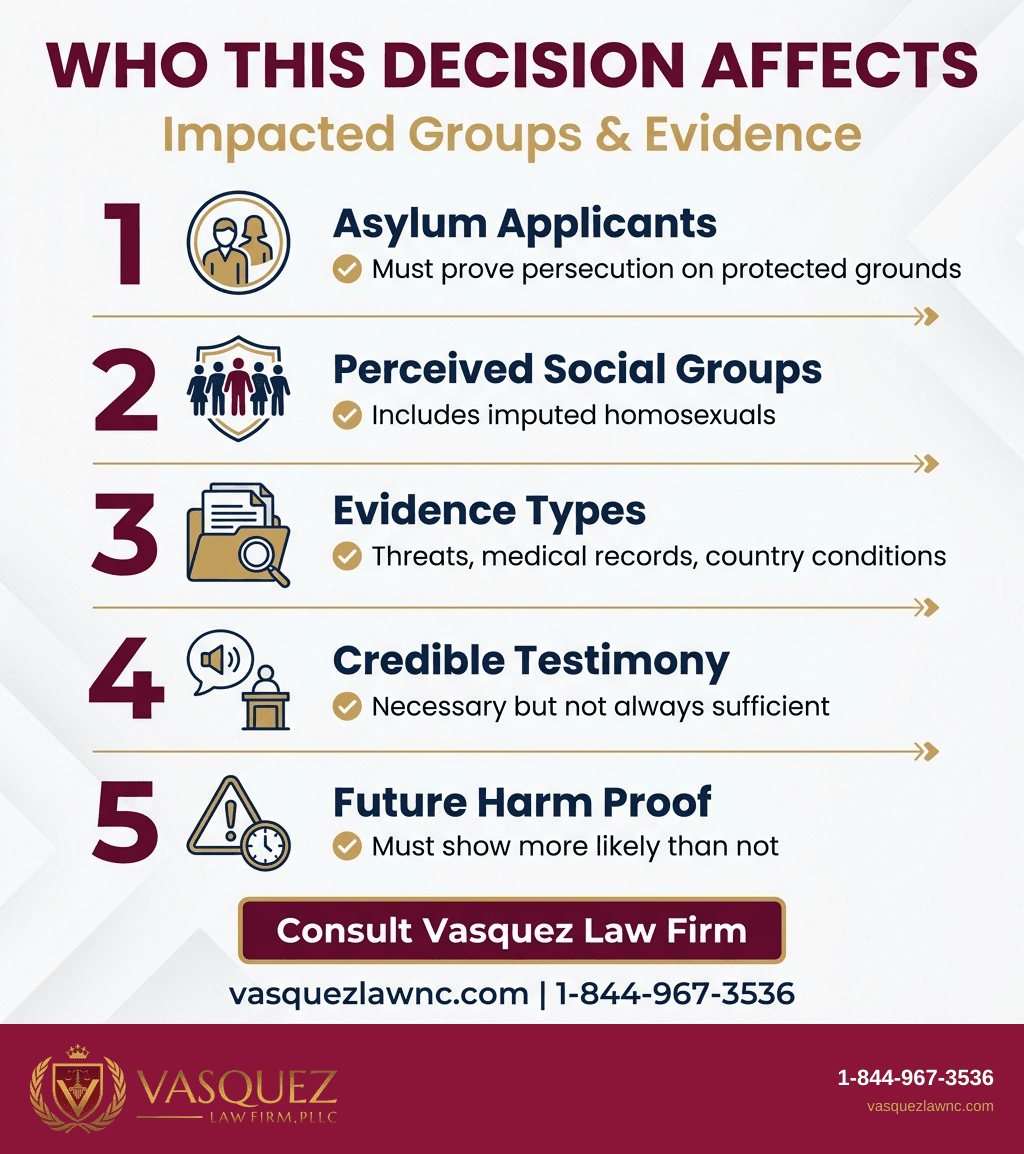
Asylum applicants must demonstrate that they are unable or unwilling to return to their native country because of persecution or a well-founded fear of persecution on account of race, religion, nationality, membership in a particular social group, or political opinion. In this case, the proposed group involved people perceived as homosexual. The court focused on the alleged persecutor’s personal perception and motive.
The Board found that the alleged assailant targeted the applicant because of age, low self-esteem, and poor economic status. The court concluded that the record supported that finding. The record also showed homophobic attitudes in Jordan and the use of blackmail. Those facts did not compel a finding that perceived sexual orientation was one central reason for the abuse.
What evidence affected the future-risk analysis?
The record showed that the last reported sexual assault occurred in 2011. The applicant stayed in Jordan until 2014. He later returned to Jordan three times. Each visit lasted about 30 days. During the most recent visit, he testified that one alleged assailant came to his college campus twice. He was not harmed.
The agency found that future torture was not more likely than not. A person with a different record may present different evidence. That evidence could include threats, reporting records, medical records, witness evidence, or country-conditions materials. The evidence must relate to the legal elements that the person must prove.
In our experience, the cases we handle often turn on the connection between the record and the requested relief. The record must clearly link each feared harm to the exact legal element required for that relief.
For that reason, a person in proceedings should work with an immigration legal team. The team can help identify the correct claim. It can also help organize evidence before an individual hearing. A credible account is essential. Immigration relief also requires proof of the statutory standard.
What law governed the Fourth Circuit asylum decision?
Federal law defines a refugee in 8 U.S.C. § 1101(a)(42)(A). The definition covers a person who cannot or will not return to a country. The reason must be persecution or a well-founded fear of persecution. The persecution or fear must be on account of one of the protected grounds listed in the statute. Section 1158(b)(1)(A) authorizes discretionary asylum for a qualifying refugee.
For asylum, 8 U.S.C. § 1158(b)(1)(B)(i) requires the protected ground to be at least one central reason for persecution. This required cause-and-effect connection is the nexus requirement. A protected characteristic does not need to be the only reason. It also does not need to be the dominant reason. However, it cannot be incidental, tangential, superficial, or subordinate. In everyday terms, the protected ground must play a central part in the persecution.
Why is withholding of removal harder to prove?
Withholding of removal under 8 U.S.C. § 1231(b)(3)(A) requires a clear probability of persecution. The persecution must be on account of a protected ground. A clear probability means the applicant must meet a higher standard than the standard for asylum. The Fourth Circuit repeated that an applicant who cannot satisfy asylum’s requirements cannot satisfy withholding’s higher standard on the same record.
CAT protection follows a different structure. It does not require a nexus to a protected ground. Under 8 C.F.R. § 1208.16(c)(2), the applicant must prove that torture is more likely than not if removed. Under 8 C.F.R. § 1208.18(a)(1), the feared torture must involve a public official. The official must act, instigate the torture, consent to it, or acquiesce in it. Acquiescence means that the official knows about the conduct and allows it to happen, as defined by the governing legal standard.
The court held that past torture alone does not establish CAT eligibility. The applicant must also show a likely future risk. The regulations require consideration of evidence relevant to future torture. That evidence includes past torture, possible internal relocation, and country conditions. Humanitarian asylum also has a distinct rule under 8 C.F.R. § 1208.13(b)(1)(iii). The nexus requirement still applied in this case.
For a broader explanation of hearing preparation, see our guide to the asylum process and individual hearings. The USCIS Policy Manual also collects agency guidance on immigration benefits. Removal-defense claims, however, are decided within the immigration court and Board system.
What should you do if your asylum case involves past harm?
Start by separating the facts of past harm from the legal theory for relief. A legal theory is the legal basis for the protection you request. Write a dated chronology. It should identify the harm, the people involved, and any reports to police or other officials. It should also identify later threats, travel history, and the reasons a return now would create danger. Accuracy matters. Do not alter documents. Do not guess at dates.
Next, identify the protected ground for an asylum or withholding claim. The question is not only whether the applicant suffered serious harm. The question is whether a protected trait was at least one central reason for that harm or for feared future persecution. Evidence may include direct statements, threats, community records, affidavits, or expert materials. It may also include records showing why an alleged persecutor selected the applicant.
For CAT protection, prepare evidence about future risk and official involvement or acquiescence. Evidence about internal relocation can matter. This is because 8 C.F.R. § 1208.16(c)(3) directs immigration judges to consider whether an applicant could relocate. The possible destination must be a part of the country where torture is not likely.
Review all prior filings before submitting new declarations. Differences between an asylum application, psychological evaluation, police record, criminal record, and testimony can become central at a hearing. If the Board has already decided an appeal, evaluate the court-review deadline promptly. A petition for review is governed by federal procedural rules.
Need help assessing the record in an immigration matter? Vasquez Law Firm offers a free evaluation for immigration cases. Request a free immigration evaluation to discuss available options. Se Habla Español.
What should readers watch after this Fourth Circuit asylum decision?
The Fourth Circuit’s published ruling remains the court’s resolution of this petition. Future cases can involve different evidence. They can also involve different protected grounds or a different factual record. The key point is that federal appellate review of agency factfinding is limited by the substantial-evidence standard. Factfinding means deciding what the facts show.
People with pending proceedings should watch their immigration court notices, Board decisions, and filings closely. A removal order, an appeal, and a motion to reopen are separate procedural stages. Each stage has different standards. Our overview of the Board motion-to-reopen standard explains why new evidence and procedural posture can be decisive after a final order. Procedural posture means the stage and status of a case.
The U.S. Supreme Court may still review this Fourth Circuit decision. The opinion does not state whether the petitioner will seek that review. For dependable updates on an individual benefit application, applicants can use USCIS Processing Times where that tool applies. Court filings and immigration-court notices remain more relevant for removal litigation.
Information creates options. Preserve records. Follow official notices. Seek a case-specific review before making a decision that could affect a pending claim or your ability to remain in the United States.
Frequently Asked Questions
Did the court find the applicant’s past abuse unimportant?
No. The immigration judge found the evidence about the sexual assaults credible, and the Fourth Circuit expressly recognized the severity and grievousness of the reported crimes. The denial rested on separate legal requirements. The court found substantial evidence supporting the agency’s conclusion that the applicant did not prove the required nexus for asylum and withholding, or a likely future torture risk for CAT protection.
Can past persecution support asylum without a future fear?
In limited circumstances, humanitarian asylum may be available under 8 C.F.R. § 1208.13(b)(1)(iii) even without a well-founded fear of future persecution. In this case, however, the court held that the applicant had not established that the past harm occurred on account of his proposed protected ground. The humanitarian-asylum request therefore failed with the asylum claim.
Does CAT protection require a protected social group?
No. CAT protection does not require an applicant to prove persecution because of race, religion, nationality, political opinion, or a particular social group. It does require proof that torture is more likely than not upon removal and that a public official would inflict it, instigate it, consent to it, or acquiesce in it.
Why did travel back to Jordan matter?
The Board and Fourth Circuit considered the applicant’s three voluntary returns to Jordan, each for about 30 days, when assessing future risk. The agencies also considered that he was not harmed after refusing to enter a vehicle during two campus encounters. Travel can have different implications in another case depending on the reasons, circumstances, and evidence.
What is a nexus in an asylum case?
A nexus is the required connection between persecution and a protected ground. For asylum, the protected ground must be at least one central reason for the harm. The Fourth Circuit explained that mixed motives are possible. Yet the evidence must still show that the persecutor’s subjective perception of the protected trait played a central role, rather than merely showing that the applicant was vulnerable.
Can a federal appeals court reconsider all evidence from scratch?
No. Under 8 U.S.C. § 1252(b)(4)(B), the court generally treats agency factual findings as conclusive unless the record would compel a reasonable adjudicator to decide differently. The Fourth Circuit reviewed legal conclusions anew, but it did not reweigh the immigration judge’s factual record. That distinction makes careful fact development before the immigration judge especially important.
Sources
Legal disclaimer: This article is general information and is not legal advice. A free consultation does not create an attorney-client relationship. For an assessment of your facts, contact Vasquez Law Firm for a free evaluation in Raleigh, NC and Orlando, FL.
Ready to discuss an immigration concern? Contact Vasquez Law Firm for a free consultation about your immigration options and the evidence your case may require.
Reviewed by Attorney Vasquez, Managing Attorney
Seeking Asylum in the US?
You must file within 1 year of arrival. Our attorneys can help build your case.
Keep Reading


William Vasquez
Founder & CEO, Vasquez Law Firm, PLLC
William Vasquez is the founder and CEO of Vasquez Law Firm, PLLC, a results-driven firm specializing in immigration, criminal defense, personal injury, and workers' compensation. A U.S. Air Force veteran and recipient of the Joint Service Achievement Medal, William is dedicated to fiercely fighting for his clients' rights.
Related Legal Services
Need legal help? Learn more about immigration lawyers in North Carolina, or contact us for a free evaluation.
You can also visit statewide immigration legal services for more information.