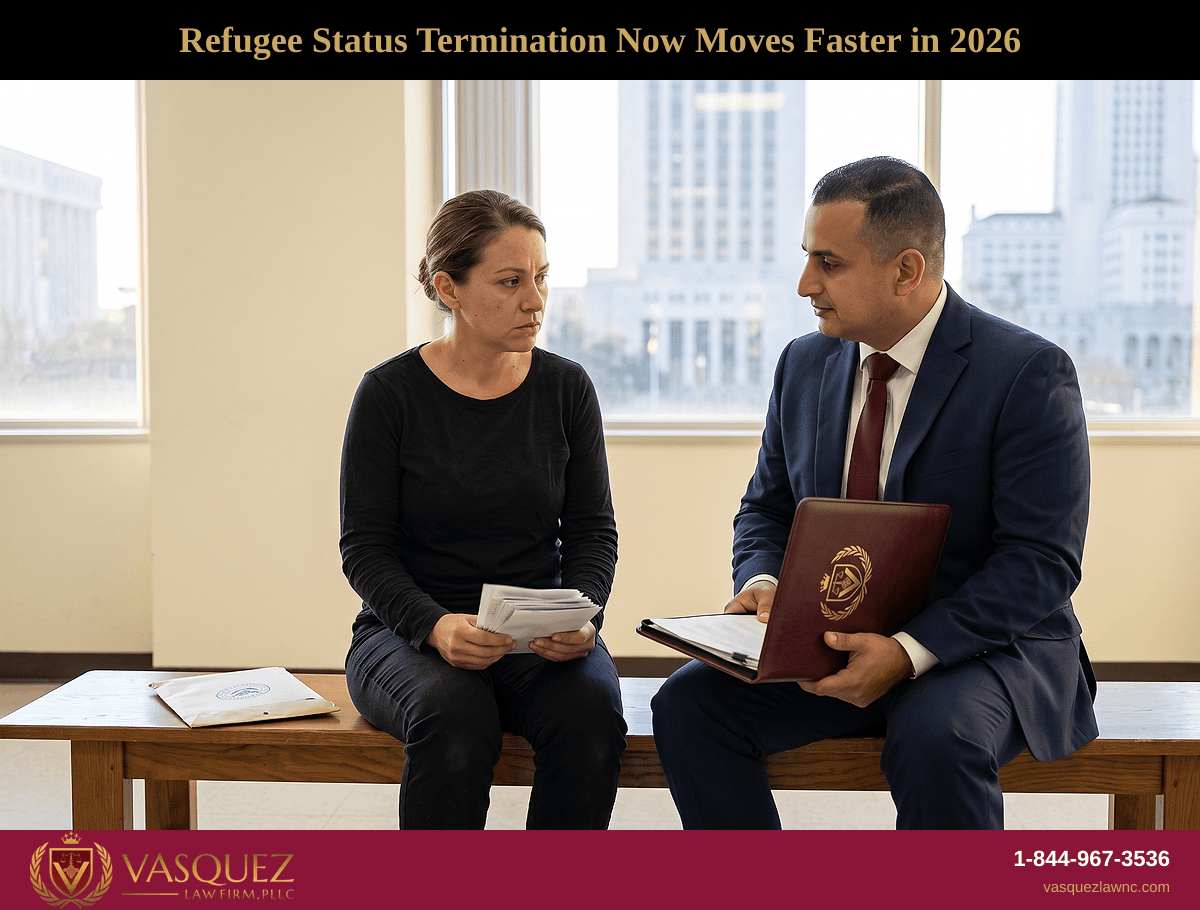
Refugee Status Termination Now Moves Faster in 2026
A refugee status termination notice now allows 10 days to respond. Protect your record, gather proof, and request a free evaluation today.
Published on October 14, 2026
Talk to an immigration attorney
Free call. A clear plan for your case.
Free & confidential · Se habla espanol · 24/7
Have questions? Talk to an attorney - free evaluation.
Call 1-844-967-3536Worried how the latest immigration news affects you?
Schedule a confidential case review with an immigration attorney - know exactly where you stand.
USCIS Case Status
Check your USCIS case status
Enter your receipt number and get the official status. Free, no registration.
Refugee Status Termination Now Moves Faster in 2026
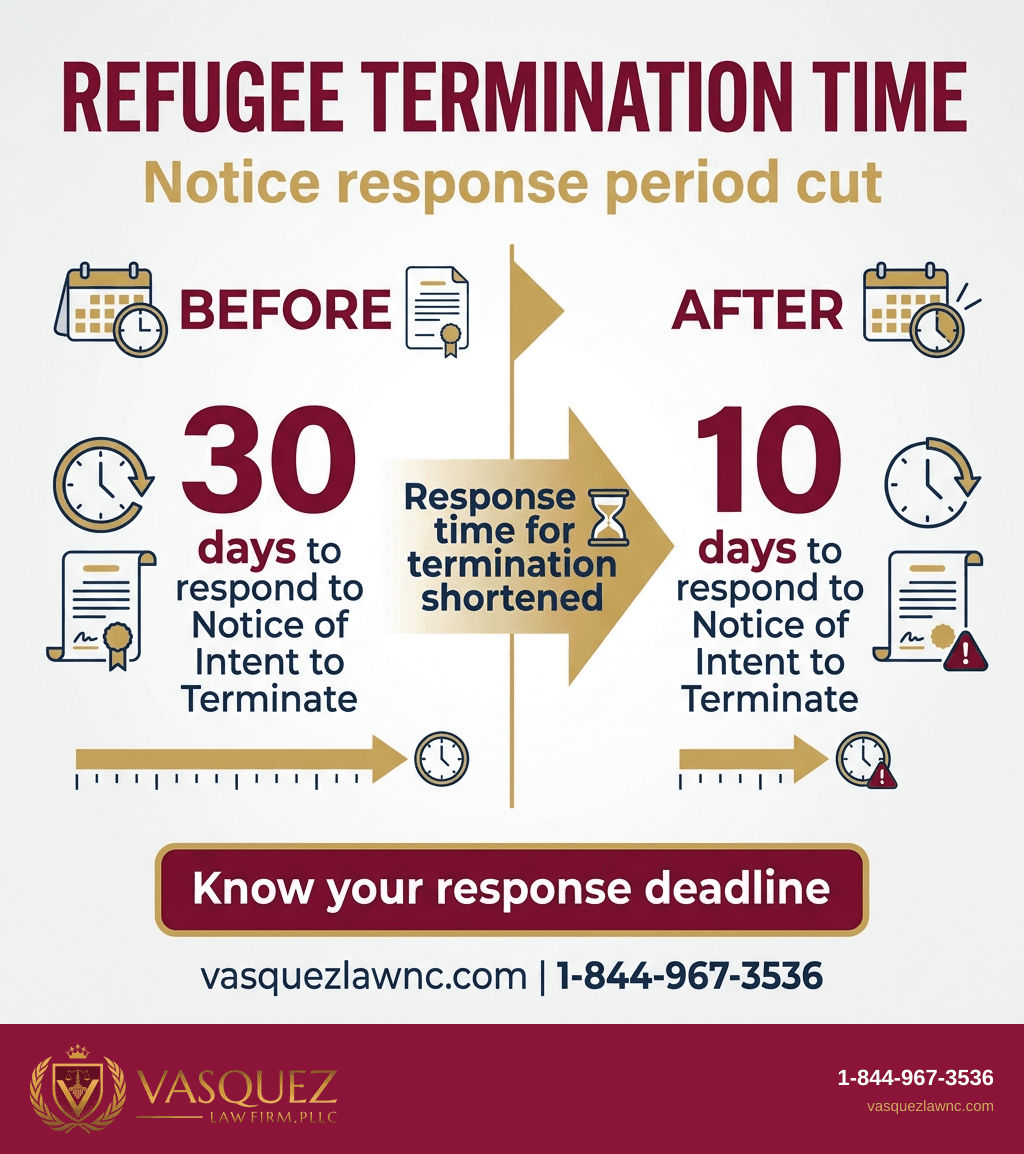
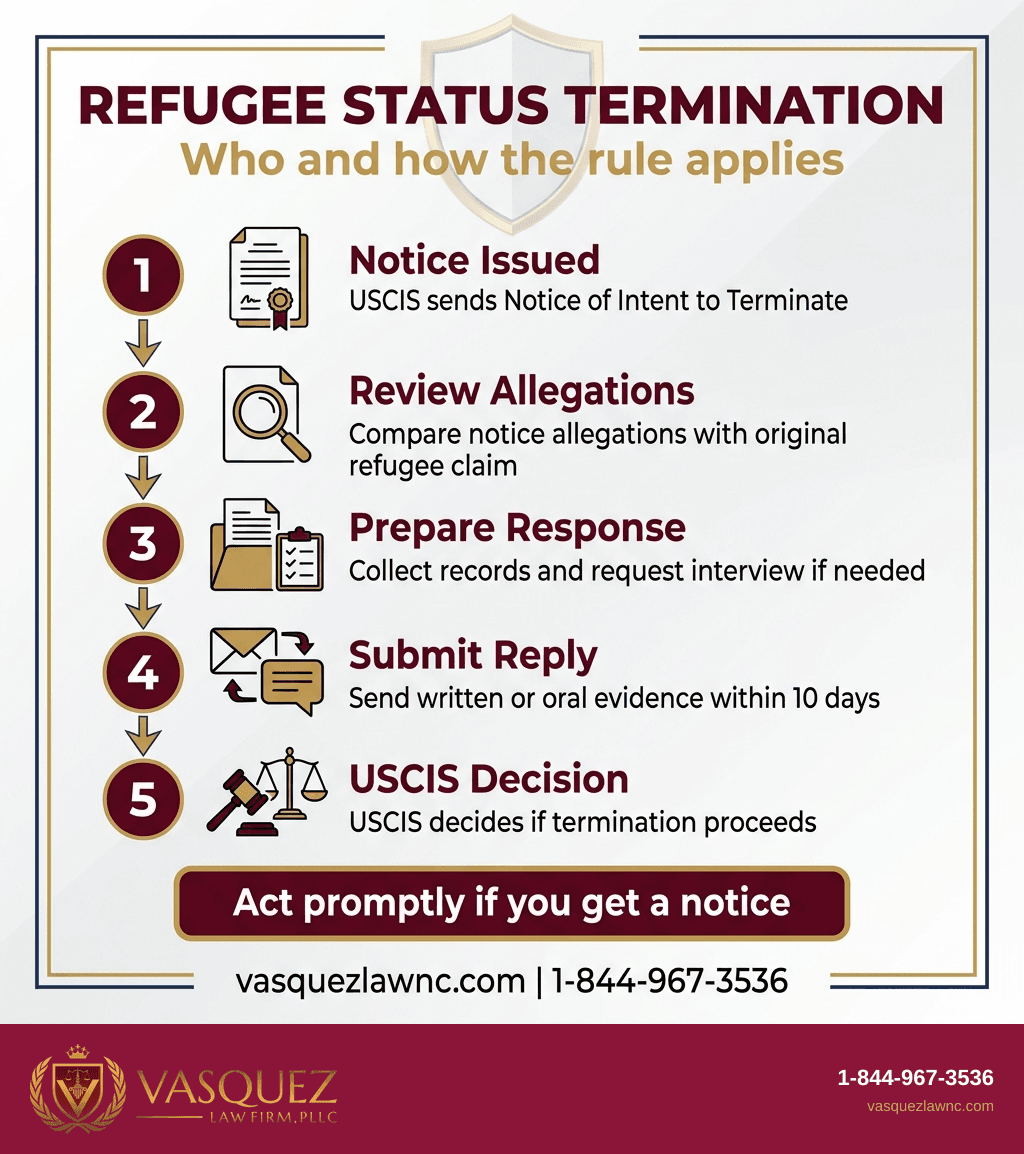
On October 14, 2026, USCIS cut the response period for a refugee status termination notice from 30 days to 10 days. A refugee who receives a Notice of Intent to Terminate now has less time. The person must understand the allegation, collect records, request an interview, and send a response before USCIS decides the case.
The Department of Homeland Security issued the change as an interim final rule. An interim final rule is an agency rule that takes effect before the usual public-comment process ends. The rule is called Removing 30-Day Refugee Termination Notice, Federal Register Document 2026-20956. It applies nationwide. Federal immigration law controls refugee admission and status. Our immigration attorneys can explain the process. They can also help a family identify important records.
Legal disclaimer: This article provides general legal information, not legal advice for any individual case. A Notice of Intent to Terminate can have serious consequences. Readers should seek advice based on their own documents and immigration history.
What changed in refugee status termination?
USCIS changed 8 CFR 207.9 effective October 14, 2026. The regulation now gives a person 10 days to respond. The former period was 30 days. The period begins after USCIS issues a Notice of Intent to Terminate, also called a NOIT.
The change involves a narrow legal finding. USCIS may begin termination when it decides that a person was not a refugee under INA section 101(a)(42) when admitted to the United States. The interim final rule does not create a general process for ending refugee status because of any later conduct.
Through this IFR, DHS is amending 8 CFR 207.9 to change the 30-day notice-and-response period for aliens whose refugee status is terminated by USCIS to a 10-day notice-and-response period.
A NOIT must explain the reason for the proposed termination. The notice gives the recipient a chance to offer written or oral evidence. That evidence can support the original refugee claim. It can also oppose termination. Under the earlier process, a person could request another interview. The person could also submit documents during the longer response period. The rule makes that response period shorter.
DHS said the goal is faster action. The agency wants to act when it finds that a person did not qualify at admission. Its Federal Register notice connects the change to screening, identity, fraud, national security, and public safety concerns. The agency cited Operation Post-Admission Refugee Reverification and Integrity Strengthening. This program is known as Operation PARRIS. It reviews certain refugee cases that were approved in the past.
Why the clock matters
Ten days can pass quickly when a notice arrives by mail. Records may also be with relatives or agencies. A recipient may need translation. A person should save the envelope, the notice, and every attachment. The date on the notice controls the response period described in the regulation.
In our experience, the first question after a serious USCIS notice is whether the agency has the correct facts. Identity information and family history also matter. A careful response starts by comparing each allegation with the refugee application. It should also compare the allegation with interview history and later immigration filings.
Who can receive a refugee status termination notice?
The rule applies to a principal refugee when USCIS seeks to terminate that person's status. USCIS must determine that the person was not a refugee when admitted. A principal refugee is the applicant whose claim formed the basis for the refugee case.
Federal Register Document 2026-20956 explains the statutory termination ground. It applies to principal refugees, not directly to derivative refugees. A derivative refugee can include the principal refugee's spouse. It can also include the principal refugee's unmarried child under age 21. USCIS may still terminate a derivative refugee's status. This can happen if USCIS terminates the principal refugee's status.
Timing is important. The notice states that refugee status can be terminated only while the person remains in refugee status. The person must also not have adjusted to lawful permanent resident status or naturalized. Lawful permanent resident status means green-card status. Naturalized means the person became a U.S. citizen through the naturalization process. If lawful permanent resident status is later rescinded under INA section 246, the person returns to prior refugee status. The person may then face termination if the statutory standard is met.
What a termination finding can trigger
The effects go beyond the status label. The Federal Register notice says USCIS will terminate refugee status and employment authorization if it decides the person was not a refugee at admission. Employment authorization means permission to work in the United States. The person will also be subject to removal from the United States.
The notice also explains that USCIS termination of refugee status has no appeal. After termination, USCIS processes the person for removal under INA sections 235, 240, and 241. Those provisions cover inspection, removal proceedings, and removal procedures. A removal case can involve separate procedures and defenses. Still, the NOIT response is the early chance to present evidence about the proposed termination.
USCIS commonly reviews the original refugee decision before deciding an application for lawful permanent residence. The agency may begin termination at any time before adjustment. It may do so if it concludes that the person did not qualify as a refugee at admission. Readers who need help at that stage can speak with our refugee immigration legal team. The team can discuss documents connected to the original admission.
What law governs refugee status termination?
INA section 207(c)(4), codified at 8 U.S.C. 1157(c)(4), gives the Secretary of Homeland Security authority to terminate a person's status. The same authority covers that person's spouse or children. The Secretary must determine that the person was not in fact a refugee at the time of admission. The law also authorizes regulations that govern the procedure.
INA section 101(a)(42), 8 U.S.C. 1101(a)(42), defines a refugee. In general, a refugee is a person outside the country of nationality who meets the legal persecution standard and other eligibility requirements. The Federal Register notice lists these protected grounds: race, religion, nationality, political opinion, and membership in a particular social group.
Background facts matter because refugee admission is conditional at entry. INA section 209, 8 U.S.C. 1159, governs a refugee's adjustment to lawful permanent resident status. Adjustment means changing from refugee status to green-card status. The interim final rule separates its termination process from policies about detention or adjustment.
What USCIS must determine
The rule describes one termination basis. USCIS must find that the person did not meet the refugee definition at admission. The notice gives examples. One example is a finding that the claimed harm was not connected to a protected ground. Another is a finding that the person had another nationality or legal status in another country. That fact could affect eligibility.
The sole basis for USCIS to terminate the status of an alien conditionally admitted to the United States as a refugee is if USCIS determines that the alien did not meet the definition of a refugee at the time of admission to the United States.
The rule also discusses the persecutor bar. This is a rule that excludes a person who ordered, incited, assisted, or otherwise took part in persecution on a protected ground. These legal standards depend on the facts. A response should address the exact allegation in the notice. It should not treat the notice as a routine request for more evidence.
What should you do after receiving a refugee status termination notice?
Start by reading every page of the NOIT on the day it arrives. Find the stated basis for proposed termination. Also find the notice date and return address. Look for instructions about requesting oral testimony. Make a complete copy before sending anything to USCIS.
Next, gather records that directly answer the allegation. Helpful materials may include the Form I-590 refugee application and interview records. They may also include identity documents and proof about nationality or residence. Records of past harm or feared harm may help. Family documents and later immigration filings may also matter. Keep originals unless USCIS expressly requires them.
Then create a timeline. List important dates and places. Include family relationships, prior names, and prior addresses. List each statement made in immigration paperwork. Inconsistencies may have an explanation. Still, identify and address them with evidence. If translation is needed, keep the original-language record. Obtain an accurate English translation.
Finally, decide whether to request another interview. Also decide how to present a written response. The NOIT process allows written or oral evidence. The shorter period makes organized preparation essential. A related asylum decision update may help readers understand how factual records can shape immigration proceedings. Refugee status and asylum remain distinct forms of protection.
A refugee status termination notice deserves immediate, document-based review. Vasquez Law Firm offers a free evaluation for immigration matters. Se Habla Español.
What should refugees watch next?
The interim final rule took effect on October 14, 2026. DHS accepts written comments through November 13, 2026. Comments must be submitted through Regulations.gov under DHS Docket No. USCIS-2026-0397. The Federal Register notice asks commenters to identify the relevant part of the rule. It also asks them to support proposed changes with data, information, or authority.
For someone facing an individual NOIT, the immediate rule is settled. The response period described in 8 CFR 207.9 is now 10 days. The most reliable public sources for this rulemaking are the Regulations.gov docket and the Federal Register entry. The entry is titled Removing 30-Day Refugee Termination Notice.
It is not yet settled whether later rulemaking will change the 10-day response process. That uncertainty should not delay action on a notice already received. Keep copies of the notice and proof of delivery. Also keep submissions and any USCIS receipt or correspondence.
USCIS maintains its USCIS Policy Manual for agency policy guidance. For personal status questions, review official notices closely. Do not rely on a petitioner, resettlement contact, or informal message to explain a termination allegation.
Frequently Asked Questions
Can refugee status be revoked after admission?
USCIS may terminate refugee status while a person still holds refugee status if it determines the person was not a refugee at the time of admission. The governing authority is INA section 207(c)(4), 8 U.S.C. 1157(c)(4). The October 14 rule changes the response period for that process, not the underlying statutory standard.
How long do I have to answer a NOIT?
Under the amended 8 CFR 207.9, the response period is 10 days from issuance of the Notice of Intent to Terminate. The Federal Register notice explains that a missed response can result in termination. Preserve the notice and act promptly because the period is much shorter than the previous process.
Can I submit documents and ask for an interview?
Yes. The Federal Register notice describes a right to offer written or oral evidence supporting the refugee claim and opposing termination. It also describes a request for an additional interview. The evidence should respond directly to USCIS's stated grounds and should be organized so the adjudicator can connect each record to the issue raised.
Does termination affect employment authorization?
It can. The notice states that if USCIS determines a person was not a refugee at admission, the person's refugee status and employment authorization will be terminated. Because work authorization may be tied to refugee status, recipients should obtain case-specific legal guidance before making employment or travel decisions based on a pending NOIT.
Can I appeal USCIS termination of refugee status?
The Federal Register notice states there is no appeal from USCIS's termination of refugee status. That makes the NOIT response especially important. Termination can also lead to processing under the INA removal provisions, where separate procedural rights and potential defenses may be relevant to the facts of the individual case.
Is refugee status the same as asylum?
No. Refugee classification is generally processed overseas before admission through the U.S. Refugee Admissions Program. Asylum is a separate protection process for people who apply under different procedural circumstances. Both areas can involve persecution-based claims, but the October 14 rule specifically amends the refugee termination regulation at 8 CFR 207.9.
Do not treat a 10-day refugee status termination deadline as routine correspondence. Vasquez Law Firm provides free immigration consultations for clients nationwide, with in-person consultations in Raleigh, NC and Orlando, FL.
Schedule Your Free Consultation
Legal disclaimer: This information is general education, not legal advice. An attorney can assess the notice, filing history, and available options in your specific matter.
Reviewed by Attorney Vasquez, Managing Attorney
Worried About Immigration Policy Changes?
New policies can affect your case. Get current legal advice from an experienced immigration attorney.
Keep Reading


William Vasquez
Founder & CEO, Vasquez Law Firm, PLLC
William Vasquez is the founder and CEO of Vasquez Law Firm, PLLC, a results-driven firm specializing in immigration, criminal defense, personal injury, and workers' compensation. A U.S. Air Force veteran and recipient of the Joint Service Achievement Medal, William is dedicated to fiercely fighting for his clients' rights.
Related Legal Services
Need legal help? Learn more about get immigration legal help today, or contact us for a free evaluation.
You can also visit our North Carolina immigration practice for more information.