BIA Reverses $8,000 Bond Over Driving and Address Records
A BIA bond detention decision ordered detention without bond after driving violations, address conflicts, and weak relief claims. Know your rights today.
Published on November 3, 2026· Updated November 3, 2026
Talk to an immigration attorney
Free call. A clear plan for your case.
Free & confidential · Se habla espanol · Mon-Fri 8am-7pm, Sat 9am-2pm (ET)

Have questions? Talk to an attorney - free evaluation.
Call 1-844-967-3536Worried how the latest immigration news affects you?
Schedule a confidential case review with an immigration attorney - know exactly where you stand.
USCIS Case Status
Check your USCIS case status
Enter your receipt number and get the official status. Free, no registration.
On November 2, 2026, the Board of Immigration Appeals ordered a respondent, the person in the case, detained without bond. The Board reviewed driving-related violations, conflicting residence information, and a weak record of possible relief from removal. This BIA bond detention decision reversed an Immigration Judge's order. The judge had set bond at $8,000.
The ruling concerning the respondent is reported at 30 I&N Dec. 218 (BIA 2026), Interim Decision #4271. It shows how the Board can reassess custody evidence on appeal after an Immigration Judge has granted bond. A person seeking release must provide reliable proof. That proof must show they will attend future hearings. It must also show they will follow future court orders.
Need legal help?
Immigration in NC and FL. Personal injury and workers compensation across NC. Criminal defense in select NC counties depending on the charge (DWI in 12 counties), and traffic tickets in 20 NC counties. Tell us your county and we will tell you exactly what we can do.
People facing custody review can speak with our immigration attorneys about preparing organized evidence for a bond hearing. This article gives general legal information. It is not advice for any individual case.
What happened in the BIA bond detention decision?
The Board sustained, or granted, the Department of Homeland Security appeal. The appeal challenged an Immigration Judge's April 1, 2026 bond order. The Immigration Judge later explained the ruling in a memorandum dated May 5, 2026. That judge found the respondent eligible for bond. The judge set the bond amount at $8,000.
The Board assumed, without deciding, that the respondent was not a danger to the community. It still reviewed the flight-risk decision anew. Flight risk means the chance that a person will not attend required hearings. The Board decided that release was not warranted. It vacated, or canceled, the bond grant. It required detention without bond.
“We conclude that no amount of bond is sufficient to ensure the respondent’s appearance at future immigration hearings in light of his multiple violations of motor vehicle laws, failure to establish a fixed address, and apparent lack of eligibility for relief from removal.”
The record described encounters with police in June and August 2017. The Board cited an improper lane change. It also cited inoperative brake lights, a suspended license, and repeated driving without a valid license. The respondent disputed the allegations' accuracy. He said he misunderstood driving-related procedural requirements. The Board decided that the record did not support that explanation.
Why the Board focused on compliance
The decision linked repeated licensing violations with the chance of obeying future immigration court instructions. It relied on Matter of A-L-S-, 29 I&N Dec. 794 (BIA 2026). That case explains what flight risk includes. It includes appearing at hearings. It also includes following future Immigration Judge orders.
This BIA bond detention decision did not say that every traffic-related violation requires detention. The Board reviewed the respondent's circumstances, including his violations of motor vehicle laws, lack of a fixed address, and claimed eligibility for relief.
Who can this BIA bond detention decision affect?
The ruling directly decides one respondent's custody status. A custody redetermination is a hearing where an Immigration Judge decides whether release on bond is appropriate.
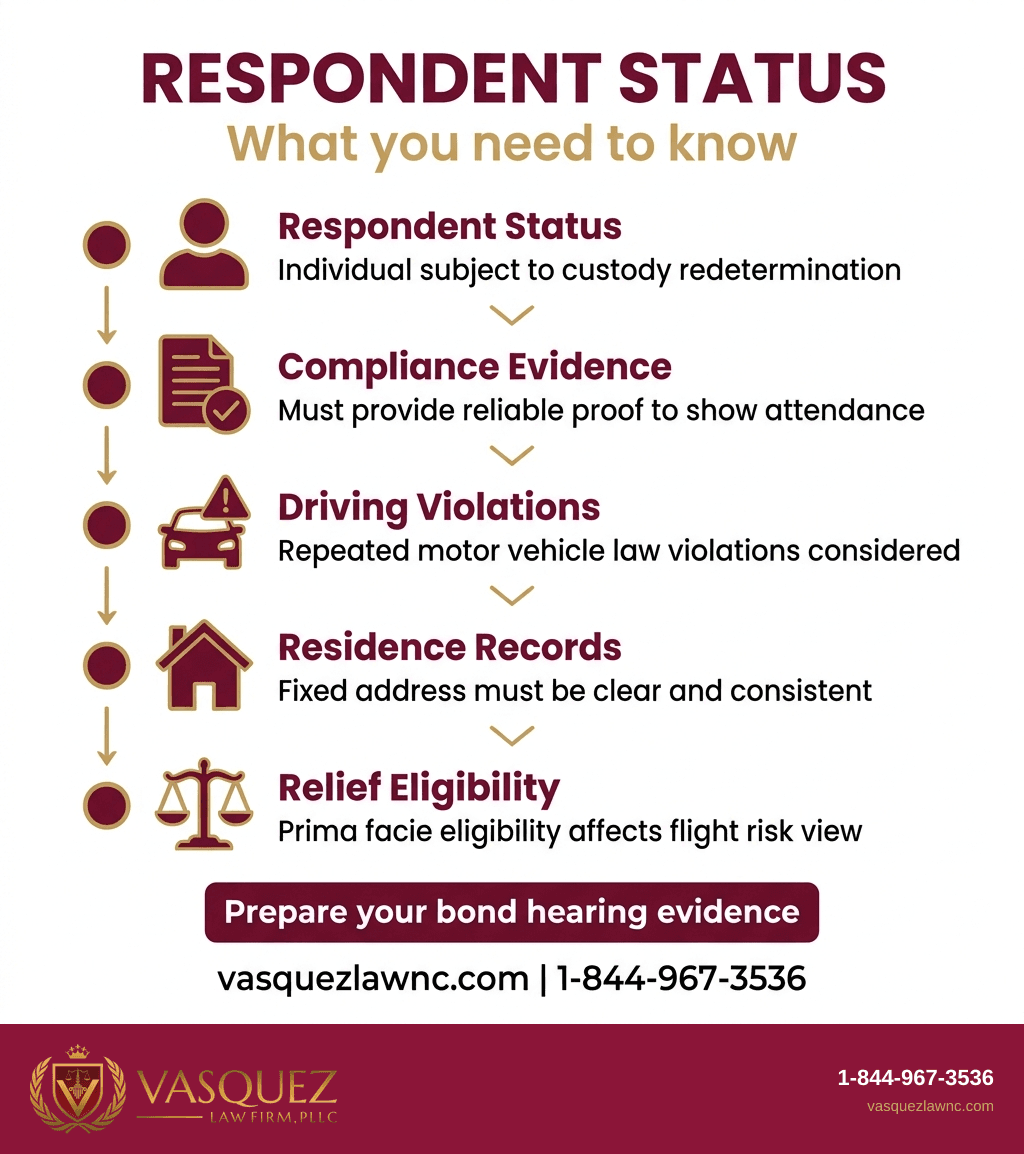
Under the approach used here, a person requesting bond must show they will likely attend future immigration proceedings. The Board cited Matter of Guerra, 24 I&N Dec. 37, 40 (BIA 2006) for this burden. The burden is the required responsibility to provide enough proof. Evidence that looks inconsistent can carry serious weight.
Residence records became central evidence
DHS detained the respondent in February 2026. The detention followed an encounter in Cheyenne, Wyoming. At that time, he claimed to be unmarried and to have no children. A later custody-redetermination application listed a wife and children. It listed the address only as USA.
At the hearing, the respondent said he would live in Ocala, Florida. He submitted a letter from a friend. The friend said they would ensure that he attended hearings. On appeal, the respondent said he had a valid Indiana driver's license. He also said he lived in Westfield, Indiana. The Board found the residence evidence unclear.
“The respondent’s failure to provide a clear fixed address weighs heavily against finding he is not a flight risk.”
Families should understand the practical lesson. A support letter may help explain a release plan. However, the letter should match address records and other evidence. The cases we handle often show the same point. A release plan is strongest when every document tells the same verifiable story.
The Board also considered a pending cancellation of removal application. The Board asked whether that application made attendance more likely. It found that the respondent had not shown prima facie eligibility. Prima facie means enough initial evidence to show apparent eligibility. The record showed entry in August 2016. It also showed removal proceedings beginning in February 2026.
For readers with upcoming court dates, the immigration court hearing process can affect custody planning. It can also affect the underlying removal case. A BIA bond detention decision depends on the evidence in the record. It does not depend on a family's hopes alone.
What immigration bond rules did the Board apply?
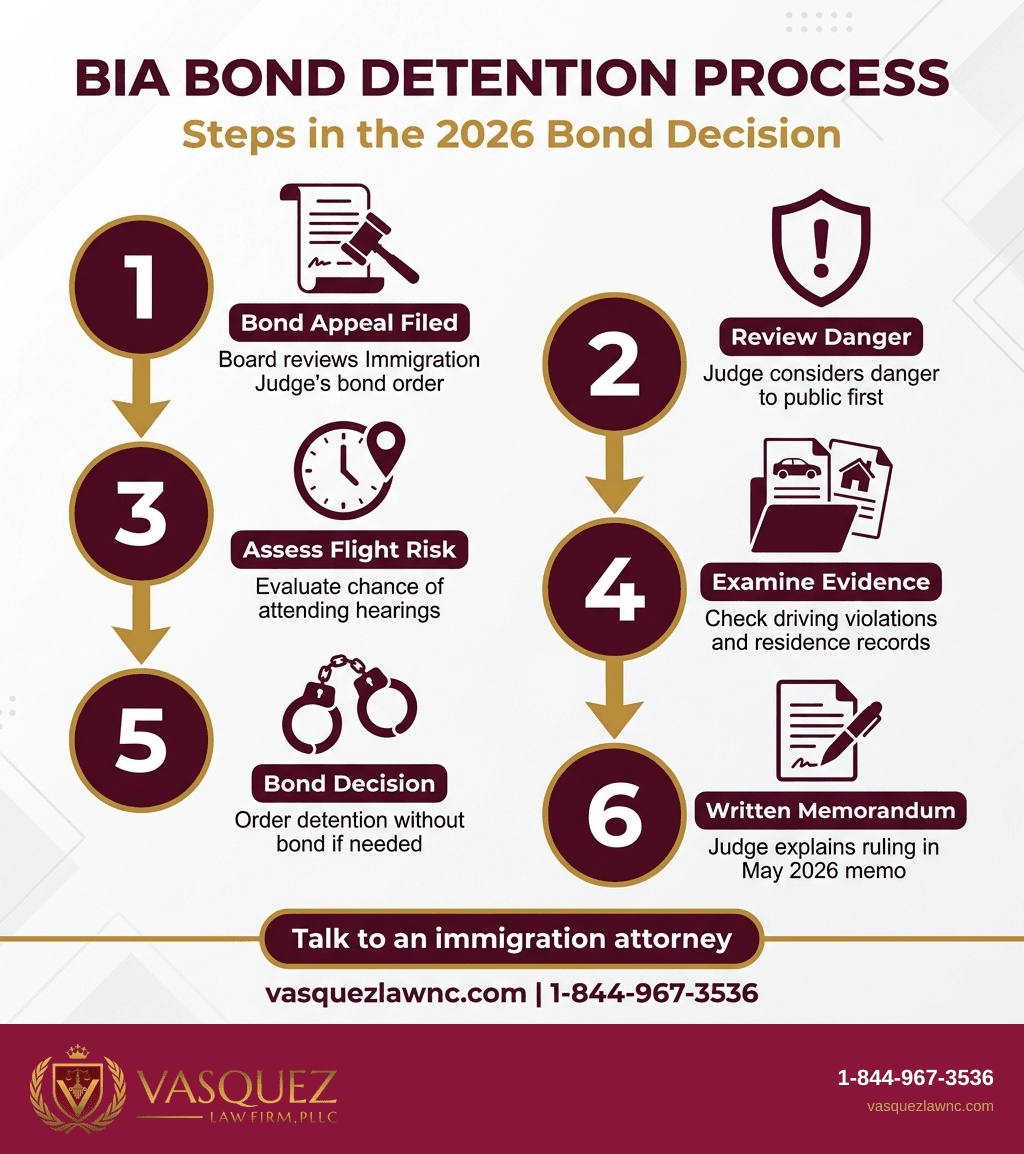
Under Matter of Urenas, 25 I&N Dec. 140 (BIA 2009), an Immigration Judge first considers danger. The judge asks whether release would endanger people or property. The judge then considers what is needed to ensure appearance at future proceedings.
In this case, the Board did not decide the danger issue. It found flight risk sufficient to deny bond. It cited Matter of Dobrotvorskii, 29 I&N Dec. 211 (BIA 2025). That case explains how the Board reviews flight-risk decisions. The Board reviews the final flight-risk judgment anew. It reviews the underlying factual findings for clear error. Clear error means a serious mistake in the facts, not merely a different view of the evidence.
Relief from removal can matter
The decision also discussed nonpermanent-resident cancellation of removal. The law appears in INA section 240A(b)(1)(A), 8 U.S.C. § 1229b(b)(1)(A). INA means the Immigration and Nationality Act. This provision requires 10 years of continuous physical presence. The Board decided that the record did not establish this requirement.
The Board cited Matter of Andrade, 19 I&N Dec. 488 (BIA 1987). A person with a greater likelihood of being granted relief has a greater motivation to appear for future hearings. The Board also cited Matter of A-L-S-. That case explains that speculative future eligibility does not materially diminish flight risk. Speculative means based on possibility rather than proof.
This section gives background on the legal framework. It does not say that every person with a pending application lacks a basis for bond. Eligibility for relief and bond evidence require a case-specific review. Readers may also find our discussion of cancellation of removal at the BIA useful. It explains the relationship between court relief and custody evidence.
What should families prepare for a bond hearing?
A fixed residence should have records that match one another. Before a bond hearing, collect documents that identify the proposed address. Collect records that identify the people who will live there. Review every form for consistency. Compare each form with earlier statements to immigration officers or the court.
Build a clear attendance plan. Identify the transportation the person will use. Identify family support. Explain how the person will receive immigration court notices. If a friend or relative writes a support letter, the letter should be accurate. It should explain that person's relationship, address, and ability to help.
Gather records related to any request for relief from removal. In this decision, the Board treated apparent eligibility for relief as relevant to flight risk. A pending application by itself may not answer eligibility questions. It may also not answer questions about future compliance.
Request and review the record carefully. The respondent challenged the driving-related allegations. The Board found no supporting evidence for that challenge. If a record contains an error, families should preserve documents that address it directly.
Our immigration legal team can evaluate custody evidence and removal-defense issues during a free evaluation. Se Habla Español. Do not rely on a general checklist. Detention, prior records, and relief eligibility may overlap in important ways.
What should people watch after a bond denial?
The immediate result in this case is detention without bond for the respondent. The decision reinforces an important point. Immigration Judges and the Board may review the complete record. They do so when deciding whether a bond amount can reasonably ensure future attendance.
People with removal cases should watch their hearing notices. They should keep one accurate mailing address. They should preserve copies of every filing. The official USCIS Policy Manual is an official reference for USCIS benefit policies. Immigration court notices control the dates and requirements in a pending court case.
A different record might change the custody result for a particular person. That record might include verified housing. It might include consistent family information. It might also include documented relief eligibility. This is why the details of each file matter.
What's Your Immigration Situation?
Answer 3 questions - we'll tell you your options
Question 1 / 3
What best describes your situation?
Keep Reading
A BIA bond detention decision is not the end of a family's ability to organize facts. Families can correct misunderstandings with evidence. They can also prepare for the removal case. Careful documentation can help the next legal decision rest on a clearer record.

Frequently Asked Questions
What is a bond redetermination hearing?
A bond redetermination hearing is a custody hearing before an Immigration Judge. The judge considers whether release is appropriate and, if so, what bond amount may ensure future appearance. In this decision, the Board concluded that no bond amount could sufficiently address the respondent's flight risk based on the record it reviewed.
What did the BIA decide in this case?
The Board sustained DHS's appeal, vacated the Immigration Judge's bond grant, and ordered detention without bond. It assumed without deciding that the respondent was not a danger to the community. The Board instead relied on flight-risk concerns tied to driving-related violations, unclear residence evidence, and apparent ineligibility for claimed relief.
Why did the respondent's address matter?
The Board found conflicting information about where the respondent lived and with whom. The record included an address listed only as USA, a proposed residence in Ocala, Florida, and an appellate claim of residence in Westfield, Indiana. The Board treated the lack of a clearly established fixed address as significant evidence of flight risk.
Can driving-related violations affect an immigration bond case?
They can be considered as part of the record. In this case, the Board treated repeated driving without a valid license and other motor-vehicle-law violations as evidence relevant to whether the respondent would comply with future Immigration Judge orders.
How did cancellation of removal affect the decision?
The Immigration Judge had considered the pending cancellation application in finding less flight risk. The Board disagreed because the record reflected entry in August 2016 and proceedings beginning in February 2026. It concluded that the record did not show the continuous physical presence required by INA section 240A(b)(1)(A).
Who has the burden of proof at a bond hearing?
The Board stated that a person in custody seeking release on bond must show that they do not present a flight risk and are likely to attend future immigration proceedings. It cited Matter of Guerra, 24 I&N Dec. 37 (BIA 2006). Reliable address, family, compliance, and relief evidence can therefore be central to the hearing record.
Records cited
- Decision concerning the respondent, 30 I&N Dec. 218 (BIA 2026), Interim Decision #4271
- USCIS Policy Manual
Legal disclaimer: This article is general information, not legal advice. Immigration custody and removal cases depend on the record, procedural posture, and applicable law.
For a free evaluation, contact Vasquez Law Firm. We meet immigration clients in Raleigh, NC and Orlando, FL, and assist clients nationwide. Schedule your free immigration evaluation to discuss the facts of your situation.
Reviewed by Attorney Vasquez, Managing Attorney

William Vasquez
Founder & CEO, Vasquez Law Firm, PLLC
William Vasquez is the founder and CEO of Vasquez Law Firm, PLLC, a results-driven firm specializing in immigration, criminal defense, personal injury, and workers' compensation. A U.S. Air Force veteran and recipient of the Joint Service Achievement Medal, William is dedicated to fiercely fighting for his clients' rights.
Related Legal Services
Need legal help? Learn more about our immigration law practice, or contact us for a free evaluation.
You can also visit immigration lawyers serving all of North Carolina for more information.