BIA Vacates $20,000 Bond Order and Orders Detention Without Bond
A BIA bond appeal ruling vacated a $20,000 release order in a visa overstay case. See what evidence courts weigh, then seek a free evaluation.
Published on October 15, 2026· Updated October 15, 2026
Talk to an immigration attorney
Free call. A clear plan for your case.
Free & confidential · Se habla espanol · Mon-Fri 8am-7pm, Sat 9am-2pm (ET)
Have questions? Talk to an attorney - free evaluation.
Call 1-844-967-3536Check your case status now
Look up your immigration case below, then talk to an attorney about what it means — free.
Questions about your result?
Talk to an attorney about your case — free, no obligation.
On October 6, 2026, the Board of Immigration Appeals ordered a Russian citizen held without bond. In Matter of M-S-V-, 30 I&N Dec. 130 (BIA 2026), the Board addressed how detention decisions depend on the quality of the proof. The proof may concern safety, community ties, a sponsor, and possible immigration relief.
For a person in detention, release or continued custody can affect work and family contact. It can also affect the person’s ability to prepare a removal defense. A Vasquez Law Firm immigration attorney can review the records, applications, and supporting proof. These materials may matter at an immigration bond hearing. An immigration bond hearing is a hearing that decides whether a detained person may be released while the case continues.
Legal disclaimer: This article provides general legal information, not legal advice for any individual. Bond eligibility and custody decisions depend on a person’s record, detention authority, and evidence. Our nationwide immigration legal team can assess an individual situation through a free evaluation.
What happened in the BIA bond appeal ruling?
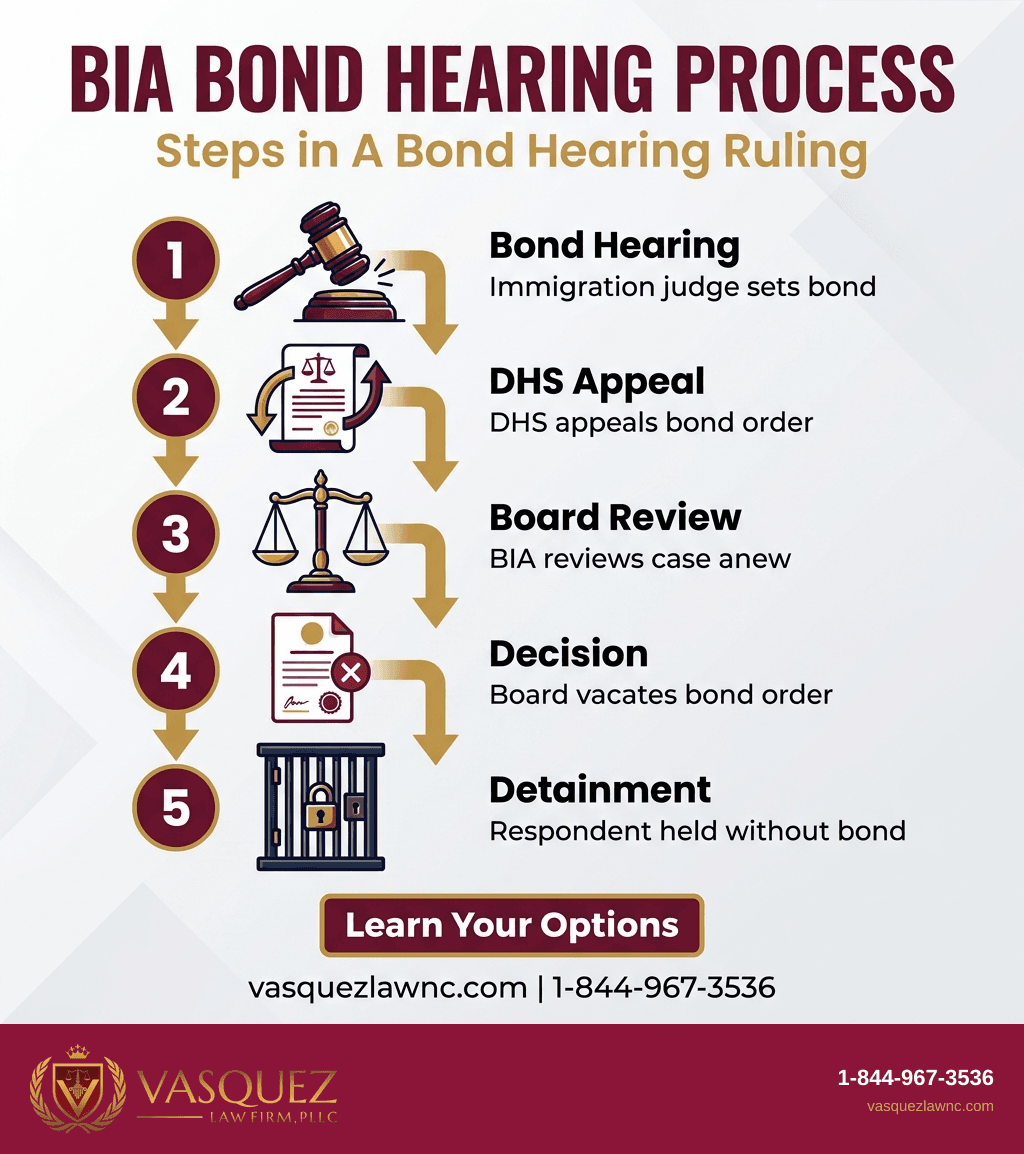
The Board sustained the Department of Homeland Security appeal. It vacated the March 17, 2026 bond order. The respondent had entered the United States on September 28, 2021. He entered as a nonimmigrant visitor. He was authorized to remain until March 27, 2022. He later overstayed. DHS detained him on February 24, 2026, under INA section 236, 8 U.S.C. § 1226.
After a March 16 bond hearing, the Immigration Judge found that the respondent did not pose a danger to the community and that a $20,000 bond could mitigate his flight risk. A bond is money paid to secure release. DHS appealed on April 8. It challenged both findings. The Board treated danger and flight risk as questions of judgment and reviewed them anew (de novo). It used clear-error review for the factual findings behind those judgments. Clear-error review asks whether the lower decision clearly made a factual mistake.
The respondent failed to establish that he does not pose a danger to the community where he worked as a long-haul truck driver without a valid commercial driver’s license and was arrested for failing to stop at a port of entry on an interstate.
Why the record mattered
The ruling focused on the record before the Immigration Judge. The record means the evidence and information filed in the case. The Board found that the respondent’s arrest mattered to the danger inquiry. It also found that the evidence about commercial driving mattered. The regular driver’s license the respondent provided was expired at the time. It also found no evidence that the respondent held a valid commercial driver’s license.
The Board also considered whether the respondent could show that he would attend future hearings. It found that relief applications were unfiled at the time of the hearing. It also found insufficient proof about the proposed sponsor. The result was detention without bond.
This is a decision from the Board of Immigration Appeals. It concerns the evidence and legal standards in a custody appeal. The decision does not address the merits of any future asylum claim or removal case.
Who may this BIA bond appeal decision affect?
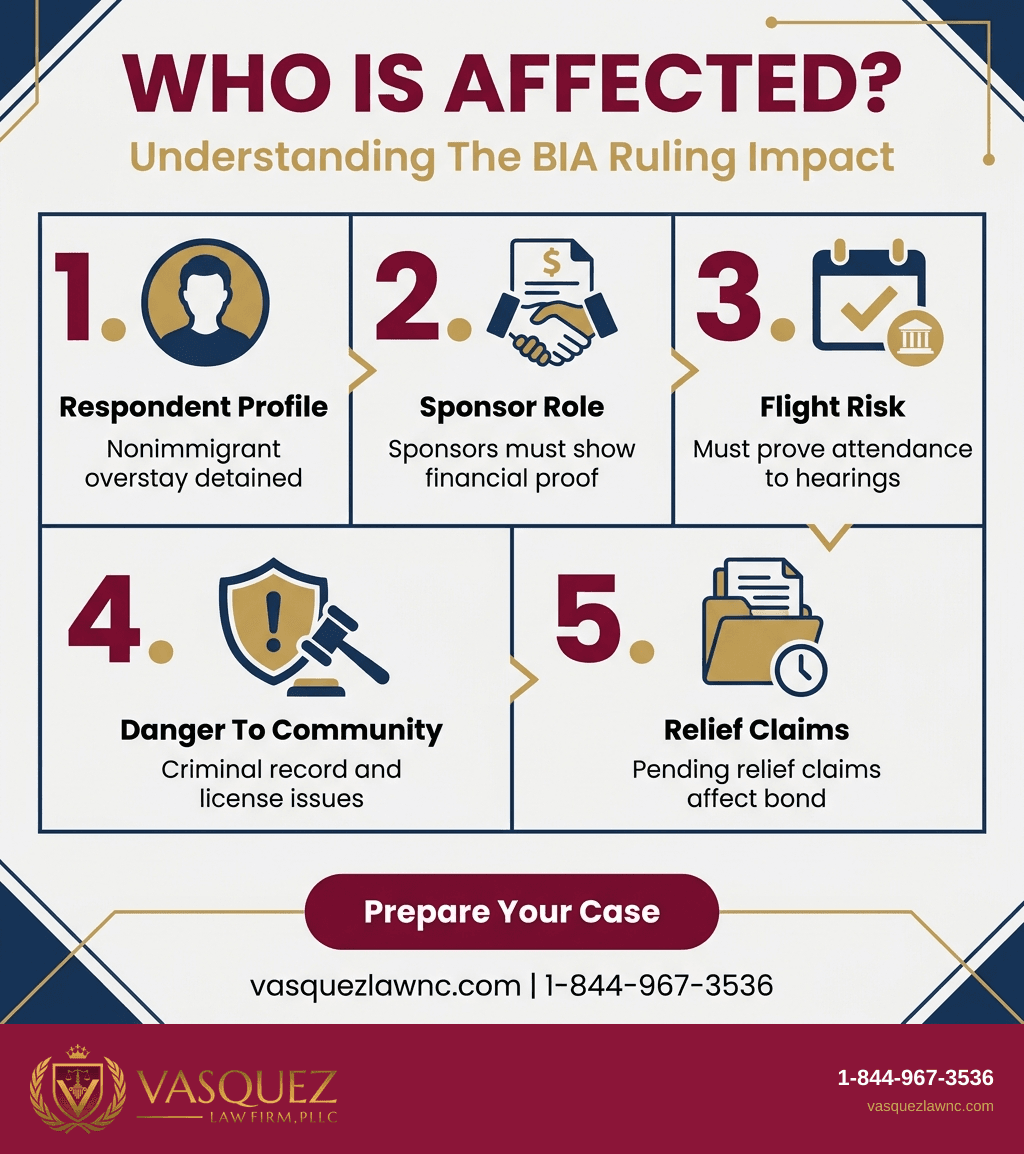
Matter of M-S-V- directly decides one respondent’s custody appeal. The decision is especially relevant when a person relies on a friend or acquaintance as a proposed sponsor. The detained person must show that they are not a danger to the community. They must also show that they are not a flight risk. A flight risk is a person who may not attend future hearings.
The decision distinguishes informal support from a visa sponsor or bond obligor. The Board explained that the latter roles carry enforceable financial or legal responsibility. Enforceable means that the law can require a person to meet the responsibility. A statement that someone will provide housing or general support may receive limited weight. The record must support the relationship, address, and financial ability to support the detained person.
An ambiguous social connection and uncertain financial ability to provide support do not fulfill the rigorous standards for a valid, reliable, and credible sponsor that may mitigate an alien’s flight risk.
For families, this language makes documentation central. A sponsor letter and a passport were in the record here. However, the Board found no supporting financial evidence. It also said that the claimed relationship was not verified. The Board noted that three character-reference letters listed addresses different from those on the writers’ driver’s licenses.
Relief claims can matter at bond
The Board treated the likelihood of immigration relief as relevant to whether a person has a reason to appear. Immigration relief is a legal way to remain in the United States or avoid removal. The respondent said he intended to seek asylum. He had not filed an application before the Immigration Judge. The Board held that an intention to apply later did not establish a sufficiently concrete incentive to appear.
That finding does not mean every person must have the same relief claim. It means a bond presentation should accurately identify any existing relief path. It should support that path with the documents available in the record. In our experience, families often ask whether a sponsor letter alone can secure release. Custody decisions instead turn on the complete evidentiary record. An evidentiary record is the full set of documents and other proof submitted for consideration.
What law governs an immigration bond hearing?
INA section 236, codified at 8 U.S.C. § 1226, governs the arrest and detention of certain noncitizens during removal proceedings. Codified means written into a statute. In Matter of M-S-V-, the respondent was detained under that provision. Immigration custody proceedings are separate from criminal proceedings.
The Board cited Matter of Guerra, 24 I&N Dec. 37, 40 (BIA 2006) as identifying factors to be considered in determining whether an alien merits release from immigration detention, including the alien’s manner of entry and length and stability of residence in the United States. The Board also cited Matter of Siniauskas, 27 I&N Dec. 207 (BIA 2018). That case concerns the respondent’s burden to show that release would not present danger or flight risk. A burden is the responsibility to provide enough proof on an issue.
For broader federal immigration guidance, readers can consult the USCIS Policy Manual. Court custody rules and agency benefit processes differ. A filing strategy should match the forum handling the case. A forum is the court or agency that has authority over the matter.
What happens on appeal?
Under 8 C.F.R. § 1003.1(d)(3), the Board reviews questions of law, discretion, and judgment under its appellate authority. Appellate authority is the power to review a lower decision. The decision says danger and flight risk are questions of judgment reviewed de novo. De novo means the Board reviews the issue anew. It reviews underlying factual findings for clear error.
The record rule also matters. The respondent submitted further material to the Board. That material included information about a new sponsor and an updated asylum application. The Board did not accept that new evidence on appeal. It cited 8 C.F.R. § 1003.1(d)(3)(iv). The Board said the respondent could seek custody redetermination before the Immigration Judge. Custody redetermination is a new custody review. The respondent would need to show materially changed circumstances under 8 C.F.R. § 1003.19(e).
What should a detained person and family prepare?
A strong immigration bond hearing record begins before the hearing. Gather identity documents and proof of a stable residence. Gather records of family and community ties. Also gather documents that support any pending application for relief from removal. Submit materials consistently. Make sure addresses and dates can be verified.
For a proposed sponsor, prepare more than a supportive letter. The ruling highlights several useful types of proof. Explain the relationship. Provide the sponsor’s immigration status where relevant. Describe the planned housing arrangement. Show the sponsor’s actual financial ability to provide support. The evidence should match the claims made at the hearing.
- Obtain the Notice to Appear and every custody or charging record available.
- Organize records that address danger concerns directly. Do not leave the Immigration Judge to infer important facts.
- Document residence, family relationships, employment history, and community connections accurately.
- Identify any existing relief application. Provide a copy with supporting materials.
- Review the proposed sponsor’s records for accuracy and consistency. Include proof of the sponsor’s ability to help.
Families should not assume that a future filing will carry the same weight as an application already in the Immigration Court record. They should also avoid submitting late material to the Board. The Board may not weigh that material for the first time on appeal.
Need help preparing for an immigration bond hearing? Vasquez Law Firm offers free immigration evaluations for clients nationwide. Request a free evaluation to discuss the custody record and available options. Se Habla Español.
What should families watch after this ruling?
Matter of M-S-V-, 30 I&N Dec. 130 (BIA 2026) applies a rule that already existed: in the custody determination, the respondent carries the burden. The respondent must establish no danger and no flight risk. Families facing detention can use this framework when deciding what evidence to gather.
Watch the Executive Office for Immigration Review’s published BIA decisions. Also watch the Immigration Court docket for developments in an individual case. For benefit processing issues outside detention, USCIS maintains its Processing Times page. A pending removal case requires careful attention to the court’s notices and orders.
Frequently Asked Questions
Is a bond appeal to the BIA necessarily favorable to the detained person?
A bond appeal to the BIA can result in review of an Immigration Judge’s custody decision, but it is not automatically favorable to either side. In Matter of M-S-V-, DHS appealed a release order and the Board ordered detention without bond. The outcome depends on the governing detention authority, the record, and the danger and flight-risk findings.
Who has the burden at an immigration bond hearing?
The Board stated that, in custody determination proceedings, the respondent bears the burden of establishing that the person is not a flight risk or a danger to the community. That is why records supporting residence, sponsor credibility, relief eligibility, and safety issues can be central to a bond request.
Can a friend serve as a bond sponsor?
A friend may offer support, but the Board held that an unclear relationship and unsupported financial ability did not sufficiently reduce flight risk in this case. A friend’s statement differs from a visa sponsor or bond obligor because it does not itself create enforceable legal or financial responsibility. Documentation can affect the weight assigned to support.
Does an intent to apply for asylum help in a bond appeal before the BIA?
The Board found that a stated intent to seek asylum did not establish a meaningful likelihood of relief where no asylum application had been presented to the Immigration Judge. A filed application does not guarantee release. Still, the decision shows why the status of relief filings may be relevant to the incentive-to-appear analysis.
Can the BIA consider new evidence on appeal?
The Board said it reviews the record that was before the Immigration Judge and would not accept the respondent’s new sponsor information and updated asylum material on appeal. Under 8 C.F.R. § 1003.1(d)(3)(iv), the Board may not make findings of fact on appeal. A custody-redetermination motion may be an available procedural step when circumstances materially change.
What happened to the $20,000 bond in this case?
The Board sustained DHS’s appeal, vacated the Immigration Judge’s March 17, 2026 bond order, and ordered the respondent held in DHS custody without bond. It concluded that the respondent had not met the burden on danger or flight risk in the record before the Immigration Judge.
Sources
- Matter of M-S-V-, 30 I&N Dec. 130 (BIA 2026), Executive Office for Immigration Review
- USCIS Policy Manual
Legal disclaimer: This information is general and does not create an attorney-client relationship. For advice about a detention or removal case, contact Vasquez Law Firm for a free evaluation. We meet immigration clients in Raleigh, NC and Orlando, FL, and assist clients nationwide.
Reviewed by Attorney Vasquez, Managing Attorney
Need a Work Visa or Permit?
H-1B, TN, L-1, and more. We help workers and employers navigate the visa process.
Keep Reading

Regulatory Analysis: Hearing Requirements for Commercial Drivers
Federal hearing requirements for commercial drivers directly affect immigrant communities who rely on driving jobs for economic stability.
These regulations ensure road safety while providing pathways for qualified drivers to maintain their commercial licenses.
Understanding exemption processes is crucial for immigrant drivers who may have different medical standards or documentation from their home countries.

William Vasquez
Founder & CEO, Vasquez Law Firm, PLLC
William Vasquez is the founder and CEO of Vasquez Law Firm, PLLC, a results-driven firm specializing in immigration, criminal defense, personal injury, and workers' compensation. A U.S. Air Force veteran and recipient of the Joint Service Achievement Medal, William is dedicated to fiercely fighting for his clients' rights.
Related Legal Services
Need legal help? Learn more about our immigration law practice, or contact us for a free evaluation.
You can also visit North Carolina immigration law firm for more information.