Naturalization Rules Require Lawful Admission
By William J. Vásquez · Updated November 13, 2026
Naturalization Act rules can expose green card issues during an N-400 review. Understand LPR status, travel, and records. Request a free evaluation.
Published on November 13, 2026· Updated November 13, 2026
Talk to an immigration attorney
Free call. A clear plan for your case.
Free & confidential · Se habla espanol · Mon-Fri 8am-7pm, Sat 9am-2pm (ET)
Have questions? Talk to an attorney - free evaluation.
Call 1-844-967-3536Free Tool
Check Your USCIS Case Status Now
Enter your receipt number - get the official USCIS status in English or Spanish. No registration.
Naturalization Rules Require Lawful Admission
A Permanent Resident Card can show that you have green card status. It does not, by itself, show that you lawfully obtained that status. People often discuss Naturalization Act rules as history. However, modern citizenship cases focus on federal naturalization requirements. USCIS reviews several points. It asks whether the applicant was lawfully admitted for permanent residence. It also asks whether the applicant kept that status. USCIS checks for any barrier to naturalization. This guide explains the review described in USCIS Policy Manual, Volume 12, Part D, Chapter 2.
Questions about a green card history or a planned Form N-400 filing deserve careful review. Vasquez Law Firm offers a free case review. Se Habla Español.
Call 1-844-967-3536. In-person case reviews are available in Raleigh, NC and Orlando, FL.
Quick Answer
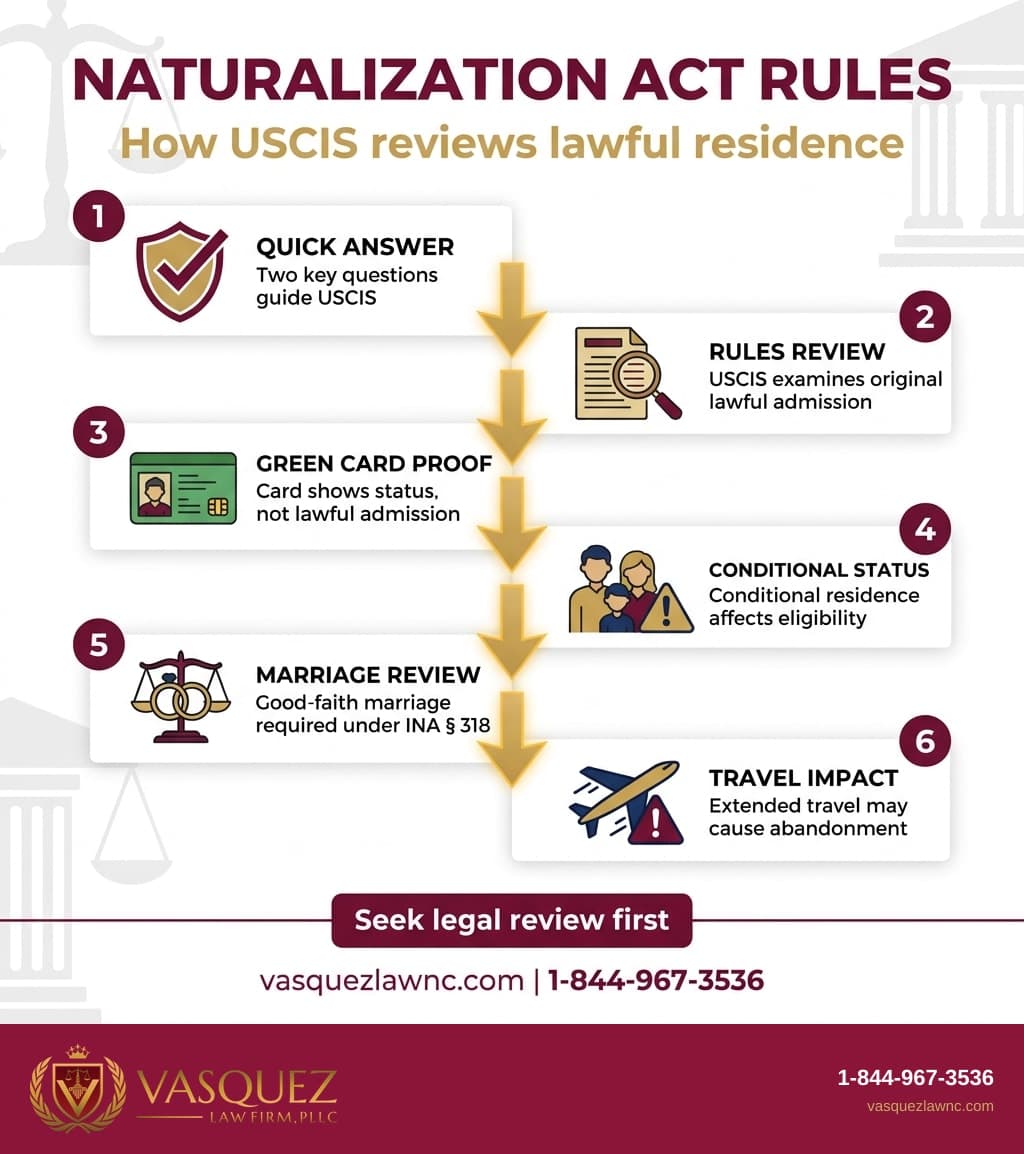
Naturalization Act rules in a modern citizenship case focus on two questions. Was the person lawfully admitted for permanent residence? Did the person keep that status through naturalization? Under INA § 318, a green card alone may not answer those questions. USCIS can review the original immigration basis. It can also review travel, marriage evidence, and removal history during a Form N-400 case.
- Lawful permanent residence generally must be established, with exceptions for certain U.S. nationals and members of the U.S. armed forces.
- Conditional residents usually need removed conditions.
- Extended travel can raise abandonment concerns.
- Pending removal proceedings generally block a grant of naturalization, except for certain military-service applications.
How do Naturalization Act rules review lawful permanent residence?
A person may have a valid Form I-551. Even so, USCIS may examine the original admission or adjustment process. Lawful admission for permanent residence means that the person legally received permanent resident status under the immigration law that applied at that time. INA § 318 requires an applicant to show that lawful admission. The rule applies to the law in effect when the person was admitted or adjusted status. USCIS Policy Manual, Volume 12, Part D, Chapter 2 explains this requirement. It generally concerns the first admission as a permanent resident. It does not generally concern later reentries.
“If the LPR status was not lawfully obtained for any reason, regardless of whether there was any fraud or willful misrepresentation by the applicant, the applicant is ineligible for naturalization even if the applicant was admitted as an LPR and possesses a Permanent Resident Card (PRC) (Form I-551).”
This review can involve the immigrant petition. It can involve adjustment eligibility, an immigrant visa, or an inadmissibility issue. INA § 212(a) lists inadmissibility grounds. INA § 245(a) governs adjustment of status. If the waiver was never approved, that fact may matter when USCIS reviews citizenship eligibility.
People applying nationwide can seek guidance about federal immigration representation for citizenship matters before filing. A careful review is especially useful when the permanent resident case involved prior immigration history. It can also help when the case involved a family petition or a change in marital status.
What does a green card prove?
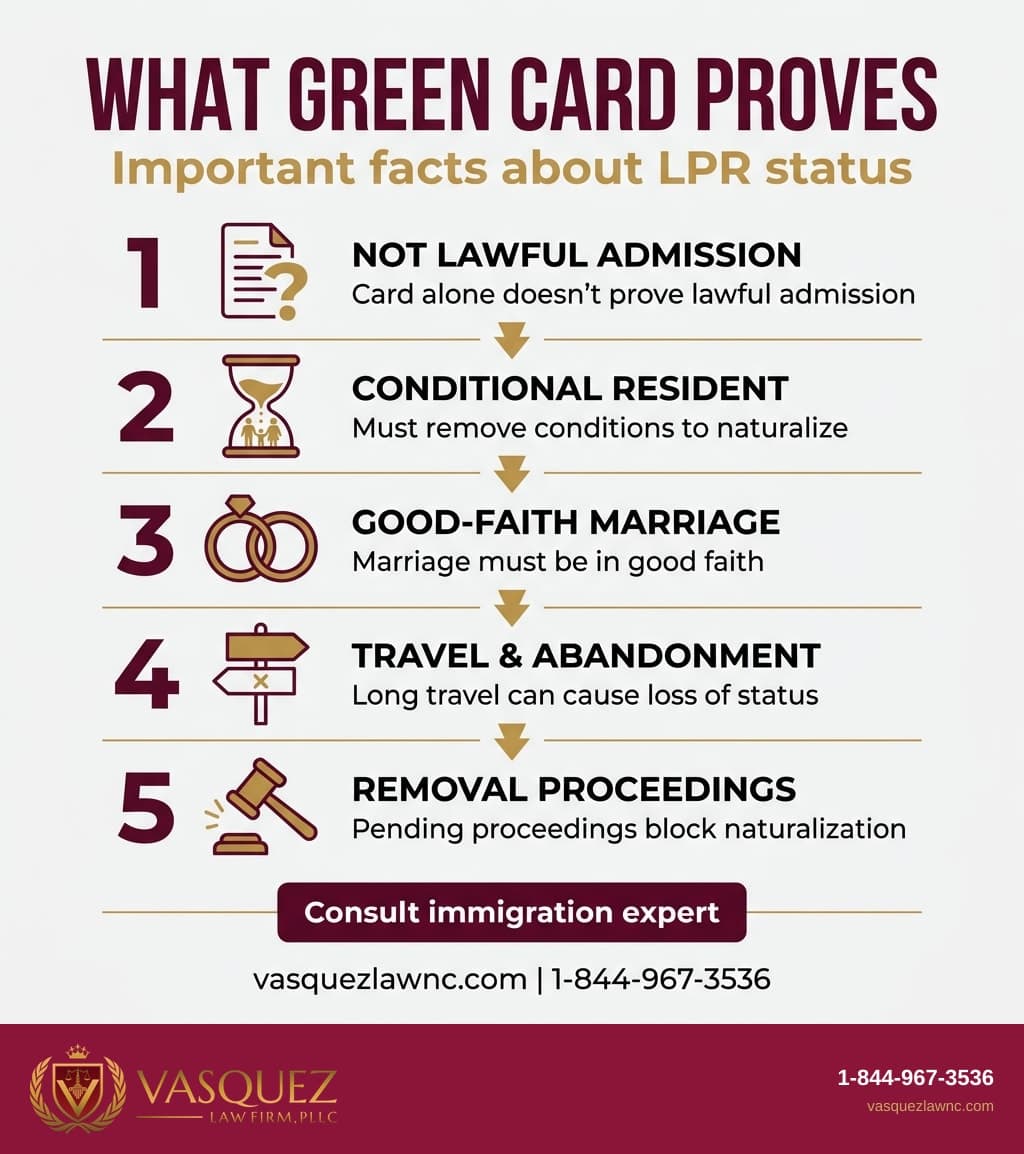
A green card is evidence of LPR status. LPR means lawful permanent resident. USCIS states that a card alone is not enough to establish lawful admission for permanent residence under all applicable provisions. An expired, lost, or stolen card may require Form I-90 for replacement evidence.
Can conditional residence affect naturalization eligibility?
A person admitted through a marriage that was less than two years old may receive conditional permanent residence. Conditional permanent residence is a temporary form of permanent resident status. It includes conditions that the person must later remove. USCIS generally treats a conditional resident as ineligible for naturalization until the conditions are removed. The usual petition for this purpose is Form I-751, Petition to Remove Conditions on Residence.
USCIS may adjudicate Form I-751 during a naturalization proceeding in some circumstances. The Policy Manual also addresses incorrect admission classifications. If a person was coded as conditional when the marriage had already passed the relevant threshold, that coding error does not itself make the admission unlawful.
Marriage-based cases also require a good-faith marriage at the beginning. A good-faith marriage is a marriage entered with a real intent to build a life together. USCIS reviews whether the spouses intended to establish a life together when they married. A marriage that was not entered in good faith can affect the lawful admission analysis under INA § 318.
Why can USCIS review the underlying marriage?
Naturalization does not erase questions about the original basis for permanent residence. USCIS may review information discovered during or after the I-751 process. Evidence of an invalid marriage can affect a citizenship application. This includes a prior marriage that was not terminated. The issue is especially important when the green card depended on that marriage.
Can travel outside the United States lead to green card abandonment?
One yearly visit to the United States does not preserve permanent resident status for someone who lives abroad. Abandonment means giving up the intent to keep the United States as a permanent home. USCIS evaluates the total circumstances. These circumstances include the length and purpose of travel. They also include intent to return and continuing ties in the United States. The core question is whether the person objectively intended to keep the United States as a permanent home.
“A single visit every year to the United States, for those residing outside of the United States, does not preserve LPR status.”
Relevant ties can include resident tax filing. They can include U.S. property or business affiliations. They can also include a driver license with a U.S. address and immediate family in the United States. USCIS may review foreign employment, property, and family connections. It may review voting abroad as well. Frequent or long trips may also matter.
Cases we handle often reveal that applicants have travel records. They may lack documents showing continued U.S. residence. Tax returns, leases, employment records, school records, and proof of family ties can help explain the facts. A reentry permit may support intent to return. It does not automatically preserve LPR status. It also does not guarantee admission.
What evidence can support continued residence?
- Federal and state tax returns filed as a resident.
- U.S. housing, property, or business records.
- Current or recent U.S. work or education evidence.
- Records showing close family ties in the United States.
- Travel evidence explaining a temporary purpose abroad.
For more context about citizenship planning, review our naturalization and citizenship pathways guide.
What happens if removal proceedings are pending during naturalization?
An applicant in removal proceedings generally cannot receive naturalization. Removal proceedings are the court process that may decide whether a person can remain in the United States. The exception covers certain military-service applications. A final removal order also bars naturalization unless a stated exception applies.
Where USCIS determines that an applicant failed to establish continued LPR status, the Department of Homeland Security may issue a Notice to Appear, Form I-862, under applicable guidance. A Notice to Appear, or NTA, is the document that starts removal proceedings. USCIS then denies the naturalization application. An immigration judge makes the final determination about abandonment in removal proceedings. LPR status is not lost until a removal order becomes final.
Why does a Notice to Appear matter?
The Policy Manual explains that an NTA is treated as a warrant of arrest for INA § 318 purposes, except in the Ninth Circuit. If removal proceedings are pending when USCIS decides the naturalization application, USCIS denies the application under INA § 318. USCIS does this instead of granting citizenship on the merits.
If a Form N-400 raises a question about travel, a prior petition, or removal proceedings, seek a free evaluation before making avoidable statements. Se Habla Español.
Call 1-844-967-3536.
What should you check before filing Form N-400?
A practical review starts with the exact basis for permanent residence. Gather the approval notices, petitions, visa records, and prior immigration filings connected to that basis. Compare the facts in those records with the information planned for Form N-400. This comparison can reveal missing details or conflicting answers before filing.
- Identify the date and category of LPR admission or adjustment.
- Review whether an I-751, waiver, or other required filing was completed.
- List all trips outside the United States and their purposes.
- Collect documents showing a continuing U.S. home and resident tax treatment.
- Review any Notice to Appear, removal order, or prior immigration court record.
- Confirm that answers on Form N-400 match the documentary record.
USCIS may request residences, travel, employment information, and other evidence through a Request for Evidence. A Request for Evidence, or RFE, is a notice asking for more proof. Failure to respond timely to an RFE will result in denial of the naturalization application for failure to meet the burden of proof. The burden of proof is the applicant's duty to provide enough evidence to show eligibility. The USCIS Policy Manual provides the agency framework for these issues.
Which Naturalization Act mistakes can put a citizenship case at risk?
An application can become harder when a person assumes the green card ends every review. The modern Naturalization Act analysis described by USCIS can reach facts from the original permanent residence case. Accuracy and preparation matter more than a quick filing. A complete review can help identify problems before they affect the application.
- Assuming a green card settles lawful admission: Review the original basis and any waiver issue.
- Claiming nonresident alien tax status: Voluntarily claiming that status to qualify for special income tax exemptions, or failing to file federal or state income tax returns because you consider yourself a nonresident alien, raises a rebuttable presumption of abandonment. A rebuttable presumption is an assumption that evidence can overcome.
- Ignoring frequent travel: Prepare records showing the temporary purpose and U.S. ties.
- Forgetting conditional residence: Confirm I-751 requirements before relying on the green card.
- Giving incomplete travel history: Reconcile passport stamps, applications, and employment records.
- Filing while removal proceedings are pending: Obtain legal review of the procedural posture.
- Waiting on an RFE: Respond by the deadline on the notice with organized evidence.
The applicant bears the burden to establish eligibility.
How does the federal naturalization framework apply nationwide?
The central statute here is INA § 318. It is supported by 8 C.F.R. § 316.2, which addresses eligibility for naturalization. The federal framework allows USCIS to examine whether LPR status was lawfully obtained and maintained.
Some applicants have special facts. Refugees, asylees, certain Cuban Adjustment Act applicants, derivatives, and applicants relying on INA § 245(i) can have distinct questions. Those questions may concern the effective date or basis of LPR status. The Policy Manual identifies limited situations where USCIS may consider an applicant lawfully admitted despite an administrative error. An administrative error is a mistake made by an agency or official.
For example, an applicant whose only issue was failure to pay the statutory sum required by INA § 245(i) may, in USCIS discretion and if all other requirements are met, submit the sum with Form I-485 Supplement A during naturalization. That exception is fact-specific. Our immigration services for green card and citizenship cases can help applicants organize questions before filing.
Frequently Asked Questions
Does a green card guarantee naturalization?
No. USCIS explains that a Permanent Resident Card is evidence of LPR status, but the card alone is insufficient to establish lawful admission for permanent residence. Under INA § 318, USCIS may review whether the original immigrant admission or adjustment complied with applicable law. The applicant carries the burden to establish eligibility for citizenship.
Can USCIS review my marriage-based green card during naturalization?
Yes. Where LPR status was based on marriage, USCIS may review whether the marriage was valid and entered in good faith. The key question is whether the spouses intended to establish a life together when they married. Information connected to Form I-751 can also raise questions during a naturalization review.
Does returning once each year preserve green card status?
No. USCIS states that one annual visit does not preserve LPR status for a person residing outside the United States. Officers consider travel length and purpose, intent to return, and continuing U.S. ties. Resident tax filings, property, family, work, and education records may be relevant to that factual review.
Does a reentry permit guarantee that I kept LPR status?
No. USCIS explains that a reentry permit may demonstrate an intent to return, but it does not automatically preserve LPR status or guarantee reentry. The agency assesses the totality of circumstances. An applicant should keep records that show the trip remained temporary and that the United States remained the intended permanent home.
What if USCIS believes I abandoned permanent residence?
USCIS may determine that the applicant failed to establish maintained LPR status and the Department of Homeland Security may issue a Notice to Appear under applicable guidance. USCIS then denies the naturalization application. An immigration judge makes the final abandonment determination in removal proceedings, and LPR status is not lost until a removal order becomes final.
Can USCIS grant naturalization while removal proceedings are pending?
Generally, no. USCIS states that it may not grant naturalization while removal proceedings are pending, except for certain military-service applications. If proceedings are pending at the time of decision, USCIS denies the application under INA § 318. This procedural issue should be assessed before an applicant submits or continues an N-400 case.
Can a required waiver be filed during naturalization to fix an old issue?
USCIS states that an unlawful LPR admission or adjustment cannot be cured by submitting Form I-601 or Form I-602 during a naturalization proceeding. The analysis depends on whether the applicant was lawfully admitted for permanent residence when that status was granted. A careful records review can identify whether another rule or exception is relevant.
What records should I review before filing Form N-400?
Review records related to the original immigrant petition or adjustment, any I-751 filing, travel history, tax treatment, U.S. residence, employment, and family ties. Also review any Notice to Appear or immigration court records. Consistent and complete information helps an applicant respond if USCIS requests additional evidence during the naturalization process.
About Vasquez Law Firm
Vasquez Law Firm provides immigration representation with compassionate, determined advocacy. The firm’s Yo Peleo® approach means taking client concerns seriously. It also means explaining options in clear language. Our bilingual support staff assists clients who prefer Spanish, and Se Habla Español.
Attorney William J. Vasquez leads the firm’s immigration work. The firm serves immigration clients nationwide. It meets immigration clients in Raleigh, NC and Orlando, FL. A free case review can help identify documents and questions to address before filing.
Sources and References
Naturalization Act questions can involve travel, green card history, and detailed federal records. Contact Vasquez Law Firm for a free, confidential case review. Se Habla Español.
Call 1-844-967-3536.
For how Vasquez Law Firm can help, see our naturalization page.
Reviewed by Attorney Vasquez, Managing Attorney


William Vasquez
Founder & CEO, Vasquez Law Firm, PLLC
William Vasquez is the founder and CEO of Vasquez Law Firm, PLLC, a results-driven firm specializing in immigration, criminal defense, personal injury, and workers' compensation. A U.S. Air Force veteran and recipient of the Joint Service Achievement Medal, William is dedicated to fiercely fighting for his clients' rights.
Related Legal Services
Need legal help? Learn more about how our immigration attorneys can help, or contact us for a free evaluation.
You can also visit our NC immigration team for more information.