BIA Vacates Bond Order, Remands for New Decision
By William J. Vásquez · Updated November 12, 2026
The BIA vacated a $15,000 bond order and remanded for a new decision addressing disputed flight-risk facts. Contact our immigration team for a free evaluation.
Published on November 10, 2026· Updated November 12, 2026
Talk to an immigration attorney
Free call. A clear plan for your case.
Free & confidential · Se habla espanol · Mon-Fri 8am-7pm, Sat 9am-2pm (ET)
Have questions? Talk to an attorney - free evaluation.
Call 1-844-967-3536Worried how the latest immigration news affects you?
Schedule a confidential case review with an immigration attorney - know exactly where you stand.
USCIS Case Status
Check your USCIS case status
Enter your receipt number and get the official status. Free, no registration.
BIA Vacates Bond Order, Remands for New Decision
A person in immigration detention may have close family ties, a stable home, and a pending protection claim. Those facts may still carry little weight if the government disputes them and the record does not support them. The Board of Immigration Appeals vacated the Immigration Judge’s decision and remanded the record for the entry of a new decision because the Immigration Judge’s decision on flight risk was insufficient for appellate review.
Need legal help?
Immigration in NC and FL. Personal injury and workers compensation across NC. Criminal defense in select NC counties depending on the charge (DWI in 12 counties), and traffic tickets in 20 NC counties. Tell us your county and we will tell you exactly what we can do.
The ruling in Matter of G-M-T-, 30 I&N Dec. 228 (BIA 2026), addresses how Immigration Judges evaluate disputed facts in bond proceedings and explain their findings for appellate review by the BIA. It gives detained immigrants and their families a clear practical message. Evidence matters when the government challenges a claim. Our immigration attorneys help families organize records for serious immigration court matters.
Call for a Free Evaluation to discuss how the ruling may affect your custody matter.
Legal disclaimer: This article provides general legal information, not legal advice for any individual case. Immigration bond outcomes depend on the record, custody authority, and facts before the Immigration Judge.
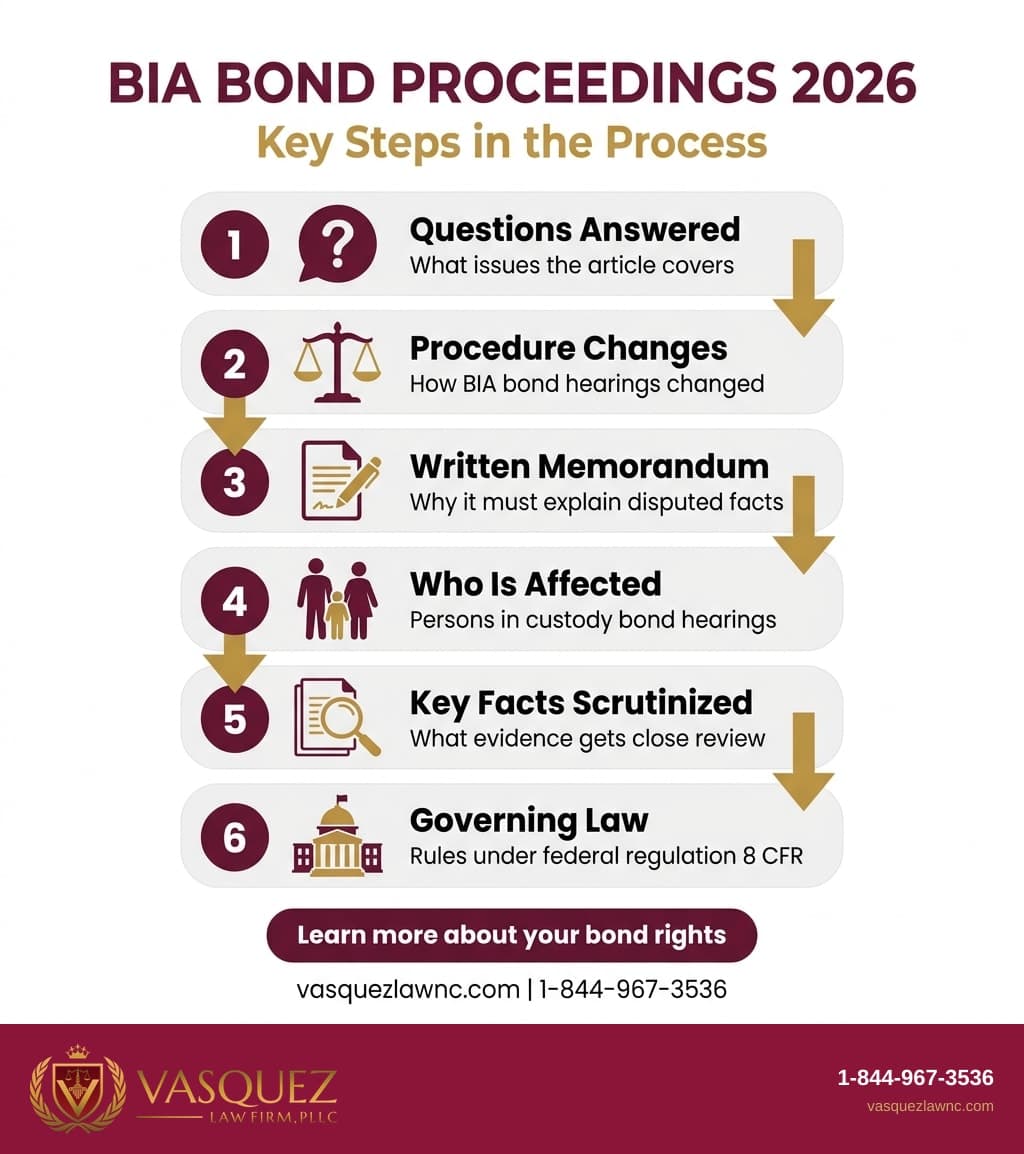
What changed in BIA bond proceedings?
The Board of Immigration Appeals vacated the Immigration Judge's order releasing the respondent on bond and remanded the record. It did so because the Immigration Judge's written bond memorandum did not fully resolve disputed facts related to flight risk.
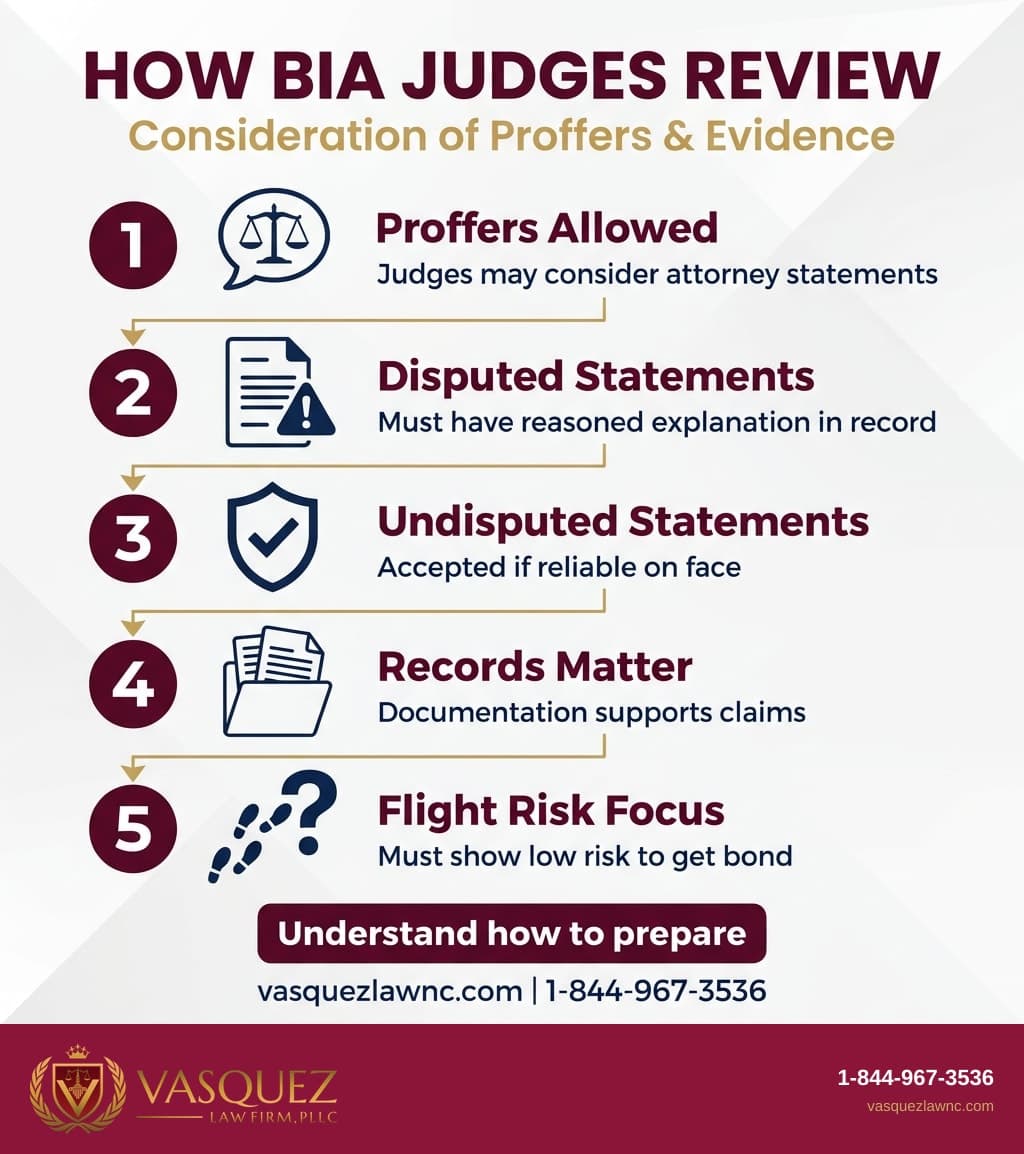
The main issue was not whether lawyers may make a proffer. A proffer is an attorney's presentation of facts without live testimony. The Board concluded that Immigration Judges may consider proffers in custody redetermination proceedings under 8 C.F.R. § 1003.19(d). A custody redetermination proceeding is a hearing about whether a detained person should remain in custody or be released.
Where a party offers an alternative proffer concerning a fact material to the bond determination or challenges a proffer as uncorroborated or inconsistent with information in the record, the Immigration Judge should address the alternative proffer or challenge and provide, in the bond memorandum, a reasoned explanation for the weight given to each account.
The decision separated two types of statements. One is an undisputed statement that appears reliable on its face. The other is a disputed statement with little support. In this case, the Department of Homeland Security challenged claims about the respondent's taxes, business, children, and protection application. The Immigration Judge accepted several claims. However, the judge did not explain why those claims outweighed the government's objections.
Why the written memorandum matters
Bond hearings are informal. They are often brief. Even so, an appealed custody decision needs enough facts and legal analysis for the BIA to review it. The Board said the explanation should appear in the bond memorandum. It does not have to be given in full detail at the hearing.
This rule keeps the hearing efficient. It also requires a record that another decision-maker can review. Documents submitted before or during the hearing may become decisive. That is especially true when each side presents a different account of important facts.
Who is affected by this BIA bond proceedings decision?
Matter of G-M-T- concerns people in custody redetermination proceedings. These people seek release on bond. They must show that they are not a flight risk. A flight risk is a concern that a person will not appear for future immigration proceedings. The respondent bears the burden of establishing that he is not a flight risk in these proceedings.
The case matters most when the government disputes a person's family ties, address, work history, tax compliance, immigration relief, or sponsor support. An attorney's statement may still be considered. But a disputed claim may receive little weight when records do not support it. The same may happen when other important information contradicts it.
What facts drew scrutiny?
The BIA found the Immigration Judge did not clearly err in several findings supported by the record. Those findings included that the respondent entered without inspection in 2011, had no criminal convictions, had a fixed address, and owned two vehicles. The Board focused instead on disputed facts that lacked a reasoned explanation.
For example, the respondent said he had paid taxes since 2012. The record did not include tax returns. The respondent also gave inconsistent descriptions of children and their immigration status. Character letters described three children. However, the record did not include objective proof, such as birth certificates or school records.
The Board also reviewed the Immigration Judge's reliance on the respondent's proffer that he had filed a Form I-589; no copy of the application was submitted in the bond proceedings. This is the application used for asylum and related protection claims. Counsel clarified that the claim sought statutory withholding of removal and Convention Against Torture protection. DHS argued that these forms of protection do not provide a lawful pathway to legal residence in the United States. The BIA required a fuller explanation of how the application affected flight risk.
In our experience, the cases we handle often depend on the records behind claims about family, work, and immigration history. Those records should answer the government's specific objections.
A proposed sponsor may matter. The Board, however, drew an important line. A person who only offers personal support does not take on the enforceable financial or legal duties of a visa sponsor or bond obligor. A bond obligor is a person who accepts legal duties connected to a bond. The type of proposed help also matters. This includes how the help will support compliance with court requirements. Those details can affect the value of the help in an immigration bond hearing and the analysis of immigration bond sponsor requirements.
What law governs immigration bond hearings?
Federal regulation 8 C.F.R. § 1003.19(d) allows an Immigration Judge to base a custody or bond decision on information available to the judge. The judge may also use information presented by the person in proceedings or the Department of Homeland Security. This broad rule explains why documents, proffers, and other useful information may be considered in a bond hearing.
The law also separates factual findings from legal judgment on appeal. Under 8 C.F.R. § 1003.1(d)(3)(i), the BIA reviews Immigration Judges' factual findings, including credibility findings, for clear error. Clear-error review does not permit reversal merely because the BIA would weigh the evidence differently; the BIA must be firmly convinced that a factual mistake occurred. Under 8 C.F.R. § 1003.1(d)(3)(ii), it reviews legal questions, discretion, and judgment de novo. De novo means the BIA considers those issues anew.
How flight risk is evaluated
Matter of Guerra identifies factors that may relate to flight risk. They can include family ties and employment history. The BIA's November 10 decision does not turn every statement into a document requirement. Instead, it explains what should happen when an opposing party challenges an important proffer. The challenge may say the proffer is inconsistent or lacks support. In that situation, the Immigration Judge should assess reliability and explain the weight given to the statement as part of the flight risk determination.
An Immigration Judge may credit a proffer without documentary support.
That sentence is important. The BIA kept flexibility for fast-moving bond matters. It also required an explanation based on the record when the dispute is important. For related detention developments, readers can also review our analysis of a BIA bond and detention decision.
The difference between asylum and withholding of removal may also matter. The BIA explained that the respondent's claimed forms of protection had high burdens of proof. The Board also noted that the respondent did not claim to have a family-based path to lawful status. A pending application by itself may not show a strong reason to appear. The record must support the application's likely effect on flight risk.
Request a Free Evaluation for help organizing records before an immigration bond hearing.
How can I prepare for a bond hearing after this decision?
Start with the exact facts that support release. Then match each important fact with reliable records. A well-organized file helps the Immigration Judge assess flight risk. It also helps preserve the reasoning needed for any appeal. An immigration bond hearing worksheet can help organize the evidence and identify missing records.
Build a claim-by-claim record
- Gather proof of a fixed address, including lease records, utility records, or other residence documents.
- Collect employment and business records that accurately support work history and lawful operations.
- Include tax records if tax compliance is offered as a favorable factor.
- Use birth certificates, school records, or comparable evidence when relying on children or family ties.
- Submit a copy of any Form I-589 or other pending immigration filing relied upon in the bond request.
- Ask each proposed sponsor to describe concrete help with housing, transportation, communication, and court attendance.
Consistency matters as much as the number of documents. Review written declarations, sponsor letters, and oral proffers. Look for conflicts about dates, relationships, immigration status, or where a person lives. If the Department of Homeland Security raises an objection, answer it directly. Use records or a careful explanation.
Our immigration legal team can explain how a documented bond presentation fits the facts of a particular case. Se Habla Español. Request a free immigration evaluation before presenting a disputed claim to immigration court.
What should I watch after this BIA bond proceedings ruling?
The remanded case now returns for more bond proceedings and a new decision. The Immigration Judge must consider the government's challenges. The judge must assess disputed information in the full record. The judge must explain the weight given to each account. The judge must then decide whether the respondent met the burden of showing no flight risk.
What's Your Immigration Situation?
Answer 3 questions - we'll tell you your options
Question 1 / 3
What best describes your situation?
Keep Reading
For other cases, the practical point is immediate. Counsel and families should expect close attention to contested proffers. A careful bond memorandum can show why one account is more reliable than another. It can identify the documents that support the account. It can also make the appellate record easier to review.
One important question remains for the respondent on remand. Does the total record establish that he does not present a flight risk? Readers can monitor published immigration adjudication materials through the Executive Office for Immigration Review decision. They can also consult the USCIS Policy Manual for separate USCIS benefit guidance.
Immigration law depends on the facts of each case. A free case review with Vasquez Law Firm can help you assess the records relevant to your custody matter. We meet immigration clients in Raleigh, NC and Orlando, FL. Legal disclaimer: A consultation does not guarantee release, bond, or any immigration outcome.

Frequently Asked Questions
Can an Immigration Judge consider an attorney's proffer at a bond hearing?
Yes. The BIA interpreted 8 C.F.R. § 1003.19(d) as allowing Immigration Judges to consider proffers in custody redetermination proceedings. A proffer can be especially useful because bond hearings are preliminary and less formal. Its weight depends on reliability, the full record, corroborating materials, and whether the opposing party disputes the assertion.
Does every bond-hearing fact need documentary proof?
No. Matter of G-M-T- states that an Immigration Judge may credit a proffer without documentary support. But when a material proffer is challenged as uncorroborated or inconsistent, the judge should evaluate its reliability and explain the weight assigned to both sides. Records can be vital in that disputed setting.
Who has the burden to show there is no flight risk?
The respondent bears the burden in the custody determination proceedings discussed by the BIA. That means the detained person must present reliable information supporting release. Family ties, work history, a fixed address, and a credible sponsor may be relevant, but the Immigration Judge can evaluate how strongly each factor supports future appearance.
Can a pending Form I-589 help in an immigration bond hearing?
It can be relevant, but the BIA required a reasoned explanation of how the pending application affects the person's incentive to appear. In this case, the application sought withholding of removal and Convention Against Torture protection. DHS argued that neither form provides a lawful pathway to legal residence in the United States. The Board explained that both require high burdens of proof.
What makes an immigration bond sponsor more helpful?
A sponsor's credibility and the concrete support offered can affect flight-risk analysis. The BIA explained that a person who only offers support does not assume the enforceable duties of a visa sponsor or bond obligor. Letters should therefore identify practical support that can help a respondent comply with immigration proceedings.
What happened to the $15,000 bond in Matter of G-M-T-?
The BIA vacated the Immigration Judge's order releasing the respondent on a $15,000 bond. It remanded the case for additional bond proceedings and a new decision. The Immigration Judge must resolve the disputed factual matters, explain the weight assigned to competing accounts, and then determine flight risk based on the record as a whole.
Sources
Contact Us for Help with BIA bond proceedings
Reviewed by Attorney Vasquez, Managing Attorney

William Vasquez
Founder & CEO, Vasquez Law Firm, PLLC
William Vasquez is the founder and CEO of Vasquez Law Firm, PLLC, a results-driven firm specializing in immigration, criminal defense, personal injury, and workers' compensation. A U.S. Air Force veteran and recipient of the Joint Service Achievement Medal, William is dedicated to fiercely fighting for his clients' rights.
Related Legal Services
Need legal help? Learn more about immigration lawyers in North Carolina, or contact us for a free evaluation.
You can also visit immigration legal services throughout NC for more information.