BIA Reverses Asylum Grant Over Credibility in 2026
A BIA asylum decision denied relief after late claim changes. See how credibility and evidence affect your case, then request a free evaluation today.
Published on October 29, 2026· Updated October 29, 2026
Talk to an immigration attorney
Free call. A clear plan for your case.
Free & confidential · Se habla espanol · Mon-Fri 8am-7pm, Sat 9am-2pm (ET)
Have questions? Talk to an attorney - free evaluation.
Call 1-844-967-3536Worried how the latest immigration news affects you?
Schedule a confidential case review with an immigration attorney - know exactly where you stand.
USCIS Case Status
Check your USCIS case status
Enter your receipt number and get the official status. Free, no registration.
BIA Reverses Asylum Grant Over Credibility in 2026
On September 9, 2026, the Board of Immigration Appeals reversed an Immigration Judge's grant of asylum. The Board, also called the BIA, found that the applicant's late-filed allegations changed the substance of his case. The BIA asylum decision, Matter of S-N-K-C-, 30 I&N Dec. 207 (BIA 2026), shows why every asylum form, declaration, and hearing statement must tell a consistent and supportable story.
Seeking Asylum in the US?
You must file within 1 year of arrival. Our attorneys can help build your case.
For a person seeking safety in the United States, an omission can become the central issue at a merits hearing. A merits hearing is the hearing where an Immigration Judge decides whether a person qualifies for protection. This decision does not mean that an applicant can never add details. It draws a critical line between explaining an existing claim and presenting a materially different account shortly before the hearing. People with active asylum matters can seek guidance from our immigration attorneys. They can help organize evidence and review filings before testimony.
Legal information only: This article provides general information. It is not legal advice for any individual case. Immigration outcomes turn on each person's record, evidence, and procedural history. A nationwide immigration legal team can review the facts of a particular case.
What did the BIA asylum decision change in 2026?
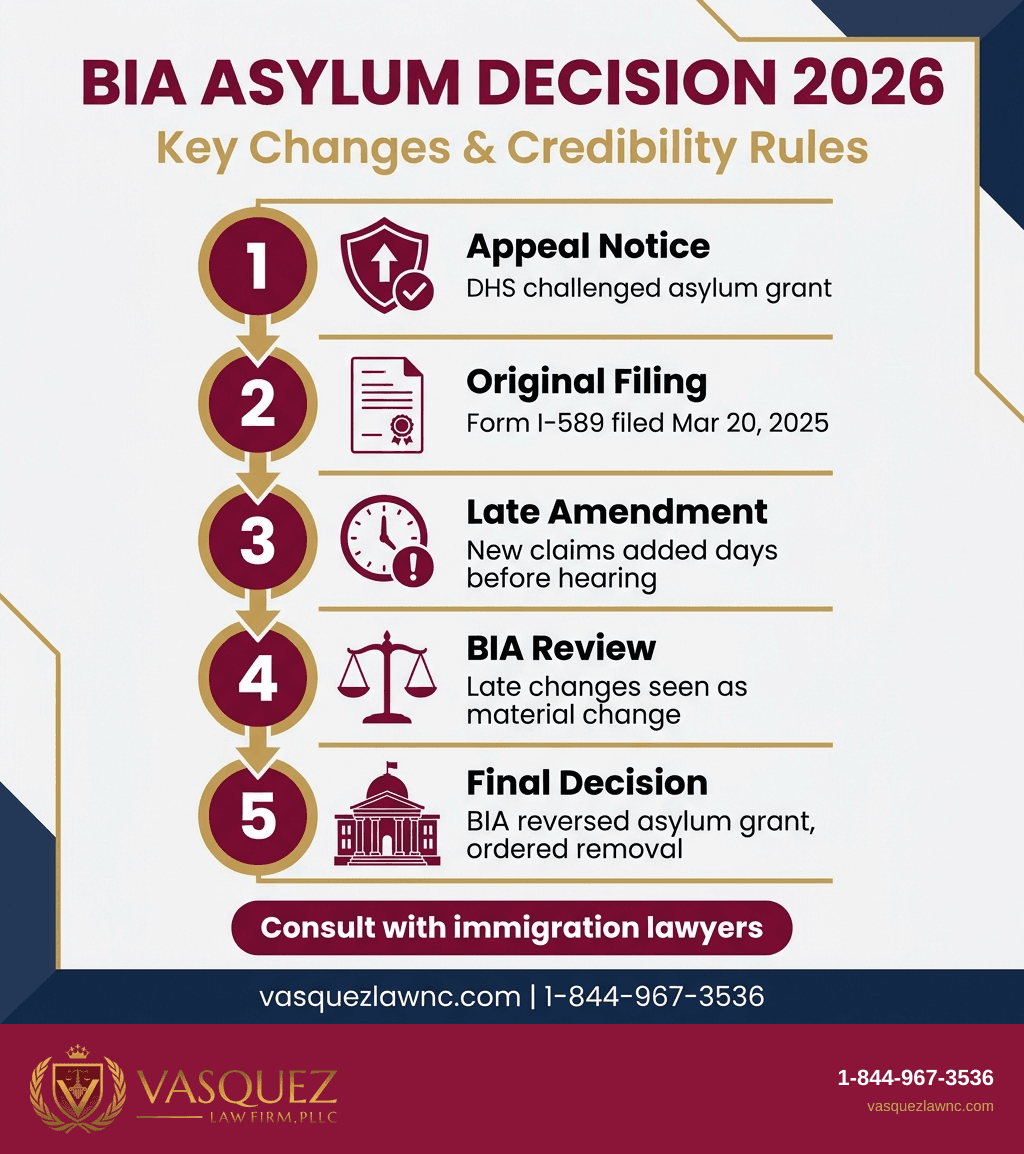
Pursuant to Order No. 7273-2026, dated October 27, 2026, the Attorney General designated the Board’s decision in Matter of S-N-K-C- (BIA Sep. 9, 2026), as precedent in all proceedings involving the same issue or issues. The Board had decided the appeal on September 9, 2026. The appeal followed the Department of Homeland Security's challenge to an Immigration Judge's August 21, 2025, asylum grant. The Department of Homeland Security is also called DHS.
The respondent was a Turkish citizen. A respondent is the person responding to an immigration case. He filed Form I-589 on March 20, 2025. He signed a resubmitted application on April 23. On both forms, he answered no to whether he had been accused, charged, arrested, detained, interrogated, convicted, sentenced, or imprisoned outside the United States.
Days before the merits hearing, he filed a declaration and amended application. He claimed five detentions in Turkey beginning in 2016. His new account included political social-media activity and physical mistreatment in detention. It also included a personal encounter with the Turkish President. He claimed that this encounter led to harm ordered by the President's nephew.
Where a declaration and amended asylum application filed shortly before the merits hearing do not merely add details but completely change the nature and substance of the respondent’s original claim, and the respondent does not adequately explain the prior omission, the Immigration Judge clearly errs in finding the respondent credible.
The Board found that the late allegations differed dramatically from the original filing. It sustained the government's appeal. It vacated the asylum grant. It denied asylum, withholding of removal, and Convention Against Torture protection. It ordered removal to Turkey.
Why did the timing matter?
The Board focused on both the content and the timing. The applicant signed the original application as true and correct. He then signed the amended filing in the same way. The Board concluded that the record did not support blaming the respondent's attorney for the omission. It also concluded that the applicant had not adequately explained why core allegations appeared shortly before the hearing.
Who does the BIA asylum decision reach, and who should pay attention?
This BIA asylum decision concerns respondents in immigration proceedings. Their written asylum claims differ materially from later declarations or testimony. The decision applies to the credibility issue described in the decision. It is especially important when a late filing does more than clarify a prior account.
The decision does not create a rule that every omission defeats an asylum case. The Board recognized that an applicant may provide additional detail during testimony. The question is whether the totality of the circumstances supports credibility. The totality of the circumstances means looking at all relevant facts together. The question becomes important when a later account changes the nature and substance of the original claim.
Applicants should pay close attention when a Form I-589, declaration, credible-fear account, supporting letter, or hearing testimony describes key events differently. Detention, arrest, political activity, physical harm, threats, family relationships, locations, and dates can all be material. They can help explain why a person fears persecution or torture.
The Board also emphasized corroboration. Corroboration means independent evidence that supports important parts of a claim. In this case, letters from friends and relatives received cautious treatment. The writers were interested parties. They were also unavailable for cross-examination. Cross-examination is questioning by the other side in a case. The Board found no independent evidence of the applicant's claimed political activity or social-media presence.
Corroboration is especially important where testimony from the respondent or other key witnesses lacks a strong foundation or otherwise is not entirely persuasive, even when issues with the testimony are not sufficient for an adverse credibility finding.
In our experience, the cases we handle often turn on whether a person can reconcile early filings with later details. That review should happen before testimony. Early review can prevent an avoidable inconsistency.
What does this mean for family evidence?
Family and friend letters can still matter. They are stronger when they identify how the writer knows the facts. They should also match the rest of the record. A letter may not independently verify an event if it only repeats what an applicant later told the writer. This BIA asylum decision highlights the value of preserving records that existed close to the claimed events.
What asylum law did the Board apply in this decision?
The Board analyzed credibility under INA sections 208(b)(1)(B)(iii) and 241(b)(3)(C). These sections are codified at 8 U.S.C. §§ 1158(b)(1)(B)(iii) and 1231(b)(3)(C).
As background, asylum is humanitarian protection for a person who meets the legal requirements for protection in the United States. Withholding of removal is a separate form of protection. It falls under INA section 241(b)(3)(A), 8 U.S.C. § 1231(b)(3)(A). Convention Against Torture protection is governed in part by 8 C.F.R. § 1208.16(c) and 8 C.F.R. § 1208.18(a).
The Board cited 8 C.F.R. § 1003.1(d)(3)(i). This regulation addresses the Board's review of an Immigration Judge's factual findings. It includes credibility findings. The Board concluded that the Immigration Judge clearly erred by finding the respondent credible. The Board relied on the substantial differences between the original application and the later account.
The decision also relied on Matter of A.J. Valdez and Z. Valdez, 27 I&N Dec. 496. That decision recognizes a strong presumption. A person who signs an immigration application is presumed to know and agree to its contents. This presumption does not prevent corrections. It does make careful review before signing especially important.
For removal defense planning, the legal lesson is practical. A case must be accurate at every stage. An attorney can identify gaps. An attorney can correct genuine errors through an appropriate filing. An attorney can also help the applicant explain the record truthfully. The applicant must not invent or overstate facts.
How is an appeal different from a new asylum application?
A Board of Immigration Appeals appeal reviews an Immigration Judge's decision. In Matter of S-N-K-C-, DHS appealed an asylum grant. The Board reversed it after assessing the credibility finding and corroborating evidence. The BIA asylum decision therefore warns people preparing for hearings. It also warns people defending a favorable decision on appeal.
What should you do if your asylum account has changed?
Start by reading every immigration filing you submitted. This includes Form I-589, declarations, prior affidavits, hearing exhibits, and interview records. Compare each document with the account you expect to give under oath. Flag omissions and inconsistencies involving the reason for harm. Also flag issues involving the people involved, prior detention, political activity, and physical injuries.
Next, gather records that independently support important facts. Depending on the claim, these records may include contemporaneous messages, medical records, photographs, police or court documents, identity records, political materials, and social-media archives. They may also include documents showing when and how a witness learned about an event. Do not alter documents. Do not create evidence after the fact.
Then prepare a truthful explanation for each difference. A correction is not the same as a contradiction. The explanation must fit the actual record. It must include what the person signed and when the new information emerged. The BIA asylum decision makes one point clear. A late claim that changes the core narrative requires careful legal assessment.
Finally, prepare witnesses and letters with precision. Ask writers to state what they know directly. Ask them to identify the basis for that knowledge. Ask them to avoid repeating assumptions. Review filings before signing them. Do this even if another person translated, typed, or prepared the document.
Need a record review before an immigration hearing or appeal? Vasquez Law Firm offers a free evaluation for immigration matters. We meet clients in Raleigh, NC and Orlando, FL. We assist immigration clients nationwide. Request your free immigration evaluation. Se Habla Español.
What should you watch after this BIA asylum decision?
Matter of S-N-K-C-, 30 I&N Dec. 207 (BIA 2026) , addresses credibility. It applies where late submissions completely change an earlier asylum claim without an adequate explanation. Applicants and representatives should monitor how Immigration Judges and the Board apply that reasoning to later cases.
People with cases before an Immigration Judge should track hearing notices, filing instructions, and decisions in their own proceedings. The Executive Office for Immigration Review publishes Board materials.
What's Your Immigration Situation?
Answer 3 questions - we'll tell you your options
Question 1 / 3
What best describes your situation?
Keep Reading
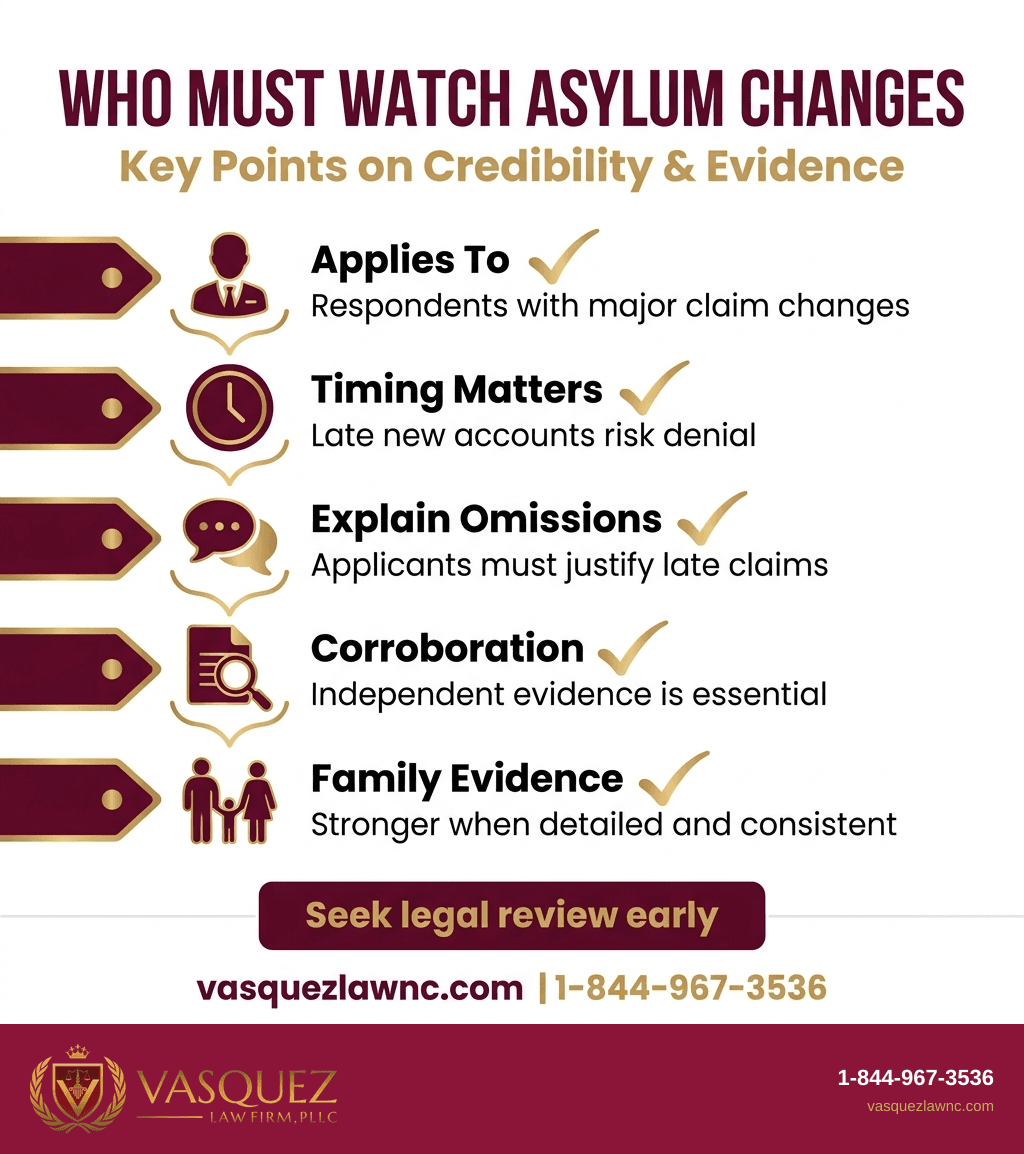
A material question for readers is whether a planned declaration merely explains an existing claim. Another question is whether it changes the claim's core substance. That distinction should be evaluated against the applicant's actual filings. It should not be decided using a generalized checklist.
For people already facing removal proceedings, prompt preparation can protect options. Our immigration court hearing guidance explains preparation issues that commonly arise before testimony. Our asylum case resource outlines the role of evidence in protection claims.

Frequently Asked Questions
What does a BIA asylum decision mean?
A BIA asylum decision is a decision by the Board of Immigration Appeals reviewing an Immigration Judge's ruling. In Matter of S-N-K-C-, the Board sustained DHS's appeal, vacated the asylum grant, and denied asylum, withholding of removal, and Convention Against Torture protection. The Board's reasoning centered on credibility and lack of sufficient independent corroboration.
Can I add details to my asylum application later?
Yes, testimony may add details to an asylum claim. But Matter of S-N-K-C- distinguishes added detail from a late account that completely changes the nature and substance of the original claim. Before filing an amendment or declaration, compare it with every earlier statement and prepare a truthful explanation for meaningful differences.
Why did the Board reject the applicant's credibility?
The Board found a dramatic difference between the original application and later allegations. The original filing denied prior detention outside the United States. The later submissions and testimony alleged five detentions, political social-media activity, physical mistreatment, and a personal encounter with the Turkish President. The Board found no adequate explanation for the prior omission.
Can letters from relatives support an asylum claim?
They can support a claim, but their weight depends on the circumstances. In this case, the Board treated letters from friends and relatives cautiously because the writers were interested parties and unavailable for cross-examination. The letters also reflected information the applicant had told them.
Did the decision affect withholding of removal and CAT protection?
Yes. The Board concluded that the applicant could not establish eligibility for withholding of removal based on testimony it found incredible. It also denied Convention Against Torture protection because the record lacked sufficient independent evidence to corroborate the incredible testimony. Each form of relief has separate legal standards, but credible evidence remained central here.
What should I review before an asylum merits hearing?
Review your Form I-589, personal declaration, prior interviews, supporting letters, and exhibits. Confirm that each document is accurate and consistent with your truthful testimony. Gather independent corroborating records where available. If you find an error or omission, get legal advice before filing a correction, because timing and the explanation for a change can affect credibility.
Sources
- Matter of S-N-K-C-, 30 I&N Dec. 207 (BIA 2026), Executive Office for Immigration Review
- USCIS Policy Manual
Legal information only: A denial, appeal, or credibility concern can have serious consequences, but no article can determine the outcome of your case. Contact Vasquez Law Firm for a free evaluation tailored to your immigration record and available options. Speak with our immigration team.
Reviewed by Attorney Vasquez, Managing Attorney

William Vasquez
Founder & CEO, Vasquez Law Firm, PLLC
William Vasquez is the founder and CEO of Vasquez Law Firm, PLLC, a results-driven firm specializing in immigration, criminal defense, personal injury, and workers' compensation. A U.S. Air Force veteran and recipient of the Joint Service Achievement Medal, William is dedicated to fiercely fighting for his clients' rights.
Related Legal Services
Need legal help? Learn more about get immigration legal help today, or contact us for a free evaluation.
You can also visit immigration lawyers serving all of North Carolina for more information.