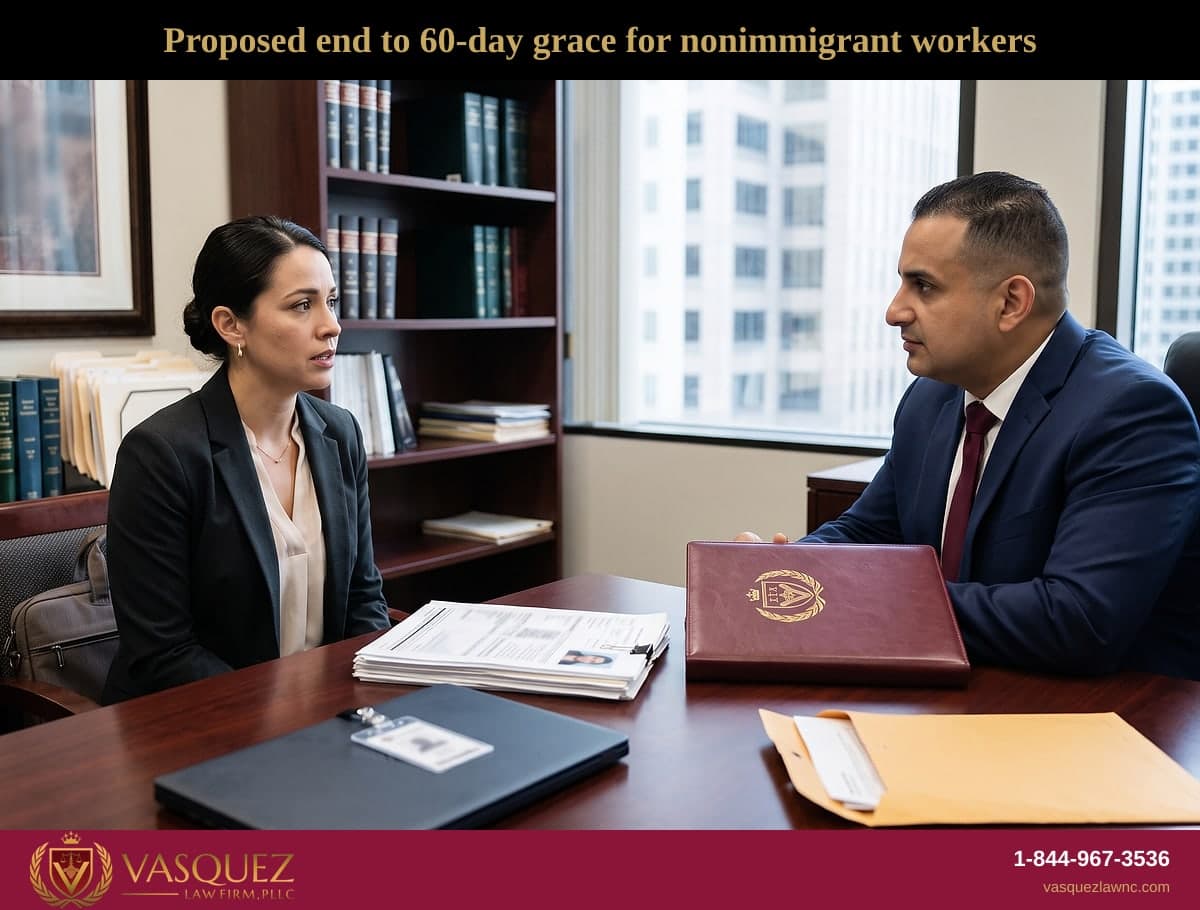
Proposed end to 60-day grace for nonimmigrant workers
By William J. Vásquez · Updated November 13, 2026
The 60-day discretionary grace period allowed certain nonimmigrant workers to remain in the U.S. after employment ended. The Department of Homeland Security proposes to eliminate this grace period, requiring immediate departure upon job loss for visa holders in E, H, L, O, and TN classifications. This change impacts thousands of workers nationwide and alters how USCIS handles status maintenance.
Published on November 13, 2026· Updated November 13, 2026
Talk to an immigration attorney
Free call. A clear plan for your case.
Free & confidential · Se habla espanol · Mon-Fri 8am-7pm, Sat 9am-2pm (ET)
Have questions? Talk to an attorney - free evaluation.
Call 1-844-967-3536Worried how the latest immigration news affects you?
Schedule a confidential case review with an immigration attorney - know exactly where you stand.
USCIS Case Status
Check your USCIS case status
Enter your receipt number and get the official status. Free, no registration.
This article provides general legal information, not individualized legal advice. Reading does not create an attorney-client relationship. For advice specific to your situation, contact Vasquez Law Firm.
What is the proposed change to the 60-day discretionary grace period?
Facing Deportation?
Time is critical. Our deportation defense attorneys are available 24/7 for emergency cases.
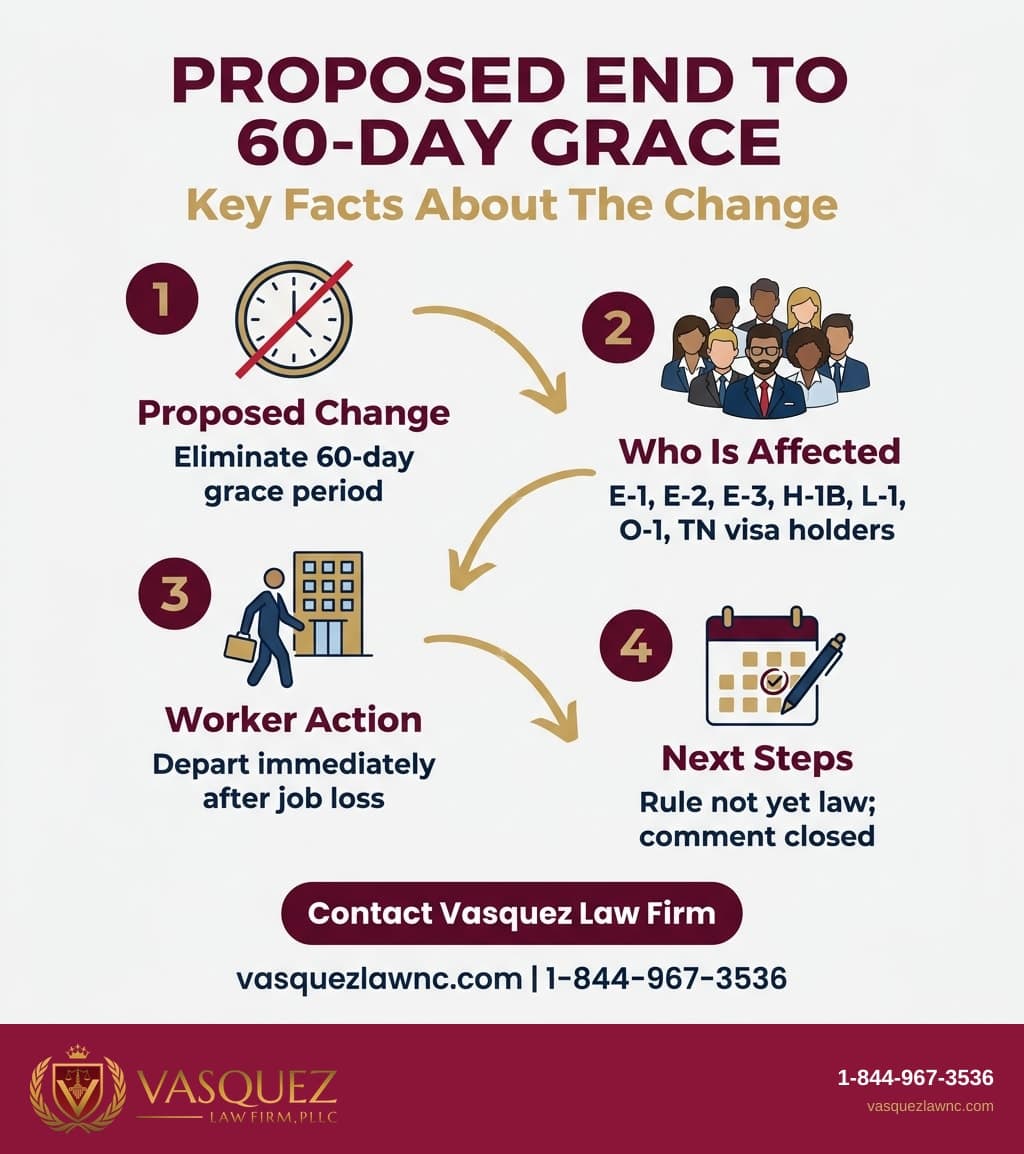
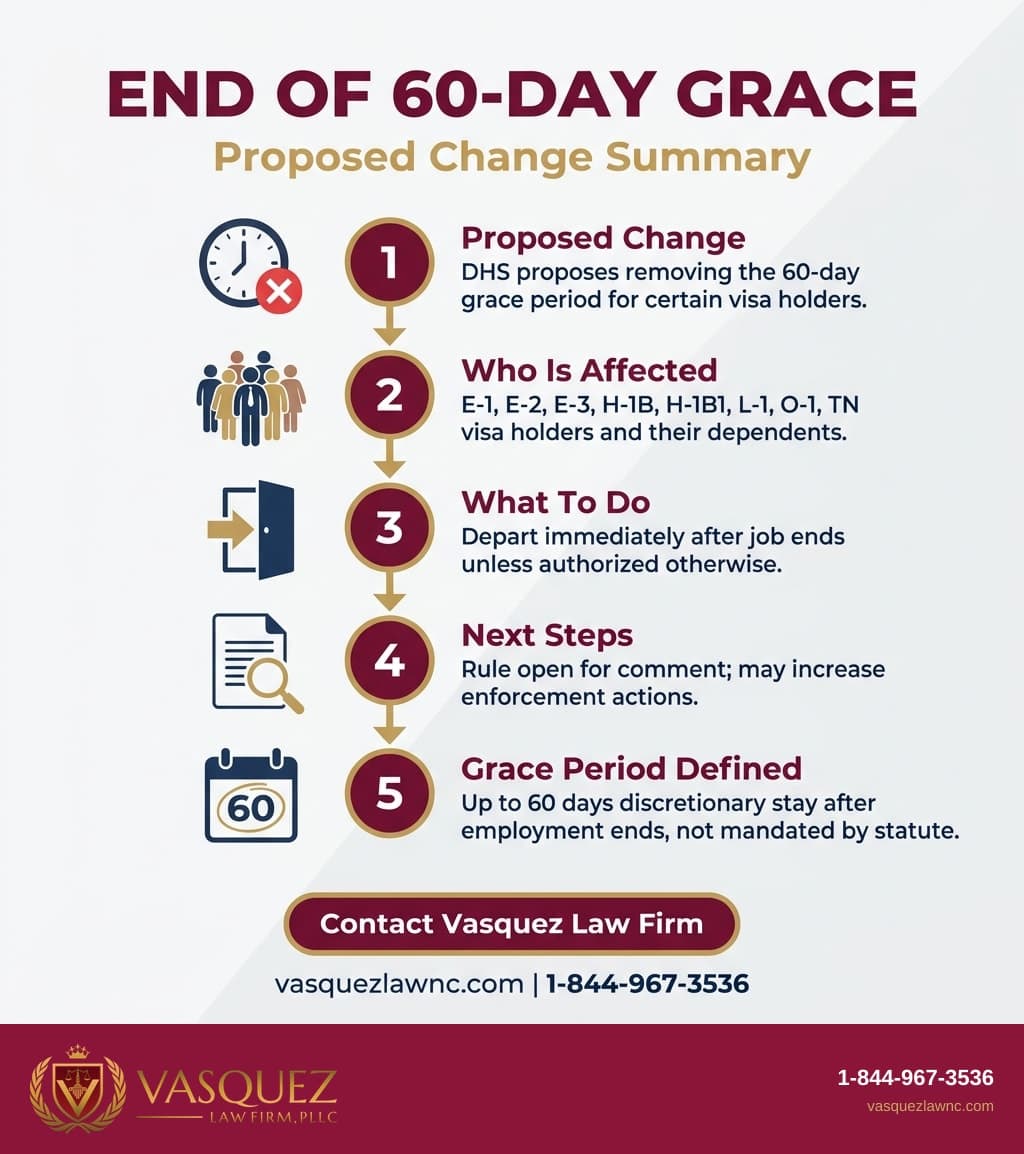
The Department of Homeland Security (DHS) has proposed a rule to eliminate the up to 60-day discretionary grace period currently allowed for certain nonimmigrant workers after their employment ends. This discretionary grace period, codified at 8 CFR 214.1(l)(2), permits nonimmigrants in E-1, E-2, E-3, H-1B, H-1B1, L-1, O-1, and TN classifications and their dependents to remain for up to 60 days after the qualifying employment or activity ends, or until the authorized validity period ends, whichever is shorter, without failing to maintain status solely because that employment or activity ended; DHS may shorten or eliminate the period. The proposed rule would require these individuals to depart immediately upon losing their qualifying employment unless otherwise authorized to stay.
This proposal aims to better align regulations with statutory provisions tying nonimmigrant status directly to specific employment or activity. It also seeks to reduce administrative burdens on USCIS caused by adjudicating discretionary grace periods.
Written comments on this proposed rule had to be submitted on or before November 10, 2026.
By proposing to remove the grace period, DHS seeks to restore the direct link between nonimmigrant status and the qualifying employment or activity, requiring immediate departure when that work ends unless the individual is otherwise authorized to remain lawfully.
Prior to 2017, no such grace period existed. It was introduced to provide flexibility for high-skilled workers facing sudden job loss to seek new employment or change status without immediate departure. DHS now believes the grace period conflicts with statutory intent and adds complexity to USCIS adjudications.
For more detail, see the Federal Register notice (DHS Docket No. USCIS-2026-0364).
Who is affected by the removal of the 60-day discretionary grace period?
This proposed rule affects aliens admitted or otherwise provided status in the following employment-based nonimmigrant visa classifications: E-1, E-2, E-3, H-1B, H-1B1, L-1, O-1, and TN, as well as their dependents. Principal nonimmigrants in these classifications must perform the qualifying employment or activity; not all dependents are authorized to work.
Specifically, the rule applies to:
- E-1, E-2, E-3: Treaty traders, investors, and specialty occupation workers from qualifying countries.
- H-1B, H-1B1: Specialty occupation workers, including nationals of Singapore and Chile under H-1B1.
- L-1: Intracompany transferees with managerial, executive, or specialized knowledge roles.
- O-1: Individuals with extraordinary ability or achievement in sciences, arts, education, business, athletics, or motion pictures/television.
- TN: Canadian and Mexican citizens admitted under USMCA (formerly NAFTA) for professional business activities.
These visa holders must maintain the employment or activity that formed the basis of their status to remain lawful. The proposed rule removes the allowance to remain in the U.S. for up to 60 days after losing that qualifying employment.
DHS acknowledges that a subset of the affected nonimmigrants may lose income if departure and return to the United States require additional time before they can begin new employment. The removal may result in some losing income due to having to leave the country before securing new work authorization.
DHS estimates that eliminating the grace period could increase Notices to Appear (NTA) issued, leading to more immigration court proceedings. This would affect both the Department of Justice's Executive Office for Immigration Review and Immigration and Customs Enforcement workload.
While the grace period was intended to enhance job portability and flexibility for high-skilled workers, DHS now believes it conflicts with statutory requirements tying lawful status directly to specific employment or activity.
What does the law say about maintaining nonimmigrant status and the grace period?
By statute, nonimmigrant visa classifications such as E-1, E-2, E-3, H-1B, H-1B1, L-1, O-1, and TN require that the alien be admitted to the United States solely to perform specific employment or activities. Maintaining lawful status requires continuing the qualifying employment or activity throughout the authorized stay.
The Immigration and Nationality Act (INA) sections defining these classifications emphasize the connection between status and employment. For example, 8 U.S.C. § 1101(a)(15)(E)(i) defines an E-1 alien as entering "solely to carry on substantial trade," while 8 U.S.C. § 1101(a)(15)(H)(i)(b) defines an H-1B alien as coming "temporarily to perform services . . . in a specialty occupation."
Failure to maintain nonimmigrant status can make an individual deportable under 8 U.S.C. § 1227(a)(1)(C)(i), but under the current discretionary grace-period regulation, cessation of qualifying employment or activity alone does not necessarily constitute a failure to maintain status. The current discretionary grace period of up to 60 days at 8 CFR 214.1(l)(2) is not mandated by statute. DHS established it in a final rule published on November 18, 2016, which took effect on January 17, 2017, to provide flexibility.
DHS argues that the grace period disconnects lawful status from statutory eligibility and that requiring immediate departure when qualifying employment ends, unless the individual is otherwise authorized to remain lawfully, would better align with the law.
"DHS now believes that removing the up to 60-day discretionary grace period currently codified at 8 CFR 214.1(l)(2) would better align with the statute because it requires that nonimmigrants depart the United States immediately upon cessation of the employment or activity on which their nonimmigrant status is based (unless otherwise authorized to lawfully remain in the United States)." (Source: Department of Homeland Security, https://www.federalregister.gov/documents/2026/09/11/2026-18631/eliminating-the-discretionary-60-day-grace-period)
Maintaining status requires compliance with the terms of the petition approval or admission, including engaging only in the approved employment or activity. Under the current regulation, an eligible nonimmigrant may benefit from the discretionary grace period after qualifying employment ends; this proposal seeks to eliminate that protection.
Aliens may apply for readmission in a new qualifying employment-based status after securing new employment and receiving necessary approvals. However, the proposed rule removes the cushion that allowed them to stay in the U.S. during the job search.
What should nonimmigrant workers do if the 60-day grace period is eliminated?
If the proposed rule becomes final, nonimmigrant workers in the affected categories must depart the United States immediately upon cessation of the qualifying employment or activity, unless they have secured a new status or other lawful authorization to remain.
Here are practical steps to follow:
- Know your visa status and its conditions. Understand that your lawful presence depends on continuing the employment or activity that justified your visa.
- Plan for immediate departure upon job loss. Without the grace period, you cannot remain in the U.S. for up to 60 days after losing your job.
- Seek new employment and file petitions promptly. If you find a new qualifying employer, ensure they file a new petition or extension before your current employment ends.
- Consider alternative visa options. You may apply for a change of status to a non-employment visa, such as student (F) status, if eligible.
- Consult an immigration attorney. Legal advice is critical to navigate timing, petitions, and maintaining lawful status.
In our experience with immigration cases, we typically see clients underestimate how quickly they must act after employment ends. A mistake to avoid is assuming that a full 60-day grace period is guaranteed: the existing period is discretionary, cannot extend beyond the authorized validity period, and would be eliminated by this proposal.
USCIS adjudicators currently face complexity in verifying employment cessation dates and exercising discretion on the grace period. Removing it would simplify adjudications but requires nonimmigrants to be more vigilant.
| Action | Current Policy (With Grace Period) | Proposed Policy (No Grace Period) |
|---|---|---|
| Remain in U.S. after job loss | Up to 60 days discretionary grace period, limited by the authorized validity period | Must depart immediately unless otherwise authorized to remain |
| File extension/change of status | Possible within grace period if otherwise eligible | Generally must file while still maintaining status |
| Risk of removal proceedings | Lower during grace period | Higher if remain unlawfully |
| Administrative burden on USCIS | Higher due to discretion | Reduced by clear rules |
Timely action and legal guidance are essential to avoid falling out of status.
What happens next with the proposed rule to eliminate the grace period?
Comments on the proposed rule had to be submitted on or before November 10, 2026.
If finalized, the rule would amend 8 CFR 214.1(l)(2) to remove the discretionary 60-day grace period for the affected visa categories. This would restore the prior policy requiring immediate departure when qualifying employment or activity ends, unless the individual is otherwise authorized to remain lawfully in the United States.
DHS stated:
What's Your Immigration Situation?
Answer 3 questions - we'll tell you your options
Question 1 / 3
What best describes your situation?
Keep Reading
"DHS is firmly committed to better aligning the regulations with the statutory purpose for which the alien was admitted or otherwise provided nonimmigrant status and to reducing administrative burdens. Removal of the up to 60-day discretionary grace period furthers these essential goals." (Source: Department of Homeland Security, https://www.federalregister.gov/documents/2026/09/11/2026-18631/eliminating-the-discretionary-60-day-grace-period)
The agency anticipates this change will reduce adjudication complexity and improve program integrity but acknowledges it may increase Notices to Appear and immigration court workloads.
Employers and nonimmigrant workers should monitor DHS announcements and consider consulting immigration counsel to prepare for the rule's possible implementation.

Frequently Asked Questions
What is the 60-day discretionary grace period?
The discretionary grace period at 8 CFR 214.1(l)(2) allows certain nonimmigrant workers and their dependents to remain for up to 60 days after qualifying employment ends, or until the authorized validity period ends, whichever is shorter, without failing to maintain status solely because the employment ended; DHS may shorten or eliminate the period. This period helps workers seek new jobs or change status.
Which visa categories are affected by the removal of the grace period?
The proposed removal affects E-1, E-2, E-3, H-1B, H-1B1, L-1, O-1, and TN nonimmigrant visa holders and their dependents.
What happens if my employment ends and the grace period is eliminated?
If the proposed elimination takes effect, affected nonimmigrants would have to depart immediately when their qualifying employment or activity ends, unless otherwise authorized to remain lawfully.
Can I apply for a new visa or change status after my employment ends?
The timing depends on the request. Eligible workers may currently seek an extension or change of status during the discretionary grace period; this proposal does not itself remove that option. If the period is eliminated, affected workers would generally need to maintain status to seek an extension or change of status, subject to applicable exceptions. After departure, they could still seek a visa and readmission once they obtain qualifying employment and the necessary approvals.
How can I prepare for this change?
Stay informed about the rule's status, maintain valid employment, and consult an immigration attorney promptly if you lose your job or want to change status.
This article provides general legal information, not individualized legal advice. Reading does not create an attorney-client relationship. For advice specific to your situation, contact Vasquez Law Firm.
If you need legal assistance, learn more about our immigration law practice, or call us at 1-844-967-3536 for a free evaluation.
Reviewed by William Vasquez, Founder & CEO, Vasquez Law Firm, PLLC.
Related Topics

William Vasquez
Founder & CEO, Vasquez Law Firm, PLLC
William Vasquez is the founder and CEO of Vasquez Law Firm, PLLC, a results-driven firm specializing in immigration, criminal defense, personal injury, and workers' compensation. A U.S. Air Force veteran and recipient of the Joint Service Achievement Medal, William is dedicated to fiercely fighting for his clients' rights.
Related Legal Services
Need legal help? Learn more about our immigration law practice, or contact us for a free evaluation.
You can also visit North Carolina immigration law firm for more information.