Family Green Card Applications Begin With Form I-130
Applying for a family green card? See how Form I-130 starts the process, what evidence matters, and when to seek a free evaluation today.
Published on October 12, 2026
Talk to an immigration attorney
Free call. A clear plan for your case.
Free & confidential · Se habla espanol · 24/7
Have questions? Talk to an attorney - free evaluation.
Call 1-844-967-3536Free Tool
Check Your USCIS Case Status Now
Enter your receipt number - get the official USCIS status in English or Spanish. No registration.
Family Green Card Applications Begin With Form I-130
A family green card case usually starts with Form I-130, Petition for Alien Relative. This petition asks USCIS to recognize a qualifying family relationship. It does not grant a green card, work permission, or immigration status by itself. A careful family green card application must identify the correct relationship. It must include the required evidence. It must also choose the correct path for the relative. The choices are adjustment of status in the United States or consular processing abroad.
For a family green card application, William J. Vasquez and Vasquez Law Firm offer free immigration consultations. Se Habla Español.
Call 1-844-967-3536. The firm meets immigration clients in Raleigh, NC and Orlando, FL.
Quick Answer
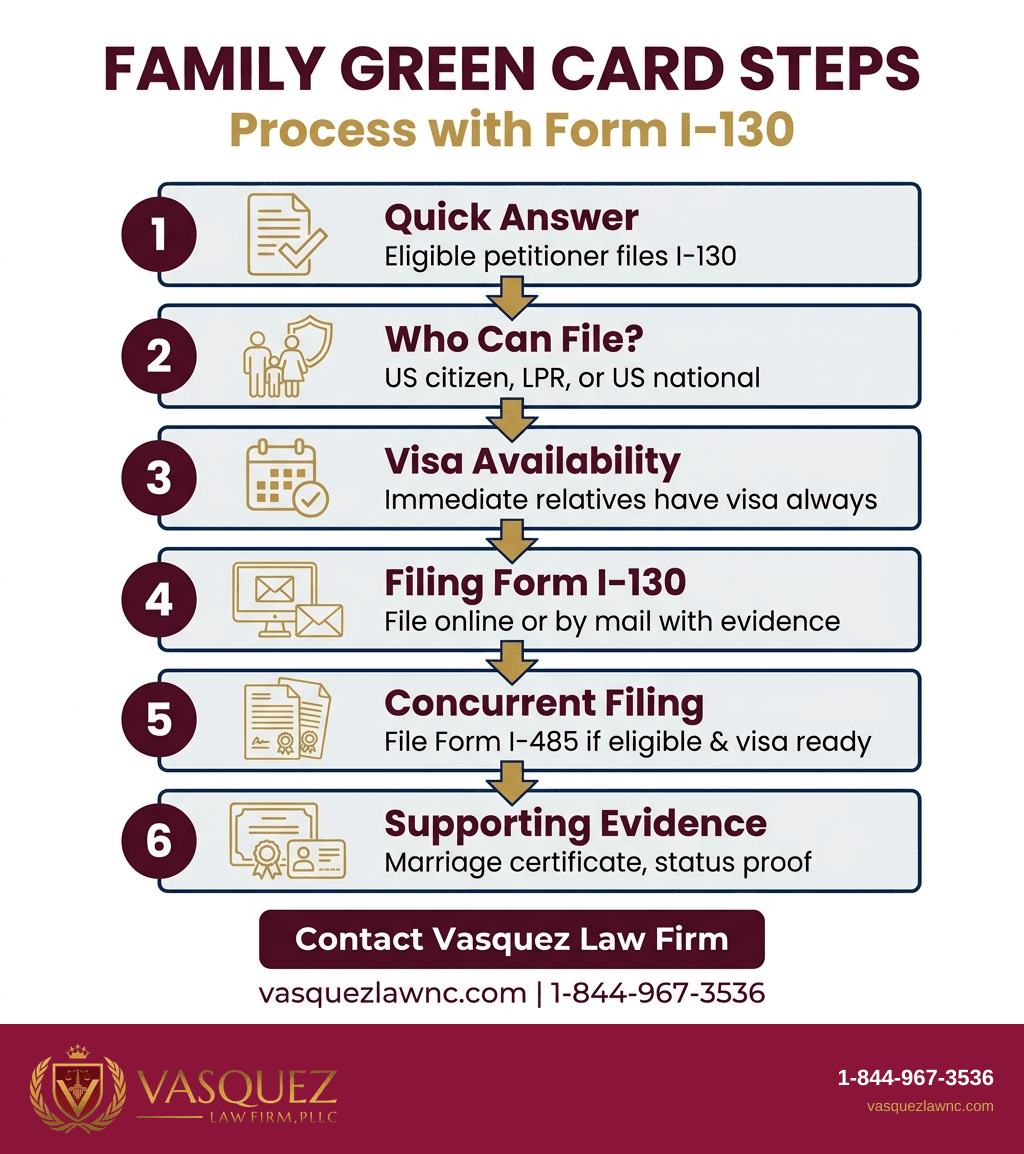
To begin a family green card process, an eligible U.S. citizen, lawful permanent resident, or U.S. national files Form I-130 to establish a qualifying relationship. The petitioner is the person who files the petition. The petitioner must choose one processing path for the beneficiary. The beneficiary is the relative seeking permanent residence. Approval is an early step. It is not a grant of immigration status.
- Confirm the petitioner and beneficiary relationship.
- Choose adjustment of status or consular processing.
- Gather relationship and identity evidence.
- File online or by mail under current USCIS instructions.
- Keep the receipt notice and case information.
Who can start a family green card petition?
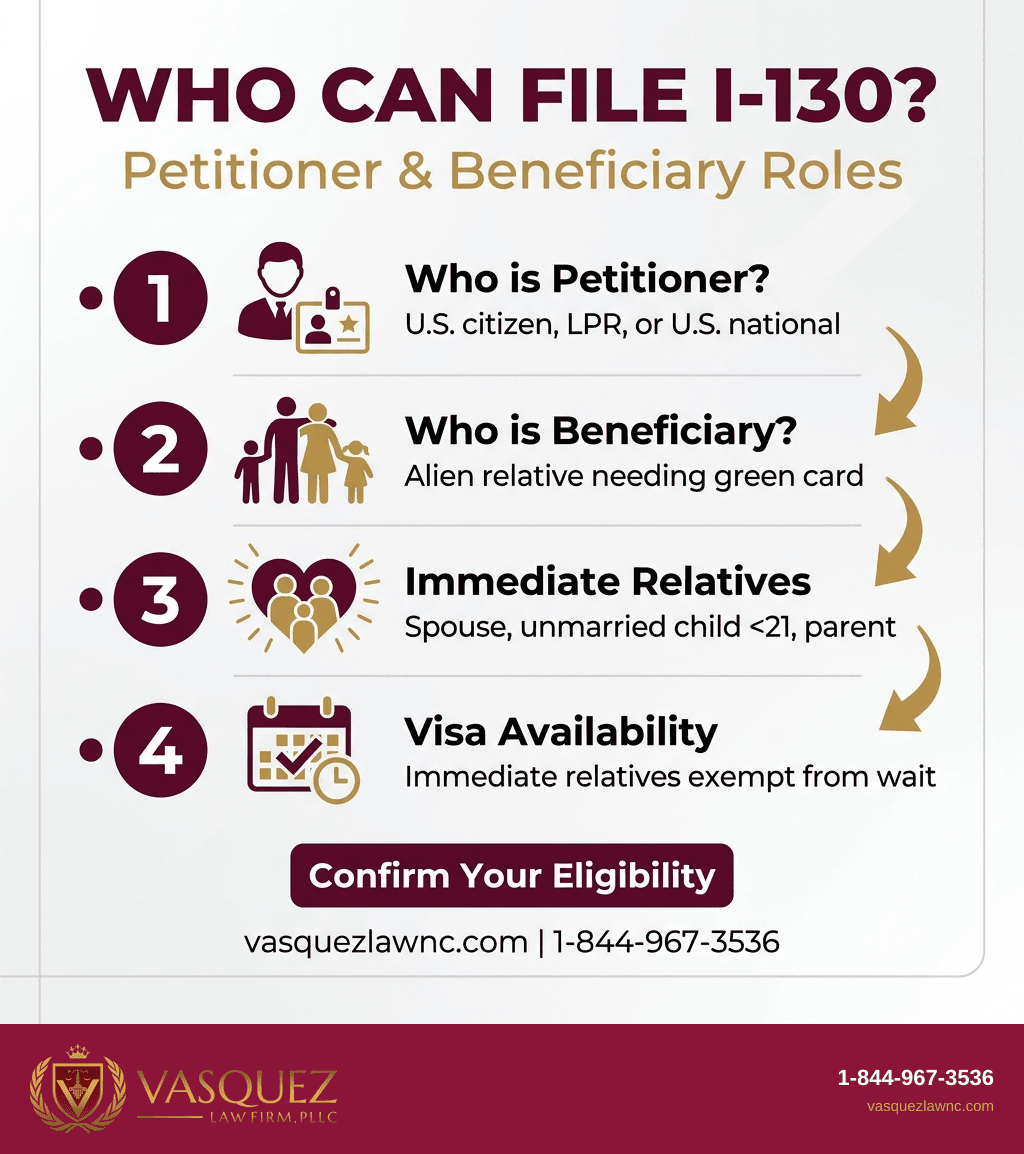
A U.S. citizen, lawful permanent resident, or U.S. national who is not a U.S. citizen may use Form I-130. The form helps establish a qualifying relationship with an eligible alien relative. An alien relative is a relative who is not a U.S. citizen. The person filing is the petitioner. The relative seeking permanent residence is the beneficiary.
USCIS describes Form I-130 as the first step to help an eligible relative apply to immigrate and seek a Green Card. The governing family classification rules appear in INA § 201(b)(2)(A)(i) for immediate relatives and INA § 203(a) for family-sponsored preference categories. A petition must match the actual relationship. The supporting records must also support that relationship.
“The filing or approval of this petition does not give your relative any immigration status or benefit.”
That difference matters. An approved petition may establish a family relationship for immigration purposes. It does not, by itself, allow a beneficiary to work, travel, remain in the country, or obtain a Permanent Resident Card. Review the firm’s family-based immigration services before choosing a filing strategy.
Immediate relatives and visa availability
USCIS states that an immigrant visa is always available when the relative qualifies as an immediate relative. An immediate relative is a close relative of a U.S. citizen who falls within a listed category. The agency identifies a U.S. citizen’s spouse, unmarried child under 21, and parent of a U.S. citizen who is at least 21 as immediate relatives in its Form I-130 guidance.
Other qualifying relatives may need to wait until an immigrant visa number becomes available. An immigrant visa number is a place in the visa system for a person who may immigrate. The relative may need that number before filing Form I-485 or seeking an immigrant visa through a consulate. The Visa Bulletin filing overview explains why visa availability can affect the next stage.
How do you file Form I-130 for a family green card?
A petition can be filed online or by mail. USCIS directs petitioners to create or log in to a USCIS online account for online filing. A petitioner filing by mail must use the current direct filing instructions. Those instructions depend on the petitioner’s residence and on whether Form I-485 is being filed at the same time.
- Confirm that the petitioner has U.S. citizenship, lawful permanent resident status, or qualifying U.S. national status.
- Identify the beneficiary and the family relationship.
- Complete every required field on Form I-130.
- For a spouse beneficiary, complete and include Form I-130A.
- Select only one Part 4 option, Question 61 or 62.
- Attach copies of required initial evidence and certified English translations where needed.
- Sign the form and submit it through the selected filing method.
Form I-130 must not leave Part 4, Question 61 or 62 blank. The petitioner must choose either adjustment of status inside the United States or consular processing outside the United States. Adjustment of status is the process of applying for permanent residence while in the United States. Consular processing is the process of applying for an immigrant visa through a U.S. consulate abroad. Completing both choices can create avoidable processing problems.
When may concurrent filing matter?
USCIS calls filing Form I-130 together with Form I-485 “concurrent filing.” The filing location depends in part on whether the relative is filing Form I-485 at the same time. Under 8 U.S.C. § 1255 and 8 C.F.R. § 245.1, adjustment of status has separate eligibility requirements. Proving the family relationship alone is not enough.
An online I-130 can still be filed if the relative is in the United States. The relative may later file Form I-485 through that relative’s own USCIS account or by mail. USCIS instructs the petitioner to provide the I-130 receipt notice copy for the I-485 packet.
What evidence supports a Form I-130 petition?
A marriage certificate is one starting document for a spouse petition. USCIS may ask for more than one record. The petitioner must provide evidence of qualifying status. The petitioner must also provide proof of the family relationship and any required supporting records.
- Proof of the petitioner’s U.S. citizenship, lawful permanent resident status, or U.S. national status.
- A marriage certificate for a spouse petition.
- Proof that prior marriages ended, when applicable.
- Birth certificates for child, parent, or sibling relationships, as applicable.
- Form I-130A for a spouse beneficiary.
- Proof of a legal name change, when applicable.
- Passport-style photographs, when applicable.
For a marriage-based family green card petition, USCIS lists examples of bona fide marriage evidence. A bona fide marriage is a real marriage entered into for marital reasons, rather than only for an immigration benefit. Examples include joint property ownership, a lease showing joint tenancy at a shared residence, combined financial resources, children’s birth certificates, third-party affidavits, and other proof of an ongoing marital union.
Translations and copies
USCIS requires a full English translation for each foreign-language document. The translator must certify that the translation is complete and accurate. The translator must also certify that the translator is competent to translate the document. Do not send original documents unless the form instructions or applicable regulations specifically request them.
Cases we handle often reveal one preventable problem. A petitioner brings relationship records but lacks a clear translation certification. The petitioner may also lack proof that a prior marriage ended. Organizing the evidence before filing can make the petition easier to review. It can also make the facts easier to explain.
What happens after USCIS receives Form I-130?
USCIS sends a receipt notice after an online submission. A receipt notice confirms that USCIS received the filing. That notice is useful if the beneficiary later files Form I-485. USCIS directs the beneficiary to include a copy in the adjustment packet.
After approval, the next route depends on the beneficiary’s location, eligibility, visa availability, and Part 4 selection. A relative who is in the United States and eligible to adjust may file Form I-485 when an immigrant visa is available. A relative outside the United States may seek an immigrant visa through consular processing.
“You must select only 1 option for Part 4 (Question 61 or 62) to indicate whether the beneficiary will seek adjustment of status inside the United States or consular processing abroad.”
Check the USCIS processing times page for Form I-130 updates by form type and service center. Published times can change. They are not a promise for any individual family green card application.
Changing the selected path
While Form I-130 is pending, USCIS says the petitioner may contact the office on the receipt notice. The petitioner may also contact the USCIS Contact Center. Another option is to submit a statement and updated beneficiary address through the USCIS online account. A change after approval may require different action. The required action depends on where the approved petition is located.
If USCIS retained an approved petition and the beneficiary later seeks consular processing, USCIS directs the petitioner to file Form I-824. If the Department of State has already created a National Visa Center case, the beneficiary may need to contact the National Visa Center through its Public Inquiry Form.
Choosing adjustment of status or consular processing affects the next steps. Request a free consultation with Vasquez Law Firm. Se Habla Español.
Call 1-844-967-3536.
Which Form I-130 mistakes can delay a family green card case?
An unsigned Form I-130 can be rejected. USCIS also identifies missing fields that can lead to rejection. These fields include relationship information, the petitioner’s full name, date of birth, mailing address, marital information, and key beneficiary details.
- Choosing both Part 4 options: Select one path only.
- Leaving Part 4 blank: Complete Question 61 or 62.
- Missing a signature: Sign the petition before submission.
- Using mixed form editions: Use pages from the same current edition.
- Omitting Form I-130A: Include it for a spouse beneficiary.
- Sending untranslated records: include a complete certified English translation.
- Sending prohibited items: USCIS will not accept electronic-chip items, batteries, or non-paper materials such as thumb drives.
- Filing one petition for several relatives: file a separate I-130 for each eligible relative unless derivative beneficiary rules apply.
If you remember one point: an I-130 approval confirms a qualifying relationship only. It does not complete the green card process.
Why is the family green card process federal nationwide?
Form I-130 is administered by USCIS under federal immigration law. The family petition framework therefore applies nationwide. The petitioner may file online. USCIS also permits mail filing under the agency’s current direct filing instructions.
As of October 2026, USCIS changed Form I-130 mail filing locations on October 7, 2026. USCIS announced a 30-day grace period for petitions postmarked on or before November 9, 2026, that were sent to a prior filing location. Confirm the current address before mailing any packet.
Federal agency resources
The USCIS Policy Manual provides agency policy guidance. USCIS also provides Form I-130 instructions and a fee schedule through its official pages. Use the current form edition and instructions. Do not rely on a copied packet from an older filing.
When should you seek help with a family green card petition?
A family green card case can require close review before the first filing. Consider a free consultation if any of these situations applies:
- You are unsure whether the beneficiary should use adjustment of status or consular processing.
- A prior marriage must be documented.
- Foreign-language records need proper translations.
- Your Form I-130 is already pending and the beneficiary’s address or processing choice changed.
- Your petition was approved but the planned processing route changed.
- You became a U.S. citizen after filing as a permanent resident.
- You need to prepare a separate petition for a spouse’s child.
About Vasquez Law Firm
Vasquez Law Firm handles immigration matters for clients nationwide. William J. Vasquez provides immigration representation with bilingual support staff. The firm focuses on clear communication. The firm’s Yo Peleo® commitment reflects a direct, caring approach to immigration matters.
For in-person immigration consultations, the firm meets clients in Raleigh, NC and Orlando, FL. Se Habla Español. Learn about immigration representation for families or review William J. Vasquez’s professional background.
Frequently Asked Questions
Does Form I-130 give my relative a green card?
No. USCIS explains that filing or approval of Form I-130 does not give the relative immigration status or a benefit. The petition is used to establish a qualifying relationship. After approval, the beneficiary may need to take another step, such as applying for adjustment of status or pursuing consular processing, depending on the facts and visa availability.
Can I file Form I-130 online?
Yes. USCIS permits online filing of Form I-130 through a USCIS online account. USCIS also permits paper filing. An online I-130 may be filed even when the beneficiary is in the United States and will later file Form I-485 through a separate online account or by mail. Keep the receipt notice for later use.
Do I need Form I-130A for my spouse?
Yes. USCIS states that a petitioner submitting Form I-130 for a spouse must also submit Form I-130A, Supplemental Information for Spouse Beneficiary. The petition should also include the marriage certificate, records showing prior marriages ended when applicable, and evidence that the marriage is bona fide.
Should I select adjustment of status and consular processing?
No. USCIS instructs petitioners to select one and only one option in Form I-130 Part 4, Question 61 or 62. The choice identifies whether the beneficiary seeks adjustment of status inside the United States or consular processing abroad. Completing both choices or leaving the section blank can create issues with later processing.
What documents prove a real marriage for Form I-130?
USCIS lists several examples: jointly owned property, a joint lease, combined financial resources, birth certificates of children born to the couple, affidavits from people with personal knowledge, and other records showing an ongoing marital union. The evidence should fit the couple’s actual circumstances and should be consistent with the petition.
Do foreign-language documents need translation?
Yes. USCIS requires a full English translation with any document submitted in a foreign language. The translator must certify that the translation is complete and accurate and that the translator is competent to translate from the foreign language into English. Submit copies unless USCIS instructions or regulations request originals.
Can I change from adjustment of status to consular processing?
Possibly. While Form I-130 remains pending, USCIS directs the petitioner to contact the office on the receipt notice or the USCIS Contact Center, or submit a statement with the beneficiary’s updated address through the online account. After approval, the appropriate step depends on whether USCIS, the National Visa Center, or a consulate holds the case.
Do I file one I-130 for my spouse and children?
USCIS generally requires a separate Form I-130 for each eligible relative unless a person can be treated as a derivative beneficiary. USCIS specifically states that a U.S. citizen petitioning for a spouse must file a separate I-130 for each shared biological child, stepchild, or adopted child, with a copy of the spouse petition receipt notice.
Sources and References
A complete family green card application starts with the correct Form I-130 strategy and evidence. Contact Vasquez Law Firm for a free, confidential consultation. Se Habla Español.
Call 1-844-967-3536. The firm meets immigration clients in Raleigh, NC and Orlando, FL.
Filing or renewing a green card?
Adjustment-of-status timing, RFEs, and travel risks all change with new policy. 15-min review of your specific case.
Keep Reading
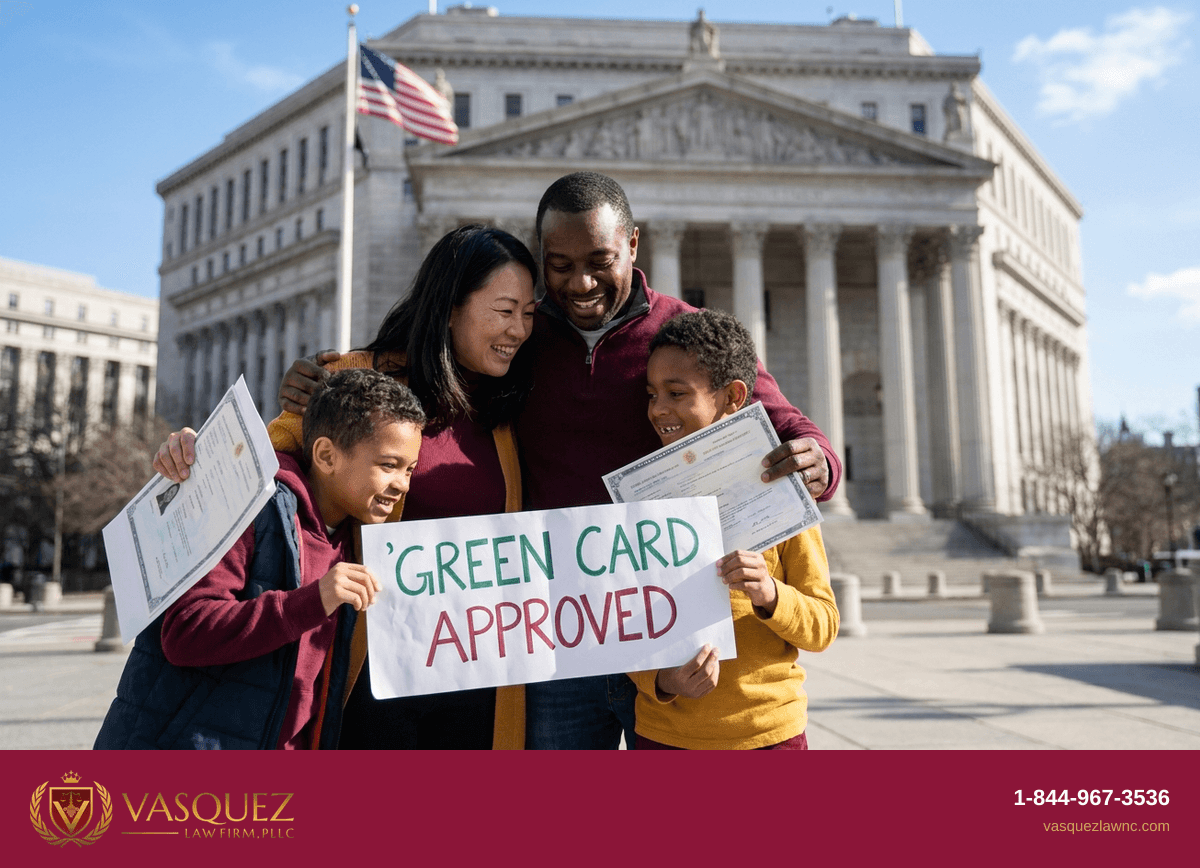
For how Vasquez Law Firm can help, see our family based page.
Reviewed by Attorney Vasquez, Managing Attorney

William Vasquez
Founder & CEO, Vasquez Law Firm, PLLC
William Vasquez is the founder and CEO of Vasquez Law Firm, PLLC, a results-driven firm specializing in immigration, criminal defense, personal injury, and workers' compensation. A U.S. Air Force veteran and recipient of the Joint Service Achievement Medal, William is dedicated to fiercely fighting for his clients' rights.
Related Legal Services
Need legal help? Learn more about immigration lawyers in North Carolina, or contact us for a free evaluation.
You can also visit NC immigration legal help for more information.