USCIS Public Charge Guidance Changes I-485s in 2026
USCIS public charge guidance changes I-485 review after Sept. 18, 2026. Protect your green card plan before filing, request a free evaluation today.
Published on October 10, 2026· Updated October 11, 2026
Talk to an immigration attorney
Free call. A clear plan for your case.
Free & confidential · Se habla espanol · 24/7

Have questions? Talk to an attorney - free evaluation.
Call 1-844-967-3536Free Tool
Check Your USCIS Case Status Now
Enter your receipt number - get the official USCIS status in English or Spanish. No registration.
USCIS Public Charge Guidance Changes I-485s in 2026
Starting September 18, 2026, USCIS will use new public charge guidance for certain Form I-485 green card applications. The applications must be submitted on or after that date. For many family-based applicants, the evidence in the file may now have more weight. This evidence can include financial records, education, health, family circumstances, and public-benefit history.
Filing or renewing a green card?
Adjustment-of-status timing, RFEs, and travel risks all change with new policy. 15-min review of your specific case.
The federal policy applies wherever an applicant lives. This includes Raleigh, NC, Orlando, FL, and all other parts of the country. Families preparing an adjustment case can review their circumstances with Vasquez Law Firm's immigration attorneys. They can do this before filing an I-485 package under the updated framework.
This article gives general legal information. It does not give legal advice for a specific case. A public charge finding depends on the facts of each case. A person should obtain legal advice before making decisions about benefits or an immigration filing.
What did USCIS announce about public charge guidance in 2026?
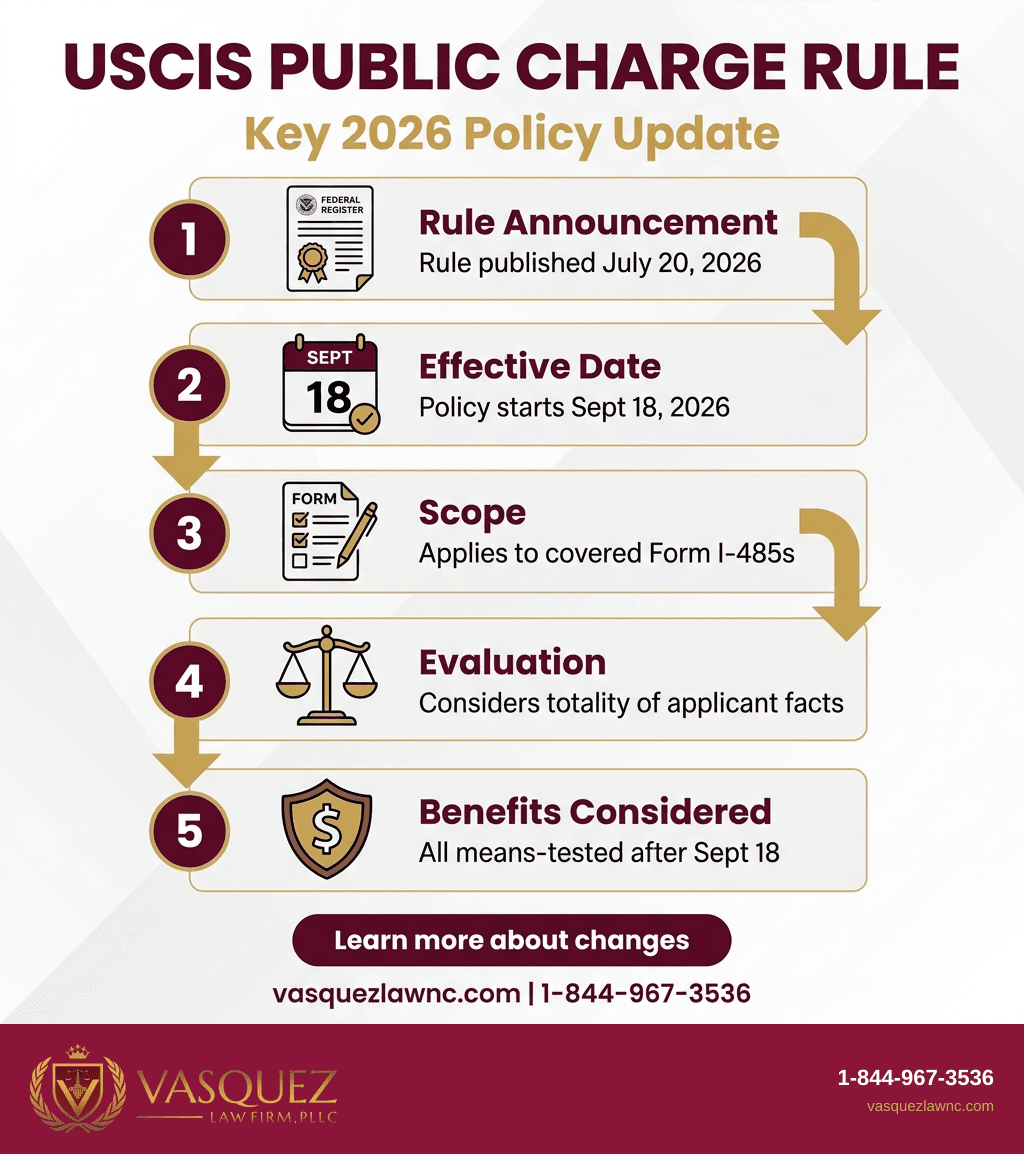
USCIS released its updated public charge guidance on August 18, 2026. The agency said the guidance follows a Department of Homeland Security final rule. The Department announced that rule on July 16, 2026. It published the rule in the Federal Register on July 20, 2026. The rule becomes effective September 18, 2026.
The rule rescinds the 2022 public charge inadmissibility regulations. Inadmissibility means that immigration law may prevent a person from entering the United States or getting a green card. In its August 18, 2026 alert, “USCIS Issues Guidance on Making Public Charge Inadmissibility Determination,” USCIS said its updated public charge guidance is controlling. This means the agency will use it to guide its decisions. It replaces the 1999 Interim Field Guidance and related prior public charge guidance.
“This guidance is effective on Sept. 18, 2026, and applies to all Forms I-485, Application to Register Permanent Residence or Adjust Status, subject to the public charge ground of inadmissibility postmarked or electronically submitted on or after that date.”
The change focuses on adjustment of status. Adjustment of status is the process that lets an eligible person in the United States seek lawful permanent resident status. A lawful permanent resident is commonly called a green card holder. The guidance does not create a blanket denial rule. Instead, USCIS officers will decide each case separately. They will review the totality of the applicant's circumstances. This means they will consider all relevant facts together.
For benefits received before September 18, USCIS says it will consider only two types of benefits. These are public cash assistance for income maintenance and long-term institutionalization at government expense. For means-tested benefits received on or after September 18, the agency says officers may consider any and all benefits. Means-tested benefits are benefits based on a person's income or financial resources.
This date difference makes filing time and recordkeeping important. The updated USCIS public charge guidance does not say that every benefit receipt creates inadmissibility. It says a benefit history may matter. Officers may review that history with the other evidence in the record.
Who does the USCIS public charge guidance apply to?
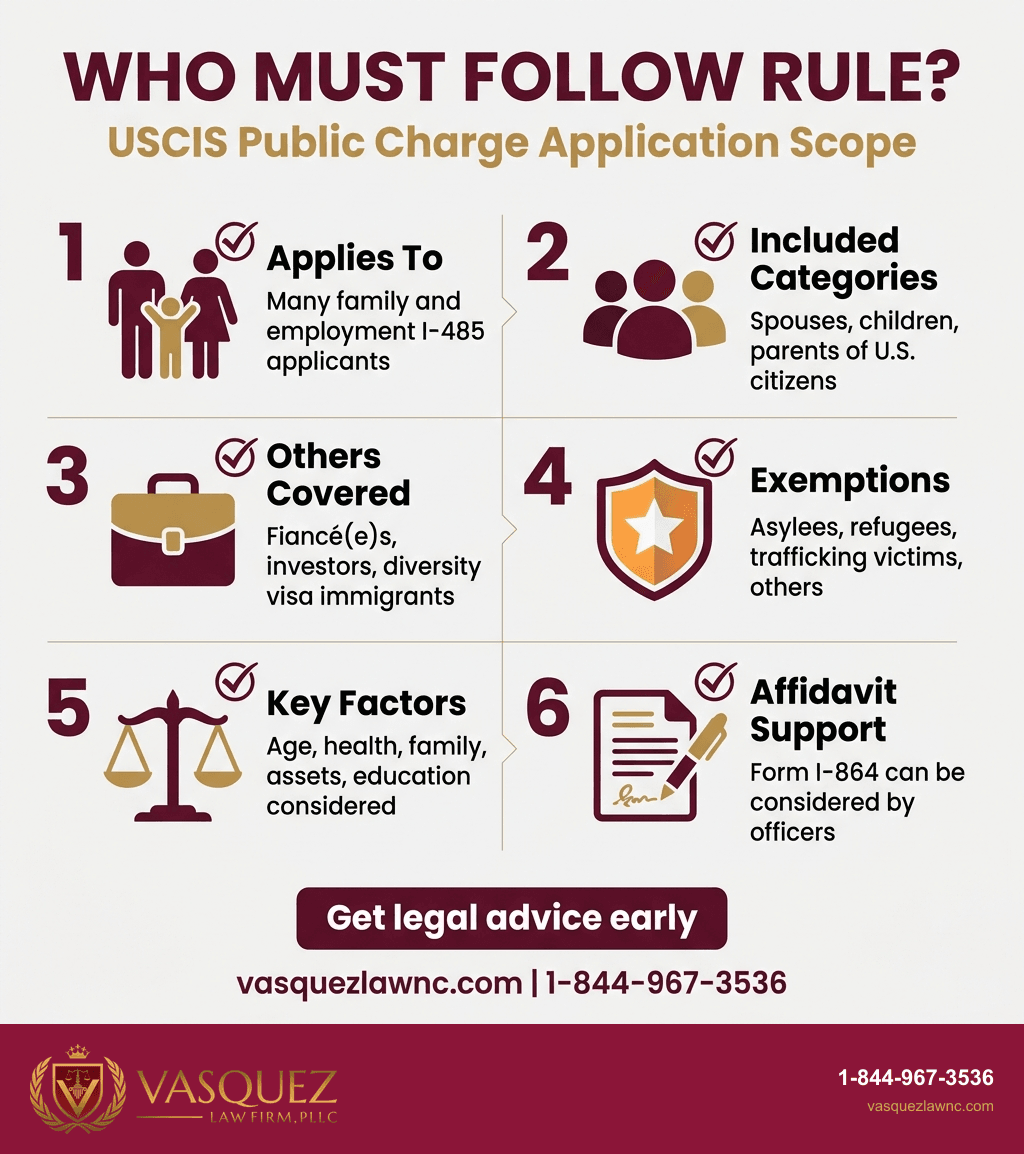
USCIS says all applicants seeking adjustment of status to lawful permanent resident status are subject to the public charge ground. Congress has made some immigration categories exempt. This means the USCIS public charge guidance reaches many family-preference and employment-based adjustment applicants.
The categories subject to the rule include spouses, children, and parents of U.S. citizens. The rule also includes unmarried and married sons and daughters of U.S. citizens. It includes certain relatives of lawful permanent residents and siblings of U.S. citizens. The listed categories also include fiancé(e)s of U.S. citizens, diversity visa immigrants, widows and widowers, preference workers, investors, and religious workers. Several other listed categories may also be covered.
USCIS also lists broad exemptions. An exemption means that the public charge ground does not apply to a person in the exempt category. The exemptions include asylees and refugees. They also include T nonimmigrants who are victims of human trafficking. U nonimmigrants who are victims of qualifying criminal activity may qualify. Other exemptions include self-petitioners under the Violence Against Women Act, special immigrant juveniles, applicants for registry, and certain Cuban and Haitian entrants. People adjusting under several humanitarian statutes may also be exempt.
Exemptions depend on an immigration category. They do not depend only on a difficult financial period. A person should identify the exact category under which they seek adjustment. A family-based I-130 petition is often part of a larger adjustment case. An approved petition alone, however, does not decide public charge inadmissibility.
“USCIS officers will consider the five statutory factors and any other factor relevant to assessing the alien's likelihood at any time of becoming a public charge.”
The five factors are age, health, family status, assets, resources and financial status, and education and skills. A statutory factor is a factor that a law requires officers to consider. USCIS may also consider Form I-864, Affidavit of Support Under Section 213A of the INA. This form is a sponsor's legally enforceable promise. Under that promise, the sponsor agrees to use financial resources to support the intending immigrant.
The cases we handle often depend on whether families collect the right financial and household records before filing the I-485. Applicants should not assume that they are exempt or subject based only on a benefit name. They also should not rely only on a relative's status. The exact immigration category and complete facts matter.
What law governs public charge inadmissibility?
Congress placed the public charge ground of inadmissibility in INA section 212(a)(4). The statute is codified at 8 U.S.C. § 1182(a)(4). A statute is a law passed by Congress. The law requires officers to consider, at minimum, age, health, family status, assets, resources and financial status, and education and skills.
The statute also permits officers to consider an affidavit of support under INA section 213A. An affidavit of support is a written promise to provide financial support. That support obligation is codified at 8 U.S.C. § 1183a. In many family-based cases, Form I-864 provides important evidence. It can show the sponsor's income, assets, household size, and legal support commitment.
These statutes provide the background law. The August 2026 USCIS public charge guidance explains how the agency says it will use its discretion after the new DHS final rule takes effect. Discretion means the officer has room to weigh the facts. The guidance does not replace the factors that Congress listed in the statute.
USCIS describes public charge as a forward-looking question. The question is whether an applicant is likely at any time to become a public charge. The INA does not define that phrase. The agency guidance tells officers to review all relevant evidence. It does not tell them to apply one automatic test.
This difference matters in an I-485 filing. A past fact may matter, but the legal question concerns future likelihood and the full record. The USCIS alert does not create a point system. It does not set a fixed income threshold. It also does not promise a result based on one document.
Applicants can consult the USCIS Policy Manual for the agency's published policy materials. Readers can also review our update on October 2026 green card filing rules. That update may help with filing strategy.
What should I do before filing Form I-485 after September 18?
First, confirm whether your adjustment category is subject to public charge inadmissibility. Keep a copy of the approval notice, petition receipt, or other record. The record should identify the category that supports your I-485 application.
Second, prepare a clear picture of your finances. Gather the proposed sponsor's Form I-864 materials. Also gather recent tax documents, employment evidence, pay records, and proof of assets if you will use assets. Include documents that show household composition. Make sure the figures match on all forms and supporting records.
Third, list any means-tested public benefits that may be relevant to the applicant. Record the benefit type and dates. Record the agency that provided the benefit. Also record whether the benefit was received before or on or after September 18, 2026. Do not hide information. Do not assume that a program does or does not matter.
Fourth, collect evidence that addresses the statutory factors when appropriate. This evidence may include school records, certifications, and work history. It may also include health insurance information and medical documents related to employability. Proof of available family support may help as well. The right evidence depends on the person and the immigration category.
Fifth, keep proof of submission. USCIS makes the postmark or electronic submission date important under the updated policy. Check current USCIS processing times separately. Do not confuse processing time with the filing date that controls this guidance.
A careful review by an immigration legal team serving Raleigh, NC, Orlando, FL, and clients nationwide can help find missing evidence. The team can also explain how the statutory factors may apply. No lawyer can promise approval. Careful preparation can make the record more accurate and complete.
Questions about the USCIS public charge guidance? Request a free immigration evaluation with Vasquez Law Firm before submitting an I-485 application. Se Habla Espanol.
What should applicants watch for after the USCIS public charge change?
September 18, 2026 is the main date to watch. The new guidance applies to subject I-485 applications postmarked or electronically filed on or after that date. USCIS says the guidance is controlling. At the same time, the agency says the guidance is intended to guide but not prescribe an officer's discretionary case-by-case decision.
Applicants should watch the USCIS Policy Manual and USCIS newsroom notices for future policy revisions. They should also keep copies of every benefit notice and immigration filing. A totality review depends on accurate and reliable records.
It is not yet settled whether a particular benefit record will outweigh other favorable evidence in an individual applicant's case. The current rule readers can rely on is that USCIS will review the statutory factors, relevant evidence, and any permitted additional factors together.
What's Your Immigration Situation?
Answer 3 questions - we'll tell you your options
Question 1 / 3
What best describes your situation?
Keep Reading
If an officer finds an applicant inadmissible only because of likely public charge, USCIS may invite the applicant to post a public charge bond. A bond is a financial promise or payment that may support the immigration application. The agency says the bond amount considers potential government assistance over the next five years. Form I-945 may be filed only after USCIS issues an invitation in a Notice of Intent to Deny.

Frequently Asked Questions
Does the USCIS public charge guidance affect every green card applicant?
No. USCIS says adjustment applicants are subject to the public charge ground unless their immigration category is exempt. The agency lists many exempt categories, including refugees, asylees, T and U nonimmigrants, VAWA self-petitioners, special immigrant juveniles, and several humanitarian adjustment categories. Confirm the actual category supporting your application before drawing conclusions.
What are the five public charge factors USCIS must consider?
INA section 212(a)(4) identifies age, health, family status, assets, resources and financial status, and education and skills. USCIS says officers will consider those factors and other relevant evidence under the totality of circumstances. The agency may also consider a Form I-864 affidavit of support where it applies.
Will receiving a benefit automatically deny my I-485?
The USCIS guidance does not say that any benefit automatically requires denial. It directs officers to make case-by-case determinations based on all relevant evidence. For means-tested benefits received before September 18, 2026, USCIS says it will consider only public cash assistance for income maintenance and long-term institutionalization at government expense.
What changes for benefits received after September 18, 2026?
USCIS says that for means-tested public benefits received on or after September 18, 2026, officers may consider any and all benefits. The guidance gives examples such as cash assistance for income maintenance, housing assistance, food stamps, financial aid for college, or similar benefits. Individual eligibility and immigration consequences require careful analysis.
Can I file Form I-945 to offer a public charge bond now?
No. USCIS says an applicant may submit Form I-945 only if the agency invites them to do so in a Notice of Intent to Deny. USCIS will not accept an unsolicited public charge bond. If invited, the applicant may submit a cash bond or a surety bond through a U.S. Treasury-certified surety company.
Does this policy apply outside Raleigh, NC and Orlando, FL?
Yes. This is a federal USCIS policy governing covered Form I-485 applications nationwide. It is not limited to Raleigh, NC, or Orlando, FL. Those locations are where Vasquez Law Firm offers in-person immigration consultations, while immigration representation can address federal matters for eligible clients throughout the United States.
Where can I get advice before submitting my I-485?
Review the filing record with a qualified immigration attorney before submission, especially if public benefits, sponsorship income, health issues, or household changes could require explanation. Bring the I-485 draft, I-864 documents, benefit notices, tax records, and identity documents. Individual facts determine whether the public charge ground applies and how evidence should be presented.
Do not file based on guesswork. Contact Vasquez Law Firm for a free consultation about your green card application and the USCIS public charge guidance. This information is general and not individualized legal advice.
Reviewed by Attorney Vasquez, Managing Attorney

William Vasquez
Founder & CEO, Vasquez Law Firm, PLLC
William Vasquez is the founder and CEO of Vasquez Law Firm, PLLC, a results-driven firm specializing in immigration, criminal defense, personal injury, and workers' compensation. A U.S. Air Force veteran and recipient of the Joint Service Achievement Medal, William is dedicated to fiercely fighting for his clients' rights.
Related Legal Services
Need legal help? Learn more about our immigration law practice, or contact us for a free evaluation.
You can also visit North Carolina immigration lawyers for more information.