BIA Denies Sua Sponte Reopening for Arriving Alien Seeking Adjustment
BIA sua sponte reopening was denied for an arriving alien seeking adjustment. Review your removal options and request a free evaluation today.
Published on October 30, 2026· Updated October 30, 2026
Talk to an immigration attorney
Free call. A clear plan for your case.
Free & confidential · Se habla espanol · Mon-Fri 8am-7pm, Sat 9am-2pm (ET)
Have questions? Talk to an attorney - free evaluation.
Call 1-844-967-3536Worried how the latest immigration news affects you?
Schedule a confidential case review with an immigration attorney - know exactly where you stand.
USCIS Case Status
Check your USCIS case status
Enter your receipt number and get the official status. Free, no registration.
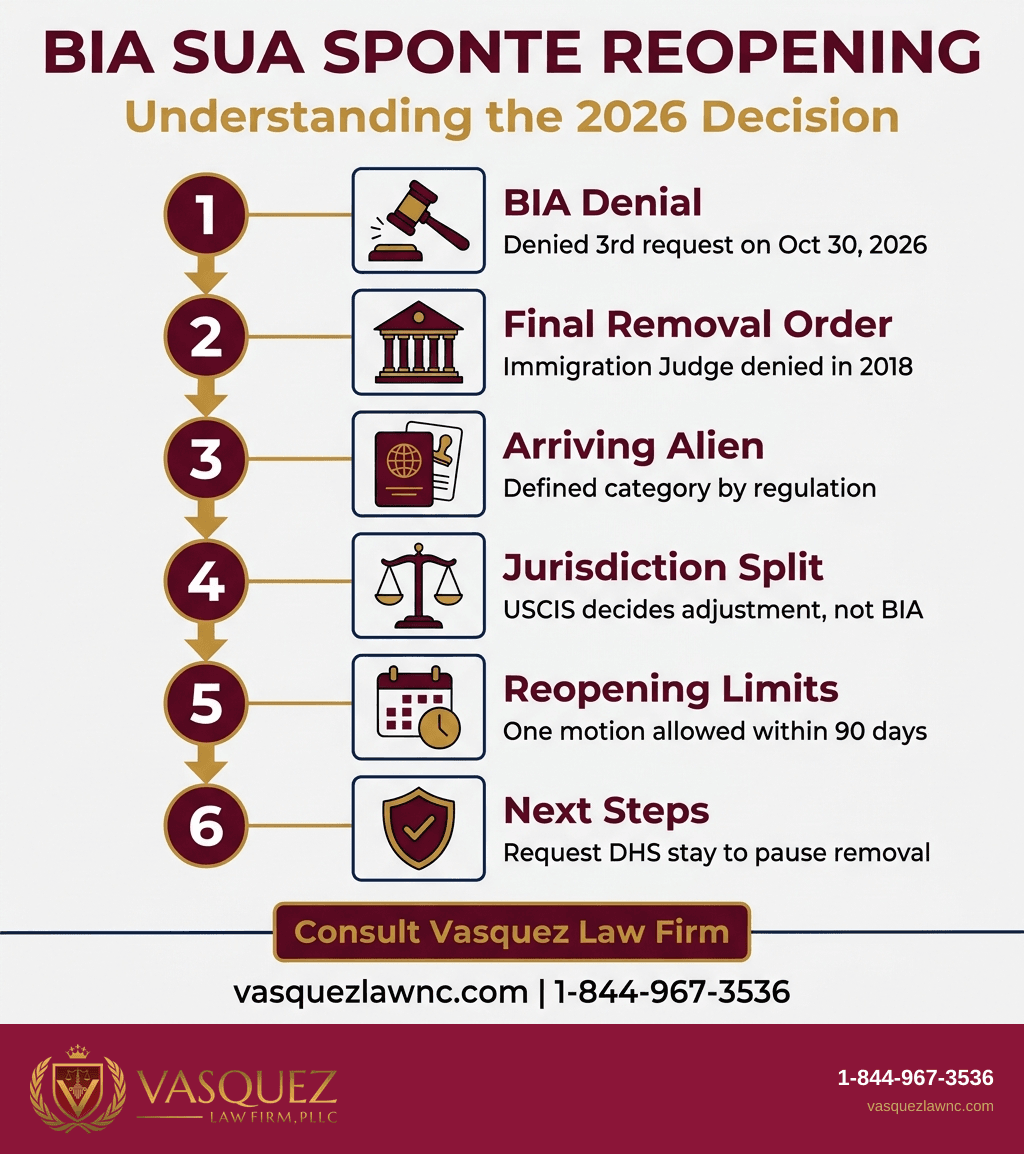
On October 30, 2026, the Board of Immigration Appeals denied a third request for BIA sua sponte reopening from a Haitian national. He wanted to pursue adjustment of status with USCIS. The decision, reported at 30 I&N Dec. 212 (BIA 2026), leaves the respondent's removal proceedings closed. This remains true despite an approved family petition. His spouse later became a United States citizen.
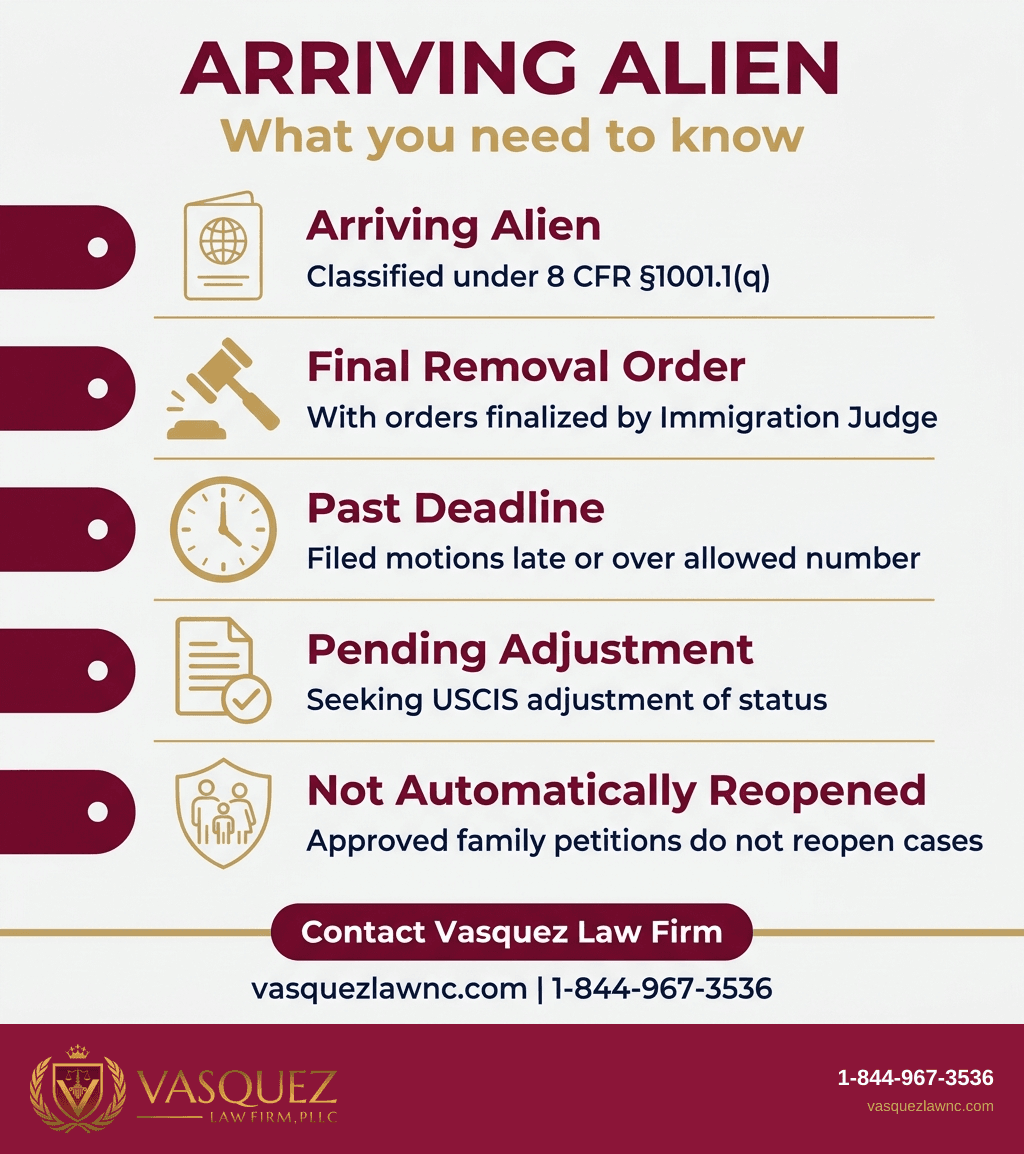
The case gives a strong warning to an arriving alien under a final removal order. An arriving alien is a defined immigration category. A pending USCIS benefit does not, by itself, give the Board an exceptional reason to reopen a case. People in this situation should understand the difference between immigration court authority and USCIS authority. They should do this before filing another motion.
Legal disclaimer: This article provides general legal information, not legal advice for any individual case. Removal orders, adjustment eligibility, and motion deadlines require case-specific review. Our immigration attorneys evaluate federal immigration matters for clients nationwide.
What did the BIA decide about sua sponte reopening on October 30, 2026?
The Board denied the respondent's March 24, 2025 motion to reopen and terminate removal proceedings. The decision is reported at 30 I&N Dec. 212 (BIA 2026). The respondent asked the Board to reopen his case on its own motion. This is called sua sponte reopening. He wanted to seek adjustment of status before USCIS.
The Board said the respondent received personal service of a Notice to Appear on February 9, 2017. The notice classified him as an arriving alien. An Immigration Judge denied his applications and ordered removal on September 19, 2018. The Board dismissed his appeal on February 3, 2021. It later denied reopening requests on March 27, 2023, and October 10, 2024.
The latest motion followed a major family change. The respondent said his lawful permanent resident wife had naturalized. Naturalization is the process of becoming a United States citizen. This change made an immigrant visa immediately available to him as an immediate relative. He also sought reopening based on his wife's psychological conditions. He described emotional and financial hardship to his wife and two children if he had to leave the country.
The Board generally will not exercise its discretion to reopen proceedings sua sponte for an arriving alien to pursue adjustment of status before United States Citizenship and Immigration Services.
The Board reaffirmed Matter of Yauri, 25 I&N Dec. 103 (BIA 2009). It decided that reopening only to let an arriving alien pursue adjustment before USCIS usually is not exceptional. The Board requires an exceptional situation for this extraordinary remedy.
This ruling concerns a Board motion. It does not concern a new adjustment application filed with USCIS. The ruling also does not reduce the importance of family-based petitions. Instead, it shows that the Board generally will not exercise its discretion to reopen proceedings sua sponte for an arriving alien to pursue adjustment of status before USCIS.
Who does the BIA sua sponte reopening decision reach?
The decision directly addresses an arriving alien with a final removal order. It also addresses someone who seeks adjustment before USCIS. The ruling addresses a request for the Board to reopen on its own authority when the motion is untimely or number barred and no applicable exception permits reopening. Untimely means filed after the allowed deadline. Number barred means the person has used the allowed number of motions.
Under 8 C.F.R. § 1001.1(q), an arriving alien is a defined immigration category. It does not mean every noncitizen who entered the United States recently.
The Board described the respondent's motion as both late and number barred. INA § 240(c)(7), 8 U.S.C. § 1229a(c)(7), generally permits one motion to reopen. The motion must be filed within 90 days of the final administrative order. The respondent filed his third motion more than four years after the Board's February 3, 2021 final order.
USCIS, rather than an Immigration Judge or the Board, has exclusive jurisdiction over an adjustment application. This applies when the respondent is classified as an arriving alien. Exclusive jurisdiction means only that agency may decide the application. The Board reached this jurisdiction conclusion in the respondent's earlier appeal. It relied on 8 C.F.R. § 1245.2(a)(1) and Matter of Silitonga, 25 I&N Dec. 89 (BIA 2009).
This division of authority can create a difficult practical problem. USCIS may be able to decide adjustment. Meanwhile, the immigration court case may remain closed under a final removal order. The Board said a person may request a stay of removal from the Department of Homeland Security. A stay temporarily pauses removal while another agency considers an application.
The request here that we reopen a case to stay proceedings while an arriving alien seeks adjustment of status before USCIS is a common situation, not an exceptional one, and does not meet this high standard.
The decision arose in the Ninth Circuit. In that circuit, Singh v. Holder, 771 F.3d 647 (9th Cir. 2014) required the Board to recognize its authority to reopen on its own motion. Even there, the Board declined to use that authority. The ruling therefore focuses on discretion. It does not say the Board has no power to act in every case.
In our experience, clients often ask one question after receiving a final order. They ask whether an approved family petition automatically reopens the immigration court case. Under this decision's reasoning, it does not. Readers considering removal defense can review how proceedings work with our immigration court hearing guide.
What law governs BIA sua sponte reopening and adjustment?
Two different reopening paths matter. A statutory motion to reopen is based on a law passed by Congress. It falls under INA § 240(c)(7), 8 U.S.C. § 1229a(c)(7). This motion generally has a one-motion limit. It also has a 90-day filing period. The regulation at 8 C.F.R. § 1003.2(c)(2) contains the related Board rules.
A sua sponte reopening request is different. Under 8 C.F.R. § 1003.2(a), the Board may reopen or reconsider a case on its own motion. The Board described this power as limited to exceptional situations. It relied on Matter of J-J-, 21 I&N Dec. 976, 984 (BIA 1997). That decision says this authority is not meant to fix filing defects. It also is not meant to bypass regulations because enforcing them causes hardship.
The Board also cited Matter of G-D-, 22 I&N Dec. 1132 (BIA 1999). That decision describes circumstances compelling enough for extraordinary action. Examples include new case law showing a dramatic departure from legal principles applied routinely. The Board concluded that the respondent's circumstances did not present an exceptional situation.
Adjustment of status is the process of seeking lawful permanent resident status without completing immigrant visa processing abroad. INA § 245(a), 8 U.S.C. § 1255(a), is the main adjustment statute. Eligibility under that statute and authority to decide an application are separate legal questions.
For arriving aliens in the situation described by the Board, 8 C.F.R. § 1245.2(a)(1) gives adjustment jurisdiction to USCIS. For that reason, the Board viewed reopening as a request to pause a final removal case. Another agency would then handle related relief. For broader background on federal immigration developments, see our 2026 immigration law update.
What should I do if I have a final removal order and a USCIS case?
Begin by collecting every immigration court and USCIS record. Include the Notice to Appear, Immigration Judge decision, Board decisions, and prior motions. Also collect receipts, approval notices, and every filing showing the status of a family petition or adjustment application.
Next, identify the exact category on the Notice to Appear. Also identify the date of the final administrative order. These facts can affect jurisdiction, reopening limits, and possible legal options. Do not assume that an approved I-130 petition ends a removal order. A naturalized spouse or a pending USCIS filing does not necessarily end it either.
Then separate the legal tasks. A USCIS adjustment case may require proof of the qualifying relationship and eligibility. A Board reopening request requires a different showing under the reopening rules. If removal is an immediate concern, the Board's decision identifies a stay request to DHS as another option. This is different from seeking sua sponte reopening.
Check official case updates through the USCIS Processing Times page when a USCIS application is pending. Processing estimates do not decide whether a removal order remains enforceable. Use them only as one part of a complete case review.
Carefully preserve proof of family changes and hardship. Marriage records, naturalization records, medical documentation, and financial records may matter. Evidence about children may also matter to a particular filing. Organize these documents truthfully. Review them against the correct procedural option. Do not treat them as an automatic reopening trigger.
A final order deserves a careful procedural review. Vasquez Law Firm offers a free immigration evaluation. Se Habla Español. We meet immigration clients in Raleigh, NC and Orlando, FL, and assist clients nationwide.
What should I watch after this BIA sua sponte reopening decision?
The immediate rule is narrow but important. The Board generally will not use sua sponte reopening for an arriving alien seeking adjustment before USCIS. This applies when the motion is untimely or number barred. A final removal order remains a serious procedural fact. It remains effective unless an authorized agency action changes it.
Watch for future Board precedent applying or distinguishing this decision. Pay special attention to a motion claiming an exceptional circumstance beyond a pending USCIS adjustment application. The Board's decision also confirms that circuit law can affect the analysis. The Board applied Singh v. Holder in this Ninth Circuit case.
For USCIS policy materials, use the USCIS Policy Manual. For developments in a pending removal case, keep copies of every Board, Immigration Court, DHS, and USCIS notice. The Board decided that this respondent's circumstances were not exceptional enough for sua sponte reopening; whether different circumstances warrant reopening requires a case-specific assessment.
Frequently Asked Questions
What is BIA sua sponte reopening?
BIA sua sponte reopening is when the Board of Immigration Appeals considers reopening a case on its own motion under 8 C.F.R. § 1003.2(a). It differs from an ordinary motion to reopen filed under INA § 240(c)(7). In this decision, the Board said this extraordinary authority is limited to exceptional situations.
Why did the Board deny reopening in this case?
The Board found that the third motion was both untimely and number barred. It also found that an arriving alien's effort to pursue adjustment of status before USCIS was a common circumstance, not an exceptional one. The respondent's spouse's naturalization and claimed family hardship did not lead the Board to exercise sua sponte authority.
Can an approved I-130 petition reopen a removal case?
An approved family petition can be important evidence of a qualifying relationship, but it did not automatically reopen proceedings in this case. The respondent argued that an immigrant visa had become immediately available after his wife naturalized. The Board still denied reopening because the request did not meet its exceptional-situation standard.
Who decides adjustment of status for an arriving alien?
The Board stated that USCIS has exclusive jurisdiction over adjustment applications filed by respondents classified as arriving aliens. It cited 8 C.F.R. § 1245.2(a)(1) and Matter of Silitonga. That allocation of authority was central to the Board's decision not to reopen proceedings merely to await USCIS adjudication.
What is the normal deadline for a motion to reopen?
INA § 240(c)(7) generally allows one motion to reopen filed within 90 days after the final administrative order. The Board applied those limits in this decision and noted that the respondent filed a third motion more than four years after his final order. Statutory and regulatory exceptions can affect individual cases.
Can someone request a stay of removal while USCIS decides a case?
Yes. The Board stated that people may request a stay of removal from DHS while an application is adjudicated. A stay request and a motion to reopen are separate procedural tools. Their requirements, decision-makers, and effects differ, which is why the record and current posture of the case should be reviewed carefully.
Do not rely on assumptions about a final removal order. Contact Vasquez Law Firm for a free evaluation of your immigration options. This information is general and is not individualized legal advice.
Sources
Reviewed by Attorney Vasquez, Managing Attorney
Facing Deportation?
Time is critical. Our deportation defense attorneys are available 24/7 for emergency cases.
Keep Reading


William Vasquez
Founder & CEO, Vasquez Law Firm, PLLC
William Vasquez is the founder and CEO of Vasquez Law Firm, PLLC, a results-driven firm specializing in immigration, criminal defense, personal injury, and workers' compensation. A U.S. Air Force veteran and recipient of the Joint Service Achievement Medal, William is dedicated to fiercely fighting for his clients' rights.
Related Legal Services
Need legal help? Learn more about immigration case consultation, or contact us for a free evaluation.
You can also visit statewide immigration attorneys for more information.