BIA Reverses Cancellation of Removal Grant
Cancellation of removal can be denied despite strong family ties. See the 2026 BIA ruling and request a free evaluation now with counsel.
Published on October 29, 2026· Updated October 29, 2026
Talk to an immigration attorney
Free call. A clear plan for your case.
Free & confidential · Se habla espanol · Mon-Fri 8am-7pm, Sat 9am-2pm (ET)
Have questions? Talk to an attorney - free evaluation.
Call 1-844-967-3536Worried how the latest immigration news affects you?
Schedule a confidential case review with an immigration attorney - know exactly where you stand.
USCIS Case Status
Check your USCIS case status
Enter your receipt number and get the official status. Free, no registration.
Disclaimer: This article provides general legal information, not individualized legal advice. Immigration outcomes depend on the record in each case.
The Attorney General designated Matter of Guanrong Yang, 30 I&N Dec. 199 (BIA 2026), as precedent in all proceedings involving the same issue or issues. The decision reversed a grant of cancellation of removal. Cancellation of removal is a request to stop deportation and keep lawful status. The Board of Immigration Appeals found that serious and recent adverse factors outweighed the applicant's positive equities. Equities are facts that support the applicant.
The case gives lawful permanent residents a clear warning. Meeting the threshold rules for cancellation of removal may not end the analysis. The applicant must also persuade the immigration judge to exercise discretion favorably. Discretion means the power to choose whether to grant relief when the legal requirements are met.
For people facing deportation, the ruling illustrates how serious and recent criminal conduct can outweigh favorable equities. The record may include family ties, residence, work history, taxes, remorse, and rehabilitation. Rehabilitation means evidence that a person has changed and addressed past conduct. A timely review by immigration attorneys can help identify which evidence belongs in that record before a hearing.
What happened in the 2026 cancellation of removal decision?
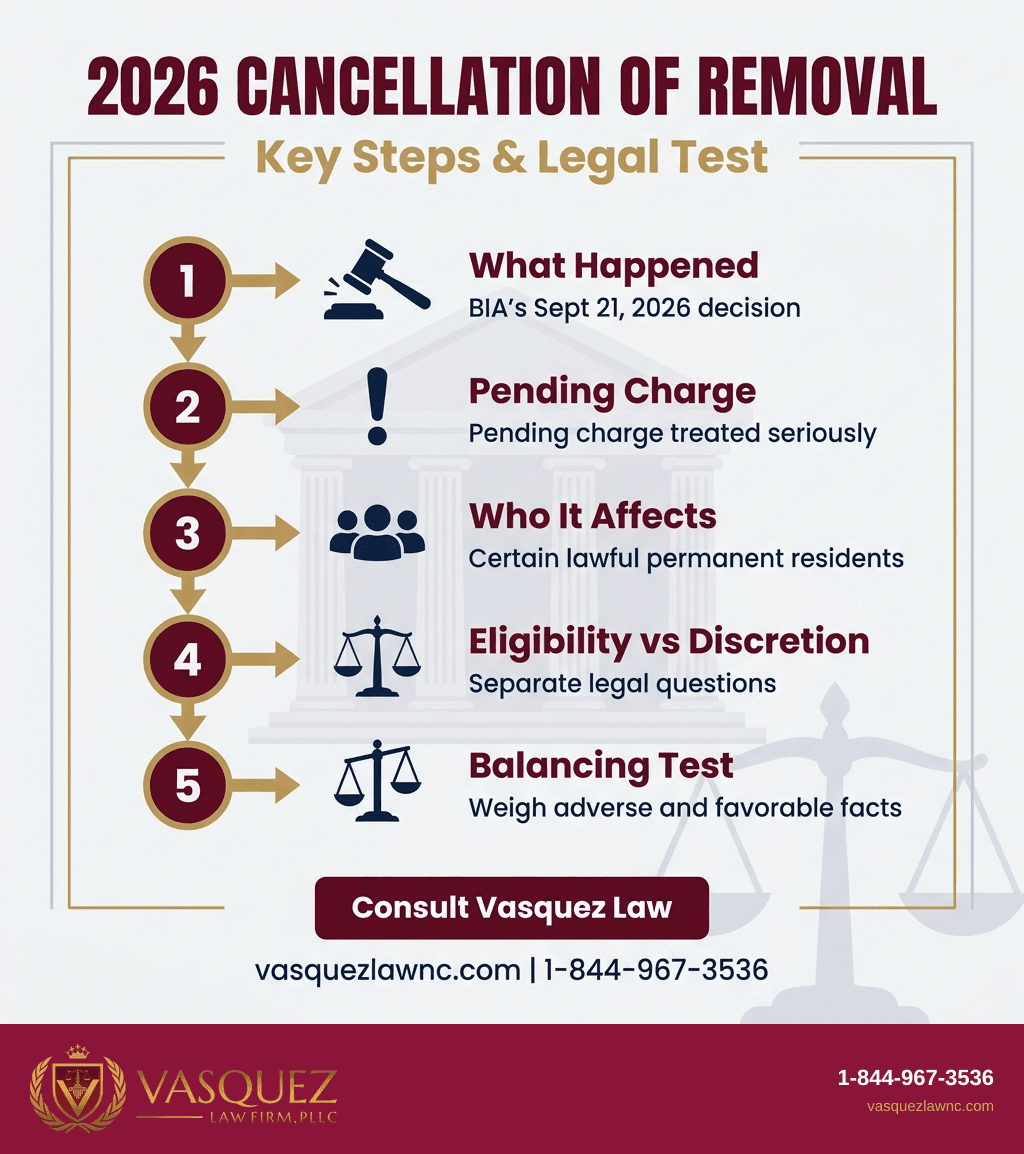
The Board of Immigration Appeals decided Matter of Guanrong Yang on September 21, 2026. The Attorney General later designated it as precedent under Order No. 7271-2026. The designation was dated October 27, 2026. It was issued pursuant to 8 C.F.R. § 1003.1(g)(3). “Pursuant to” means under or according to.
The Department of Homeland Security appealed an immigration judge's September 15, 2025 decision. That decision granted cancellation of removal under INA § 240A(a), 8 U.S.C. § 1229b(a). The Board sustained the appeal, reversed the grant, and ordered the respondent removed to China.
The respondent is required to demonstrate statutory eligibility for relief from removal and that he merits a favorable exercise of discretion.
The Board reviewed the discretionary question anew. In other words, it considered that question again. It concluded that the immigration judge did not adequately consider the nature, recency, and seriousness of the respondent's record.
The record included four arrests in the five years before the hearing. It also included a 2022 Arkansas conviction for possession of a controlled substance with purpose to deliver marijuana. In 2023, the respondent was convicted in Oklahoma of cultivation of a controlled substance and trafficking in illegal drugs.
While on Oklahoma probation, the respondent left the state and traveled to California, according to the decision. A warrant issued over that probation violation. He was then arrested on a separate domestic violence charge. That charge remained pending at the hearing.
Why did the pending charge matter?
The Board treated the alleged conduct behind the pending case as a serious negative factor. It relied on Matter of Pinzon. That case permits consideration of criminal conduct in a discretionary assessment, even without a resulting conviction.
The Board recognized favorable facts. They included employment, tax payments, accountability, remorse, character witnesses, family ties, hardship, residence, and work history. Still, it found that the serious adverse factors outweighed those equities.
Who can this cancellation of removal ruling affect?
Matter of Guanrong Yang concerns cancellation of removal for certain lawful permanent residents under INA § 240A(a). Its reasoning matters in proceedings involving the same issues. One issue is whether an otherwise eligible permanent resident merits relief as a matter of discretion.
The decision does not turn cancellation of removal into an automatic denial for every person with an arrest or conviction. It requires decision-makers to balance adverse factors against favorable equities. It also requires meaningful attention to the seriousness and recency of criminal conduct.
Eligibility and discretion are separate questions
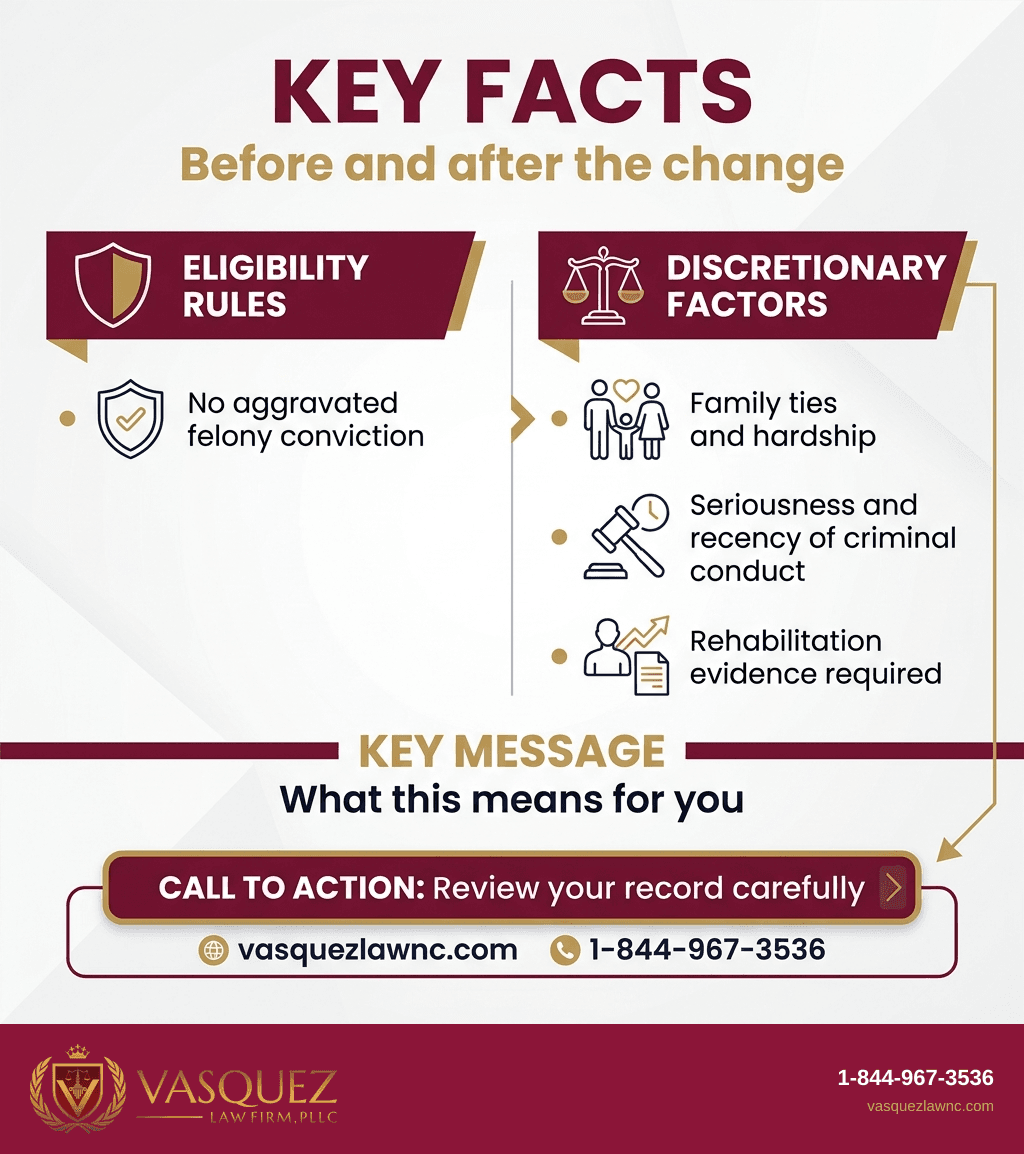
A permanent resident seeking this form of cancellation must show lawful permanent residence for at least five years. The person must also show continuous residence in the United States for seven years after admission in any status. The person must have no aggravated-felony conviction. An aggravated felony is a serious conviction that immigration law treats as a bar to this relief. These are statutory eligibility requirements identified in 8 U.S.C. § 1229b(a).
Then comes discretion. The Board cited family ties, family hardship, length of residence, employment history, criminal conduct, and rehabilitation as relevant considerations. A person can satisfy the initial eligibility rules yet lose on discretion. Here, the Board denied relief on discretionary grounds without deciding the disputed aggravated-felony eligibility issue.
The Board also repeated that a person with a criminal record will ordinarily need evidence of rehabilitation before discretionary relief is granted. Documents may show completed conditions, treatment, community support, steady work, accountability, and changed conduct. Such documents may therefore carry practical importance. Their weight depends on the whole record.
In our experience, the cases we handle often turn on whether a client began collecting rehabilitation and family-hardship evidence before the immigration court record closed.
This ruling is especially relevant where an applicant has recent convictions, unresolved criminal allegations, probation concerns, or multiple incidents. It also shows why applicants should not assume favorable testimony alone will overcome serious adverse facts.
What does the law require for cancellation of removal?
INA § 240A(a), codified at 8 U.S.C. § 1229b(a), provides cancellation of removal for qualifying lawful permanent residents. “Codified” means placed into the United States Code. Cancellation of removal is a form of relief from removal.
Under INA § 240(c)(4)(A), 8 U.S.C. § 1229a(c)(4)(A), the applicant bears the burden to establish eligibility and show that relief should be granted. The burden of proof is the duty to provide enough evidence to support the request. The same burden appears in 8 C.F.R. § 1240.8(d).
How does the balancing test work?
The Board described discretionary review as a balance. On one side are adverse factors showing that the person may be undesirable as a permanent resident. On the other side are favorable equities presented by the applicant. It cited Matter of Marin, Matter of Arai, and Matter of Mendez for that framework.
For serious criminal offenses, Matter of Buscemi explains that unusual or outstanding countervailing equities may be needed. Countervailing equities are strong favorable facts that answer or outweigh negative facts. Matter of C-V-T- identifies factors including family ties, hardship, long residence, employment, the seriousness and recency of criminal activity, and rehabilitation.
The Board reviews discretionary issues de novo under 8 C.F.R. § 1003.1(d)(3)(ii). “De novo” means that the Board reviews the issue anew. That means it may assign different weight to evidence than the immigration judge assigned. The immigration judge had found the favorable equities stronger.
Considering our conclusion that the respondent does not merit relief as a matter of discretion, we need not reach DHS’ remaining arguments on appeal regarding the respondent’s disqualifying aggravated felony.
That sentence matters because the Board resolved the appeal on discretion. It did not decide the separate aggravated-felony argument.
What should I do if I seek cancellation of removal?
Start by separating eligibility evidence from discretionary evidence. Gather proof of permanent resident status, admission history, and continuous residence. Then review every criminal court record carefully. This review should include charging papers, judgments, plea records, sentencing documents, probation records, and evidence of case completion.
Build the favorable record with documents that can be verified. Relevant materials may include tax records and employment history. They may also include letters from people with direct knowledge of your character. Proof of family relationships can help. Evidence showing hardship to relatives if removal occurs can also help.
Where rehabilitation is an issue, preserve records of counseling, treatment, classes, compliance with criminal-court requirements, community involvement, and concrete changes after an incident. Do not minimize prior conduct in sworn testimony. The Yang decision gave weight to accountability and remorse. It found that they did not outweigh the adverse record.
Ask an attorney to examine whether the conviction language and court documents affect statutory eligibility, not only discretion. This distinction can shape the legal arguments. It can also shape the evidence needed for immigration court.
Need to assess your cancellation of removal record? Vasquez Law Firm offers a free evaluation for immigration matters. Meet with our team in Raleigh, NC and Orlando, FL, or discuss your federal immigration case remotely. Request your free evaluation. Se Habla Español.
For related immigration-court preparation, review our discussion of deportation defense and current immigration law developments. A careful file review is more useful than relying on general assumptions about a cancellation of removal success rate.
What should cancellation of removal applicants watch next?
The precedent designation says the decision applies in proceedings involving the same issue or issues.
The rule today is that statutory eligibility and favorable discretion are separate requirements. A favorable decision at the immigration judge level can be reviewed by the Board. The Board may weigh the evidence differently on discretionary questions.
It is not predetermined in any individual case how much weight a particular conviction, pending allegation, rehabilitation record, or family hardship evidence will receive. That assessment remains fact-specific under the balancing framework.
These include Matter of Guanrong Yang, 30 I&N Dec. 199 (BIA 2026). Immigration-court cancellation cases are decided through EOIR proceedings.
Frequently Asked Questions
Can deportation be cancelled for a green card holder?
Yes, a qualifying lawful permanent resident may seek cancellation of removal under INA § 240A(a). The applicant must meet the residence and aggravated-felony requirements, then show that discretion should be exercised favorably. Yang shows that satisfying threshold requirements alone may not be enough when serious adverse factors outweigh the positive record.
What is the seven-year rule for immigration cancellation?
For permanent-resident cancellation under 8 U.S.C. § 1229b(a), the applicant must have resided continuously in the United States for seven years after admission in any status. The statute also requires at least five years as a lawful permanent resident and no aggravated-felony conviction. Each requirement must be evaluated alongside discretionary factors.
Can a pending criminal case affect cancellation of removal?
It can. In Yang, the Board treated conduct connected with a pending domestic violence case as a serious negative factor despite the absence of a conviction at the hearing. The Board relied on prior precedent allowing criminal conduct to be considered in a discretionary determination even when it did not result in conviction.
Does rehabilitation matter in cancellation of removal?
Yes. The Board stated that a person with a criminal record ordinarily will need rehabilitation evidence before discretionary relief is granted. In Yang, the respondent's accountability and remorse were favorable facts. They did not overcome the Board's assessment of the recent and serious adverse record, showing why detailed rehabilitation evidence matters.
What happens after cancellation of removal is granted?
A grant can still be reviewed on appeal. In Yang, an immigration judge granted cancellation of removal, but DHS appealed. The Board reviewed discretion de novo, reversed the immigration judge's decision, and ordered removal. Applicants should preserve a complete record because both eligibility and discretionary findings may be examined on appeal.
Is cancellation of removal the same as a green card application?
No. Permanent-resident cancellation under INA § 240A(a) is relief sought in removal proceedings by a person who already has lawful permanent resident status. The question is whether that status and relief should be preserved despite removal charges.
Where can I read the official decisions and guidance?
Disclaimer: This is general information, not legal advice for your facts. If removal proceedings or a criminal record may affect your status, contact Vasquez Law Firm for a free immigration consultation. Our nationwide immigration legal team can review your options. Schedule a free consultation.
Reviewed by Attorney Vasquez, Managing Attorney
Facing Deportation?
Time is critical. Our deportation defense attorneys are available 24/7 for emergency cases.
Keep Reading


William Vasquez
Founder & CEO, Vasquez Law Firm, PLLC
William Vasquez is the founder and CEO of Vasquez Law Firm, PLLC, a results-driven firm specializing in immigration, criminal defense, personal injury, and workers' compensation. A U.S. Air Force veteran and recipient of the Joint Service Achievement Medal, William is dedicated to fiercely fighting for his clients' rights.
Related Legal Services
Need legal help? Learn more about our immigration legal services, or contact us for a free evaluation.
You can also visit immigration lawyers serving all of North Carolina for more information.