How the Proposed H-1B Cap Petition Fee Would Work
DHS proposed a $103,265 fee on H-1B cap-subject petitions to help cover immigration system costs. It is not final yet. See who would pay.
Published on October 13, 2026
Talk to an immigration attorney
Free call. A clear plan for your case.
Free & confidential · Se habla espanol · 24/7

Have questions? Talk to an attorney - free evaluation.
Call 1-844-967-3536Worried how the latest immigration news affects you?
Schedule a confidential case review with an immigration attorney - know exactly where you stand.
USCIS Case Status
Check your USCIS case status
Enter your receipt number and get the official status. Free, no registration.
This article provides general legal information, not individualized legal advice. Reading does not create an attorney-client relationship. For advice specific to your situation, contact Vasquez Law Firm.
What is the proposed fee for certain H-1B petitions announced by DHS in 2026?
Need a Work Visa or Permit?
H-1B, TN, L-1, and more. We help workers and employers navigate the visa process.
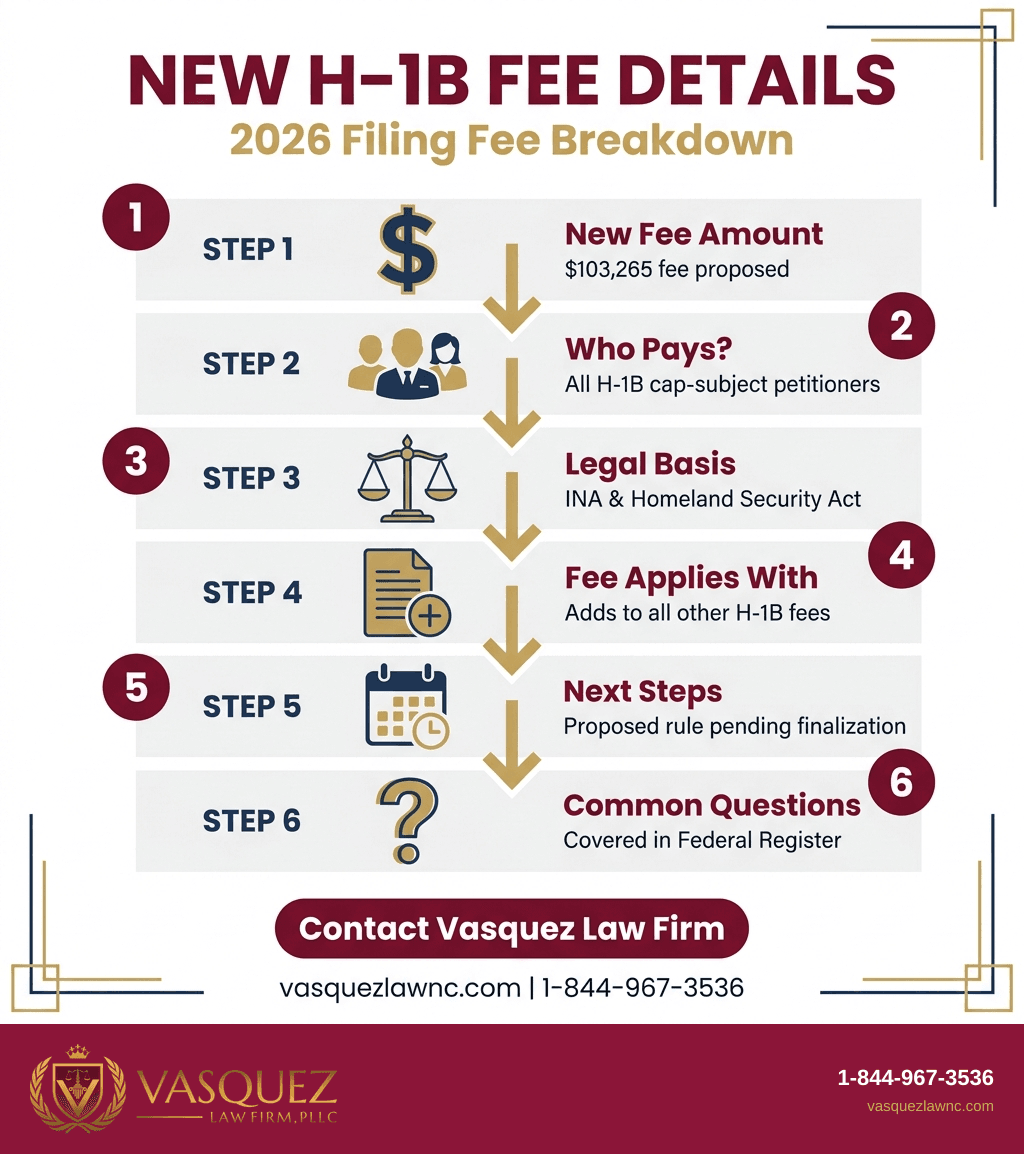
The Department of Homeland Security (DHS) has proposed a new fee of $103,265. This proposed fee would apply to all H-1B cap-subject petitions, including those eligible for the advanced degree exemption. An H-1B cap-subject petition is a request covered by the yearly limit on H-1B visas. The advanced degree exemption covers certain people with a U.S. master’s degree or a higher degree.
The $103,265 fee would be imposed in addition to all other applicable fees or payments. DHS states that the proposed fee would serve as a dedicated revenue mechanism to help recover a portion of the federal government's costs of administering the lawful immigration system, including activities carried out by DHS, the U.S. Department of Justice (DOJ), the U.S. Department of State (DOS), and the U.S. Department of Labor (DOL).
The proposed fee is a separate charge. Petitioners would have to pay it at the time of filing the H-1B cap-subject petition, if DHS issues a final rule. DHS says the fee would support work by several federal agencies, including USCIS, U.S. Customs and Border Protection (CBP), Immigration and Customs Enforcement (ICE), the Executive Office for Immigration Review (EOIR), the Department of State (DOS), and the Department of Labor (DOL).
The fee would be imposed in addition to all other applicable fees or payments, including any separate payment obligation required under a Presidential Proclamation.
The proposal appears in the Federal Register under DHS Docket No. USCIS-2026-0298. DHS says the fee would create a steady source of money to cover the costs of administering immigration cases and related services.
DHS states:
"The Department of Homeland Security (DHS) proposes to establish a $103,265 fee, payable at the time of filing, for all H-1B cap-subject petitions, including those eligible for the advanced degree exemption, which would be imposed in addition to all other applicable fees or payments." (Source: DHS, https://www.federalregister.gov/documents/2026/08/25/2026-17324/fee-for-certain-h-1b-petitions)
This proposed fee is different from current H-1B petition fees. DHS says it would help track money and direct it toward the costs described in the proposed rule.
Who would be affected by the proposed H-1B petition fee and how would it apply?
The proposed $103,265 fee would apply only to H-1B cap-subject petitions filed with USCIS. The annual numerical cap limits this group to 65,000 visas, with an additional 20,000 exemptions for beneficiaries with a U.S. master’s or higher degree (the advanced degree exemption). A beneficiary is the person who would receive the immigration benefit.
The proposed fee would not apply to cap-exempt H-1B petitions. A cap-exempt petition is not covered by the annual H-1B numerical limit.
If DHS issues a final rule, petitioners would have to pay the proposed fee along with all other applicable fees. A petitioner is the employer or other person filing the petition. Employers that sponsor foreign workers under the H-1B cap should plan for this large added cost if the rule is finalized.
The proposal would apply nationwide to every petitioner filing a cap-subject petition. DHS says it chose H-1B cap-subject petitioners because they usually have more financial resources than other immigration benefit requesters. DHS considered sharing these costs among all immigration benefit applicants but rejected that approach, citing fairness and the ability to pay.
The rule clarifies:
"For the reasons provided in this notice, DHS is proposing to add a fee at 8 CFR 106.2(a)(3)(xii) that would apply only to H-1B cap-subject petitions, including those eligible for the advanced degree exemption (not to all H-1B petitions such as cap-exempt filings)." (Source: DHS, https://www.federalregister.gov/documents/2026/08/25/2026-17324/fee-for-certain-h-1b-petitions)
An employer that files several H-1B cap-subject petitions would have to pay the proposed fee for each petition if the rule is finalized. The proposed fee would be in addition to all other applicable fees or payments.
What legal authority supports the proposed H-1B petition fee?
DHS relies on authority under the Immigration and Nationality Act (INA) and the Homeland Security Act of 2002. The INA is the federal law that governs immigration and nationality matters.
More specifically, section 286(m) of the INA (8 U.S.C. 1356(m)) gives the Secretary of Homeland Security authority to set fees for providing adjudication and naturalization services at a level that will ensure recovery of the full costs of providing all such services. DHS says this authority covers more than USCIS costs and includes costs for other federal agencies involved in the immigration system, such as CBP, ICE, EOIR, DOS, and DOL.
DHS intends the proposed fee to cover several kinds of work, including adjudication, enforcement, vetting, records management, and coordination between agencies.
DHS explains the legal basis as follows:
"The Secretary's authority for these proposed regulatory amendments is found in various sections of the INA, 8 U.S.C. Titles I-V, and the Homeland Security Act of 2002 (HSA), Public Law 107-296, 116 Stat. 2135 (codified in part at 6 U.S.C. 101 et seq.)." (Source: DHS, https://www.federalregister.gov/documents/2026/08/25/2026-17324/fee-for-certain-h-1b-petitions)
The government has used this authority before to fund USCIS through user fees deposited into the Immigration Examinations Fee Account (IEFA). The proposed fee would extend cost recovery to several agencies for costs related to the H-1B program.
What should petitioners do regarding the proposed H-1B fee?
Petitioners filing H-1B cap-subject petitions should monitor the status of the proposed rule. The proposed fee of $103,265 would be due at the time of filing the petition if DHS issues a final rule. The amount would be in addition to all other applicable fees or payments.
DHS has stated that the proposed fee would be imposed in addition to all other applicable fees or payments. Petitioners should review the proposed rule text at https://www.federalregister.gov/documents/2026/08/25/2026-17324/fee-for-certain-h-1b-petitions and watch for any final rule. Petitioners should also monitor USCIS announcements and regulatory updates for changes and instructions about implementation.
Careful planning is essential. Experienced counsel can help employers follow the rules and avoid costly mistakes. Employers should review all fees before filing and confirm the payment requirements if a final rule is issued.
What happens next with the proposed H-1B petition fee rule?
The public comment period for the proposed rule closed on September 24, 2026. The proposed fee is not in effect unless DHS issues a final rule. DHS may revise the rule after reviewing the comments and may then issue a final rule. The final rule would state its effective date. The proposed fee would become mandatory on that date, if the final rule keeps the fee.
DHS recognizes that the proposed fee would have a significant effect. DHS expects the higher cost could reduce some H-1B cap registrations and filings, but also expects the fee to produce the money needed for immigration system costs, depending on filing numbers meeting projections.
What's Your Immigration Situation?
Answer 3 questions - we'll tell you your options
Question 1 / 3
What best describes your situation?
Keep Reading

The rulemaking process also considers related fee rules and policies. DHS is considering these matters to coordinate the overall immigration fee structure.
DHS states:
"DHS acknowledges that the scope of the proposed fee increase in this rule is significant... DHS anticipates this proposed fee would generate the necessary revenue provided filing volumes do not fall short of those projected herein... Balancing the goals of administering the lawful immigration programs using fee revenue, DHS has made considered judgments about how to receive the needed funds using available and appropriate means." (Source: DHS, https://www.federalregister.gov/documents/2026/08/25/2026-17324/fee-for-certain-h-1b-petitions)
Stakeholders should watch the Federal Register and USCIS communications for any final rule and its effective dates. Preparing early can help petitioners avoid interruptions and plan for the potential new cost.
What are common questions about the proposed H-1B petition fee?
Who would have to pay the proposed $103,265 H-1B fee?
All petitioners filing H-1B cap-subject petitions, including those eligible for the advanced degree exemption, would have to pay the proposed fee if DHS issues a final rule. Cap-exempt petitions would not be subject to this fee.
Is the proposed fee in addition to existing H-1B fees?

Yes, the proposed fee would be imposed in addition to all other applicable fees or payments.
When would the proposed fee take effect?
The proposed fee is not in effect unless DHS issues a final rule. The public comment period closed September 24, 2026. If DHS issues a final rule, it will specify the effective date.
How does this proposed fee relate to the H-1B cap lottery process?
The proposed fee would apply at the time of filing the H-1B cap-subject petition after selection in the lottery, if DHS issues a final rule. The proposed fee would not apply to the initial electronic registration.
This article provides general legal information, not individualized legal advice. Reading does not create an attorney-client relationship. For advice specific to your situation, contact Vasquez Law Firm.
For more information on immigration benefits and fees, visit our immigration practice area. To understand how we research this content, see our editorial policy. Meet our team at Vasquez Law Firm attorneys.
Reviewed by William Vasquez, Founder & CEO, Vasquez Law Firm, PLLC.

William Vasquez
Founder & CEO, Vasquez Law Firm, PLLC
William Vasquez is the founder and CEO of Vasquez Law Firm, PLLC, a results-driven firm specializing in immigration, criminal defense, personal injury, and workers' compensation. A U.S. Air Force veteran and recipient of the Joint Service Achievement Medal, William is dedicated to fiercely fighting for his clients' rights.
Related Legal Services
Need legal help? Learn more about immigration case consultation, or contact us for a free evaluation.
You can also visit immigration attorneys across North Carolina for more information.