L-1 Visas for Intracompany Transfers Build U.S. Teams
Need L-1 Visas for Intracompany Transfers? Review executive, manager, new office, family, and fee rules. Request a free evaluation today.
Published on October 30, 2026· Updated October 30, 2026
Talk to an immigration attorney
Free call. A clear plan for your case.
Free & confidential · Se habla espanol · Mon-Fri 8am-7pm, Sat 9am-2pm (ET)
Have questions? Talk to an attorney - free evaluation.
Call 1-844-967-3536Worried how the latest immigration news affects you?
Schedule a confidential case review with an immigration attorney - know exactly where you stand.
USCIS Case Status
Check your USCIS case status
Enter your receipt number and get the official status. Free, no registration.
L-1 Visas for Intracompany Transfers Build U.S. Teams
An L-1A petition may let a qualifying company transfer an executive or manager from a related foreign business to a U.S. office. L-1 Visas for Intracompany Transfers may also support a planned U.S. office. The employer must prove the company relationship. It must also prove qualifying work abroad and the proposed executive or managerial role.
Business immigration consultations with Vasquez Law Firm are available by Zoom or phone. Attorney William J. Vasquez can discuss your options in a free consultation. Se Habla Español.
Call 1-844-967-3536.
Quick Answer
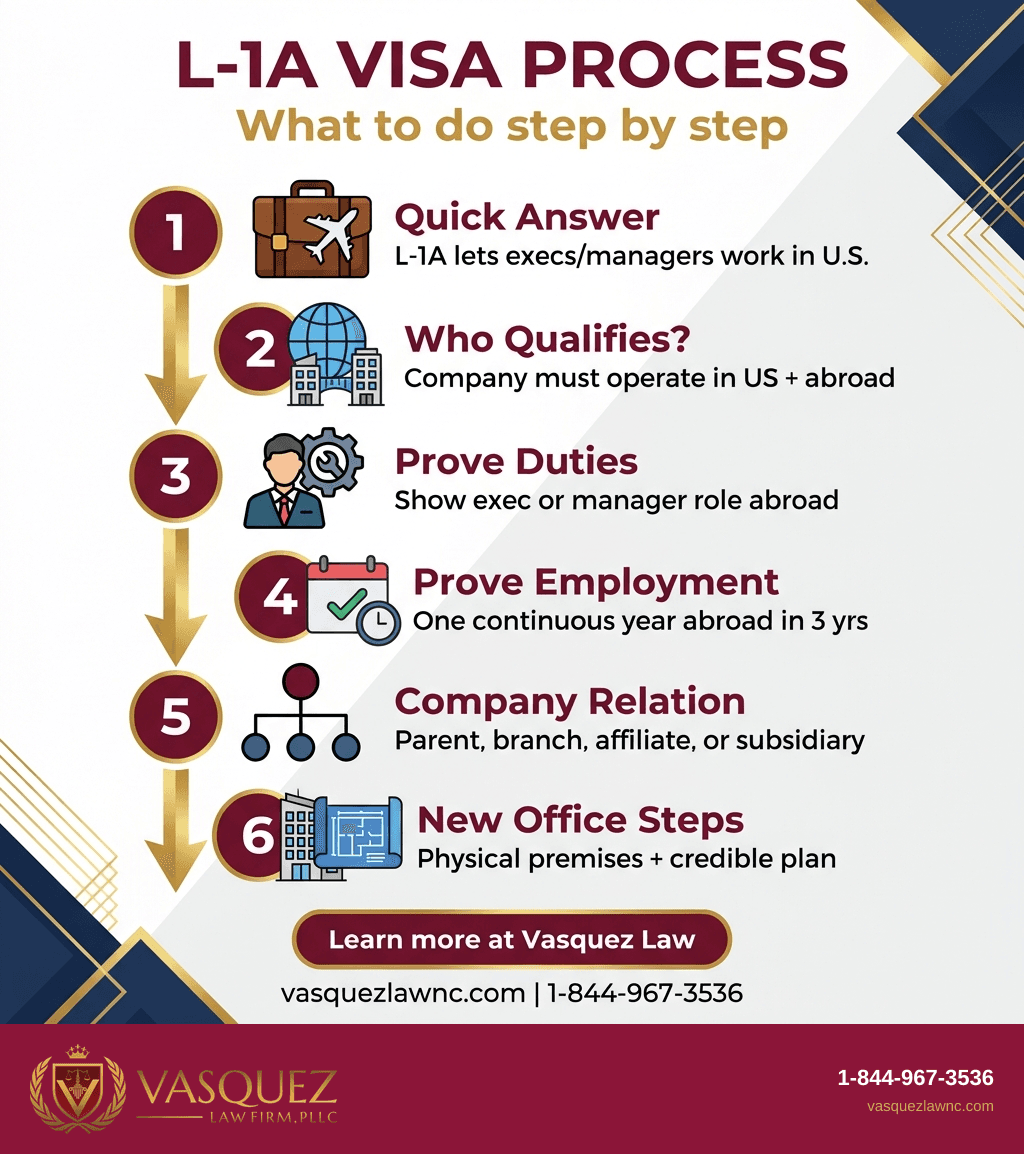
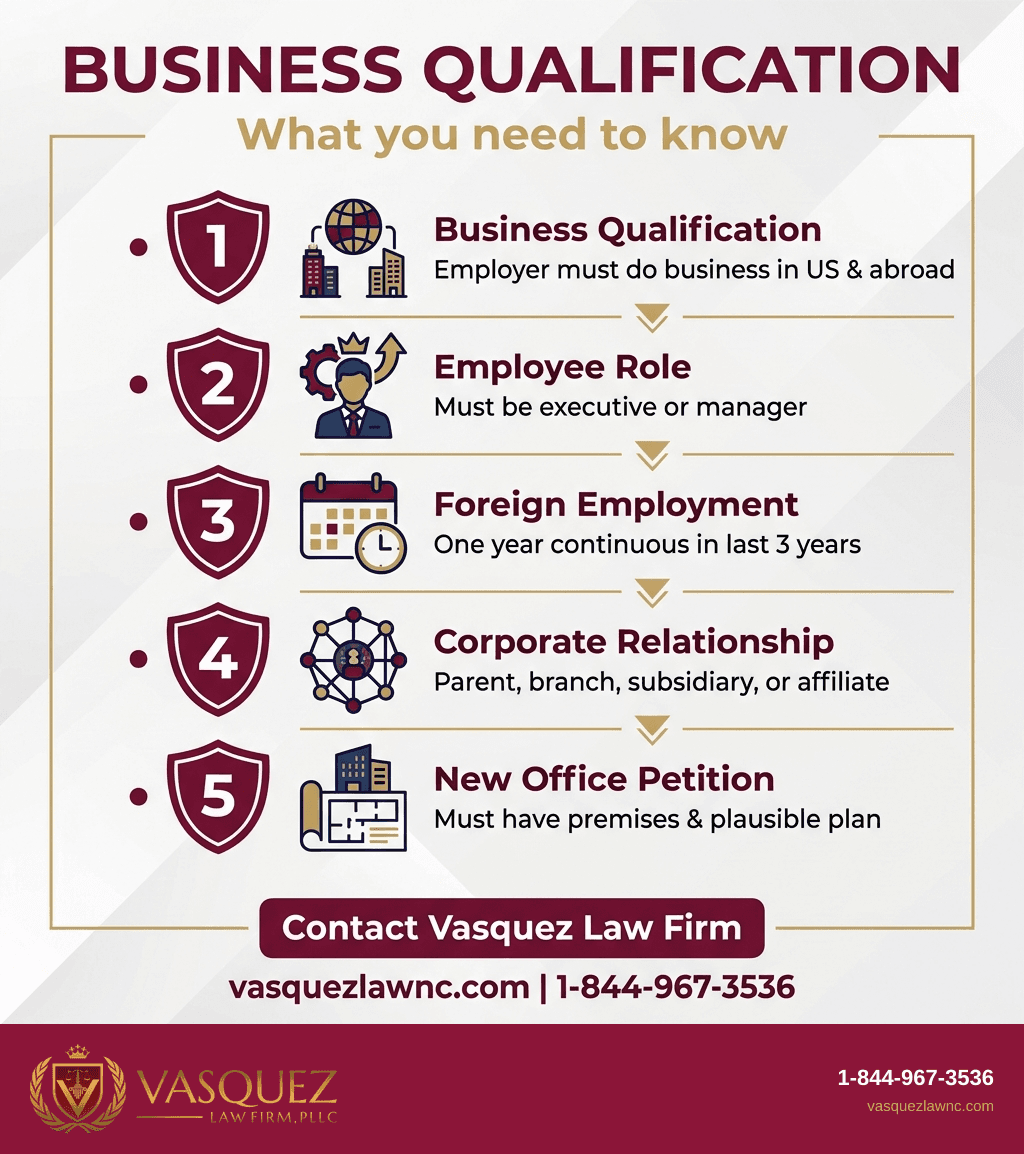
L-1 Visas for Intracompany Transfers let qualifying organizations move certain executives and managers to a related U.S. business. The employer files Form I-129. The worker generally needs one continuous year of qualifying foreign employment during the three years immediately before admission. A new office requires premises and a credible plan to support the role within one year of the petition’s approval.
- L-1A is for executives and managers.
- The U.S. and foreign entities need a qualifying relationship.
- New offices have a different initial stay period.
- L-2 spouses may work incident to status when properly documented.
Who can qualify for an L-1A visa?
A company with a parent, branch, subsidiary, or affiliate abroad may qualify to transfer an executive or manager. USCIS calls these connected businesses qualifying organizations. The employer must currently be, or will be, doing business in the United States and at least one other country, directly or through a qualifying organization, for the duration of the worker's L-1 stay.
The L-1A nonimmigrant classification enables a U.S. employer to transfer an executive or manager from one of its affiliated foreign offices to one of its offices in the United States.
Doing business means regularly, systematically, and continuously providing goods or services. A simple office or agent is not enough. This difference matters for L1 visa requirements. Corporate records alone may not prove real business activity.
Executive and manager duties
INA § 101(a)(44) and 8 C.F.R. § 214.2(l)(1)(ii) define executive and managerial capacity. An executive has broad power to make decisions with limited supervision. A manager may supervise professional staff. A manager may also run an organization or part of one. The manager may manage an essential function at a high level without directly supervising other people.
For help reviewing an L-1A visa petition, see the firm's business immigration services. Immigration rules are federal. They apply nationwide.
What foreign employment must intracompany transferees prove?
One continuous year is the main employment requirement. The named employee generally must have worked abroad for a qualifying organization for one continuous year during the three years immediately before admission to the United States. The planned U.S. job must also be executive or managerial.
Employment records should link the worker's foreign duties to the U.S. job. Helpful records often include organizational charts, job descriptions, payroll records, proof that the foreign business operates, and documents showing who made important decisions. A job title alone is not enough. The record should show the worker's real duties and authority.
The corporate relationship
A petition should clearly explain the relationship between the U.S. and foreign businesses. State whether the connection is a parent, branch, subsidiary, or affiliate. A consistent ownership record helps USCIS decide whether the organizations qualify.
Cases we handle often include a missing document about an ownership change or the employee's actual management duties. A careful filing should connect the company records, staffing structure, and worker's role. It should not treat these facts as separate issues.
USCIS discusses L-1 classifications in its Policy Manual. A separate L1B visa requirements analysis applies to specialized knowledge workers. It is not the same as an L-1A executive or manager filing.
How does a new office L-1A petition work?
A foreign company may send an executive or manager to create a related U.S. office. This option is available even if the foreign company does not yet have a related U.S. office. The new office filing must show physical premises large enough for the operation.
The intended U.S. office will support an executive or managerial position within one year of the approval of the petition.
Under 8 C.F.R. § 214.2(l)(3)(v), the company must also show that the employee worked as an executive or manager for one continuous year during the three years before filing. The initial stay for a new office is limited to one year. Other qualified L-1A employees may receive an initial stay of up to three years.
New office checklist
- Evidence of secured physical premises.
- Documents showing the qualifying corporate relationship.
- Records of the employee's qualifying foreign employment.
- A business plan and operating evidence showing the U.S. office can support an executive or managerial position within one year of the approval of the petition.
- A detailed U.S. job description tied to the planned structure.
People considering a U.S. L1 visa can request a virtual review through the firm's immigration representation for business transfers. Se Habla Español.
How long can L-1A status and L-2 status last?
An L-1A extension may be granted in periods of up to two years. The maximum L-1A period is seven years. A worker should check the authorized period on the admission record. The worker should request any extension before relying on continued work authorization.
A spouse and unmarried children under 21 may seek L-2 classification. If family members are already in the United States and seek a change or extension of L-2 status, they may apply together on Form I-539 with the required fee.
L-2 spouse work authorization
An L-2 spouse in valid L-2S status is employment authorized incident to status. This means the status itself gives work permission. USCIS identifies an unexpired Form I-94 marked L-2S as acceptable employment authorization evidence for Form I-9 purposes. An L spouse may still file Form I-765 to request an employment authorization document.
Family immigration questions may overlap with work planning. The firm's article on changing immigration representation during a pending matter explains why a complete copy of filings and notices matters.
What fees and processing issues affect an L1 visa USA filing?
On Aug. 10, 2026, DHS issued a final rule to amend regulations concerning the statutory 9-11 Response and Biometric Entry-Exit Fee for H-1B and L-1 Visas (9-11 Biometric Fee). The regulatory changes require petitioners that are covered employers to submit the 9-11 Biometric Fee for all H-1B and L-1 petitions. Form I-129 petitions postmarked or electronically submitted on or after Sept. 9, 2026, must include the fees as required under the final rule.
A covered employer employs 50 or more people in the United States. More than 50 percent of those employees must be in H-1B or L-1A or L-1B status. The fee does not apply to an amended petition that does not seek to extend the worker's currently authorized H-1B or L-1 status.
Processing time review
USCIS publishes changing estimates for each form through its Processing Times tool. Check Form I-129 and the relevant service-center information before making business travel or staffing decisions. Do not use a general estimate for a particular petition.
A blanket petition may give qualifying organizations more flexibility. To qualify, the petitioner and qualifying organizations must engage in commercial trade or services. The petitioner must have operated a U.S. office for at least one year. The petitioner must also have at least three domestic and foreign branches, subsidiaries, and affiliates. In addition, the petitioner and the other qualifying organizations must meet at least one of these criteria: at least 10 L-1 approvals in the previous 12 months, U.S. subsidiaries or affiliates with combined annual sales of at least $25 million, or a U.S. workforce of at least 1,000 employees.
Questions about an L-1 petition record, a new office plan, or the covered-employer fee? Request a free virtual consultation with Vasquez Law Firm. Se Habla Español.
What L-1 visa mistakes can delay an intracompany transfer?
A filing is harder to review when the documents tell different stories. Start with the actual company structure and duties. Then make each exhibit support that account.
- Using a title instead of duties: Explain authority, staff, functions, and decisions.
- Ignoring the foreign entity: Document its ongoing operations and relationship to the U.S. entity.
- Calling an office a business: Show regular, systematic, and continuous goods or services.
- Leaving ownership changes unexplained: Add records that show continuity of the qualifying relationship.
- Underdeveloping a new office plan: Address premises and the requirement that the office support an executive or managerial position within one year of the petition’s approval.
- Missing the fee review: Determine whether the covered-employer standard applies.
- Assuming L-2 status alone proves work eligibility: Review the I-94 classification and available documentation.
If you remember one point: L-1A visas for intracompany transfers require proof of both a qualifying business relationship and a qualifying executive or managerial role.
How does the federal L-1 framework apply nationwide?
L-1 classification is a federal nonimmigrant visa category. A nonimmigrant visa category is for a person who plans to stay in the United States temporarily. USCIS decides Form I-129 petitions. A worker who needs a visa may pursue visa processing through the proper process after petition approval. Canadian citizens have special visa-exempt procedures described by USCIS for blanket petitions and certain ports of entry.
Business immigration consultations are virtual by Zoom or phone. Vasquez Law Firm meets immigration clients in Raleigh, NC and Orlando, FL for in-person immigration consultations where appropriate. The firm handles L-1 matters remotely.
When should you seek L-1 visa guidance now?
Seek legal guidance before filing if the company recently reorganized. Guidance may also help if the U.S. office is new. It is important when the employee manages an essential function rather than staff. It is also important when the company relationship needs an explanation. A review can help with an L-1 extension, L-2 family filing, blanket petition, or covered-employer fee analysis.
For related employment visa information, see the firm's H-2B seasonal worker visa overview. H-2B and L-1 classifications serve different purposes. The right option depends on the facts.
About Vasquez Law Firm
Vasquez Law Firm handles immigration matters nationwide with compassionate, determined representation. The firm's Yo Peleo® approach reflects a commitment to clear preparation and direct advocacy. William J. Vasquez leads the firm's work. Bilingual support staff assist him.
For immigration matters, the firm offers virtual consultations by Zoom or phone. It also offers in-person immigration consultations in Raleigh, NC and Orlando, FL. Se Habla Español. A free consultation can help identify document and timing issues that deserve attention before a filing.
Frequently Asked Questions
What is an L-1A visa?
An L-1A visa classification allows a qualifying U.S. employer to transfer an executive or manager from an affiliated foreign office to a U.S. office. It can also support an executive or manager sent to establish an affiliated U.S. office. The employer files Form I-129 and must show the qualifying organization relationship and the worker's qualifying role.
What employment history is required for L-1A?
The employee generally must have worked for a qualifying organization abroad for one continuous year during the three years immediately before admission to the United States. The employee must seek to provide service in an executive or managerial capacity for the same employer's branch or a qualifying organization in the United States.
Can a foreign company use L-1A to open a U.S. office?
Yes. A foreign company without an affiliated U.S. office may send an executive or manager to establish one. The employer must show secured physical premises, qualifying executive or managerial employment abroad, and that the intended office will support an executive or managerial position within one year of petition approval.
How long can an L-1A worker remain in the United States?
A new office L-1A approval has a maximum initial stay of one year. Other qualified L-1A employees may receive a maximum initial stay of three years. Extensions may be granted in increments of up to two years, until the worker reaches the seven-year maximum period for L-1A status.
Can an L-2 spouse work?
An L-2 spouse in valid L-2S status is employment authorized incident to status. USCIS identifies an unexpired Form I-94 marked L-2S as acceptable evidence of employment authorization for Form I-9 purposes. An L spouse may also file Form I-765 to request an employment authorization document, although that filing is not required to obtain authorization incident to status.
Which employers pay the 9-11 Biometric Fee?
The fee rule covers an employer if it employs 50 or more individuals in the United States, and more than 50 percent of those employees are in H-1B or L-1A or L-1B nonimmigrant status. The fee does not apply if the petitioner is filing an amended petition that does not seek to extend the alien’s currently authorized H-1B or L-1 status.
Does a blanket L petition guarantee L-1A approval?
No. USCIS explains that blanket L approval does not guarantee that an employee will receive L-1A classification. It can allow an eligible organization to transfer employees more quickly because the intracompany relationship has been established in advance, but each worker must still meet the relevant classification requirements.
Where can I check Form I-129 processing times?
USCIS provides current estimates through its Processing Times tool. Select Form I-129 and review the applicable service-center information. Published estimates can change, and an individual filing may require different handling based on its classification, evidence, service center, and any request for additional evidence.
Sources and References
Ready to assess L-1 Visas for Intracompany Transfers? Contact Vasquez Law Firm for a free, confidential consultation by Zoom or phone. Se Habla Español.
Call 1-844-967-3536.
For how Vasquez Law Firm can help, see our work visas page.
Reviewed by Attorney Vasquez, Managing Attorney


William Vasquez
Founder & CEO, Vasquez Law Firm, PLLC
William Vasquez is the founder and CEO of Vasquez Law Firm, PLLC, a results-driven firm specializing in immigration, criminal defense, personal injury, and workers' compensation. A U.S. Air Force veteran and recipient of the Joint Service Achievement Medal, William is dedicated to fiercely fighting for his clients' rights.
Related Legal Services
Need legal help? Learn more about our immigration law practice, or contact us for a free evaluation.
You can also visit immigration lawyers serving all of North Carolina for more information.