BIA Bars Green Card Approval Conditioned on Later I-693
By William J. Vásquez · Updated November 25, 2026
BIA Form I-693 requirement bars conditional green card approval without the medical form. Review your I-485 record and request a free evaluation today.
Published on November 24, 2026· Updated November 25, 2026
Talk to an immigration attorney
Free call. A clear plan for your case.
Free & confidential · Se habla espanol · Mon-Fri 8am-7pm, Sat 9am-2pm (ET)
Have questions? Talk to an attorney - free evaluation.
Call 1-844-967-3536Free Tool
Check Your USCIS Case Status Now
Enter your receipt number - get the official USCIS status in English or Spanish. No registration.
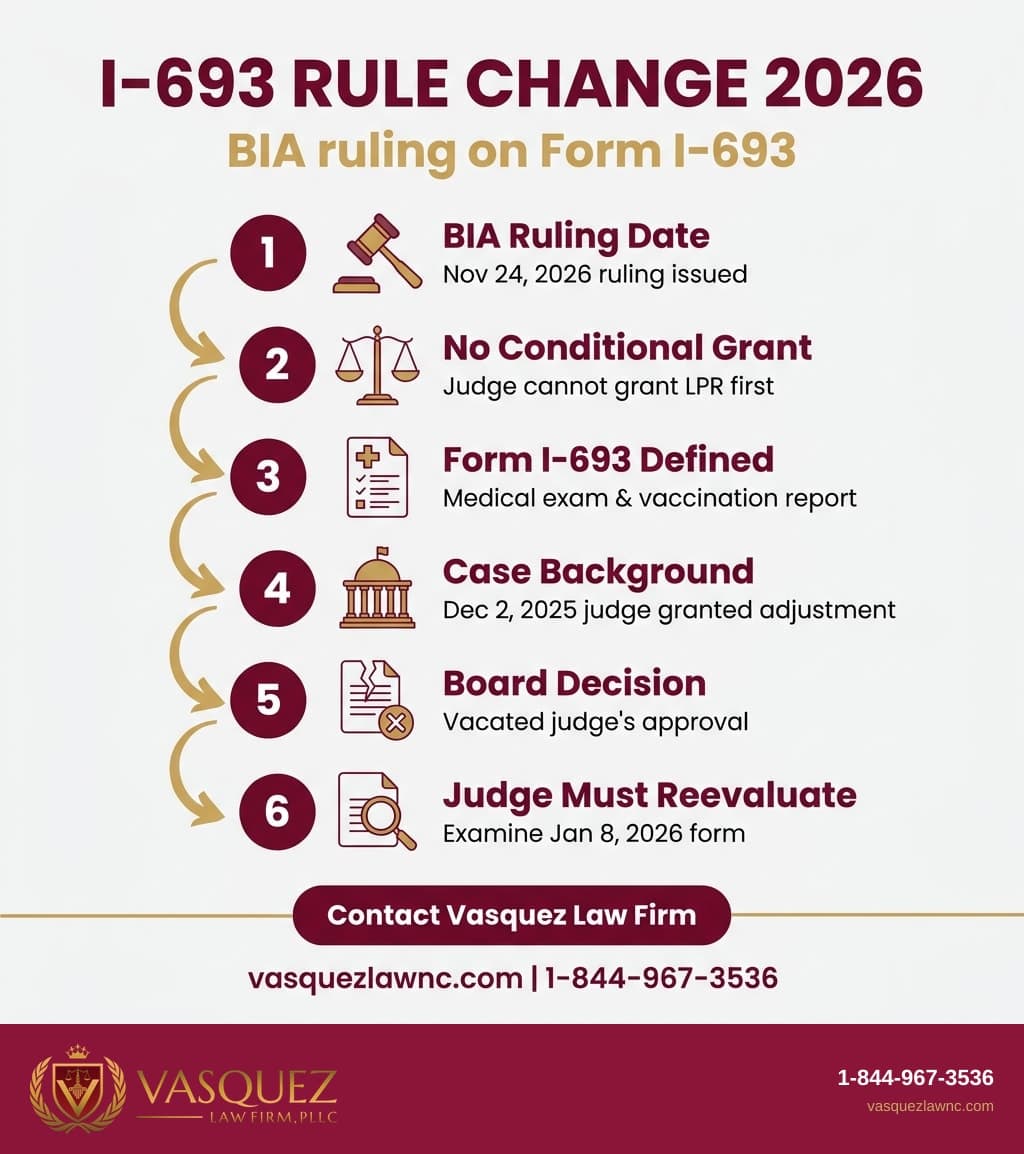
A green card applicant who goes to an immigration court hearing without a completed medical examination cannot first receive lawful permanent residence and give the Form I-693 later. On November 24, 2026, the Board of Immigration Appeals issued a precedent decision, 30 I&N Dec. 259 (BIA 2026), Interim Decision #4277. The Board vacated an adjustment approval that allowed later medical paperwork.
The BIA Form I-693 requirement matters most to people seeking adjustment of status through Form I-485 while in removal proceedings. A missing medical form can delay a case that otherwise seems ready for a decision. Our immigration attorneys help families review adjustment records. We also help prepare the evidence that immigration court requires.
Ready to Apply for a Green Card?
Family-based, employment-based, or other paths — we guide you through every step.
Legal disclaimer: This article offers general legal information, not legal advice for any individual case. Immigration outcomes depend on the record, eligibility, and procedure before the agency or court.
What did the BIA Form I-693 requirement ruling decide?
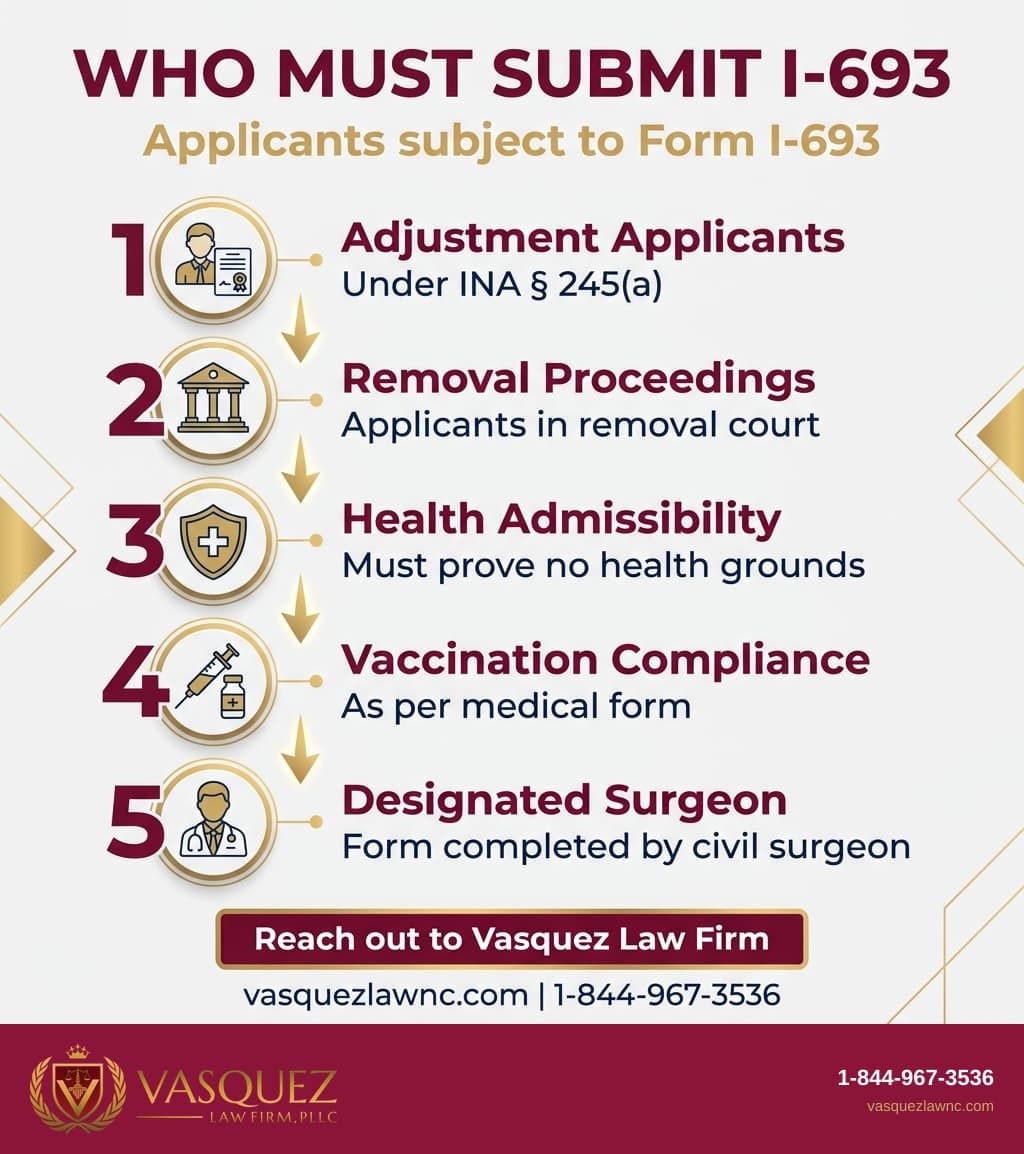
The Board decided that an immigration judge may not grant adjustment of status and require a future Form I-693 filing. Form I-693 is the Report of Immigration Medical Examination and Vaccination Record. It documents an applicant's medical examination and vaccination record. A designated civil surgeon completes the form.
The case involved a Mexican citizen who had conceded removability under INA § 237(a)(1)(B). Removability means that the government claims a person can be removed from the United States. At a removal hearing on December 2, 2025, the immigration judge granted adjustment under INA § 245(a). The judge allowed the respondent a 60-day period after release from detention to submit the medical form.
It is improper to grant lawful permanent residence conditioned upon the future submission of a Form I-693, Report of Immigration Medical Examination and Vaccination Record.
The Department of Homeland Security appealed. The Board sustained that appeal. It denied a motion to terminate the appeal as moot. A motion to terminate as moot asks to end a case because the dispute supposedly no longer matters. The Board vacated the immigration judge's December 2, 2025 decision. It returned the matter to the immigration judge.
The respondent had completed a Form I-693 on January 8, 2026. The Board explained that the earlier approval had not become final, so DHS did not need to commence rescission proceedings. The Board also said it could not evaluate the newly offered form on appeal. Its fact-finding authority is limited by 8 C.F.R. § 1003.1(d)(3)(iv).
The remand is narrow. A remand sends a case back to a lower decision-maker for more action. Here, the immigration judge must evaluate the January 8 medical form. The judge must update background checks and issue a new decision. The BIA Form I-693 requirement focuses on when proof must exist. That timing applies when an immigration judge grants adjustment. The Board directed the immigration judge to evaluate the later Form I-693 on remand but did not decide whether it established the respondent's eligibility.
Who must meet the BIA Form I-693 requirement?
The decision concerns applicants for adjustment of status under INA § 245(a). This includes applicants seeking lawful permanent residence during removal proceedings. Section 245(a), codified at 8 U.S.C. § 1255(a), requires an applicant to establish several facts. One requirement is that the applicant is admissible to the United States. Admissible means legally allowed to enter or remain in the country.
Health-related inadmissibility grounds appear in INA § 212(a)(1)(A), 8 U.S.C. § 1182(a)(1)(A). The Board explained that limited exceptions did not apply in this case. Therefore, the adjustment applicant had to establish that those health-related grounds did not make the applicant inadmissible.
What the medical record must establish
Under the BIA's discussion, a valid civil surgeon Form I-693 addresses vaccination compliance. It also addresses the absence of communicable diseases of public health significance, disqualifying physical or mental disorders, or drug addiction. The form must be completed by a designated civil surgeon. It must also be executed under INA § 232(b), 8 U.S.C. § 1222(b). Executed means properly completed and signed as the law requires.
The ruling also points to 8 C.F.R. §§ 106.2(a)(39) and 1245.5. It also points to 8 C.F.R. § 1245.2(a)(3)(i) and (ii). These provisions are part of the rules the Board applied. The Board concluded that the applicant had not established statutory eligibility at the hearing. Statutory eligibility means meeting the requirements set by law.
The Form I-485 instructions cited in the decision require applicants subject to the requirement to submit either a Form I-693 or a partial Form I-693, such as the vaccination record, as applicable. Those applicants must submit the form with Form I-485. People seeking adjustment should treat the I-693 medical form as case evidence. They should not assume that the form can safely wait until after an approval.
In our experience, clients often ask whether an incomplete medical record can be fixed after a favorable hearing. The safer course is to identify and address the issue before the judge rules. This helps the court review all required evidence at the proper time.
What law governs Form I-693 in an I-485 case?
INA § 245(a) is the adjustment statute. It requires the applicant to prove eligibility. In removal proceedings, INA § 240(c)(4)(A)(i), 8 U.S.C. § 1229a(c)(4)(A)(i), and 8 C.F.R. § 1240.8(d) place the burden on the applicant. The applicant must establish eligibility for the requested relief. Relief means the legal protection or benefit the person asks the government to grant.
Medical admissibility is one part of that burden. INA § 212(a)(1)(A) lists health-related grounds of inadmissibility. The Board treated a valid Form I-693 as the way to prove compliance when the health-related requirement applies.
Why a continuance is different from a conditional grant
The Board relied on Matter of Reyes, 17 I&N Dec. 239, 240 (BIA 1980). It explained that the medical examination may be the only unresolved eligibility issue. In that situation, the proper procedural option is to consider a brief continuance. A continuance is a pause in the proceedings. The proper option is not to grant permanent residence and require later paperwork.
Instead, if an alien’s eligibility for adjustment of status hinges solely upon the completion of a medical exam, the proper remedy is to consider whether a brief continuance of proceedings is warranted.
Under 8 C.F.R. § 1003.29, an immigration judge considers whether a continuance is warranted. The judge must decide whether a pause is appropriate. A continuance does not turn an incomplete application into an approved adjustment case.
The Board also rejected the argument that DHS needed to start rescission proceedings under INA § 246, 8 U.S.C. § 1256. Rescission is a process for canceling an immigration benefit in certain situations. The earlier decision had not become final under 8 C.F.R. § 1003.39. For readers, the practical lesson is clear. A favorable oral or written ruling may still be subject to appeal and finality rules.
What should I do before an I-485 adjustment hearing?
Before an adjustment hearing, compare the documents in your file with the Form I-485 instructions. Also compare them with the issues identified in the charging and court record. Confirm whether the BIA Form I-693 requirement applies to your application. Confirm whether the medical form is complete, properly executed, and ready for submission.
Build a medical-document checklist
First, preserve a copy of the Form I-485 package. Keep every receipt, notice, filing, and exhibit already submitted. Second, obtain the civil surgeon Form I-693 when it is required. Third, review the form for the medical examination and vaccination information discussed in the decision.
Prepare the court record
Bring organized copies of the I-693 medical form and other adjustment evidence. Counsel can assess those documents under the court's filing procedures. Ask whether the record supports requesting a continuance. This question matters if the medical examination is the only issue left to complete. Do not assume that a judge can approve adjustment while reserving the form for later.
Keep background-check issues in view
The Board directed the immigration judge on remand to update background checks under 8 C.F.R. § 1003.47(d). That instruction shows why an adjustment case can require current evidence. This remains true even after a medical form becomes available. Keep copies of court notices. Respond carefully to requests connected to the record.
For broader federal immigration guidance, consult the USCIS Policy Manual. Speak with counsel about the facts of your own case. A review by our immigration legal team can help identify document gaps before they affect a hearing.
Have an I-485 case in immigration court? Vasquez Law Firm offers a free evaluation to discuss document preparation and procedural options. Se Habla Español. We meet immigration clients in Raleigh, NC and Orlando, FL.
What should adjustment applicants watch next?
The immediate rule from Interim Decision #4277 is specific. An immigration judge should not issue a conditional grant of permanent residence based on a future Form I-693 filing. If the medical examination is the sole unresolved issue, the decision directs attention to whether a brief continuance is warranted.
In the remanded case, the immigration judge will evaluate the Form I-693 executed on January 8, 2026. The judge will update background checks and enter a new decision. The scope is limited because DHS did not pursue other challenges to the earlier adjustment ruling.
What's Your Immigration Situation?
Answer 3 questions - we'll tell you your options
Question 1 / 3
What best describes your situation?
Keep Reading
It is not yet settled whether a later-filed medical form will establish eligibility on the remanded record in every similar case. Applicants can rely today on the Board's distinction. The distinction is between a continuance before a decision and a conditional approval after one.
Check hearing notices, filings, and immigration court communications for case-specific instructions. For matters handled by USCIS, the agency's USCIS Processing Times page is an official place to monitor posted processing information. Readers can also review our discussion of BIA appellate procedures. That discussion explains why a case record and appeal posture matter.

Frequently Asked Questions
Is Form I-693 required for adjustment of status?
For applicants required to submit it, the Board stated that a valid Form I-693 is needed to establish that health-related inadmissibility grounds do not bar adjustment. The decision cites the Form I-485 instructions, which require the form, or a required partial form such as a vaccination record, to accompany Form I-485. Limited exceptions may exist under the governing law.
Can an immigration judge approve my green card while I finish the medical exam?
No, not through a conditional grant that requires a later Form I-693 submission. The decision, 30 I&N Dec. 259, holds that this approach is improper. Where the medical examination is the only remaining eligibility issue, the Board identified a brief continuance as the procedural option an immigration judge may consider.
What is a civil surgeon Form I-693?
Form I-693 is the Report of Immigration Medical Examination and Vaccination Record. The Board described it as a form completed by a designated civil surgeon. It addresses vaccination compliance and health findings relevant to INA § 212(a)(1)(A), including communicable diseases of public health significance and other listed health-related grounds.
Does a medical form completed later make an appeal moot?
In the BIA case, the respondent completed the form on January 8, 2026, but the Board denied the motion to terminate the appeal as moot. The Board said it could not review the offered form on appeal because its authority to make findings of fact is limited. It remanded for the immigration judge to evaluate it.
What happens after a remand in an adjustment case?
The answer depends on the remand order. In this case, the Board directed the immigration judge to evaluate the Form I-693, update background checks, and issue a new decision. The Board limited the proceedings to those issues because DHS had not meaningfully pursued other challenges to the earlier adjustment decision.
Does a favorable immigration judge decision become final immediately?
The Board held that rescission proceedings were not required because the immigration judge's adjustment decision had not become final under 8 C.F.R. § 1003.39. Finality and appeal posture can affect what procedure applies next. A person facing removal proceedings should obtain advice based on the actual order and procedural history.
Sources
Do not let a missing medical record become an avoidable court problem. Contact Vasquez Law Firm for a free case review about your immigration matter. This is general information, and an attorney must review your individual record before advising you.
Reviewed by Attorney Vasquez, Managing Attorney

William Vasquez
Founder & CEO, Vasquez Law Firm, PLLC
William Vasquez is the founder and CEO of Vasquez Law Firm, PLLC, a results-driven firm specializing in immigration, criminal defense, personal injury, and workers' compensation. A U.S. Air Force veteran and recipient of the Joint Service Achievement Medal, William is dedicated to fiercely fighting for his clients' rights.
Related Legal Services
Need legal help? Learn more about get immigration legal help today, or contact us for a free evaluation.
You can also visit our North Carolina immigration practice for more information.