Citizenship Definition Explains Who Qualifies as Child
By William J. Vásquez · Updated November 24, 2026
Need a citizenship definition for a child? See how parentage, adoption, residence, and physical presence affect claims. Contact us for a free evaluation.
Published on November 24, 2026· Updated November 24, 2026
Talk to an immigration attorney
Free call. A clear plan for your case.
Free & confidential · Se habla espanol · Mon-Fri 8am-7pm, Sat 9am-2pm (ET)
Have questions? Talk to an attorney - free evaluation.
Call 1-844-967-3536Free Tool
Check Your USCIS Case Status Now
Enter your receipt number - get the official USCIS status in English or Spanish. No registration.
Citizenship Definition Explains Who Qualifies as Child
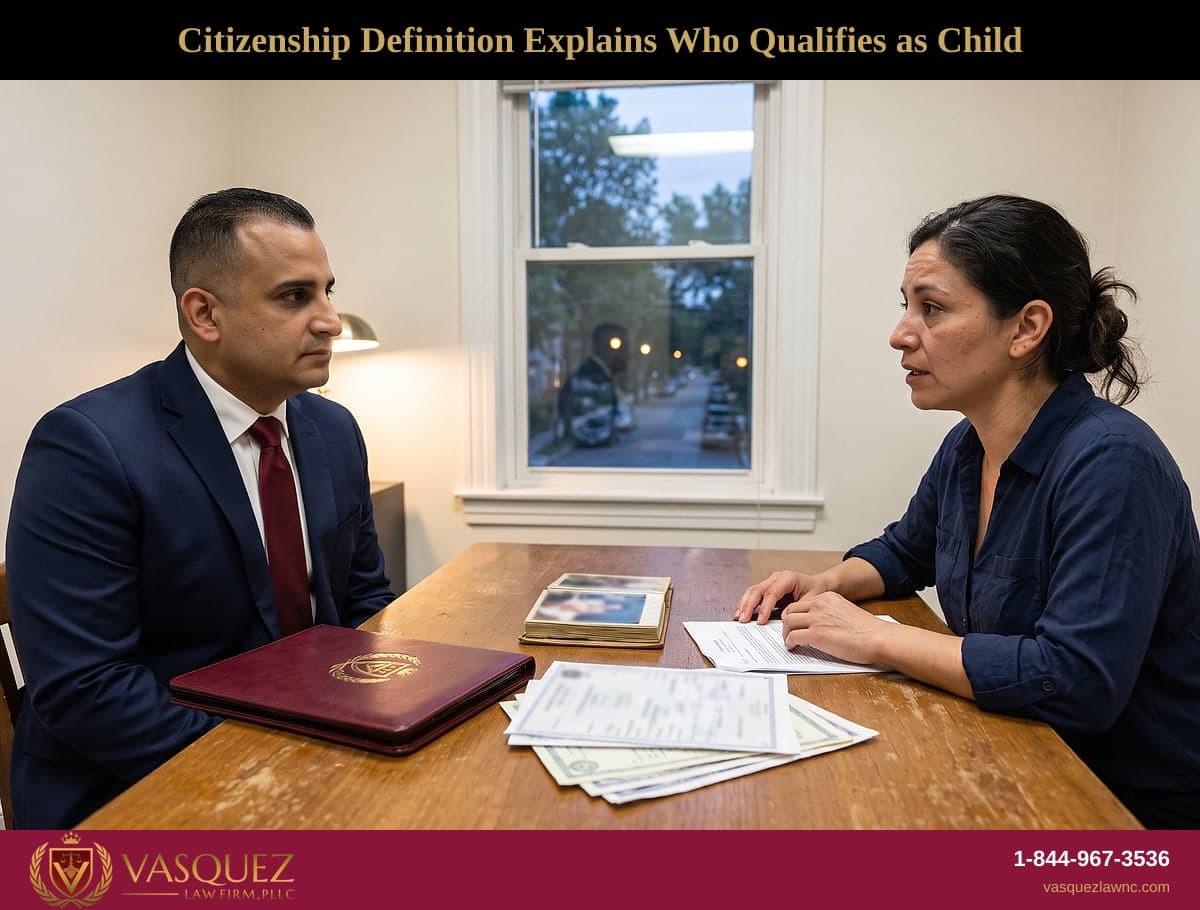
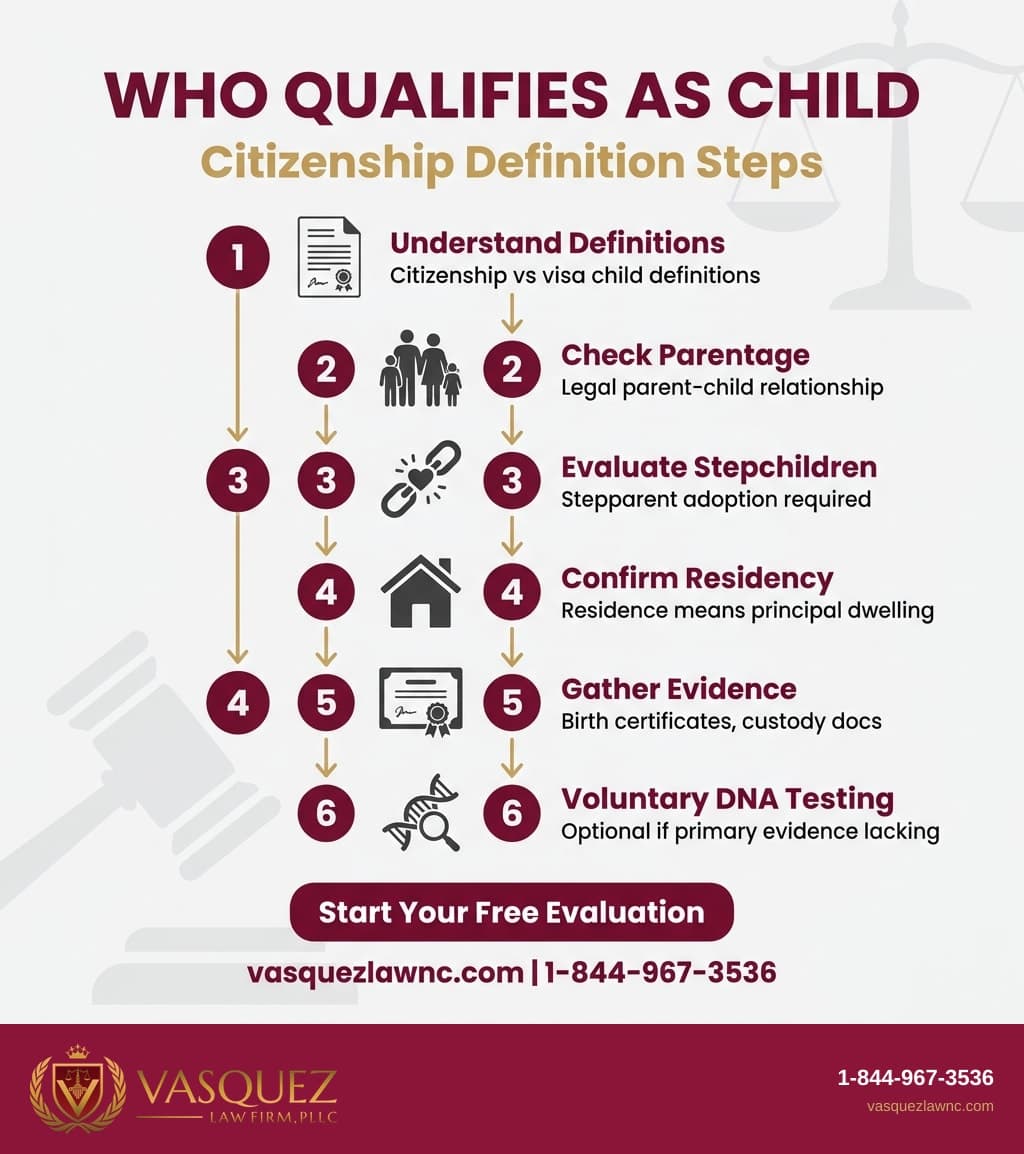
A child may qualify for immigration benefits through a stepparent. The child may not qualify for citizenship through that same stepparent. This difference is central to the citizenship definition used by U.S. Citizenship and Immigration Services. USCIS uses a separate definition of child for citizenship and naturalization. Parentage means the legal relationship between a parent and child. Legal custody means the legal right to care for and make decisions for a child. Adoption, residence, and physical presence may also affect a claim to U.S. citizenship.
Questions about a citizenship claim need careful review before you file. William J. Vasquez and Vasquez Law Firm offer free immigration evaluations. Se Habla Español.
Call 1-844-967-3536. In-person immigration consultations are available in Raleigh, NC and Orlando, FL.
Quick Answer
The citizenship definition of a child differs from the definition used for visa petitions. USCIS reviews the claimed parent-child relationship. It also reviews the child’s age and marital status. The specific citizenship rule also matters. A stepchild generally cannot obtain citizenship through a nonadoptive U.S. citizen stepparent.
- Citizenship rules use INA § 101(c).
- Visa petition rules use INA § 101(b).
- Legal parentage can control the outcome.
- Residence and physical presence are different tests.
- Adoption has separate legal requirements.
Who qualifies as a child under the citizenship definition?
The USCIS Policy Manual, Volume 12, Part H, Chapter 2 explains that the definition of child for citizenship and naturalization differs from the definition used for visa approval and issuance. One significant difference is that a stepchild is not included in the definition relating to citizenship and naturalization. Although a stepchild may be the stepparent’s “child” for purposes of visa issuance, the stepchild is not the stepparent’s “child” for purposes of citizenship and naturalization. A stepchild is not eligible for citizenship or naturalization through the U.S. citizen stepparent unless the stepparent adopts the stepchild and the adoption meets certain requirements.
A stepchild is not eligible for citizenship or naturalization through the U.S. citizen stepparent unless the stepparent adopts the stepchild and the adoption meets certain requirements.
INA § 101(c) governs the citizenship definition of child. By contrast, INA § 101(b) is the definition often used in family immigration matters. This difference matters before a family files Form N-600, Application for Certificate of Citizenship. It also matters before a person makes a citizenship claim through a parent.
Children claiming through a U.S. citizen mother
USCIS recognizes several possible parent-child relationships. One is a genetic child of a legally recognized U.S. citizen mother. Another is an adopted child who meets the adoption rules that apply. A third is a child of a non-genetic gestational mother recognized as the legal parent under the relevant jurisdiction’s law. A jurisdiction means the state or country whose law applies. A U.S. citizen spouse may also qualify as a parent without a genetic or gestational relationship if that person was married to the child’s genetic or gestational parent at the time of birth and both parents are recognized by the relevant jurisdiction as the child’s legal parents.
Children claiming through a U.S. citizen father
A child may qualify through a U.S. citizen father when the required legal relationship exists. For a child born out of wedlock who claims citizenship at birth, the evidence must demonstrate that the requirements under INA 309 are met. Legitimation can matter. Legitimation means “placing a child born out of wedlock in the same legal position as a child born in wedlock.” That law may depend on the child’s or father’s residence or domicile.
Domicile means a person’s true, fixed, principal, and permanent home, to which the person intends to return and remain even when living elsewhere. For family questions involving a citizenship claim, review the firm’s citizenship and immigration legal services before relying on the broader visa-petition definition of child.
What evidence supports a child citizenship claim?
A birth certificate recorded by the proper authority is generally USCIS’s primary evidence of a genetic or gestational relationship. A genetic relationship is a biological parent-child relationship. A gestational relationship concerns the person who carried and gave birth to the child. The birth certificate can establish the relationship when it identifies the relevant parent or parents. The record must be reviewed under the law of the jurisdiction that recognizes legal parentage.
In general, absent other evidence to the contrary, USCIS considers a child’s birth certificate as recorded by a proper authority as primary and sufficient evidence to determine a child’s genetic or gestational relationship to the parent (or parents).
Reliable primary evidence is not always available. When reliable primary evidence is unavailable and officers request additional evidence to establish the claimed genetic relationship, they must suggest voluntary DNA testing; they cannot require DNA test results. The August 2026 policy alert described this testing as optional evidence. Families should not treat a DNA result as a replacement for all legal-parentage evidence. DNA may show a genetic link. It does not always establish who the law recognizes as the legal parent.
Citizenship evidence checklist
- Birth certificate and certified translations where appropriate.
- Documents showing legal parentage under the relevant jurisdiction’s law.
- Final adoption documents when the claim is through adoption.
- Evidence of legal custody when the citizenship provision requires it.
- School, employment, military, medical, tax, lease, or property records relevant to residence or physical presence.
- Voluntary DNA testing materials if USCIS requests further evidence.
Cases we handle often show one gap that families could avoid. Families gather proof of a biological connection. They do not gather proof that the relevant jurisdiction legally recognized the parent-child relationship. This issue can be especially important in adoption cases. It can also matter in assisted reproductive technology and disputed-parentage matters.
Assisted reproductive technology, or ART, includes medical methods used to help create a pregnancy. A person considering Form N-600 should match each document to the citizenship path claimed. Submitting an unorganized stack of family records may not show that each requirement is met. USCIS describes its guidance in the USCIS Policy Manual.
How do residence and physical presence affect citizenship?
A parent can spend substantial time in the United States and still face a residence question. INA § 101(a)(33) defines residence as a person’s principal, actual dwelling place in fact, without regard to intent. In simpler terms, residence concerns the person’s main real home. Physical presence means the actual time a person is in the United States.
The term residence is defined in the INA as the person's “principal actual dwelling place in fact, without regard to intent.”
This difference can affect whether a U.S. citizen parent can transmit citizenship. To transmit citizenship means to pass citizenship to a child under the law. USCIS explains that travel, temporary visits, vacations, and commuting do not by themselves establish residence. A person may count actual time in the United States toward physical presence. That can be true even if the person did not establish a U.S. residence.
Records that can help
USCIS lists many records that can help establish residence or physical presence. These include school transcripts, military records, medical and vaccination records, employment records, leases, tax records, utility records, automobile registrations, deeds, and professional licenses. The useful record depends on what the applicable citizenship statute requires.
For citizenship at birth, INA § 301 and INA § 309 may apply. For automatic acquisition of citizenship after birth, INA § 320 can apply. A child residing outside the United States may instead require analysis under INA § 322. These are separate pathways. Therefore, the correct citizenship definition is only the starting point.
How do adoption and assisted reproductive technology affect citizenship?
An adoption must be full, final, and complete. It must also meet the requirements applicable for adopted children. A Hague Convention adoptee is a child adopted through the process established by the Hague Convention on Intercountry Adoption.
Assisted reproductive technology can involve genetic parents, gestational parents, donors, and intended legal parents. USCIS recognizes that a gestational and legal parent may transmit citizenship if all other statutory requirements are met. A non-genetic, non-gestational legal parent may also transmit citizenship in the circumstances described in the Policy Manual.
The key question is not only who contributed genetic material. USCIS evaluates whether the relevant jurisdiction recognized the claimed person as the child’s legal parent at birth. Legal parentage means recognition under the law, not only a biological connection. When legal parentage is disputed, USCIS follows an applicable court judgment. USCIS does not adjudicate cases involving unresolved legal parentage without a final determination by a proper authority, but it may deny a case while the dispute remains unresolved.
Families facing adoption or parentage questions can review immigration representation for family citizenship matters before filing. The inquiry is federal. Family-law documents may still arise under the jurisdiction connected to the child’s birth or parentage.
What steps should you take before filing a citizenship application?
A strong filing begins by identifying the exact citizenship pathway. It does not begin by choosing a form first. Form N-600 is identified by USCIS as the Application for Certificate of Citizenship. Form N-600K is identified as the Application for Citizenship and Issuance of Certificate Under Section 322.
- Identify whether the claim concerns citizenship at birth, acquisition after birth, or a child residing outside the United States.
- Identify the claimed U.S. citizen parent and legal relationship.
- Collect records for parentage, custody, adoption, residence, and physical presence that fit the pathway.
- Check the child’s age and marital status under the applicable provision.
- Review prior USCIS decisions and supporting evidence before submitting a new filing.
- Seek an individualized legal review if parentage, legitimation, adoption, or custody is disputed.
A prior denial does not always end the analysis. USCIS states that some applicants whose Form N-600 was denied and who become eligible after a policy change may use Form I-290B, Notice of Appeal or Motion, to seek reopening. Reopening asks USCIS to review the case again. The right option depends on the decision and current eligibility.
For a related immigration-status concern, see our explanation of an immigration work permit. Work authorization and citizenship are distinct benefits. Do not assume that eligibility for one proves eligibility for the other.
If a family record, adoption order, or custody history creates uncertainty, request a free immigration evaluation with Vasquez Law Firm. Se Habla Español.
Call 1-844-967-3536.
What citizenship definition mistakes should families avoid?
A common mistake is applying the visa-petition definition of child to a citizenship claim. USCIS expressly separates those definitions. Another mistake is counting a short visit or workplace as a U.S. residence without proof of a principal actual dwelling place.
- Mistake: Treating a stepparent relationship as enough. Fix: Review whether a qualifying adoption occurred.
- Mistake: Using only a birth certificate where parentage is legally disputed. Fix: obtain the proper legal determination.
- Mistake: Mixing residence with physical presence. Fix: build separate evidence for each requirement.
- Mistake: Ignoring legal custody. Fix: identify whether the claimed statute requires custody evidence.
- Mistake: Assuming genetic connection alone resolves ART cases. Fix: document legal parentage.
- Mistake: Filing Form N-600 without identifying the statutory pathway. Fix: analyze INA § 301, § 309, § 320, or § 322 as appropriate.
- Mistake: Delaying review where a child’s age matters. Fix: obtain advice promptly.
If you remember one point: the citizenship definition of child is narrower than the family-visa definition in an important way, particularly for stepchildren. Verify the exact legal relationship before filing.
Why is the citizenship definition a federal immigration issue?
Its analysis may depend on state or foreign law to determine legal parentage, residence, domicile, custody, or adoption status.
USCIS also addresses children of members of the U.S. armed forces and U.S. government employees residing abroad. INA § 320(c), added by the Citizenship for Children of Military Members and Civil Servants Act, addresses qualifying children residing with certain parents stationed outside the United States. The child must satisfy the requirements identified by the statute and USCIS guidance.
When should you request a citizenship evaluation now?
- A child’s claim depends on a stepparent or adoption.
- The claimed parent is a gestational, non-genetic, or intended legal parent.
- Parentage or legal custody is disputed.
- A prior Form N-600 decision exists.
- Evidence of U.S. residence or physical presence is incomplete.
- The claim involves birth outside the United States.
- The family needs to determine whether INA § 301, § 309, § 320, or § 322 applies.
About Vasquez Law Firm
Vasquez Law Firm handles immigration matters for clients nationwide. The firm combines compassionate communication with determined advocacy. This approach is reflected in its Yo Peleo® commitment. Our bilingual support staff helps clients communicate clearly throughout the immigration process.
William J. Vasquez is admitted to the North Carolina State Bar and Florida Bar. The firm provides in-person immigration consultations in Raleigh, NC and Orlando, FL. It can assist immigration clients nationwide. Visit William J. Vasquez’s professional profile for firm information.
Frequently Asked Questions
What is the citizenship definition of a child?
For citizenship and naturalization, INA § 101(c) supplies the relevant definition of child. USCIS distinguishes it from INA § 101(b), which applies in visa petition and related immigration contexts. The correct definition depends on the type of benefit sought and the claimed parent-child relationship. A child generally must be under the age of 18 and unmarried to acquire citizenship after birth.
Can a stepchild get citizenship through a U.S. citizen stepparent?
Not through the stepparent relationship alone. USCIS states that a stepchild is not eligible for citizenship or naturalization through a U.S. citizen stepparent unless the stepparent adopts the child and the adoption meets the required conditions. A stepchild may be treated differently for visa issuance. Families should separate a visa-petition analysis from a citizenship analysis.
What is the difference between residence and physical presence?
Residence means a person’s principal actual dwelling place in fact, without regard to intent, under INA § 101(a)(33). Physical presence measures actual time spent in the United States. A temporary visit can count as time physically present, yet not establish residence. The citizenship statute involved determines which requirement applies and what evidence is useful.
Can DNA testing prove a citizenship relationship?
DNA testing may help establish a claimed genetic relationship if reliable primary evidence is unavailable. USCIS cannot require DNA results to verify the relationship. When an officer requests additional evidence and primary evidence is unavailable, unreliable, or insufficient, USCIS policy directs officers to suggest voluntary DNA testing. Legal parentage can still require separate proof in some cases.
Do adopted children qualify under the citizenship definition?
An adopted child can qualify if the child satisfies the applicable adoption requirements and the adoption is full, final, and complete. The relevant citizenship pathway may also require proof of legal custody, residence, age, or other facts.
Can a gestational parent transmit U.S. citizenship?
USCIS explains that a gestational and legal parent can transmit citizenship if the other applicable requirements are met. The relevant jurisdiction must recognize that parent as the child’s legal parent. In assisted reproductive technology cases, genetic relationship and legal parentage are not always identical. If legal parentage remains disputed, USCIS does not adjudicate the case without a final determination by a proper authority and may deny the case while the dispute remains unresolved.
Which citizenship form may apply to a child?
USCIS identifies Form N-600 as the Application for Certificate of Citizenship. It identifies Form N-600K as the Application for Citizenship and Issuance of Certificate Under Section 322. The appropriate form depends on the citizenship provision and the child’s circumstances. Selecting a form should follow the legal analysis, not replace it.
Can a previous citizenship denial be reviewed again?
USCIS states that a person whose Form N-600 was denied but who becomes eligible following a policy change may file Form I-290B, Notice of Appeal or Motion, to request reopening. Whether that option fits a particular case depends on the decision, the changed eligibility basis, and the supporting documents. A careful review of the denial notice is important.
Sources and References
Do not let an uncertain citizenship definition delay a needed review. Contact Vasquez Law Firm for a free, confidential immigration evaluation. Se Habla Español.
Start Your Free Evaluation Now
Call 1-844-967-3536.
Ready to Become a US Citizen?
The naturalization process has strict requirements. Let us help you get it right the first time.
Keep Reading

For how Vasquez Law Firm can help, see our citizenship page.
Reviewed by Attorney Vasquez, Managing Attorney

William Vasquez
Founder & CEO, Vasquez Law Firm, PLLC
William Vasquez is the founder and CEO of Vasquez Law Firm, PLLC, a results-driven firm specializing in immigration, criminal defense, personal injury, and workers' compensation. A U.S. Air Force veteran and recipient of the Joint Service Achievement Medal, William is dedicated to fiercely fighting for his clients' rights.
Related Legal Services
Need legal help? Learn more about experienced immigration attorneys in Charlotte, or contact us for a free evaluation.
You can also visit immigration attorneys across North Carolina for more information.