2026 Proclamation Extends H-1B Entry Restrictions
By William J. Vásquez · Updated November 24, 2026
The 2026 restriction on entry of certain nonimmigrant workers extends the $100,000 payment requirement for most H-1B visa petitions filed abroad. This rule targets abuses by IT staffing firms and aims to protect American workers by limiting low-wage foreign labor entries. Federal courts have blocked the payment for now. Learn who is affected, where the court cases stand, and what employers and workers should do.
Published on November 24, 2026· Updated November 24, 2026
Talk to an immigration attorney
Free call. A clear plan for your case.
Free & confidential · Se habla espanol · Mon-Fri 8am-7pm, Sat 9am-2pm (ET)
Have questions? Talk to an attorney - free evaluation.
Call 1-844-967-3536Worried how the latest immigration news affects you?
Schedule a confidential case review with an immigration attorney - know exactly where you stand.
USCIS Case Status
Check your USCIS case status
Enter your receipt number and get the official status. Free, no registration.
This article gives general legal information. It is not individualized legal advice. Reading it does not create an attorney-client relationship. For advice about your situation, contact Vasquez Law Firm.
What changed with the 2026 restriction on entry of certain nonimmigrant workers?
Need a Work Visa or Permit?
H-1B, TN, L-1, and more. We help workers and employers navigate the visa process.
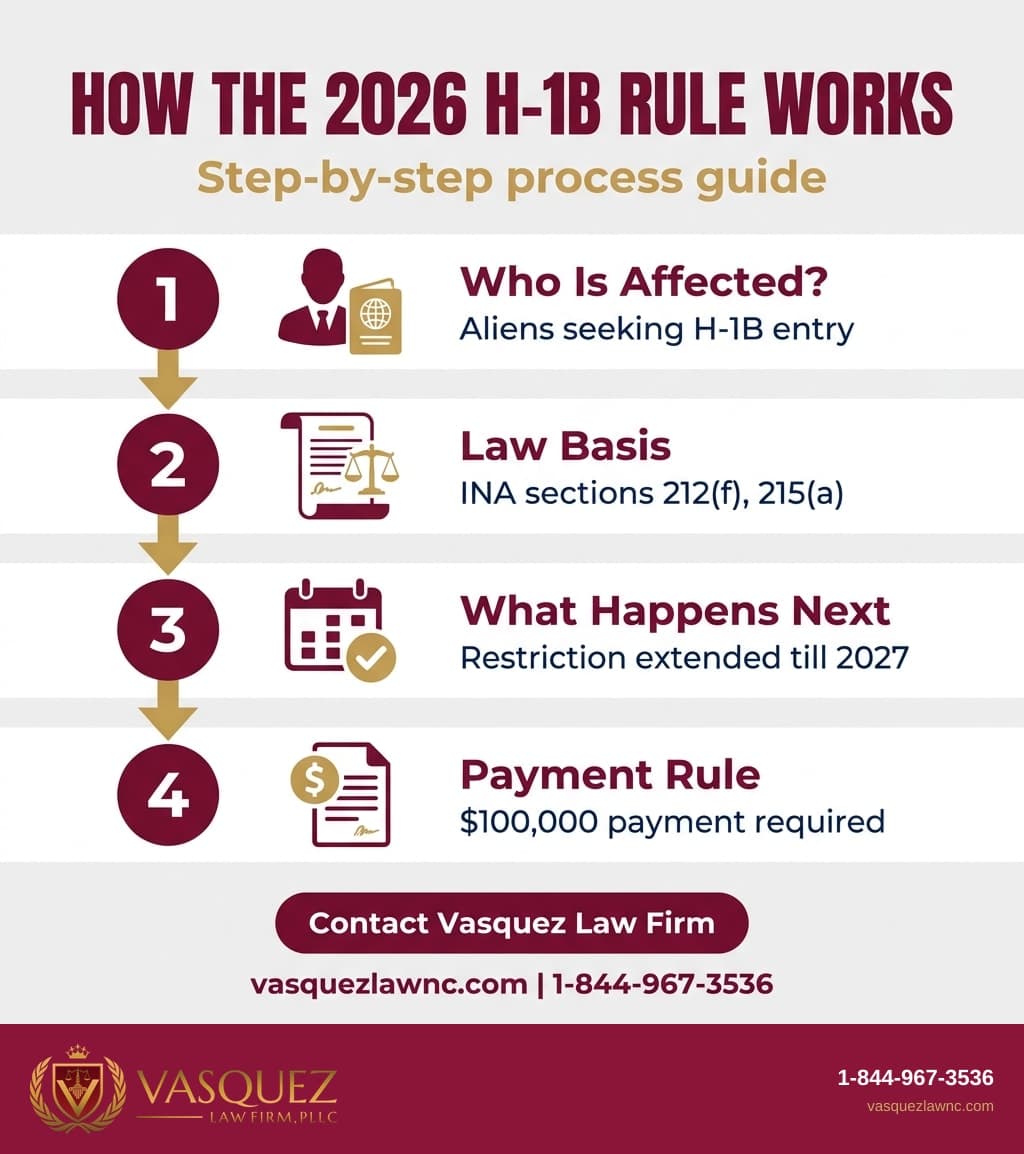
The 2026 restriction extends the 2025 Proclamation. That Proclamation limits entry of certain H-1B nonimmigrant workers. A nonimmigrant worker is a temporary worker who does not seek permanent residence through that status. Under the proclamation, a covered worker cannot enter without the employer’s $100,000 payment unless a national interest exception granted by the Secretary of Homeland Security applies. Federal courts have blocked this payment for now, as explained below.
This extension lasts until September 21, 2027. It continues efforts to stop abuse of the H-1B visa program. It does so by discouraging low-wage, low-skilled workers and protecting American labor markets.
The government first issued the Proclamation on September 19, 2025. Proclamation 10973 addressed serious abuse in the H-1B program. It focused especially on IT staffing and outsourcing firms. These firms supplied entry-level foreign workers at low wages.
Proclamation 11069 extends the restrictions set forth in the 2025 Proclamation for an additional 12 months, citing ongoing concerns such as lower wages, unemployment among recent graduates, and fraud.
The 2025 Proclamation imposed an entry restriction on certain H-1B workers, with a $100,000 petition payment requirement and limited exceptions. A petition is an employer’s formal request for approval of a worker’s H-1B status. The payment applies when the worker is outside the U.S. Limited national interest exceptions apply.
Since the payment rule began, more than 700 petitions included this payment. The Department of Homeland Security (DHS) issued a final rule establishing weighted selection that favors higher-skilled and higher-paid workers. The Department of Labor (DOL) published a proposed rule that, once finalized, would strengthen prevailing wage protections. The prevailing wage is the usual wage paid for similar work in a specific area.
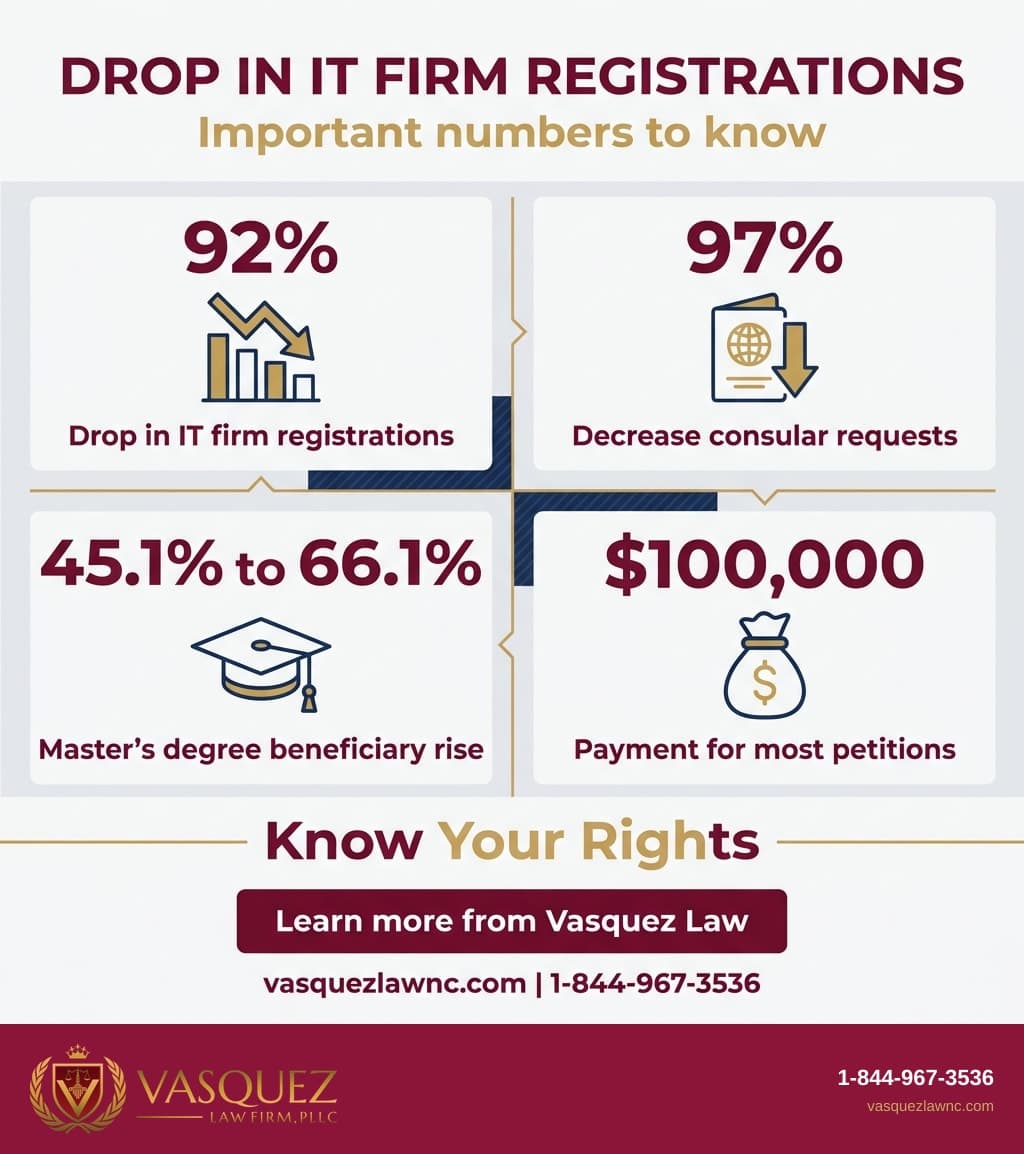
Data shows a 92% drop in H-1B registrations by large IT outsourcing firms. It also shows a nearly 97% decrease in consular processing requests from FY 2025 to FY 2027. Consular processing is the visa process handled by a U.S. consulate outside the country.
The share of registrations for beneficiaries with at least a U.S. master’s degree rose from 45.1% in FY 2026 to 66.1% in FY 2027. A beneficiary is the worker who would receive the immigration benefit. Job offers at higher wage levels now make up nearly half of H-1B selections.
The proclamation says the conditions requiring restrictions still exist. Unemployment and underemployment among recent graduates remain high. Underemployment means working less, or in a lower-level job, than a person’s training allows.
Concerns about fraud also continue. The proclamation states that, without an extension, it is highly likely that progress will halt and program abuse will resume. The proclamation says this would harm American workers and the labor market.
The proclamation orders the $100,000 payment requirement to continue. It applies to H-1B workers seeking entry. Exceptions apply to people found to be in the national interest.
It also tells DHS and the Department of State to enforce the payment rule. They must enforce it during visa processing and entry decisions.
"The 2025 Proclamation set forth a restriction on entry of certain H-1B nonimmigrant workers, except for those petitions that were accompanied or supplemented by a $100,000 payment, subject to very limited exceptions." (Source: Federal Register, https://www.federalregister.gov/documents/2026/09/23/2026-19554/restriction-on-entry-of-certain-nonimmigrant-workers)
Is the $100,000 H-1B payment being collected right now?
No. As of early November 2026, federal court orders block the $100,000 payment, so employers filing H-1B petitions do not currently have to include it. On June 8, 2026, a federal court in Massachusetts vacated the fee policy, and on July 24, 2026, the U.S. Court of Appeals for the First Circuit declined to pause that ruling. Read more in our post on the June 2026 ruling.
On September 30, 2026, a federal court in California blocked the agency policies that carry out the fee under both the 2025 Proclamation and this 2026 extension. In a separate case, a federal court in Washington, D.C. upheld the fee in December 2025.
The government has appealed these rulings. If a higher court lifts the orders, the payment rules described below could apply again, possibly with little notice. Check the current status before you file a petition or travel.
Who is affected by the 2026 restriction on H-1B nonimmigrant workers?
The 2026 restriction affects aliens seeking to enter the United States as H-1B nonimmigrant workers. Here, aliens means people who are not U.S. citizens or nationals. The workers must be in specialty occupations under section 101(a)(15)(H)(i)(b) of the Immigration and Nationality Act (INA).
The restriction applies to aliens outside the U.S. They must seek admission to give effect to the approval of their H-1B petition. Admission means permission to enter the United States. The payment-based restriction concerns petitions that are neither accompanied nor supplemented by the employer’s $100,000 payment, subject to national interest exceptions.
The restriction is intended to deter low-wage and low-skilled recruitment, but its legal scope is not limited by wage level or to workers hired by IT staffing and outsourcing firms. These firms have historically used the program to supply lower-paid foreign labor.
The proclamation reports that the largest IT staffing and outsourcing firms reduced their combined H-1B registrations by 92% after the 2025 Proclamation and DHS’s final rule. It attributes changes in recruitment patterns to the combined effects of the payment requirement and weighted selection, rather than isolating the payment’s direct effect.
However, the proclamation continues to allow limited national interest exceptions. The Secretary of Homeland Security may decide that hiring certain aliens is in the national interest. The Secretary must also decide that the hiring does not threaten U.S. security or welfare.
As a result, some employers or industries may avoid the payment requirement. An exception requires the Secretary of Homeland Security’s discretionary determination that the hiring is in the national interest and poses no threat to U.S. security or welfare.
The restriction applies to aliens who enter or attempt to enter the United States after the effective date of the proclamation.
It includes people seeking admission through consular notification, ports of entry, pre-flight inspection, or pre-clearance. A port of entry is an approved place where people enter the country. Pre-flight inspection and pre-clearance allow U.S. officials to review travelers before arrival.
Employers filing H-1B petitions for aliens outside the U.S. must get and keep proof of payment. The Department of State checks the payment receipt during visa processing. For applicants subject to the payment requirement, visa approval requires verification that the filing employer made the payment.
In short, the affected group includes nonimmigrant workers applying for H-1B status from abroad. Their employers must not have failed to make the required payment. The exception is for people who receive national interest waivers. A waiver is official permission not to follow a specific requirement.
What does the law say about the restriction on entry for H-1B workers?
The 2026 restriction relies on sections 212(f) and 215(a) of the Immigration and Nationality Act (INA). These sections appear at 8 U.S.C. § 1182(f) and 8 U.S.C. § 1185(a).
These laws give the President power to suspend or limit entry of aliens. The President may use that power when the restriction is considered in the national interest.
The proclamation uses this power to limit entry of aliens seeking H-1B nonimmigrant status. The status comes under 8 U.S.C. § 1101(a)(15)(H)(i)(b). The restriction does not apply when the petition includes a $100,000 payment.
The payment is meant to discourage low-wage hiring and abuse of the program.
The proclamation states:
Pursuant to sections 212(f) and 215(a) of the Immigration and Nationality Act (INA) ( 8 U.S.C. 1182(f) and 1185(a) ), the entry into the United States of aliens as nonimmigrants to perform services in a specialty occupation under section 101(a)(15)(H)(i)(b) of the INA ( 8 U.S.C. 1101(a)(15)(H)(i)(b) ), is restricted, except for those aliens whose petitions are accompanied or supplemented by a payment of $100,000—subject to the exceptions set forth in subsection (c) of this section. (Source: Federal Register, https://www.federalregister.gov/documents/2026/09/23/2026-19554/restriction-on-entry-of-certain-nonimmigrant-workers)
For H-1B petitions on behalf of workers outside the United States who are subject to the payment requirement, employers must obtain and retain proof of payment before filing. It directs the Department of State and DHS to work together on enforcement.
They must deny entry to covered H-1B workers whose employers have not made the payment, unless a national interest exception applies.
The payment restriction applies to aliens who must seek admission to the United States to effectuate the approval of an H-1B petition, including through consular notification, notification at a port of entry, pre-flight inspection, or pre-clearance.
What should you do if you or your employer are affected by the 2026 H-1B entry restriction?
If you are an H-1B worker outside the United States, review the payment requirement. The same applies to an employer filing an H-1B petition for a foreign worker.
While the court orders stand, the $100,000 payment is not required. If the orders are lifted, the petition would need to be accompanied or supplemented by the payment unless an exception applies.
First, employers should check compliance before submitting H-1B petitions for workers abroad. They should get and keep documents proving payment.
Second, petitioners must understand the limited national interest waivers. A petitioner is the employer or other person who files the petition. Petitioners should consult legal counsel about possible eligibility for an exception.
Third, workers should closely follow their visa applications. They should confirm that the payment was made. They should also confirm that the Department of State verified it during consular processing.
In our immigration case experience, employers and workers often misunderstand this payment rule. Many employers do not realize that proof of payment is needed at the start.
That mistake can cause visa delays or denials. Clear communication can prevent these problems. Early legal guidance can also help.
Employers should follow the Department of Labor’s pending rulemaking. Rulemaking is the process of creating or changing government rules. The pending rulemaking would improve prevailing wage protections.
What's Your Immigration Situation?
Answer 3 questions - we'll tell you your options
Question 1 / 3
What best describes your situation?
Keep Reading
It may affect future wage requirements for H-1B workers.
If the payment rule is enforced again, failing to follow it can cause visa denials and barred entry. Taking action early is therefore important.
What happens next with the 2026 restriction on H-1B entry?
The proclamation orders four officials to review the restriction together. They are the Secretary of State, Attorney General, Secretary of Labor, and Secretary of Homeland Security.
No later than 30 days following the completion of the H-1B lottery that immediately follows this proclamation, the Secretary of State, the Attorney General, the Secretary of Labor, and the Secretary of Homeland Security shall jointly submit to the President a recommendation on whether an additional extension or renewal of the restriction on entry is in the interests of the United States.
The review will ask whether the conditions supporting the restriction still exist. It will also ask whether the policy still serves U.S. economic and national security interests.
The proclamation describes continuing DHS and DOL efforts to improve the H-1B program. These efforts include a weighted selection process.
DHS’s weighted selection process favors workers with higher skills and higher pay. Separately, DOL proposed a rule to strengthen prevailing wage protections.
Officials are expected to keep monitoring the policy. They may make further policy changes. The goal is to protect American workers while attracting needed high-skilled foreign labor.
"No later than 30 days following the completion of the H-1B lottery that immediately follows this proclamation, the Secretary of State, the Attorney General, the Secretary of Labor, and the Secretary of Homeland Security shall jointly submit to the President... a recommendation on whether an additional extension or renewal of the restriction on entry pursuant to section 1 of this proclamation is in the interests of the United States." (Source: Federal Register, https://www.federalregister.gov/documents/2026/09/23/2026-19554/restriction-on-entry-of-certain-nonimmigrant-workers)
What are common questions about the 2026 H-1B entry restriction?
Does the $100,000 payment apply to all H-1B workers?
No. The payment requirement covers H-1B workers who must seek admission after the proclamation’s effective date to effectuate approval of a covered petition, subject to national interest exceptions granted by the Secretary of Homeland Security.
Can H-1B workers already in the U.S. be affected?
Remaining in the United States does not itself trigger this entry restriction. A worker already in the country may nevertheless be affected if the worker later seeks admission to effectuate approval of a covered petition after the effective date.
How is the $100,000 payment verified?
For a covered petition on behalf of a worker outside the United States, the employer must obtain and retain proof of payment before filing. The Department of State verifies payment during visa processing and denies covered applications without payment unless an exception applies.
What happens if an employer does not pay the fee?
While the court orders described above remain in place, employers do not have to pay it. If the orders are lifted, the worker is subject to the payment requirement, and no national interest exception applies, nonpayment would result in denial of the visa application and refusal of entry.
Is this restriction permanent?
No. The proclamation extends the restriction for 12 months, with expiration scheduled for September 21, 2027, absent another extension. It requires a recommendation on whether an additional extension or renewal is in the interests of the United States.
This article provides general legal information, not individualized legal advice. Reading does not create an attorney-client relationship. For advice specific to your situation, contact Vasquez Law Firm.
If you need legal assistance, learn more about our immigration legal services, or call us at 1-844-967-3536 for a free evaluation.
Reviewed by William Vasquez, Founder & CEO, Vasquez Law Firm, PLLC.
Related Topics

William Vasquez
Founder & CEO, Vasquez Law Firm, PLLC
William Vasquez is the founder and CEO of Vasquez Law Firm, PLLC, a results-driven firm specializing in immigration, criminal defense, personal injury, and workers' compensation. A U.S. Air Force veteran and recipient of the Joint Service Achievement Medal, William is dedicated to fiercely fighting for his clients' rights.
Related Legal Services
Need legal help? Learn more about learn about our immigration practice, or contact us for a free evaluation.
You can also visit statewide immigration attorneys for more information.